Sony A6600 vs A6700: Should You Upgrade to the Latest APS-C Sony?
Sony A6600 vs A6700 comes down to more than sensor resolution. The A6700 brings better autofocus, 10-bit video, 4K 120p, a newer processor, and modern controls, while the A6600 remains a capable and battery-efficient APS-C camera.

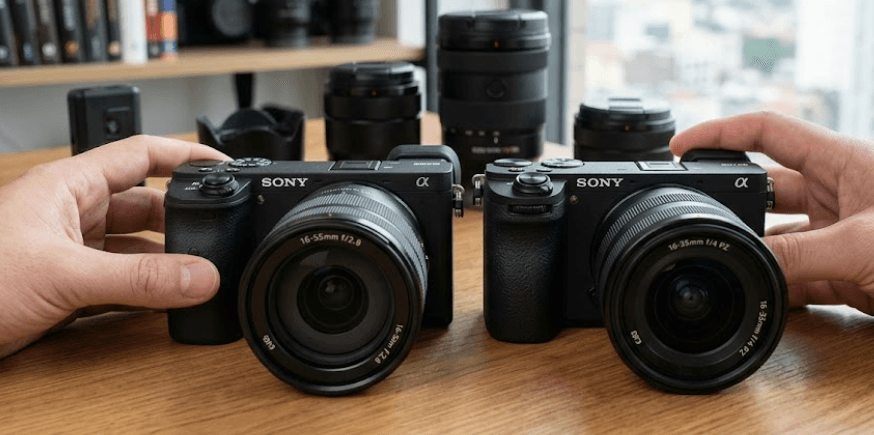
TL;DR Sony A6600 vs A6700 is a comparison between a still-capable older APS-C camera and a much newer generation of Sony technology. The A6600 offers a 24.2MP APS-C sensor, 5-axis stabilization, 11fps continuous shooting, and excellent battery life, while the A6700 moves to a 26MP back-illuminated sensor, BIONZ XR processing, an AI processing unit, improved subject recognition, a fully articulating touchscreen, USB-C, and 10-bit video with 4K recording up to 120p. Sony India currently lists the A6600 at an MRP of ₹1,24,990 and the A6700 at ₹1,36,990 for the body-only versions, although actual retail prices can vary. For an existing A6600 owner, the A6700 is most compelling if autofocus, video, handling, and newer connectivity matter to your work. If you mainly shoot still photographs and already own the A6600, the upgrade is less urgent.
Sony A6600 vs A6700: What Has Changed?
The Sony A6600 and A6700 may look like members of the same compact APS-C family, but they represent different generations of Sony's camera technology. The A6600 was introduced as a high-end APS-C body built around a 24.2MP Exmor CMOS sensor, BIONZ X processing, 5-axis in-body image stabilization, and an 11fps maximum continuous shooting rate. The A6700 keeps the compact E-mount concept but moves to a 26MP back-illuminated Exmor R CMOS sensor and Sony's newer BIONZ XR processor. It also adds a dedicated AI processing unit for subject recognition and tracking. These changes are more important than the relatively small increase from 24.2MP to 26MP because they affect autofocus, video processing, handling, and the camera's ability to recognize subjects.
The biggest difference becomes obvious when you look beyond megapixels. Both cameras can shoot at up to 11fps, so the A6700 does not provide a major headline advantage in maximum burst speed. Instead, Sony has used the newer processing hardware to improve how the camera handles focusing and subject recognition. The A6700 can recognize humans, animals, birds, insects, cars, trains, and airplanes, and its autofocus system provides up to 759 phase-detection points for still photography. DPReview found the A6700's subject tracking particularly strong, with reliable recognition and tracking during demanding movement tests. That makes the newer camera more interesting for wildlife, travel, family, sports, and other situations where keeping a moving subject in focus matters more than simply increasing the burst rate.
The A6700 also represents a much bigger change for video creators. The A6600 records 4K video, including 4K HDR and HLG, but its video system is fundamentally from an older generation. The A6700 adds 10-bit 4:2:2 recording and can record 4K at up to 120p, although the 4K 120p mode comes with an approximately 38% crop. It can also produce 4K 60p through 6K oversampling, which gives video creators considerably more flexibility when recording high-quality footage. Sony also adds features such as S-Cinetone, S-Log3, a fully articulating touchscreen, and Active stabilization for movies. For someone who primarily photographs rather than records video, these features may not justify replacing an A6600, but for hybrid shooters they make the A6700 a much more meaningful upgrade.
Key Specifications Compared
| Feature | Sony A6600 | Sony A6700 |
|---|---|---|
| Sensor | 24.2MP APS-C CMOS | 26MP APS-C BSI CMOS |
| Processor | BIONZ X | BIONZ XR |
| AI Processing Unit | No | Yes |
| Continuous Shooting | Up to 11fps | Up to 11fps |
| Stabilization | 5-axis IBIS | 5-axis IBIS |
| Video | 4K | Up to 4K 120p |
| 10-bit Video | No | Yes |
| Rear Screen | Tilting LCD | Fully articulating touchscreen |
| USB | Micro USB | USB-C |
| Battery | NP-FZ100 | NP-FZ100 |
| Weight With Battery/Card | Approx. 503g | Approx. 493g |
The core specifications show why this is not simply a megapixel upgrade. The A6700 retains the A6600's large NP-FZ100 battery and 5-axis stabilization while adding newer processing, a newer sensor, and much more capable video hardware. Sony rates the A6700 at approximately 550 shots using the viewfinder and 570 using the LCD under CIPA testing, while the A6600 is rated at approximately 810 shots with the viewfinder and 810 shots with the LCD under Sony's specifications. That means the older A6600 actually has a meaningful battery-life advantage for still photography.
Sony A6600 vs A6700 Image Quality
Image quality is one area where the A6600 remains much more competitive than its age might suggest. Its 24.2MP APS-C sensor can produce detailed RAW files with plenty of flexibility for editing, and the camera's 5-axis stabilization helps when shooting handheld at slower shutter speeds. For travel photography, portraits, family photography, landscapes, and everyday shooting, the A6600 is still capable of producing excellent results. The difference in nominal resolution is also fairly small, with the A6700 offering 26MP rather than 24.2MP. That increase gives you slightly more resolution and a little additional cropping flexibility, but it is not large enough by itself to transform the way your photographs look.
The A6700's newer 26MP back-illuminated sensor does bring a more modern foundation to the camera, particularly when combined with the BIONZ XR processor. Sony designed the sensor and processing system to handle more demanding imaging and video workloads, while the newer autofocus architecture makes it easier to keep subjects properly tracked. This can make the A6700 feel significantly better even when the final still image does not look dramatically different from an A6600 photograph. In other words, the upgrade is less about suddenly getting twice the image quality and more about getting a camera that can acquire and process the shot more intelligently. That distinction is important when deciding whether an existing A6600 owner actually needs to upgrade.
For photographers who mainly shoot static subjects, the difference becomes harder to justify. If your typical work involves landscapes, architecture, posed portraits, products, or carefully composed travel photographs, the A6600 already provides the fundamental tools you need. You get the same Sony E-mount ecosystem, 5-axis stabilization, an APS-C sensor, and a strong battery. The A6700 becomes much easier to recommend when your subjects are unpredictable or when you switch frequently between stills and video. Its improved subject recognition can reduce the amount of manual intervention needed during shooting, while the newer video system gives hybrid creators considerably more room to grow.
Which Camera Wins For Stills?
| Photography Need | Better Choice |
|---|---|
| Landscapes | A6700, but A6600 remains excellent |
| Portraits | A6700 for AF, A6600 for value |
| Wildlife | A6700 |
| Sports | A6700 |
| Travel | A6700 |
| Static Subjects | A6600 can be sufficient |
| Battery Life | A6600 |
| Existing A6600 Owner | Upgrade only if newer features matter |
The important point is that the A6700 does not make the A6600 obsolete for photography. Instead, it makes the newer model more versatile. If autofocus reliability is critical to your work, the A6700's recognition system is one of the clearest reasons to upgrade. If you already get the photographs you need from the A6600 and rarely miss focus, spending more money for a relatively small resolution increase is difficult to justify.
Sony A6600 vs A6700 Autofocus And Handling
Autofocus is one of the strongest reasons to choose the A6700 over the A6600. The A6600 already had an advanced autofocus system for its generation, including real-time tracking and eye detection. However, the A6700 adds Sony's newer AI processing architecture and subject recognition system. It can recognize people, animals, birds, insects, cars, trains, and airplanes, giving the camera more information to work with when deciding what should remain in focus. Sony lists up to 759 phase-detection AF points for still photography on the A6700, while the older A6600 uses Sony's earlier-generation autofocus architecture.
The difference is especially useful when the subject is moving unpredictably. DPReview's testing found that the A6700's tracking system performed very strongly during demanding subject movement tests, maintaining focus while the subject changed position through the frame. That does not mean every A6600 photograph will be out of focus, because the older camera remains highly capable. It means the A6700 gives the photographer a larger margin for error. If you regularly photograph children running around, birds taking off, vehicles moving through the frame, or people walking toward the camera, that additional intelligence can save shots that might otherwise require more careful timing and manual intervention.
Handling is another area where the A6700 feels more modern. The A6600 uses a tilting rear LCD, while the A6700 has a fully articulating 3-inch touchscreen that can be positioned for front-facing recording and unusual shooting angles. The newer camera also moves to USB-C, replacing the A6600's older Micro USB connection. The A6700 weighs approximately 493g with battery and memory card, compared with approximately 503g for the A6600, so despite the newer hardware it is slightly lighter. These changes may look small individually, but they make the A6700 easier to integrate into a modern hybrid shooting workflow.
Autofocus And Controls At A Glance
| Feature | A6600 | A6700 |
|---|---|---|
| Real-Time Tracking | Yes | Yes, newer generation |
| Subject Recognition | Older system | AI-assisted recognition |
| Recognized Subjects | Primarily people/animals | People, animals, birds, insects, vehicles |
| Touchscreen | Limited generation | Fully articulating touchscreen |
| USB | Micro USB | USB-C |
| AF Points | 425 phase detection | Up to 759 phase detection |
Sony A6600 vs A6700 For Video
Video is where the A6700 creates the clearest separation between the two cameras. The A6600 can record 4K footage and remains useful for everyday video, YouTube, travel content, and basic filmmaking. However, its recording capabilities reflect its older design. The A6700 adds 10-bit 4:2:2 internal recording, giving editors significantly more flexibility when working with color and footage that needs substantial post-production. Sony also includes S-Cinetone and S-Log3, making the A6700 more attractive to creators who want to integrate it into a more serious video workflow.
The headline feature is 4K 120p recording. This gives the A6700 the ability to capture high-frame-rate 4K footage that can be slowed down for smoother slow-motion sequences. There is a significant crop in this mode, approximately 38%, so it is not a feature you should treat as completely unrestricted. The A6700 can also record 4K 60p using 6K oversampling, which is particularly useful when you want detailed footage without using the extreme crop associated with 4K 120p. DPReview found the A6700's full-width 4K video readout substantially improved compared with the A6600, making rolling shutter less problematic in normal shooting.
The A6700 also introduces Active stabilization for movie shooting, combining its sensor-shift stabilization with electronic stabilization. This can help when recording handheld footage while walking or moving around, although electronic stabilization can involve additional cropping. For vloggers and creators, the fully articulating touchscreen and newer subject recognition system are equally important because they make self-recording and subject tracking easier. If you only occasionally record short clips, the A6600 can still do the job. But if video is a major part of your work, the A6700 is a much more convincing upgrade because several improvements work together rather than relying on one headline feature.
Video Features Compared
| Video Feature | Sony A6600 | Sony A6700 |
|---|---|---|
| 4K Recording | Yes | Yes |
| 4K 60p | No | Yes |
| 4K 120p | No | Yes, cropped |
| 10-bit Internal Recording | No | Yes |
| S-Cinetone | No | Yes |
| S-Log3 | Yes | Yes |
| Active Stabilization | No | Yes |
| Fully Articulating Screen | No | Yes |
Sony A6600 vs A6700 Price And Value
Price makes the decision more complicated because the A6600 is an older camera but Sony continues to list it in India. Sony India's current product page lists the A6600 body-only model at an MRP of ₹1,24,990, while the A6700 is currently listed at an MRP of ₹1,36,990. That is an MRP difference of ₹12,000, although street prices, discounts, bundles, and stock can change the actual amount you pay. Because of that, buyers should compare the current selling prices rather than assuming the older camera will always be substantially cheaper.
If you are buying your first Sony APS-C camera, the A6700 is generally the more sensible long-term choice when the two are relatively close in price. You get the newer sensor, BIONZ XR processor, AI processing unit, improved subject recognition, USB-C, articulating touchscreen, 10-bit video, and 4K 120p. The A6600 becomes more attractive when you find it at a meaningful discount or when your requirements are primarily still photography. Its NP-FZ100 battery also gives it an advantage in CIPA-rated still-image battery life, so buyers who prioritize long shooting sessions can still find a practical reason to choose it.
For existing A6600 owners, the calculation is different. You already have a capable camera, an E-mount lens collection, 5-axis stabilization, and excellent battery life. The A6700's improvements are valuable, but they are not all equally important to every photographer. If you shoot mostly landscapes and portraits, the A6600 can continue serving you well. If you are moving toward wildlife, fast-moving subjects, professional video, vlogging, or hybrid content creation, the A6700's newer autofocus and video system make the upgrade much easier to justify.
Price And Upgrade Value
| Buyer Situation | Better Choice |
|---|---|
| Buying First APS-C Sony | A6700 |
| Existing A6600 For Stills | Keep A6600 |
| Wildlife And Action | A6700 |
| Serious Video | A6700 |
| Vlogging | A6700 |
| Long Battery Priority | A6600 |
| Large Existing E-Mount Kit | Keep A6600 unless features are limiting |
Should You Upgrade From The A6600?
The A6700 is a substantial generational upgrade, but it is not a replacement that makes every A6600 owner immediately need to upgrade. The biggest improvements are concentrated in autofocus intelligence, processing, video, controls, and connectivity rather than basic still-image resolution. Sony has kept the 11fps maximum burst rate, the same NP-FZ100 battery family, and 5-axis stabilization, so an A6600 user who is already happy with those aspects will not suddenly experience a completely different camera for everyday still photography. The upgrade makes more sense when your current camera is limiting what you want to shoot rather than simply because a newer model exists.
For photographers who are increasingly shooting video, the decision is much easier. The A6700's 10-bit recording, 4K 60p, 4K 120p, S-Cinetone, S-Log3, Active stabilization, and articulating touchscreen create a substantially more capable hybrid camera. The 4K 120p mode does have a significant crop, so it should not be treated as an all-purpose recording setting, but it is still a valuable feature for creators who need slow motion. The newer autofocus and subject-recognition system also make the A6700 particularly useful for creators who work alone and need the camera to reliably follow them or their subjects.
For a new buyer, the A6700 is the camera I would choose if the price difference is only around the current official MRP gap. It has a newer platform and a longer feature runway, while still retaining the compact APS-C design and Sony E-mount compatibility. For an A6600 owner, however, there is no need to upgrade simply for the 26MP sensor. The better question is whether you need better subject recognition, modern video features, a fully articulating touchscreen, USB-C, and newer processing. If the answer is yes, the A6700 is a meaningful upgrade. If the answer is no, the A6600 remains a very capable camera.
Frequently Asked Questions
Q. Is the Sony A6700 much better than the A6600?
The A6700 is significantly more advanced overall, but the improvement is not mainly about megapixels or burst speed. Both cameras can shoot at up to 11fps, while the A6700 adds a newer 26MP BSI sensor, BIONZ XR processor, AI processing unit, improved subject recognition, 10-bit video, 4K 120p, USB-C, and a fully articulating touchscreen.
Q. Is the A6700 worth upgrading from the A6600?
It is worth upgrading if you need better autofocus tracking, stronger video capabilities, modern connectivity, or newer handling features. If you mainly shoot still photographs and are happy with your A6600's image quality and autofocus, the upgrade is less urgent.
Q. Does the A6700 have better autofocus than the A6600?
Yes. The A6700 uses a newer AI processing unit and offers subject recognition for humans, animals, birds, insects, cars, trains, and airplanes. Sony lists up to 759 phase-detection AF points for still photography, while independent testing found its tracking performance to be particularly strong.
Q. Does the Sony A6700 shoot 4K 120fps?
Yes. The A6700 supports 4K 120p recording, but Sony specifies an approximately 38% image crop in this mode. It also supports 4K 60p using 6K oversampling.
Q. Does the A6600 have better battery life than the A6700?
Yes, based on Sony's CIPA ratings for still photography. The A6600 is rated at approximately 810 shots, while the A6700 is rated at approximately 550 shots using the viewfinder or 570 shots using the LCD. Both use the NP-FZ100 battery.
Q. Is the A6700 better for video than the A6600?
Yes. The A6700 offers 10-bit 4:2:2 recording, 4K 60p, 4K 120p, S-Cinetone, S-Log3, Active stabilization, and a fully articulating screen. These features make it substantially more capable for serious hybrid shooting and video creation.
Q. Does the A6700 have better image quality than the A6600?
The A6700 has a newer 26MP back-illuminated APS-C sensor compared with the A6600's 24.2MP APS-C sensor. However, the resolution difference alone is relatively small, so the biggest practical improvements come from the newer processing, autofocus, and overall camera system rather than a dramatic jump in still-image detail.
Q. Is the Sony A6600 still worth buying in 2026?
Yes, particularly if you find it at a good price and primarily want a stills-focused APS-C camera with excellent battery life, stabilization, and Sony's extensive E-mount lens ecosystem. Its value depends heavily on the actual selling price compared with the newer A6700.
Q. Which is better for wildlife photography, A6600 or A6700?
The A6700 is the better choice because of its newer subject-recognition and autofocus system. It can recognize animals and birds and provides more sophisticated tracking capabilities. The A6600 remains capable, but the A6700 gives wildlife photographers a better autofocus system for unpredictable movement.
Q. Should I buy the A6700 if I already own Sony E-mount lenses?
Yes, if your existing lenses meet your needs and you want a newer camera body. Both cameras use Sony's E-mount system, so moving from the A6600 to the A6700 does not require replacing your existing compatible lenses. That makes the upgrade considerably simpler for existing Sony APS-C users.
Final Recommendation
The Sony A6700 is the better camera overall, but whether it is the better purchase depends on who is buying it. For a new buyer choosing between the two at relatively close prices, the A6700 makes more sense because it brings a newer 26MP BSI sensor, BIONZ XR processing, AI-powered subject recognition, improved autofocus, 10-bit video, 4K 120p, USB-C, a fully articulating touchscreen, and modern hybrid-shooting features. Sony India currently lists the body-only A6700 at ₹1,36,990, compared with ₹1,24,990 for the A6600, although actual market pricing can differ.
For an existing A6600 owner, however, I would not recommend upgrading just because the A6700 is newer. The A6600 still has excellent battery life, 5-axis stabilization, 11fps shooting, and a capable 24.2MP sensor. If your photography is mainly landscapes, portraits, travel, or other relatively controlled subjects, you can continue using it without feeling that you are missing a fundamental feature.
The upgrade becomes much easier to justify if you are moving into wildlife, action, vlogging, filmmaking, or serious hybrid photography. In those situations, the A6700's autofocus intelligence, subject recognition, 10-bit video, 4K 120p, improved controls, and modern connectivity offer genuine benefits rather than simply a newer number on the camera body. For new buyers, choose the A6700. For happy A6600 owners, upgrade when its autofocus or video capabilities are actually limiting your work.