Nikon Z50 vs Canon 90D: Which APS-C Camera Should You Buy in 2026?
Nikon Z50 and Canon 90D offer different APS-C experiences. The Z50 brings a compact mirrorless design, while the 90D delivers DSLR handling, long battery life, and high-resolution images

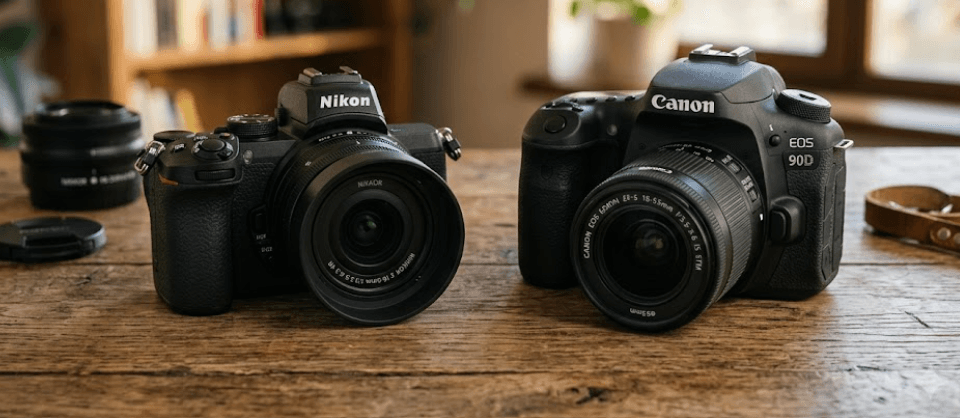
TL;DR The Nikon Z50 is a lightweight mirrorless camera with a 20.9-megapixel sensor, fast hybrid autofocus, and excellent portability, while the Canon EOS 90D is a heavier DSLR built around a 32.5-megapixel sensor, a weather-sealed body, and dramatically longer battery life, so your choice really comes down to whether you value compact mirrorless handling or DSLR-style durability and resolution.
Nikon Z50 at a Glance
The Nikon Z50 is a mirrorless APS-C camera built around a 20.9-megapixel CMOS sensor and Nikon's EXPEED 6 image processor, and it was designed to give photographers a lighter, more travel-friendly alternative to a traditional DSLR. It uses Nikon's Z-mount system, which means it can accept native DX lenses built for the smaller sensor as well as full-frame Z lenses, though the latter apply a 1.5x crop when mounted. Weighing just 395 grams body only, it is one of the more pocketable interchangeable-lens cameras Nikon has produced, making it a natural fit for vloggers, students, and anyone who prioritizes carrying less gear.
Autofocus on the Z50 is handled by a 209-point hybrid phase-detection system that covers roughly 90 percent of the frame width and height, giving it fast and reliable subject acquisition for a camera in this class. It can shoot continuously at up to 11 frames per second, which is genuinely quick for an entry-to-mid-level mirrorless body, and its native ISO range of 100 to 51,200 extends further to 204,800 when expanded. These numbers place it comfortably ahead of many rivals it competed against at launch, including the Fujifilm X-T30 and Sony A6400.
Where the Z50 shows its age is in battery life and card support, since it relies on a single UHS-I SD card slot and returns approximately 300 shots per charge under CIPA testing, a modest figure next to DSLR competitors. It is also worth noting that Nikon ended production of the original Z50 in November 2024, and the camera has since been succeeded by the Z50II, so anyone buying the original Z50 today will typically be purchasing older retailer stock or a used unit rather than a current production model.
Canon EOS 90D at a Glance
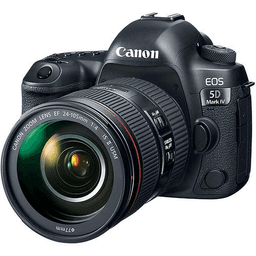
The Canon EOS 90D is a DSLR built around a 32.5-megapixel APS-C CMOS sensor paired with Canon's DIGIC 8 processor, and it was positioned as an enthusiast-level upgrade to the earlier EOS 80D. It uses Canon's EF and EF-S lens mount, giving it access to one of the largest and most mature lens ecosystems in photography, spanning decades of both first-party Canon glass and third-party alternatives. At 701 grams body only, it is noticeably heavier and larger than the Z50, reflecting its DSLR construction and more substantial handgrip.
For stills shooting, the 90D relies on a 45-point all cross-type autofocus system visible through its optical pentaprism viewfinder, which offers 100 percent frame coverage and 0.95x magnification. Switch to Live View mode and the camera shifts to Dual Pixel CMOS autofocus with 5,481 selectable focus positions, giving it mirrorless-level focusing responsiveness while still keeping the option of an optical viewfinder. Continuous shooting tops out at 10 frames per second through the viewfinder and 7 frames per second in Live View, and its native ISO range runs from 100 to 25,600, expandable to 51,200.
The 90D's standout practical advantage is battery life, since its LP-E6N battery delivers approximately 1,300 shots per charge under CIPA testing, more than four times what the Z50 offers. It also features a weather-sealed body and a UHS-II-compatible SD card slot, both of which suit outdoor and event photographers who need durability and faster write speeds. Canon has not released a direct DSLR successor to the 90D, since the company has shifted its enthusiast APS-C development toward mirrorless bodies like the EOS R7, which means the 90D remains available mainly through existing retailer inventory and the used market rather than as an actively produced current model.
Sensor, Resolution and Image Quality
Resolution is one of the clearest differences between these two cameras, since the Canon EOS 90D's 32.5-megapixel sensor offers considerably more detail than the Nikon Z50's 20.9-megapixel sensor, which matters most if you regularly crop images tightly or print at very large sizes. That extra resolution is genuinely useful for wildlife and sports photographers who need to crop in on distant subjects without losing sharpness, and it also gives more flexibility when producing large prints for exhibitions or client deliverables. However, more megapixels on a similarly sized APS-C sensor also means smaller individual pixels, which can slightly affect noise performance at very high ISOs compared to a lower-resolution sensor of the same generation.
The Nikon Z50, despite its lower pixel count, benefits from a newer sensor design paired with the EXPEED 6 processor, and its native ISO ceiling of 51,200 stretches further than the 90D's native 25,600 limit. In practical terms, this means the Z50 can push into dimmer shooting conditions with comparatively cleaner results before needing to rely on expanded ISO settings. Photographers who frequently shoot indoors, at dusk, or in low-light events may find the Z50's sensor behavior more forgiving, even though its resolution ceiling is lower on paper.
| Specification | Nikon Z50 | Canon EOS 90D |
|---|---|---|
| Sensor Resolution | 20.9 MP APS-C | 32.5 MP APS-C |
| Native ISO Range | 100–51,200 | 100–25,600 |
| Expanded ISO | Up to 204,800 | Up to 51,200 |
| Image Processor | EXPEED 6 | DIGIC 8 |
| Card Slot | 1x SD (UHS-I) | 1x SD (UHS-II) |
Neither sensor will disappoint casual and enthusiast shooters, and both cameras produce images that hold up well for web use, social media, and moderate-size prints. The real decision point is whether resolution and cropping flexibility matter more to your workflow than slightly cleaner low-light files, and that answer will differ depending on whether you shoot mostly wildlife and sports or mostly travel and everyday scenes.
Autofocus, Shooting Speed and Handling
Autofocus performance on the Nikon Z50 benefits from its mirrorless design, since the 209-point hybrid system operates directly on the image sensor and covers nearly the entire frame, which makes subject tracking feel consistent whether you are composing through the electronic viewfinder or the rear touchscreen. This on-sensor approach also means there is no meaningful difference in autofocus behaviour between stills and Live View style shooting, since the camera is always using the same detection method. Combined with its 11 frames per second burst rate, the Z50 handles moderately fast action, such as pets, children, or casual sports, without much hesitation.
The Canon EOS 90D takes a more traditional DSLR approach, using a dedicated 45-point phase-detection system through the optical viewfinder and switching to a completely different Dual Pixel CMOS system when the mirror flips up for Live View shooting. This dual-system design gives photographers the choice between the instant, lag-free feel of an optical viewfinder and the highly accurate, face-and-eye-aware focusing of Live View, though it does mean autofocus behavior is not identical across both modes. Its 10 frames per second burst rate through the viewfinder is close to the Z50's, and the addition of a dedicated focus joystick makes it easier to reposition the active AF point quickly during action sequences.
In terms of physical handling, the Z50's smaller, lighter body suits photographers who want a discreet setup for travel or street photography, while the 90D's larger grip and weather-sealed construction suit photographers who shoot for long stretches outdoors or in less predictable conditions. Neither camera includes in-body image stabilization, so stabilization depends entirely on the lens attached, which is a factor worth checking against your existing or planned lens collection before committing to either system.
Video Performance and Everyday Usability
Video capability is reasonably close between the two cameras, though each has its own limitations worth understanding before you buy. The Nikon Z50 records 4K UHD video at up to 30 frames per second using the full width of its sensor, meaning there is no additional crop factor applied during 4K recording, and it can shoot Full HD footage at up to 120 frames per second for smooth slow-motion clips. Its 3.2-inch tilting touchscreen works well for vlogging angles, though it does not flip fully forward the way some competitors' screens do.
The Canon EOS 90D also records 4K UHD video without an additional crop, a genuine improvement over some earlier Canon DSLRs that applied heavy crop factors in 4K mode, though its frame rate tops out at around 25 or 29.97 frames per second rather than a true 30p option. Full HD recording on the 90D reaches up to 120 frames per second as well, matching the Z50's slow-motion capability. Its 3-inch fully articulating touchscreen flips out and rotates forward, which many vloggers and solo content creators find more practical than a simple tilt mechanism.
For everyday usability beyond video, both cameras include Wi-Fi and Bluetooth for transferring images to a smartphone, and both support touchscreen operation for menu navigation and focus point selection. The Z50's smaller size makes it easier to hold steady for handheld video, while the 90D's Dual Pixel autofocus in Live View gives it an edge in smooth, confident focus pulls during video recording, so your preference here may depend on whether portability or focus reliability matters more for your typical shooting scenarios.
Which Camera Should You Buy in 2026
Choosing between these two cameras in 2026 requires being honest about their market position, since neither is a current flagship release, and both have been succeeded by newer models within their respective manufacturers' lineups. The Nikon Z50 has been directly replaced by the Z50II, while Canon has moved its enthusiast APS-C development toward mirrorless bodies like the EOS R7 rather than releasing a direct DSLR successor to the 90D, so buyers today are generally purchasing remaining retailer stock or well-maintained used units of either camera rather than brand-new current-generation gear.
If your priority is portability, video-friendly design, and a lower barrier to entry, the Nikon Z50 remains a sensible pick, particularly for travel photographers, students, and content creators who want a lightweight mirrorless system with access to Nikon's growing Z-mount lens catalog. Its faster burst rate and wider native ISO range also make it a strong choice for anyone shooting in variable lighting conditions without wanting to carry a heavier body all day.
If your priority is resolution, battery endurance, and a rugged build that can handle long outdoor sessions, the Canon EOS 90D is the more practical option, especially for wildlife, sports, and event photographers who benefit from its higher megapixel count and dramatically longer battery life. Its extensive EF and EF-S lens compatibility also makes it an easy fit for anyone already invested in Canon's DSLR ecosystem or looking to buy affordable used glass.
Frequently Asked Questions
Q. Is the Nikon Z50 still available to buy new in 2026?
The original Nikon Z50 has been succeeded by the Z50II, which Nikon released in November 2024, so new units of the original Z50 are increasingly limited to remaining retailer stock rather than active production. Buyers who specifically want the original Z50 at a lower price point can often find it through clearance listings or the used market.
Q. Is the Canon EOS 90D still in production?
Canon has not confirmed the 90D as discontinued in every market, but the company has shifted its enthusiast APS-C focus toward mirrorless cameras such as the EOS R7, and the 90D has had no direct DSLR successor. Most current availability comes through existing retailer inventory and used equipment dealers.
Q. Which camera has better image quality, the Z50 or the 90D?
The Canon EOS 90D offers higher resolution at 32.5 megapixels compared to the Nikon Z50's 20.9 megapixels, which benefits cropping and large prints. The Z50's newer sensor design gives it a slight edge in low-light noise performance at very high ISO settings.
Q. Does the Nikon Z50 have in-body image stabilization?
No, the Nikon Z50 does not include in-body image stabilization, so stabilization depends entirely on whether the attached lens has its own optical stabilization system. This is also true of the Canon EOS 90D, which has no in-body stabilization either.
Q. Which camera is better for beginners?
The Nikon Z50 is generally considered more beginner-friendly due to its lighter weight, simpler mirrorless operation, and touchscreen-driven interface. The Canon EOS 90D has a steeper learning curve because of its dual autofocus systems and more traditional DSLR controls.
Q. How long does the battery last on each camera?
The Nikon Z50 returns approximately 300 shots per charge under CIPA testing, while the Canon EOS 90D returns approximately 1,300 shots per charge, making it significantly more efficient for long shooting days without spare batteries.
Q. Can both cameras shoot 4K video without a crop?
Yes, both the Nikon Z50 and the Canon EOS 90D record 4K UHD video using the full width of their sensors without an additional crop factor. The Z50 reaches 30 frames per second in 4K, while the 90D tops out closer to 25 or 29.97 frames per second.
Q. Is the Canon EOS 90D weather sealed?
Yes, the Canon EOS 90D features a weather-sealed body designed to resist dust and light moisture, which makes it more suitable for outdoor shooting in unpredictable conditions. The Nikon Z50 does not include equivalent weather sealing.
Q. Which lens system offers more options, Nikon Z-mount or Canon EF?
Canon's EF and EF-S mount has decades of lenses available from both Canon and third-party manufacturers, giving the 90D an extensive and often more affordable lens selection. Nikon's Z-mount is newer but growing steadily with both native DX lenses and compatible FX lenses.
Q. Should I buy new or used for either of these cameras in 2026?
Since both cameras have been succeeded by newer models and are past their primary production cycles, buying used from a reputable dealer often provides better value than paying premium prices for remaining new stock. Checking shutter count and overall condition is especially important for the Canon EOS 90D given its DSLR mechanical shutter mechanism.
Final Recommendation
Deciding between the Nikon Z50 and the Canon EOS 90D ultimately comes down to matching the camera to your actual shooting habits rather than chasing a single "better" spec sheet, since each camera was designed with a different type of photographer in mind. The Z50 rewards those who want a light, mirrorless, video-friendly companion for travel and everyday shooting, while the 90D rewards those who need higher resolution, longer battery life, and a rugged body for demanding outdoor and action photography. Both cameras remain capable performers even years after their original release, and their current market position as discontinued or soon-to-be-discontinued models often means better pricing for buyers willing to shop carefully.
Long-term value also depends on lens ecosystem loyalty, since committing to either camera effectively commits you to that brand's mount system for future upgrades. Canon's EF and EF-S lineup offers broader used-market affordability, while Nikon's Z-mount, though newer, is backed by a manufacturer actively expanding its mirrorless lens catalog. Whichever system you lean toward, both cameras remain genuinely usable, well-reviewed tools that can produce excellent results in the hands of a photographer who understands their strengths and limitations.