Nikon Z5 vs Z6: Entry vs Mid-Tier Full-Frame Mirrorless Compared
The Nikon Z5 and Z6 share a full-frame Z-mount platform, but the Z6 is faster and stronger for video, while the Z5 offers dual SD slots and better battery life.

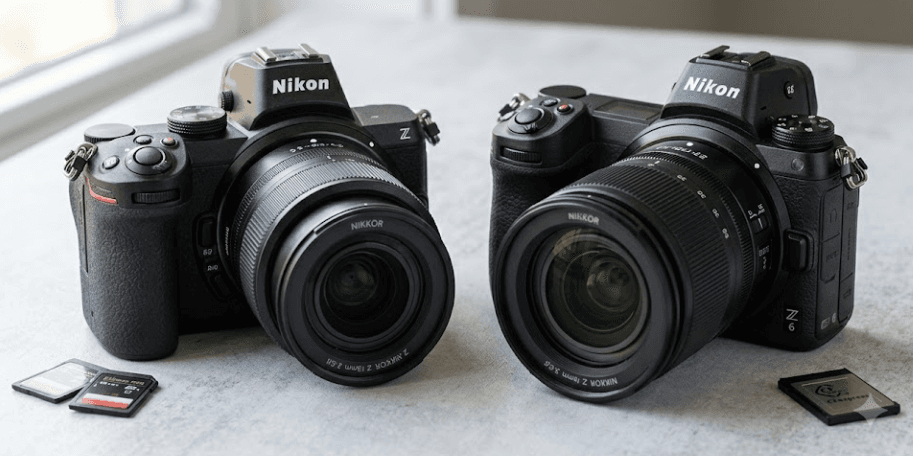
TL;DR The Nikon Z5 and Nikon Z6 are both full-frame mirrorless cameras built around Nikon's Z mount, but they target slightly different photographers. The Z5 is the more affordable, stills-focused entry point, with a 24.3MP sensor, dual UHS-II SD card slots, 5-axis in-body image stabilization, and stronger rated battery life. The Z6 moves up the range with a 24.5MP BSI CMOS sensor, faster burst shooting, a higher-resolution rear display, and significantly stronger video capabilities, including uncropped 4K recording. For photographers who mainly shoot landscapes, portraits, travel, family photos, and everyday stills, the Z5 remains a practical choice. For low-light work, action, hybrid shooting, and video, the Z6 is the more capable body.
Nikon Z5 And Z6 Positioning
The Nikon Z5 and Z6 can look surprisingly similar at first glance, which is part of what makes this comparison useful. Both cameras use Nikon's full-frame FX-format sensor and Z mount, both have 24MP-class resolution, both use Nikon's EXPEED 6 image processor, and both include 5-axis in-body image stabilization. Their bodies are also closely related in size and handling, so choosing between them is less about whether one feels like a completely different camera and more about deciding which features matter for your photography.
The biggest distinction is where Nikon positioned each model. The Z5 was introduced as an entry-level full-frame mirrorless camera, making it a logical step for photographers moving from smartphones, entry-level DSLRs, or smaller-sensor cameras. The Z6 was positioned higher as an enthusiast-oriented model, with a stronger emphasis on speed, low-light performance, and video. That difference still matters when comparing the two today because the Z5 is not simply a smaller Z6. It makes deliberate compromises in areas such as continuous shooting and video to deliver a more accessible full-frame package.
For still photography, however, the gap is not as dramatic as the product hierarchy might suggest. Both cameras can produce detailed 24MP-class images, offer electronic viewfinders with 3.69-million-dot resolution, and provide in-body stabilization for handheld shooting. The Z5 also has an important practical advantage with two SD card slots, while the original Z6 uses a single XQD card slot that is also compatible with CFexpress Type B cards through firmware support. That makes the Z5 particularly attractive to photographers who value backup storage and affordable media.
Z5 And Z6 At A Glance
| Feature | Nikon Z5 | Nikon Z6 |
|---|---|---|
| Sensor | 24.3MP full-frame CMOS | 24.5MP full-frame BSI CMOS |
| Processor | EXPEED 6 | EXPEED 6 |
| Stabilization | 5-axis in-body | 5-axis in-body |
| Standard Burst | Approx. 4.5 fps | Approx. 5.5 fps |
| High-Speed Burst | Not available | Approx. 12 fps mode |
| Memory Cards | Dual UHS-II SD | Single XQD/CFexpress Type B |
| EVF | 3.69 million dots | 3.69 million dots |
| Rear Screen | 3.2-inch, 1.04M dots | 3.2-inch, 2.1M dots |
| 4K Video | Up to 30p with 1.7x crop | Up to 30p using full sensor width |
| IBIS | 5-axis | 5-axis |
The specifications show why neither camera is automatically the better choice for every buyer. The Z6 wins several performance categories, but the Z5 counters with features that are genuinely useful for still photographers.
Sensor And Image Quality
The Nikon Z5 uses a 24.3MP full-frame CMOS sensor, while the Nikon Z6 uses a slightly higher-resolution 24.5MP backside-illuminated CMOS sensor. The difference in megapixels is effectively negligible for normal photography. You are not buying the Z6 because it suddenly gives you dramatically larger files. The more important distinction is sensor design. The Z6's BSI construction gives it an advantage in light-gathering efficiency and contributes to its stronger performance when shooting at higher ISO settings.
For daylight photography, the difference between the two cameras is unlikely to determine whether a photograph looks good or bad. Both have enough resolution for travel photography, portraits, landscapes, events, family photography, and most enthusiast applications. A photographer using a good NIKKOR Z lens will generally get far more practical benefit from choosing the right focal length and exposure settings than from worrying about the small difference between 24.3MP and 24.5MP.
Low-light shooting is where the Z6 makes a stronger case. Both cameras have a native ISO range of 100 to 51,200, but the Z6 offers a higher extended sensitivity range, and its BSI sensor gives it a technical advantage for challenging lighting. The Z5 remains perfectly capable for evening streets, indoor portraits, and general night photography, especially when its in-body stabilization can help reduce camera shake. However, photographers who regularly work at high ISO values have a clearer reason to step up to the Z6.
Image Quality Differences
| Image Factor | Nikon Z5 | Nikon Z6 |
|---|---|---|
| Effective Resolution | 24.3MP | 24.5MP |
| Sensor Design | CMOS | BSI CMOS |
| Native ISO | 100-51,200 | 100-51,200 |
| Full-Frame Sensor | Yes | Yes |
| In-Body Stabilization | Yes | Yes |
| Low-Light Advantage | Good | Better |
The takeaway is simple: the Z5 is not an image-quality compromise in everyday shooting, but the Z6 has the stronger sensor technology for photographers who frequently work in difficult light.
Autofocus And Shooting Speed
Autofocus is one of the areas where the two cameras are more closely matched than their positioning might suggest. Both use a hybrid autofocus system with 273 focus points and support features such as subject tracking and eye-detection autofocus. That means the Z5 is not an entry-level camera with a basic focusing system. For portraits, travel, family photography, and general subjects, it provides a capable autofocus experience.
The bigger difference appears when you start shooting continuously. The Z5 tops out at approximately 4.5 frames per second, which is adequate for ordinary moving subjects but relatively slow for sports and fast wildlife. The Z6 has a standard continuous shooting mode around 5.5 fps and can reach approximately 12 fps in its high-speed continuous mode. That difference can become important when you are trying to capture a precise moment in a football match, a bird taking flight, or a fast-moving subject.
This makes the Z6 the more natural choice for action-oriented photography. The Z5 can certainly photograph moving subjects, but its slower burst rate gives you fewer frames from which to choose. If your photography is primarily portraits, landscapes, architecture, street photography, food, or travel, that limitation is much less important. The Z5's autofocus capabilities remain sufficient for a broad range of everyday still photography.
Which Camera Is Faster?
| Shooting Requirement | Better Choice | Why |
|---|---|---|
| Landscapes | Z5 | Burst speed is less important |
| Portraits | Z5/Z6 | Both offer capable AF |
| Travel | Z5 | Strong stills package |
| Sports | Z6 | Much faster high-speed shooting |
| Wildlife | Z6 | Higher burst capability |
| Everyday Photography | Z5/Z6 | Both are capable |
The Z6's speed advantage is therefore meaningful, but it should not be treated as a reason for every photographer to spend more. It matters most when your subject actually moves quickly.
Video Performance And Displays
Video is arguably the clearest reason to choose the Z6 over the Z5. Both cameras can record 4K UHD video at up to 30 frames per second, but the way they achieve it is significantly different. The Z5 applies a substantial 1.7x crop when recording 4K, which narrows the field of view and can make wide-angle shooting more difficult. The Z6 can record 4K using the full width of its sensor and oversamples its footage, giving it a considerably stronger starting point for video work.
The Z6 also offers more flexibility for serious video users. It supports 1080p recording at higher frame rates, including 120p for slow-motion footage, and provides features such as N-Log that are useful in more advanced video workflows. The Z5 is better understood as a stills-first camera that happens to offer 4K video rather than as a true hybrid-focused body. For casual clips, family videos, and occasional content creation, the Z5 can be enough. For filmmaking, vlogging with wide lenses, or professional hybrid work, the Z6 is considerably more attractive.
The rear screens also favor the Z6. Both cameras have a 3.2-inch tilting touchscreen, but the Z5 uses a 1.04-million-dot display while the Z6 uses a sharper 2.1-million-dot panel. Both share a 3.69-million-dot electronic viewfinder, so the difference is mainly visible when composing or reviewing images on the rear display. The Z6 also includes a top OLED information panel, while the Z5 replaces that area with a conventional mode dial.
Video And Display Comparison
| Feature | Nikon Z5 | Nikon Z6 |
|---|---|---|
| 4K Maximum | 30p | 30p |
| 4K Crop | 1.7x | Full sensor width |
| Full HD | Up to 60p | Up to 120p |
| N-Log | No | Yes |
| Rear Screen | 1.04M dots | 2.1M dots |
| EVF | 3.69M dots | 3.69M dots |
| Top Information Display | No | Yes |
If video is an important part of your workflow, the Z6 is the easy recommendation. The Z5's 4K crop is its biggest weakness compared with the Z6.
Storage And Battery Life
The Nikon Z5 has one feature that can be more valuable to professional still photographers than a faster burst rate: two memory card slots. Both slots accept UHS-II SD cards, allowing photographers to record files to multiple cards depending on their chosen setup. For important events such as weddings, paid shoots, or once-in-a-lifetime travel, having a second card can provide an additional layer of protection against card failure.
The original Z6 takes a different approach with a single XQD card slot, which also supports CFexpress Type B cards. These cards can provide very high performance, but they can also be more expensive than SD cards. More importantly, a single-card design means there is no second in-camera card available for immediate backup. That does not make the Z6 unsuitable for professional photography, but it is a practical consideration for photographers who prioritize redundancy.
Battery performance also gives the Z5 an advantage. Nikon rates the Z5 with the EN-EL15c battery and a higher still-image capacity than the original Z6's EN-EL15b configuration. The exact number of photographs you get will vary with settings, temperature, lens use, display behavior, and shooting style, but the Z5 is generally the stronger option for battery endurance. The Z5 can also be powered through USB, which adds convenience when working away from a conventional charger.
Storage And Battery Differences
| Feature | Nikon Z5 | Nikon Z6 |
|---|---|---|
| Card Slots | 2 | 1 |
| Card Type | UHS-II SD | XQD/CFexpress Type B |
| Backup Recording | Yes | No second slot |
| Battery | EN-EL15c | EN-EL15b originally |
| Rated Battery Advantage | Better | Lower |
| USB Power | Supported | Supported |
For event photographers, the Z5's dual-card setup can outweigh some of the Z6's performance advantages. For video-focused users, the Z6's faster media support and stronger video features may matter more.
Which Nikon Camera Should You Buy?
The Nikon Z5 makes the most sense when photography is your priority and you want to enter Nikon's full-frame Z system without paying for features you may not use. Its 24.3MP sensor provides plenty of resolution, its 5-axis stabilization helps with handheld shooting, and its dual SD card slots are genuinely useful. It is especially well suited to photographers shooting landscapes, portraits, travel, family events, architecture, and everyday subjects where a 4.5 fps burst rate is not a major limitation.
The Nikon Z6 is the better choice when you need more performance from the camera rather than simply a full-frame sensor. Its BSI sensor gives it a low-light advantage, its high-speed burst mode is much better suited to action, and its video system is substantially stronger. The full-width 4K recording alone makes the Z6 much more appealing for anyone who regularly shoots video. Its higher-resolution rear display and top information screen also contribute to a more premium shooting experience.
There is therefore no need to describe the Z5 as a "bad" version of the Z6. It is better understood as a different balance of features. The Z5 gives up speed and video capability while adding dual SD storage and strong battery performance. The Z6 spends more of its feature budget on speed, sensor technology, and video. Your shooting style should determine which trade-off makes more sense rather than the model number alone.
Z5 Vs Z6: Best For Each Buyer
| Buyer Type | Recommended Camera | Main Reason |
|---|---|---|
| First full-frame camera | Nikon Z5 | Practical stills-focused package |
| Travel photographer | Nikon Z5 | Battery and dual SD slots |
| Landscape photographer | Nikon Z5 | Full-frame detail and stabilization |
| Portrait photographer | Nikon Z5/Z6 | Both offer strong image quality |
| Sports photographer | Nikon Z6 | Faster burst shooting |
| Wildlife photographer | Nikon Z6 | Better suited to fast action |
| Video creator | Nikon Z6 | Full-width 4K and stronger video features |
| Low-light photographer | Nikon Z6 | BSI sensor advantage |
| Event photographer | Nikon Z5 | Dual card slots |
| Hybrid shooter | Nikon Z6 | Stronger stills and video balance |
Frequently Asked Questions
Q. Is the Nikon Z5 better than the Z6 for photography?
The Nikon Z5 can be the better choice for photographers who primarily shoot still images and value practicality. It has a 24.3MP full-frame sensor, 5-axis stabilization, dual UHS-II SD card slots, and strong battery performance. The Z6 has a 24.5MP BSI sensor and faster shooting, so it is better for low-light and action photography.
Q. Which camera has better low-light performance, the Nikon Z5 or Z6?
The Nikon Z6 has the technical advantage because it uses a backside-illuminated 24.5MP sensor. Both cameras have a native ISO range of 100 to 51,200, but the Z6's BSI design gives it stronger potential for high-ISO and low-light shooting.
Q. Is the Nikon Z5 good for video?
The Z5 can record 4K video at up to 30p, but its 4K mode uses a 1.7x crop. That makes it less flexible for wide-angle video and more demanding hybrid workflows. It is suitable for casual and occasional video, while the Z6 is the stronger choice for serious video work.
Q. Which Nikon camera has faster continuous shooting?
The Nikon Z6 is faster. The Z5 reaches about 4.5 frames per second, while the Z6 shoots at about 5.5 fps in standard continuous mode and offers a high-speed mode of about 12 fps.
Q. Does the Nikon Z5 have better battery life than the Z6?
Yes. The Z5 generally has the advantage in rated battery life, particularly with the EN-EL15c battery. Actual endurance varies with shooting conditions, but battery performance is one of the practical advantages of the Z5 over the original Z6.
Q. Does the Nikon Z5 have dual memory card slots?
Yes. The Nikon Z5 has two UHS-II-compatible SD card slots. The original Nikon Z6 has a single XQD slot that also supports CFexpress Type B cards. The Z5's dual-slot design is particularly useful for photographers who want in-camera file redundancy.
Q. Which camera is better for sports and wildlife?
The Nikon Z6 is better suited to sports and wildlife because of its faster continuous shooting capability. The Z5's approximately 4.5 fps maximum is adequate for slower subjects but gives you fewer frames when timing fast-moving action.
Q. Do the Nikon Z5 and Z6 use the same lens mount?
Yes. Both cameras use Nikon's Z mount and are full-frame FX-format mirrorless cameras. This means lenses designed for Nikon's full-frame Z system can be used across both bodies, making it possible to change bodies without rebuilding your lens collection.
Q. Which has the better screen, Nikon Z5 or Z6?
The Nikon Z6 has the higher-resolution rear display. Both cameras use a 3.2-inch tilting touchscreen, but the Z5 has approximately 1.04 million dots while the Z6 has approximately 2.1 million dots. Both have a 3.69-million-dot electronic viewfinder.
Q. Should you buy the Nikon Z5 or Z6?
Choose the Z5 if you mainly shoot stills and value dual SD cards, battery life, stabilization, and a straightforward full-frame package. Choose the Z6 if you need better low-light performance, faster continuous shooting, or significantly stronger video capabilities. The right choice depends more on your shooting style than on the Z6's higher position in Nikon's original lineup.
Final Recommendation
The Nikon Z5 is the better choice for photographers who want a practical entry into full-frame mirrorless photography. Its 24.3MP sensor, 5-axis stabilization, dual UHS-II SD card slots, and strong battery life make it particularly appealing for travel, portraits, landscapes, family photography, and general stills. Its biggest compromises are the slower burst rate and heavily cropped 4K video.
The Nikon Z6 is worth choosing when performance matters more than simplicity. Its 24.5MP BSI sensor gives it an advantage in low light, its high-speed continuous shooting is substantially faster, and its full-width 4K recording makes it much more capable for video. It is the more convincing option for photographers who regularly mix stills with serious video or fast-moving subjects.
For most stills-first buyers, choose the Nikon Z5. For action, low-light, and hybrid shooting, choose the Nikon Z6. The important point is that the Z5 is not simply a cheaper Z6. It is a deliberately stills-focused full-frame camera, and its dual-card setup and battery life can actually make it the more practical choice for the right photographer.