Nikon D3100 vs D3200 vs D3300 vs D3400 vs D3500: Entry-Level Nikon Compared
Compare the Nikon D3100, D3200, D3300, D3400 and D3500 on image quality, autofocus, video, battery life and features to find the best entry-level Nikon DSLR in 2026.

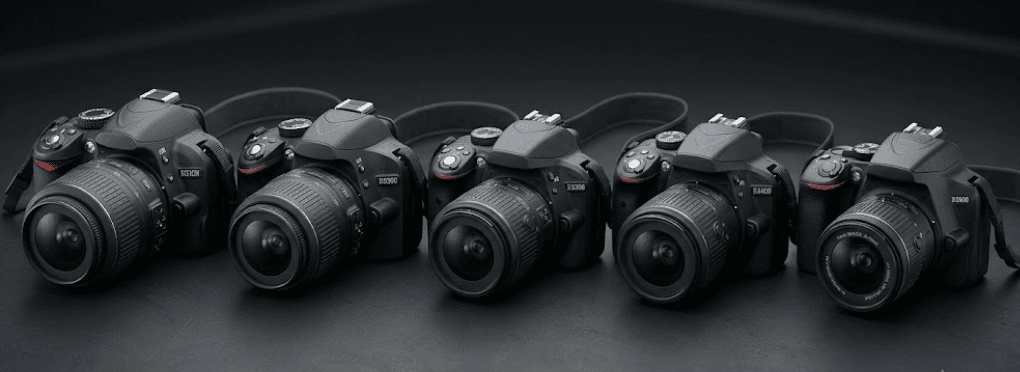
TL;DR The Nikon D3500 is the best overall choice in this lineup for most beginners buying a used Nikon DSLR in 2026, thanks to its 24.2MP DX sensor, 5fps shooting, 1,550-shot battery rating, lightweight body, and simple controls. The D3400 is a close alternative with similar image quality and a 1,200-shot battery rating, while the D3300 remains attractive because it combines a 24.2MP sensor with 5fps shooting and a built-in microphone input. The D3200 is still capable but older, and the D3100 is best considered only when its lower used price makes it significantly cheaper than the newer models.
Nikon D3100 To D3500 Evolution
The Nikon D3100, D3200, D3300, D3400 and D3500 belong to Nikon's entry-level DX-format DSLR family, but they are separated by almost eight years of development. The D3100 arrived in 2010 with a 14.2MP sensor, while the D3200 moved to 24.2MP in 2012. Nikon then introduced the D3300 in 2014 with another 24.2MP sensor and the EXPEED 4 processor, followed by the D3400 in 2016 and D3500 in 2018. The progression was less about completely changing the camera concept and more about improving image quality, processing, battery life, connectivity and physical design while keeping the cameras approachable for first-time DSLR users.
The biggest jump in this comparison happens between the D3100 and D3200. The D3100 uses a 14.2MP DX CMOS sensor and has a 230,000-dot 3-inch LCD, while the D3200 increases resolution to 24.2MP and uses a much higher-resolution 921,000-dot display. The D3200 also increases continuous shooting from the D3100's roughly 3fps class to 4fps. For someone buying a camera today, that difference is noticeable because the D3200 gives you considerably more resolution for cropping and more flexibility when editing photos. The D3300 continues the 24.2MP approach but adds the EXPEED 4 processor and raises continuous shooting to 5fps.
From the D3300 onward, the improvements become more evolutionary. The D3400 retains a 24.2MP DX sensor, 5fps continuous shooting and Full HD video, but adds Nikon SnapBridge connectivity through Bluetooth and improves battery life to a CIPA-rated 1,200 shots. The D3500 keeps the same basic 24.2MP resolution and 5fps shooting but becomes substantially lighter and extends battery life to approximately 1,550 shots. Its redesigned grip and simplified rear control layout also make it especially beginner-friendly. That is why the D3500 is usually the most sensible endpoint of this particular Nikon progression if you are choosing between these five cameras today.
Nikon D3xxx Timeline
| Model | Introduction | Resolution | Continuous Shooting | Maximum Video |
|---|---|---|---|---|
| Nikon D3100 | 2010 | 14.2MP | Approx. 3fps | 1080p/24 |
| Nikon D3200 | 2012 | 24.2MP | 4fps | 1080p/30 |
| Nikon D3300 | 2014 | 24.2MP | 5fps | 1080p/60 |
| Nikon D3400 | 2016 | 24.2MP | 5fps | 1080p/60 |
| Nikon D3500 | 2018 | 24.2MP | 5fps | 1080p/60 |
The specifications show a clear pattern: the D3100 is the oldest and most limited model, while the D3300, D3400 and D3500 form the stronger part of the lineup for modern used-camera buyers.
Image Quality And Sensor Performance
Image quality is where the D3200 changed the conversation. Its 24.2MP DX-format sensor provides substantially more resolution than the D3100's 14.2MP sensor, which gives photographers more flexibility when cropping or making larger prints. The D3300, D3400 and D3500 also use 24.2MP DX-format sensors, so the headline resolution does not change across those three generations. Instead, differences come from processing, sensor implementation, shooting behavior, and the lenses attached to the camera. In practical terms, you should not assume that the D3500 produces higher-resolution photos than the D3300 dramatically simply because it is newer. Both sit in the same 24.2MP class.
The D3300 is particularly interesting because Nikon paired its 24.2MP DX sensor with the EXPEED 4 processor and a sensor design without an optical low-pass filter. That combination helped the camera deliver strong detail for its class and made it a significant step forward from the D3200. The D3400 and D3500 also target the same beginner market and retain 24.2MP resolution, meaning the choice between these later models is less about megapixels and more about battery life, body design, connectivity and condition. If you are buying used, a clean D3300 with a good lens can therefore make more sense than paying considerably more for a D3500 simply because it has a newer model number.
The D3100 still produces perfectly usable photographs, especially in good light and when paired with a capable NIKKOR lens, but its age becomes more obvious when you compare its 14.2MP sensor, older processing and lower-resolution LCD with the later cameras. It is also important to remember that these are all interchangeable-lens DSLRs, so the lens can have a major effect on the final image. A D3300 or D3500 with a sharp prime lens can produce a more satisfying result than a newer body paired with a poor or damaged lens. For used buyers, sensor condition, shutter condition, lens condition and overall maintenance can therefore matter as much as the small differences between the later camera bodies.
Sensor And Image Comparison
| Camera | Sensor | Effective Resolution | Native ISO Range |
|---|---|---|---|
| D3100 | DX CMOS | 14.2MP | ISO 100–3200 |
| D3200 | DX CMOS | 24.2MP | ISO 100–6400 |
| D3300 | DX CMOS | 24.2MP | ISO 100–12800 |
| D3400 | DX CMOS | 24.2MP | ISO 100–25600 |
| D3500 | DX CMOS | 24.2MP | ISO 100–25600 |
The later cameras offer a much broader standard ISO range than the D3100, although maximum ISO numbers should not be treated as a guarantee of clean low-light images. Actual results depend on exposure, lens aperture, shutter speed, subject movement, and how much noise you are willing to accept.
Autofocus, Shooting And Video
All five cameras are designed around Nikon's beginner-friendly DSLR approach, but their shooting performance improves as you move through the generations. The D3100 uses an 11-point autofocus system and is capable of approximately 3fps continuous shooting, while the D3200 moves to 4fps. The D3300, D3400 and D3500 all reach up to 5fps under Nikon's specified shooting conditions. That difference may not sound dramatic, but 5fps gives you a better chance of capturing a useful frame when photographing children, pets, casual sports or other moving subjects.
Video is another area where the D3300 becomes an important dividing line. The D3100 can record Full HD video at 24fps, while the D3200 reaches Full HD 1080p at up to 30fps. The D3300, D3400 and D3500 can record Full HD 1080p at up to 60fps. None of these cameras offers 4K recording, so they should not be treated as modern video-first cameras. The D3200 has a useful advantage for video creators because it includes an external stereo microphone input, whereas the D3400 and D3500 rely on their built-in monaural microphones.
For photography, the D3300, D3400 and D3500 are the stronger choices because their 5fps shooting and 24.2MP sensors give them a better balance for everyday photography. For video, however, the D3200 has one feature that should not be overlooked: its 3.5mm microphone input. If you plan to record interviews or instructional videos and want audio recorded directly into the camera, that feature can be more useful than the newer model number. The D3500 is better suited to casual Full HD clips, travel footage and simple family videos rather than serious production work, especially because it has no external microphone input or headphone jack.
Shooting Features At A Glance
| Feature | D3100 | D3200 | D3300 | D3400 | D3500 |
|---|---|---|---|---|---|
| Continuous Shooting | Approx. 3fps | 4fps | 5fps | 5fps | 5fps |
| Full HD Video | Yes | Yes | Yes | Yes | Yes |
| 1080p/60 | No | No | Yes | Yes | Yes |
| External Mic Input | No | Yes | Yes | No | No |
| Autofocus Points | 11 | 11 | 11 | 11 | 11 |
The table highlights why there is no single winner for every buyer. The D3500 is the strongest general-purpose beginner camera, but the D3200 and D3300 retain useful features that can make them attractive at the right used price.
Battery Life And Everyday Handling
Battery life is one of the clearest advantages of the newer cameras. The D3400 is rated for approximately 1,200 shots per charge, while the D3500 increases that figure to approximately 1,550 shots under CIPA testing. That is a substantial advantage for travel, events and long photography sessions, particularly when you do not want to carry multiple spare batteries. The D3500 also weighs approximately 365g for the body, compared with about 395g for the D3400 and 410g for the D3300. The reduction makes the D3500 easier to carry, although the actual weight will obviously increase once you attach a lens, battery and memory card.
The D3500 also changed the physical design rather than simply changing the internal specifications. Nikon concentrated many of the important controls on the right side of the rear panel and redesigned the grip to make the camera easier to hold. That is useful for a beginner because you can spend more time taking photographs and less time searching through menus. The camera also retains Nikon's Guide Mode, which provides step-by-step assistance for people who are still learning concepts such as shutter speed, aperture and exposure. For someone buying their first interchangeable-lens camera, these usability improvements can be more valuable than a small difference in image quality.
The D3400 offers a good middle ground. It is lighter than the D3300, retains 24.2MP resolution and 5fps shooting, and introduces SnapBridge Bluetooth connectivity. The D3500 improves that formula further with a lighter 365g body and longer battery life. However, neither model should be confused with a modern mirrorless camera in terms of connectivity or video features. The D3500 has Bluetooth through SnapBridge but does not have Wi-Fi, and its wireless functions are primarily designed around smartphone sharing and remote control rather than a modern creator-focused workflow.
Battery And Weight Comparison
| Camera | CIPA Battery Rating | Body Weight |
|---|---|---|
| D3100 | Approx. 550 shots | Approx. 455g |
| D3200 | Approx. 540 shots | Approx. 455g |
| D3300 | Approx. 700 shots | Approx. 410g |
| D3400 | Approx. 1,200 shots | Approx. 395g |
| D3500 | Approx. 1,550 shots | Approx. 365g |
The trend is clear: Nikon steadily reduced body weight while significantly improving battery endurance, with the D3500 representing the strongest combination in this lineup.
Which Nikon Should You Buy In 2026?
For most people, the Nikon D3500 is the easiest recommendation from this group. It gives you 24.2MP resolution, 5fps continuous shooting, Full HD 60p video, Bluetooth connectivity, Guide Mode and a 1,550-shot CIPA battery rating in Nikon's lightest body among these five cameras. Its biggest limitation is not image quality but age and feature set. It lacks 4K video, has no external microphone input, and uses an older DSLR design. However, if your priority is learning photography, taking travel photos, portraits, or family pictures, those limitations may not matter much.
The D3400 is the next model I would consider when the used-price difference is meaningful. Its image quality is broadly in the same class as the D3500, and it retains the same 24.2MP resolution, 5fps shooting, and 1080p/60 video. The main reasons to choose the D3400 instead are usually price and availability rather than a major performance advantage. The D3300 is also worth considering, particularly if you find a well-maintained example with a good lens. It has 24.2MP resolution, 5fps shooting, and 1080p/60 video, and it has a microphone input that the later D3400 and D3500 do not have.
The D3200 makes sense mainly when it is considerably cheaper than the D3300 or when its external microphone input is important to you. The D3100 is now the hardest model to recommend unless the price is very low and the camera is in excellent condition. Remember that all five models are discontinued, and Nikon has moved its current interchangeable-lens development toward its mirrorless Z system. Nikon confirmed that D3500 production ended in 2022, so in 2026 buyers should focus heavily on condition, shutter count, battery health, lens condition and included accessories rather than assuming that the newest model will automatically be available new.
Best Model By Buyer
| Model | Best For | Main Strength | Main Limitation |
|---|---|---|---|
| D3100 | Very low-cost beginner | Lowest entry price on used market | Oldest sensor and features |
| D3200 | Budget photography and basic video | 24.2MP sensor and mic input | 4fps shooting |
| D3300 | Best older-value option | 24.2MP, 5fps and 1080p/60 | No modern wireless connectivity |
| D3400 | Affordable everyday photography | 24.2MP, 5fps and SnapBridge | No external mic input |
| D3500 | Best overall beginner choice | Battery, weight and simplicity | No 4K or mic input |
Because these cameras are now older used products, the best deal is not necessarily the model with the highest number. A clean D3300 or D3400 with a good NIKKOR lens can be a better purchase than a heavily worn D3500. Always inspect the camera before buying and check the shutter count, sensor condition, LCD, buttons, battery, and lens for signs of damage.
Frequently Asked Questions
Q. Is the Nikon D3500 better than the D3400?
Yes, overall. The D3500 keeps the D3400's 24.2MP resolution and 5fps shooting but is lighter and has a substantially higher CIPA battery rating of approximately 1,550 shots compared with approximately 1,200 shots for the D3400.
Q. Is the Nikon D3300 better than the D3200?
For most photographers, yes. Both use 24.2MP DX sensors, but the D3300 increases continuous shooting to 5fps from the D3200's 4fps and adds 1080p/60 video.
Q. Which Nikon camera has the best battery life in this comparison?
The D3500 has the longest rated battery life, at approximately 1,550 shots per charge under CIPA testing.
Q. Does the Nikon D3500 shoot 4K video?
No. The D3500 records Full HD video, including 1920 x 1080 at up to 60p. It does not offer 4K recording.
Q. Does the Nikon D3500 have an external microphone jack?
No. The D3500 has a built-in monaural microphone but does not provide an external microphone input.
Q. Which Nikon D3xxx camera is best for beginners?
The D3500 is the strongest overall beginner choice because it combines simple controls, Guide Mode, 24.2MP resolution, 5fps shooting, low weight and excellent battery life.
Q. Does the Nikon D3400 have Wi-Fi?
The D3400 uses Bluetooth-based SnapBridge connectivity rather than built-in Wi-Fi. Nikon lists SnapBridge and Bluetooth connectivity for the camera.
Q. Is the Nikon D3100 still worth buying in 2026?
It can still work as a basic interchangeable-lens camera, but it is difficult to recommend over the D3200 or newer models unless you find it at a significantly lower price. Its 14.2MP sensor and older specifications are now noticeably dated.
Q. Which Nikon has the highest resolution in this comparison?
The D3200, D3300, D3400 and D3500 all have 24.2MP effective resolution, while the D3100 has 14.2MP.
Q. Should I buy a D3500 or a newer mirrorless camera in 2026?
If you specifically want an inexpensive DSLR and already have access to Nikon F-mount lenses, the D3500 can still be a good learning camera. However, buyers starting from scratch in 2026 should also consider Nikon's current Z-mount mirrorless system because the D3500 is a discontinued DSLR and lacks newer features such as 4K video and modern subject-detection autofocus.
Final Recommendation
The Nikon D3500 is the best overall choice from the D3100, D3200, D3300, D3400 and D3500 lineup for a beginner buying in 2026. Its 24.2MP DX sensor, 5fps continuous shooting, 1080p/60 video, Bluetooth connectivity, lightweight 365g body and approximately 1,550-shot battery rating give it the most complete combination of features for everyday photography. It is particularly well suited to someone learning photography, traveling, taking portraits or upgrading from a smartphone without wanting a complicated camera.
The D3300 is the better alternative when you find one at a substantially lower price, especially if the external microphone input matters to you. The D3400 is also a strong used option because it keeps the 24.2MP sensor and 5fps shooting while adding SnapBridge and improving battery life. The D3200 remains useful for budget buyers who want 24.2MP resolution and an external microphone input, while the D3100 should only be considered when its low used price clearly compensates for its older hardware.
The bigger point is that you should not buy these cameras purely according to the model number. Since the entire lineup is now old and discontinued, condition can make a bigger difference than one generation of hardware. Check the shutter count, sensor, LCD, battery, memory-card slot, buttons and lens before paying. If you find a clean D3500 at a sensible used price, it is the safest all-round recommendation. If the D3300 or D3400 is significantly cheaper, however, either can deliver excellent results and may offer better value for your money.