Camera Bags and Storage: What Actually Protects Your Gear
The right camera bag does more than carry your gear. Padding, dividers, weather protection, and proper long-term storage can help prevent impact damage, moisture problems, dust, and lens fungus.

TL;DR Camera bags and storage systems protect photography gear in different ways, so choosing the right setup depends on whether you are carrying equipment outdoors or storing it between shoots. A well-designed camera bag should keep the camera and lenses separated, prevent them from moving around, provide enough padding for everyday knocks, and offer reasonable protection from rain and dust. For long-term storage, the priorities change because humidity, condensation, and poor ventilation can contribute to mould and fungus. Camera manufacturers such as Nikon and Leica recommend keeping equipment in dry, sufficiently ventilated conditions and using desiccants where appropriate for long-term storage. A camera bag protects your gear while you move, while proper storage protects it when you are not using it.
Why Camera Bags Matter For Gear Protection?
A camera bag is essentially the first layer of physical protection between your equipment and the outside world. Cameras and lenses contain precision components, exposed glass elements, electronic contacts, and moving parts that can be damaged by impacts, pressure, dust, or moisture. Simply placing a camera inside a regular backpack does not provide the same protection because books, chargers, bottles, and other objects can press against the equipment while you are moving. Dedicated camera bags use padded compartments and internal organization to keep equipment separated and reduce unnecessary movement. Nikon, for example, describes its camera cases as padded designs intended to protect cameras, while other dedicated systems use padded compartments specifically to shield equipment during transport.
The internal layout of a bag is just as important as the outer material. Adjustable dividers allow you to create individual spaces for a camera body, lenses, flash units, batteries, and other accessories. This prevents a lens from repeatedly hitting the camera body or another piece of equipment when the bag is moved. A good compartment should also fit the equipment reasonably closely without forcing it into place. Too much empty space allows gear to shift, while an overly tight compartment can make removing equipment difficult and may put unnecessary pressure on it. The objective is controlled movement, not simply maximum padding.
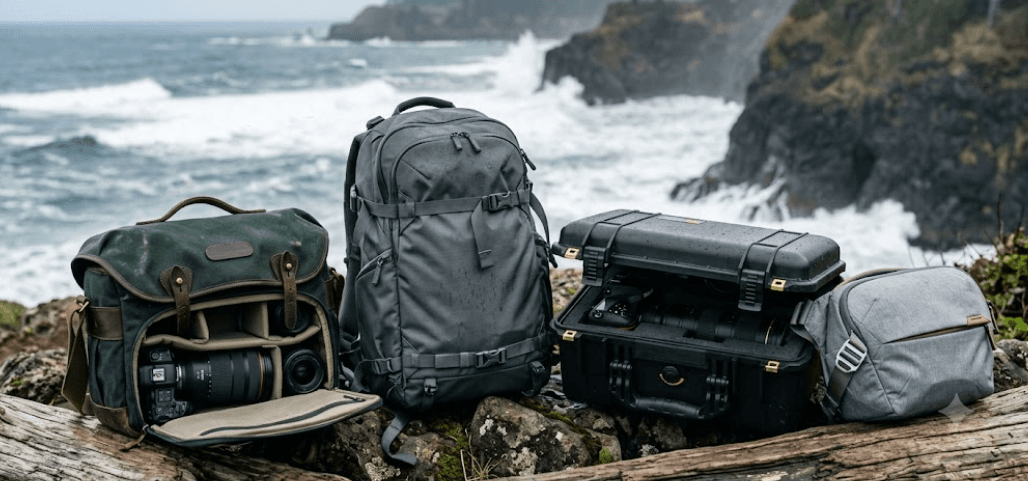
Weather protection is another important part of the equation, particularly for photographers who work outdoors. A weather-resistant exterior or rain cover can help reduce exposure to rain and splashes, but it should not be treated as proof that the equipment is waterproof. Camera manufacturers make similar distinctions with weather-resistant equipment, where protection depends on the specific camera, lens, covers, seals, and conditions involved. A bag therefore works best as part of a wider protection system rather than as a guarantee that your equipment can safely be exposed to water.
What A Good Camera Bag Should Protect Against?
The most useful camera bags focus on several everyday risks rather than one dramatic scenario. Impact protection helps with accidental drops and knocks, while dividers reduce contact between individual pieces of equipment. Weather-resistant materials and rain covers can provide additional protection when you are caught outside, while secure closures help prevent equipment from falling out during movement. Nikon's padded cases and carry systems illustrate how padding, compartments, and closures can be combined to protect equipment during transport.
| Protection Feature | Why It Matters |
|---|---|
| Internal padding | Reduces the effect of everyday knocks |
| Adjustable dividers | Keeps bodies and lenses separated |
| Secure closures | Helps prevent accidental opening |
| Weather-resistant exterior | Adds protection from light rain and moisture |
| Rain cover | Provides an additional barrier during wet conditions |
| Dedicated compartments | Prevents accessories from pressing against delicate gear |
How Padding And Dividers Protect Your Gear?
Padding is one of the most obvious features of a camera bag, but thickness alone does not determine whether a bag is protective. The placement and structure of the padding matter because different parts of a camera require different levels of protection. A camera body needs a stable compartment, while lenses need enough space around their barrels and mounts to prevent them from knocking against other equipment. Dedicated lens cases also commonly use padding because lenses contain precision optical components that can be affected by physical shocks. Nikon's lens cases, for example, combine a lightweight construction with padding and dedicated carrying features for compatible lenses.
Dividers are particularly useful when your kit changes from one shoot to another. A photographer carrying one camera body and two lenses needs a different internal arrangement from someone carrying two bodies, several lenses, batteries, and a flash. Adjustable dividers allow the same bag to accommodate different setups without leaving expensive equipment loose inside. The dividers also create physical separation, which reduces the chance of one item striking another when the bag is placed down or carried over uneven ground.
The outside construction matters too, but it should not distract from the internal protection system. A durable outer material can help the bag withstand regular use, while reinforced stitching, strong zippers, and comfortable straps influence how safely and reliably the bag can be carried. The best camera bag is therefore not necessarily the largest or most heavily padded option. It is the one that provides an appropriate combination of padding, organization, weather protection, and comfortable carrying for the equipment you actually own.
Choosing Protection Based On Your Kit
A small mirrorless setup may not require the same bag as a professional kit containing multiple large lenses. Overloading a smaller bag can compress compartments and make equipment difficult to access, while choosing a very large bag can encourage unnecessary gear to be carried around. A better approach is to select a bag around the camera body, largest lens, and accessories you regularly use rather than buying based solely on advertised capacity.
Moisture And Humidity Can Damage Camera Gear
Moisture is one of the less visible threats to camera equipment because damage may not appear immediately. Cameras and lenses can be exposed to humidity when they are used outdoors, stored in damp environments, or moved between areas with significant temperature differences. Nikon recommends storing cameras in dry, well-ventilated areas to help prevent mold and mildew, while Leica similarly recommends keeping equipment dry and removing moisture after use in humid conditions. This is particularly relevant for lenses because fungal growth can affect optical surfaces and become difficult to address once established.
Condensation is another issue that photographers should understand. Moving equipment rapidly between environments with different temperatures can cause moisture to form on or inside equipment. A camera manual from Panasonic explains that condensation can occur because of differences in temperature or humidity and can contribute to problems involving lenses, viewfinders, and other components. Its guidance recommends allowing the equipment to reach the surrounding temperature naturally when condensation occurs rather than immediately continuing to use it.
Silica gel and other desiccants can help manage moisture in appropriate storage situations, but they are not a substitute for sensible storage conditions. Nikon specifically recommends desiccant for certain long-term storage situations and notes that its moisture-absorbing capacity decreases over time. For photographers in humid environments, an electronic dry cabinet can provide more controlled storage because it actively monitors or regulates humidity. However, the exact humidity target should follow the equipment manufacturer's guidance rather than a universal number.
When A Dry Cabinet Makes Sense?
A dry cabinet becomes more useful as the value and size of a camera collection increase, particularly when several lenses and bodies need to be stored for extended periods in a humid environment. Current electronic dry cabinets are available with humidity monitoring and adjustable storage shelves, with some models designed specifically for photography equipment. For someone with a single camera and frequently used lens, however, appropriate dry, ventilated storage may be sufficient if it matches the manufacturer's recommendations.
| Storage Situation | Practical Protection |
| Daily-use camera | Padded bag or case |
| Camera used outdoors | Padded, weather-resistant bag |
| Occasional home use | Dry, ventilated storage |
| Humid environment | Controlled humidity storage may help |
| Large lens collection | Dry cabinet can provide organized humidity control |
| Long-term storage | Follow manufacturer guidance and consider desiccant |
Camera Bags And Storage Serve Different Purposes
It is easy to assume that a premium camera bag can also function as a long-term storage solution, but the two jobs are different. A bag is primarily designed for mobility, access, organization, and physical protection during transport. Long-term storage is more concerned with environmental conditions, particularly moisture, temperature, ventilation, and dust. Leica recommends closed and padded containers for protection from friction and dust but also emphasizes dry, sufficiently ventilated conditions and moisture removal.
This distinction becomes especially important after a wet outdoor shoot. Putting damp equipment straight back into a closed bag can trap moisture around the camera and accessories. Nikon's guidance recommends drying equipment and storing it in a dry environment, while its long-term storage recommendations also include periodic removal from storage to help prevent mold or mildew. The practical lesson is simple: a camera bag should not become a permanent storage box for wet or recently exposed equipment.
Your storage area should also be chosen carefully. A hot vehicle, damp cupboard, poorly ventilated room, or location exposed to rapid temperature changes is not ideal for valuable photography equipment. Camera manufacturers warn against high temperatures, excessive humidity, and condensation-related conditions because these can contribute to equipment problems.
A Better Storage Routine
After a shoot, allow equipment that has been exposed to moisture or major temperature changes to stabilize before placing it into long-term storage. Check the exterior, remove obvious moisture, and make sure the bag itself is dry. Batteries should also be treated according to the camera manufacturer's storage recommendations. Nikon manuals, for example, recommend removing batteries for extended storage and keeping them in a cool, dry place.
Common Camera Storage Mistakes To Avoid
One common mistake is treating weather resistance as waterproofing. Even cameras and lenses designed with weather resistance have specific limitations, and protection can depend on how the body, lens, doors, covers, and accessories are used. Another mistake is leaving equipment in a damp camera bag after shooting outdoors. The bag may look dry from the outside while retaining moisture inside, creating an environment that is not suitable for long-term equipment storage.
Another problem is buying a bag based entirely on capacity. A huge bag is not automatically safer if equipment is allowed to move around inside it. Organization matters because the camera and lenses should remain separated and supported. Similarly, filling every compartment can make the bag uncomfortable to carry and can make equipment harder to access safely.
Finally, photographers sometimes focus on impact protection while ignoring humidity. A heavily padded bag can protect a lens from a physical knock during transport, but it does not automatically control the environment when the equipment sits inside it for days or weeks. Long-term protection requires a different approach, particularly in humid climates. Manufacturer guidance consistently emphasizes dry storage and moisture control rather than relying on the camera bag alone.
Mistakes And Better Alternatives
| Common Mistake | Better Approach |
| Treating a rain cover as waterproofing | Use it as an additional moisture barrier |
| Leaving damp gear inside a closed bag | Dry the equipment and bag before storage |
| Buying the biggest bag available | Match capacity to your actual kit |
| Letting lenses move freely | Use padded, adjustable compartments |
| Ignoring humidity | Follow manufacturer storage guidance |
| Using expired desiccant | Replace desiccant when its capacity is depleted |
How To Choose The Right Camera Storage Setup?
The right setup depends on how frequently you shoot, where you live, and how much equipment you own. A casual photographer who carries a mirrorless body and one or two lenses may only need a compact padded bag with adjustable dividers and reasonable weather protection. Someone who photographs weddings, wildlife, or travel regularly may need a larger backpack or rolling case with stronger organization and easier access to multiple lenses.
The environment should influence the decision as much as the size of the kit. Photographers working frequently in humid conditions need to pay more attention to moisture management, while photographers who mainly shoot in dry indoor environments may place more emphasis on impact protection and comfortable carrying. The important point is that there is no single camera bag that provides every form of protection equally well. Transport protection and storage protection should be evaluated separately.
Cost should also be considered against the value of the equipment. Spending more on a bag does not automatically guarantee better protection, but buying a poorly padded or badly organized bag for expensive lenses can be a false economy. A good setup should protect the equipment you already own while remaining practical enough that you actually use it consistently.
Protection Priorities By Photographer
| Photographer Type | Main Priority | Recommended Setup |
| Casual photographer | Basic impact protection | Compact padded camera bag |
| Travel photographer | Protection and portability | Padded backpack with weather protection |
| Outdoor photographer | Impact and moisture protection | Weather-resistant padded bag |
| Professional photographer | Organization and access | Larger modular camera bag |
| Humid-climate photographer | Moisture management | Padded bag plus controlled storage |
| Large gear collection | Long-term protection | Camera bags plus dry cabinet |
Frequently Asked Questions
Q. What is the most important feature in a camera bag?
Padding and internal organization are among the most important features because they help prevent equipment from moving around and taking unnecessary impacts during transport. Adjustable dividers are particularly useful because they allow you to create separate compartments for camera bodies, lenses, and accessories.
Q. Does a camera bag protect against rain?
A weather-resistant bag or rain cover can reduce exposure to rain, but it should not automatically be treated as waterproof protection. The level of protection depends on the bag's construction and the manufacturer's specifications.
Q. Can I store my camera permanently inside its camera bag?
It is better not to treat a camera bag as the only long-term storage solution, particularly in humid conditions. Cameras and lenses should be kept in dry, appropriate conditions, and equipment exposed to moisture should be dried before extended storage.
Q. Does humidity really affect camera lenses?
Yes. High humidity can contribute to mould and mildew, which is why manufacturers recommend dry storage conditions. Nikon specifically recommends dry, well-ventilated storage to help prevent mould and mildew.
Q. Should I use silica gel with my camera equipment?
Desiccants such as silica gel can be useful in appropriate storage situations. Nikon recommends using desiccant for certain long-term storage conditions and notes that it needs to be replaced as its moisture-absorbing capacity decreases.
Q. Do I need a dry cabinet for one camera?
Not necessarily. A dry cabinet can be useful in humid environments or for larger collections, but a single camera may be adequately stored using a dry, suitable, ventilated environment that follows the manufacturer's recommendations.
Q. Are padded dividers necessary for camera bags?
They are highly useful because they separate equipment and reduce movement inside the bag. Adjustable dividers are especially practical when you regularly change lenses or carry different combinations of equipment.
Q. Can condensation damage a camera lens?
Condensation can create problems for lenses, viewfinders, monitors, and other components. If condensation occurs, manufacturers recommend allowing the equipment to reach the surrounding temperature naturally instead of immediately using it.
Q. Is a backpack better than a camera shoulder bag?
Neither is universally better. A backpack can distribute heavier equipment across both shoulders, while a shoulder bag can provide faster access. The better option depends on how much equipment you carry and how frequently you need to access it.
Q. How should camera equipment be stored for a long period?
Follow the camera manufacturer's storage instructions, keep the equipment dry, manage humidity appropriately, and remove batteries when recommended for extended storage. Nikon also recommends periodically taking equipment out of long-term storage to help prevent mould and mildew.
Final Recommendation
The best camera protection setup is not simply the most expensive bag or the thickest padding. It is a combination of sensible transport protection and appropriate long-term storage. For everyday carrying, prioritize a well-padded bag with adjustable dividers, secure closures, comfortable carrying, and suitable weather protection. For storage, pay greater attention to humidity, condensation, ventilation, and the manufacturer's recommendations. Nikon and Leica both emphasize dry storage and moisture management, while manufacturer guidance also shows why condensation should be handled carefully rather than ignored.
For most photographers, a quality padded camera bag will provide the protection needed for daily movement, while photographers in consistently humid environments or those with expensive lens collections should consider controlled-humidity storage. The key is to match the protection system to the actual risks your gear faces. A good camera bag protects your equipment while you carry it, but proper storage is what helps protect it when the shooting is over.