7 Composition Rules That Instantly Improve Your Photos
Great photos are not only about camera settings. Learn seven practical composition rules, from the rule of thirds and leading lines to framing, symmetry, and negative space.

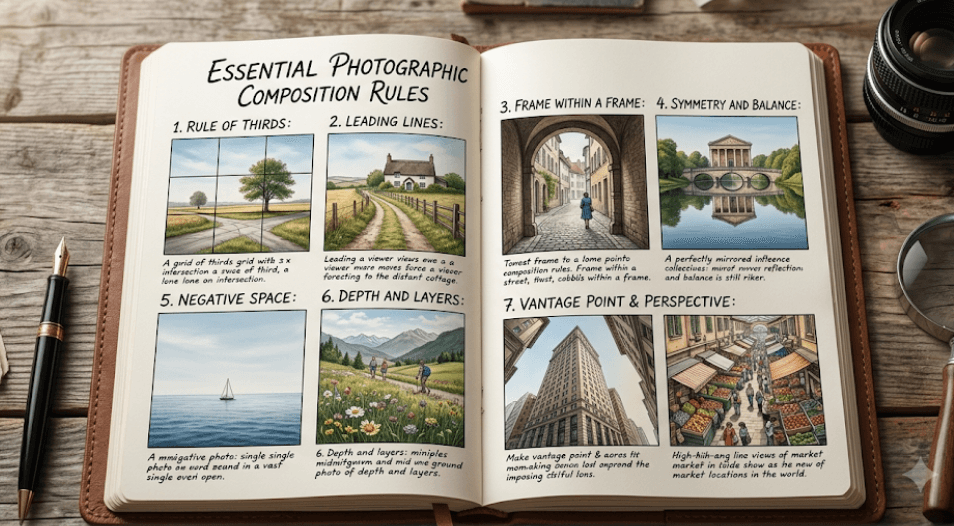
TL;DR Good photography is not always about having the most expensive camera, the sharpest lens, or the highest megapixel count. Composition often has a much bigger impact on how a photo feels because it determines where the subject sits, what the viewer notices first, and how the eye moves through the frame. The rule of thirds, leading lines, framing, negative space, symmetry and balance, patterns, and depth are seven useful techniques that can make everyday photos look more intentional. These are guidelines rather than strict laws, so the goal is to understand what each technique does and then know when to follow or break it.
Why Composition Matters In Photography
Composition is essentially the way you arrange visual elements inside a photograph. Every time you take a picture, you decide what stays inside the frame, what gets left out, where the main subject sits, and how much background or foreground you want to show. These decisions can completely change the image even when you photograph the same subject with the same camera settings. A cluttered background can distract from an otherwise great portrait, while moving a subject slightly to one side can create more breathing room and make the frame feel more natural.
This is why composition is useful for beginners as well as experienced photographers. You do not necessarily need a new camera to improve your photographs. A small change in your shooting position, framing, perspective, or subject placement can sometimes make a bigger difference than changing equipment. Adobe describes composition as a tool for organizing elements within the frame and emphasizes that composition techniques should guide decisions rather than replace creative judgment.
The most important thing is to avoid treating composition rules like mathematical formulas. The rule of thirds, for example, can help you place a subject away from the center, but a centered composition can be more effective when symmetry or a strong central subject is the point of the photograph. Similarly, leading lines are useful only when they help direct attention somewhere meaningful. Good composition is ultimately about controlling the viewer's attention and making the photograph easier to understand.
Composition Rule At A Glance
| Composition Technique | Main Purpose | Useful For |
|---|---|---|
| Rule Of Thirds | Creates balance and visual flow | Portraits, landscapes, street photography |
| Leading Lines | Directs the viewer's eye | Architecture, roads, landscapes |
| Framing | Isolates and emphasizes the subject | Portraits, travel, street photography |
| Negative Space | Creates breathing room | Minimalist photos, portraits |
| Symmetry And Balance | Creates order and visual stability | Architecture, reflections |
| Patterns | Adds rhythm and visual interest | Architecture, nature, products |
| Depth | Makes images feel more three-dimensional | Landscapes, travel, portraits |
1. Use The Rule Of Thirds
The rule of thirds is one of the most widely used composition techniques because it gives photographers an easy starting point for positioning a subject. Imagine dividing the frame with two horizontal and two vertical lines to create nine equal sections. The four points where those lines intersect are often useful locations for placing important elements of the image. Instead of automatically putting the subject directly in the center, you can position it closer to one of these intersections to create a more balanced and dynamic frame.
It is particularly useful when you want to show the subject along with some surrounding context. For example, if you photograph a person standing beside a mountain, placing the person toward one side of the frame can leave room for the landscape. The same idea works for animals, vehicles, buildings, and even products. On many cameras and smartphones, you can turn on gridlines to make this easier while composing the shot. The grid is only a guide, so the subject does not have to sit perfectly on an intersection for the technique to work.
The rule of thirds is also useful for deciding where to place the horizon. In a landscape with a dramatic sky, you may give the sky more space by placing the horizon lower in the frame. If the foreground is more interesting, you can give it greater visual weight instead. However, this is not a rule you have to obey every time. Reflections, strong symmetry, and deliberately centered subjects can work better with a central horizon.
When To Break The Rule
Use the rule of thirds when you want an easy way to create balance, but do not force every photograph into the grid. A centered portrait, for example, can feel powerful when the subject is symmetrical or when you want the viewer's attention to land immediately in the middle. Adobe also emphasizes that the rule of thirds is a guideline rather than a strict rule and that experienced photographers may deliberately move away from it.
2. Look For Leading Lines
Leading lines are visual elements that guide the viewer's eye through a photograph toward a subject or another important part of the scene. They can be obvious, such as roads, railway tracks, bridges, fences, or staircases, but they can also be subtle. Rows of trees, shadows, architectural edges, walls, or even people arranged in a particular direction can create lines that influence how the viewer moves through the image.
The direction of the line can also influence the feeling of a photograph. Vertical lines can emphasize height and strength, while diagonal lines can create a stronger feeling of movement or depth. Converging lines are particularly useful for showing distance because they appear to move toward a point farther into the scene. A road disappearing toward the horizon is a simple example, but you can find the same effect in corridors, buildings, bridges, and rows of streetlights.
The important part is where the line leads. A beautiful road cutting through a landscape may look interesting, but if it directs the viewer's attention toward an empty or distracting part of the frame, it may weaken the composition. Before pressing the shutter, look at the entire path created by the line and ask where your eyes naturally travel. If it eventually leads toward your subject, the composition becomes much stronger.
Try Different Angles
Do not assume you have to photograph a leading line from eye level. Move sideways, get lower, or change your distance from the subject. A staircase photographed from below can create a completely different visual effect from the same staircase photographed from the top. Small changes in perspective can alter the direction and strength of the lines within your frame.
3. Use Natural Framing
Framing means using elements within a scene to surround or partially surround your main subject. A doorway, window, arch, tree branches, curtains, foliage, or even objects in the foreground can create a natural frame. Instead of allowing the subject to compete equally with everything else in the photograph, framing helps separate it from the surrounding environment and gives the viewer a clearer visual destination.
This technique is especially useful in travel and street photography because interesting frames are often already present in the environment. Imagine photographing someone standing inside an old doorway or capturing a landscape through a window. The frame adds context while simultaneously directing attention toward the subject. It can also create a sense of depth because the framing element may sit closer to the camera while the subject occupies a different distance.
However, natural framing should not become another source of clutter. If the foreground element is too bright, sharp, or visually dominant, it can compete with the subject instead of supporting it. Look for framing elements that guide attention without completely taking over the photograph. You can also use focus and depth of field to make the frame less distracting when your camera and lens allow it.
Frame Without Overcrowding
A good frame does not necessarily have to surround the subject on all four sides. Even a branch entering from the top corner or a doorway covering one side of the image can be enough. The objective is not to create a literal border but to use the environment to help control where the viewer looks.
4. Give Your Subject Negative Space
Negative space is the relatively empty area surrounding a subject. It can be a plain wall, open sky, water, a large patch of grass, or another simple background. Instead of filling every part of the frame with information, negative space gives the main subject room to stand out. This can make a photograph feel cleaner, calmer, and more deliberate.
Negative space is particularly effective for portraits and minimalist photography. If a person is looking or moving toward one side of the frame, leaving space in front of them can make the image feel more natural because there is room for the implied direction of their gaze or movement. Nikon similarly recommends leaving more space in the direction a person or moving subject is facing or traveling.
The technique also works well for photographs intended for digital content. A clean area beside a product or person can create useful visual breathing room and prevent the image from feeling cramped. That does not mean empty space is automatically better. The space should support the subject rather than make the photograph feel accidentally unfinished. If there is too much unused area without a reason, the subject may become visually insignificant.
Let Empty Space Do The Work
When composing a photograph, try taking one version that fills the frame and another that leaves considerably more space around the subject. Comparing the two can help you understand how negative space changes the mood. Minimalist photography often relies heavily on this approach because removing unnecessary elements makes the remaining subject more important.
5. Create Symmetry And Balance
Symmetry occurs when elements on opposite sides of an image mirror or closely balance each other. Architecture is one of the easiest places to find it because buildings often contain repeated windows, doors, columns, and geometric structures. Reflections can also create symmetrical compositions by mirroring a landscape, building, or person across a relatively calm surface.
Symmetry can make a photograph feel organized and controlled, but balance does not always require identical elements on both sides. Asymmetrical balance works by using elements with different sizes, positions, colors, tones, or visual weights to create stability. Adobe's Lightroom Academy identifies symmetrical, asymmetrical, and radial balance as distinct approaches to photographic composition.
For example, a person standing on one side of a large frame can be balanced by a bright window, tree, or architectural feature on the opposite side. The two elements do not need to look alike. What matters is how strongly they attract attention. This is why visual balance can be more useful than simply asking whether both sides of the photograph look the same.
Centered Composition Can Work
Do not automatically move every subject away from the center because you have learned the rule of thirds. A perfectly centered building, reflection, doorway, or portrait can be more effective when symmetry is the visual idea. The important thing is to make the placement intentional rather than centering the subject simply because you did not consider other options.
6. Use Patterns And Break Them
Patterns give photographs rhythm through repetition. Repeated windows, tiles, leaves, flowers, chairs, buildings, waves, or other shapes can create visual consistency that makes a scene more interesting. You do not necessarily need an unusual subject to make a strong photograph. Sometimes the way ordinary objects repeat across the frame is enough to create a compelling composition.
The more interesting opportunity comes when the pattern is interrupted. Imagine a row of identical objects with one item that is a different color or shape. That interruption immediately creates a visual point of interest. Your eye naturally notices the element that does not follow the pattern, which means you can use repetition to establish consistency and then use contrast to create emphasis.
You can find patterns almost anywhere once you start looking for them. Architectural details are particularly useful because buildings often contain repeated geometric shapes. Nature offers another huge range of possibilities, from leaves and flowers to tree trunks and rock formations. Move closer to isolate the pattern instead of automatically photographing the entire scene.
Search For The Odd One Out
When you find a repeating pattern, take two photographs. First, capture the pattern as consistently as possible. Then look for a different element that interrupts it. The second version will often have a stronger focal point because the viewer has an obvious visual difference to discover.
7. Build Depth Into Your Photos
Depth helps a two-dimensional photograph feel more immersive by creating a stronger relationship between foreground, middle ground, and background. Instead of placing the subject against a flat backdrop, look for elements at different distances from the camera. A person in the foreground, a road in the middle ground, and mountains in the background can create a much stronger sense of space than a flat composition with everything appearing at roughly the same distance.
Changing your perspective is one of the simplest ways to improve depth. Moving closer to a foreground object can make it appear larger and create a stronger relationship between near and distant elements. Leading lines can also contribute to depth by pulling the eye from the foreground toward the background.
Depth does not require a professional camera. Smartphones can create it through perspective, layering, and computational photography, while interchangeable-lens cameras can also use depth of field to separate subjects from backgrounds. Adobe notes that shallow depth of field can help direct attention toward a main subject, but composition still matters because the background should support rather than compete with the subject.
Think In Three Layers
Before taking a landscape or travel photograph, look for something interesting in the foreground, something important in the middle, and something that completes the scene in the background. You do not need all three layers in every photograph, but deliberately searching for them can prevent flat-looking images and give your photographs a stronger sense of scale.
How To Combine Composition Rules
The real improvement happens when you stop using composition techniques independently and start combining them. A portrait can use the rule of thirds to position the person, negative space to leave room in front of their face, and natural framing to separate them from a busy environment. A landscape can combine leading lines, a foreground element, and the rule of thirds to create a clear path through the scene.
You should also remember that composition is not something you have to finish entirely in the camera. Cropping can improve the placement of a subject, while straightening can correct a distracting horizon. Adobe notes that photographers can use cropping and other post-processing tools to refine composition after the photograph has been captured.
The biggest mistake is trying to force every technique into every photograph. If you notice a beautiful symmetrical building, symmetry may be the strongest choice. If you find a winding road through a landscape, leading lines may naturally become the main technique. Good composition begins with noticing what the scene already offers and then choosing the technique that helps communicate it most effectively.
A Simple Composition Checklist
| Before You Shoot | Ask Yourself |
|---|---|
| Subject | What is the main thing I want viewers to notice? |
| Placement | Would the rule of thirds improve the balance? |
| Background | Is anything distracting from the subject? |
| Lines | Do roads, walls, shadows, or objects lead the eye? |
| Space | Does the subject need more breathing room? |
| Balance | Does one side of the frame feel too heavy? |
| Depth | Can I add foreground, middle ground, or background? |
Common Composition Mistakes To Avoid
One common mistake is putting the subject in the center of every photograph without considering the surrounding space. Centered compositions can absolutely work, but they should be a deliberate choice. Another problem is ignoring the background. A portrait can have perfect subject placement and still look messy if a pole, branch, or bright object appears to grow out of the person's head. Taking a second to scan the edges and background can prevent many avoidable distractions.
Another mistake is believing that more information automatically makes a photograph better. A frame filled with people, objects, colors, and textures can become difficult to read. Negative space, simple backgrounds, and tighter framing can sometimes produce a stronger image because the viewer immediately understands what matters. This is particularly important in minimalist photography, where removing unnecessary elements is central to the visual approach.
Finally, do not become so focused on following rules that you stop experimenting. Photography composition is not a checklist that every successful photograph must satisfy. Nikon and Adobe both present composition techniques as useful starting points while acknowledging that photographers can break them when the image benefits from a different approach.
Mistakes And Better Alternatives
| Common Mistake | Better Approach |
|---|---|
| Centering every subject | Try thirds, symmetry, or intentional centering |
| Ignoring the background | Scan the entire frame before shooting |
| Cutting off movement space | Leave room in the direction of movement |
| Using leading lines randomly | Make sure they guide attention somewhere useful |
| Filling every part of the frame | Experiment with negative space |
| Following rules rigidly | Break them when the scene calls for it |
Final Recommendation
The seven composition techniques in this guide are most useful when you treat them as tools rather than restrictions. Start with the rule of thirds because it gives you an easy way to rethink subject placement. Then practice finding leading lines, using natural frames, leaving negative space, recognizing symmetry and visual balance, spotting patterns, and creating depth through different layers of a scene. You do not need to master everything at once. Pick one technique during a photo walk and deliberately look for opportunities to use it.
The most important habit is to pause before pressing the shutter. Ask what your subject is, whether anything is distracting from it, where your eye goes first, and whether moving a few steps or changing your angle would improve the frame. That small pause can make a noticeable difference, especially when you are photographing everyday subjects with a smartphone.
Ultimately, great composition is less about memorizing seven rules and more about learning to see. Once these techniques become familiar, you will start noticing lines, patterns, empty space, balance, and depth before you even raise the camera. Learn the guidelines, practice them repeatedly, and then experiment with breaking them when your photograph benefits from it. That is what turns composition from a technical exercise into a creative skill.
Frequently Asked Questions
Q. What is composition in photography?
Composition is the way visual elements are arranged within a photograph. It determines where the subject appears, how much background is included, and how the viewer's eye moves through the frame. Good composition can make an image feel more balanced, intentional, and easier to understand.
Q. What is the rule of thirds in photography?
The rule of thirds divides the frame into nine sections using two horizontal and two vertical lines. Placing important subjects near the lines or their intersections can create a balanced and visually engaging composition. It is a guideline rather than a strict rule.
Q. How do leading lines improve a photo?
Leading lines guide the viewer's eye through the photograph toward a subject or another important area. Roads, railways, buildings, fences, shadows, and rows of objects can all act as leading lines.
Q. What is negative space in photography?
Negative space is the relatively empty area surrounding a subject. It can help isolate the subject, reduce distractions, and create a cleaner or more minimalist composition.
Q. Should the subject always be placed according to the rule of thirds?
No. The rule of thirds is a composition guideline, not a requirement. Centered compositions can work particularly well for symmetry, reflections, architecture, and subjects where the center of the frame is intentionally important.
Q. How can I use framing in photography?
You can use windows, doors, arches, foliage, branches, or other objects around a subject to create a natural frame. The technique can help separate the subject from its surroundings and direct attention toward it.
Q. What is visual balance in photography?
Visual balance is the way different elements distribute attention or visual weight across a frame. It can be symmetrical, where elements mirror each other, or asymmetrical, where different elements balance one another through size, position, color, tone, or shape.
Q. How do patterns improve photo composition?
Patterns create repetition through shapes, colors, textures, or objects. They can become more interesting when the pattern is interrupted by a different element, giving the viewer a clear point of focus.
Q. How can I add depth to my photographs?
Look for foreground, middle-ground, and background elements and use perspective to show their relationship. Leading lines, overlapping subjects, and changes in camera position can also strengthen the feeling of depth.
Q. Do I need a professional camera to use composition rules?
No. Composition principles work with smartphones, compact cameras, mirrorless cameras, and DSLRs. Changing your position, framing, subject placement, and perspective can improve a photograph regardless of the camera you use.
Ready to upgrade your tech?
Browse our collection of quality refurbished products at unbeatable prices.