
Which Sony A6000-Series Camera Is Best for Wildlife/Sports?
The Sony A6700 is the best A6000-series camera for wildlife and sports in 2026, thanks to advanced subject recognition, 11fps shooting, 5-axis stabilization, and strong battery life.

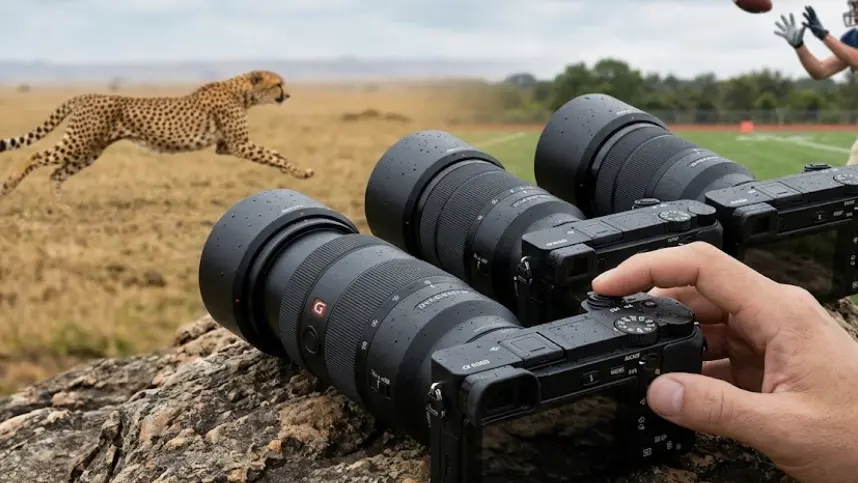
TL;DR The Sony A6700 is the best A6000-series camera for wildlife and sports in 2026 because it combines an advanced 26MP APS-C sensor, 759-point phase-detection autofocus, AI-based subject recognition, animal and bird Eye AF, 11fps continuous shooting with AF and AE tracking, and 5-axis in-body image stabilization. The older Sony A6600 remains an excellent alternative if you find it at a significantly lower price, particularly because it also offers 11fps shooting, animal Eye AF, IBIS, and Sony's larger NP-FZ100 battery. The A6400 and A6100 are more affordable choices with 11fps shooting and animal Eye AF, but they lack in-body stabilization. The original A6000 is still capable of 11fps bursts, but its older autofocus system makes it much less attractive for demanding wildlife and sports work in 2026.
Why The A6000 Series Works For Action
Wildlife and sports photography place very different demands on a camera than portraits or landscapes. You are often working with subjects that change direction quickly, move toward or away from the camera, and appear only briefly in the frame. A useful action camera therefore needs more than a high megapixel count. Autofocus tracking, continuous shooting, viewfinder responsiveness, buffer capacity, and lens selection all affect how consistently you can capture the decisive moment. Sony's A6000-series bodies are particularly interesting because even several older models can shoot at up to 11 frames per second, while newer generations significantly improve subject recognition and tracking.
The APS-C sensor format is another advantage for wildlife photographers because the smaller sensor provides a narrower field of view with compatible lenses compared with full-frame cameras. That does not magically increase the lens's actual focal length, but it can make a telephoto setup useful for subjects that are far away. A 300mm lens on an APS-C body gives an angle of view equivalent to roughly 450mm on full frame, which can be useful when photographing birds or animals without carrying an extremely long full-frame lens. The real benefit depends on the lens, shooting distance, light, and how much cropping you need to do afterward.
The important distinction between the different A6000-series generations is therefore not simply the maximum burst speed. The A6000 can already reach 11fps, and the A6100, A6400, A6500, A6600, and A6700 can also reach 11fps in their respective high-speed modes. What changes considerably is how effectively the camera identifies and follows the subject, how well it performs in difficult conditions, whether the body has stabilization, and how much battery and buffer capacity you get. For wildlife and sports, these differences can matter more than a small change in megapixel count.
Sony A6000-Series Models Compared
Autofocus And Burst Shooting
The Sony A6000 was already a fast camera for its generation, with a 24.3MP APS-C sensor and continuous shooting of up to 11fps. However, its autofocus technology is much older than what Sony introduced in later A6000-series models. The A6100 moved the series forward with 425 phase-detection and 425 contrast-detection AF points, Real-time Tracking, and Real-time Eye AF for animals. It can also shoot at up to 11fps with AF/AE tracking in Hi+ mode. That makes the A6100 a much more sensible starting point than the original A6000 if wildlife or sports is the primary reason for buying.
The A6400 offers a similar 11fps maximum burst rate but has a more advanced autofocus system than the original A6000. Sony also added Real-time Eye AF for animals through firmware update 2.00, although Sony notes that animal eye detection can depend on the animal, environment, and movement. The A6600 also shoots at up to 11fps with AF/AE tracking and adds animal Eye AF, making it particularly attractive for wildlife photographers who want a mature body without moving to the latest generation.
The A6700 takes the biggest step forward because its autofocus system combines 759 phase-detection points with a dedicated AI processor and Real-time Recognition. Sony lists recognition for humans, animals, birds, insects, cars, trains, and airplanes. For wildlife and sports, that broader recognition system is useful because the camera can identify subjects instead of relying only on a conventional focus-area approach. The A6700 still tops out at 11fps, but its advantage is how intelligently it can use that shooting speed.
| Camera | Sensor | Max Burst | Animal AF | IBIS | Wildlife/Sports Position |
|---|---|---|---|---|---|
| Sony A6000 | 24.3MP APS-C | 11fps | No advanced animal Eye AF | No | Budget/older option |
| Sony A6100 | 24.2MP APS-C | 11fps | Yes | No | Affordable action option |
| Sony A6400 | 24.2MP APS-C | 11fps | Yes, via firmware | No | Strong value option |
| Sony A6500 | 24.2MP APS-C | 11fps | Older AF system | Yes, 5-axis | Older stabilized option |
| Sony A6600 | 24.2MP APS-C | 11fps | Yes | Yes, 5-axis | Strong older-generation choice |
| Sony A6700 | 26MP APS-C | 11fps | Yes, advanced recognition | Yes, 5-axis | Best overall |
Why The A6700 Is The Best Choice
The A6700 is the most complete A6000-series camera for wildlife and sports because it improves the parts of the camera that matter most when subjects are moving unpredictably. Its 26MP APS-C sensor is paired with the BIONZ XR processor and a dedicated AI processor, while autofocus uses up to 759 phase-detection points for still images. Sony also lists recognition for animals and birds, which makes the A6700 better equipped for wildlife photography than the earlier cameras in this family.
The camera also has 5-axis in-body image stabilization rated at up to 5 stops under Sony's stated CIPA conditions. IBIS does not freeze a moving animal or athlete, so it should not be treated as a substitute for a fast shutter speed. Instead, it helps reduce camera shake when you are shooting handheld, particularly with static or slower subjects and when using longer lenses. For wildlife photographers who spend hours carrying a camera and telephoto lens, having stabilization built into the body can also make the system more flexible because compatible lenses do not always need to provide their own stabilization.
Battery performance is another area where the A6700 has an advantage over the older small-battery A6000-series bodies. Sony rates the A6700 for approximately 550 shots using the viewfinder or 570 shots using the LCD under CIPA testing. The A6600 is rated even higher at approximately 720 shots through the viewfinder or 810 shots using the LCD, so the older model still has a meaningful battery-life advantage. For long wildlife outings, however, the A6700's combination of modern autofocus, stabilization, and NP-FZ100 battery makes it the more capable overall platform.
A6600 Is The Best Older Alternative
The Sony A6600 deserves serious attention if you do not need the A6700's newer AI-based autofocus system. It uses a 24.2MP APS-C sensor and can shoot at up to 11fps with AF/AE tracking. Sony also gives it Real-time Eye AF for animals, making it considerably more suitable for wildlife than the original A6000. For a photographer who mainly shoots birds, mammals, pets, or outdoor sports and finds a discounted A6600 body, it can still provide a very capable shooting experience.
Its biggest practical advantage is the combination of animal Eye AF, 5-axis IBIS, and the NP-FZ100 battery. Sony rates the A6600 at approximately 720 shots using the viewfinder and 810 shots using the LCD under CIPA testing. That is a substantial advantage for photographers who spend long periods away from a charger. The camera also supports up to 11fps continuous shooting, so the basic burst-speed requirement for action is already covered.
The limitation is that its autofocus system does not have the A6700's dedicated AI processor and broader subject-recognition capabilities. The A6700 can recognize animals and birds among a wider list of subjects, while the A6600's animal Eye AF is an older-generation implementation. Sony also notes limitations for animal Eye AF, including that it does not work with all types of animals. If the price difference between the two cameras is small, the A6700 is easier to recommend because its newer tracking system gives you more room to grow.
A6400 And A6100 Offer Better Value
The A6400 and A6100 make sense for photographers who want to spend less while still getting the core features required for action photography. Both can shoot at up to 11fps, and both have modern autofocus features compared with the original A6000. The A6100 has 425 phase-detection and 425 contrast-detection points and supports Real-time Eye AF for animals in still photography. Sony specifically positions its 11fps AF/AE tracking as suitable for moving subjects.
The A6400 is particularly interesting because Sony added Real-time Eye AF for animals through firmware version 2.00. It also has 11fps continuous shooting with AF/AE tracking and a more advanced tracking system than the original A6000. For someone buying used equipment, this makes the A6400 one of the most sensible older bodies to consider for wildlife and sports, especially when paired with a good telephoto lens.
Neither camera has in-body image stabilization, however, so lens choice becomes more important. A stabilized telephoto lens can compensate for some of this limitation, but the camera body itself does not provide the five-axis stabilization found in the A6500, A6600, and A6700. If you regularly shoot handheld with long lenses, the A6600 or A6700 is therefore a stronger long-term choice. If your priority is keeping the initial cost down while retaining fast autofocus and 11fps shooting, the A6100 or A6400 can still be excellent value.
| Model | Best For | Main Strength | Main Limitation |
|---|---|---|---|
| A6700 | Serious wildlife and sports | AI subject recognition and IBIS | Higher cost |
| A6600 | Wildlife on a budget | Battery, animal AF and IBIS | Older AF technology |
| A6400 | Value-focused action | AF and 11fps | No IBIS |
| A6100 | Beginners | AF, animal Eye AF and 11fps | No IBIS |
| A6500 | Used-market buyers | IBIS and large buffer | Older autofocus |
| A6000 | Basic action photography | Low-cost 11fps shooting | Oldest AF system |
Lens Choice Matters More Than The Body
Even the best A6000-series body cannot compensate for a lens that is too short or too slow for the subject. Wildlife photography often requires significant reach because approaching an animal is not always possible or desirable. A 70-350mm-class lens on an APS-C body is a more practical starting point for many wildlife photographers than the basic 16-50mm kit lens. Sports photographers may need a different balance depending on whether they are shooting from the side-lines, in a stadium, or close to the action.
Image stabilization is also worth considering when choosing the lens. The A6100 and A6400 do not have IBIS, so pairing them with an optically stabilized telephoto lens can be particularly useful for handheld shooting. The A6600 and A6700 have five-axis IBIS, but stabilization still does not freeze subject movement. If a bird suddenly takes flight or a football player sprints across the frame, shutter speed remains critical. The camera and lens should therefore be treated as one system rather than buying the most expensive body and adding a basic lens.
For wildlife and sports, aperture can also be more important than simply buying the longest lens available. A faster lens can help you maintain a sufficiently high shutter speed when light levels fall, although larger-aperture telephoto lenses are typically more expensive and heavier. This is why the A6700 is best viewed as the strongest body in the series rather than automatically the best complete kit for every photographer. Your final results depend heavily on the lens, shooting technique, light, and distance from the subject.
Common Buying Mistakes To Avoid
One common mistake is choosing a camera based only on its maximum frames-per-second number. The A6000 already reaches 11fps, so focusing only on burst speed could make it seem comparable to the A6700. In practice, autofocus intelligence, subject recognition, buffer behaviour, stabilization, and battery life all influence how useful those frames are. The A6700's 11fps is therefore not impressive simply because of the number itself. Its greater advantage is the autofocus and recognition technology supporting that shooting speed.
Another mistake is assuming that animal Eye AF guarantees perfect focus on every wildlife subject. Sony explicitly notes limitations with animal recognition. The A6100's animal Eye AF, for example, supports still images and does not work with some types of animals, while the A6400's firmware documentation also warns that detection can depend on the environment, animal type, and movement. Photographers should therefore still understand AF-C, focus areas, shutter speed, and subject positioning rather than expecting the camera to solve every focusing problem automatically.
Finally, do not spend the entire budget on the camera body. A well-chosen telephoto lens can have a larger effect on wildlife photography than moving from one older body to another. If you are deciding between an A6600 with a suitable telephoto lens and an A6700 paired with a basic kit lens, the first combination can sometimes be more useful depending on the shooting situation. The best purchase is therefore the complete camera system that gives you the reach, autofocus, stabilization, and light-gathering ability your subjects require.
Frequently Asked Questions
Q. Which Sony A6000-series camera is best for wildlife photography?
The Sony A6700 is the best overall choice because it combines 26MP resolution, 11fps continuous shooting, 759 phase-detection AF points, animal and bird recognition, and 5-axis IBIS.
Q. Which Sony A6000-series camera is best for sports photography?
The A6700 is the strongest option because its advanced tracking and subject recognition complement its 11fps continuous shooting. The A6600 is a good lower-cost alternative if you find one at a substantially lower price.
Q. Is the Sony A6600 still good for wildlife in 2026?
Yes. The A6600 still offers 11fps shooting, animal Eye AF, 5-axis stabilization, and the larger NP-FZ100 battery. Its main disadvantage is that its autofocus technology is older than the A6700's AI-assisted system.
Q. Is the Sony A6400 good for wildlife photography?
Yes. The A6400 can shoot at up to 11fps with AF/AE tracking and received Real-time Eye AF for animals through firmware version 2.00. It does not have in-body image stabilization.
Q. Does the Sony A6100 have animal Eye AF?
Yes. Sony states that the A6100 supports Real-time Eye AF for animals as well as humans. Animal Eye AF is for still images and has limitations with certain animals and shooting situations.
Q. Is the original Sony A6000 still good for sports?
The A6000 can still shoot at up to 11fps, so it remains capable of basic action photography. However, its older autofocus system and lack of advanced animal Eye AF and IBIS make newer models more attractive for demanding wildlife and sports work.
Q. Does the Sony A6700 have image stabilization?
Yes. The A6700 uses five-axis sensor-shift image stabilization, with Sony rating the compensation at up to 5 stops under specified CIPA testing conditions.
Q. Does the Sony A6700 have bird autofocus?
Yes. Sony lists bird recognition among the A6700's still-image subject-recognition targets, alongside humans, animals, insects, cars, trains, and airplanes.
Q. Is 11fps enough for wildlife and sports photography?
Yes, 11fps can be very useful for action photography, particularly when combined with effective AF tracking. However, burst speed alone does not determine success. Autofocus performance, shutter speed, lens reach, buffer capacity, and timing all affect the final images. The A6700 combines 11fps with advanced recognition and tracking.
Q. Should you buy the A6700 or an older A6000-series camera?
Choose the A6700 if wildlife or sports is a serious priority and the budget allows it. Consider the A6600, A6400, or A6100 when the lower price allows you to invest more in a suitable telephoto lens, because lens reach and aperture remain critical for action photography.
Final Recommendation
The Sony A6700 is the best Sony A6000-series camera for wildlife and sports in 2026. Its 26MP APS-C sensor, 759 phase-detection AF points, AI-assisted subject recognition, animal and bird recognition, 11fps continuous shooting, and 5-axis IBIS give it the most complete action-focused package in the series. Sony also supports AF recognition for several moving subjects, making the camera considerably more versatile than the older generations.
The Sony A6600 is the best older-generation alternative if you find it at a significantly lower price. Its 11fps shooting, animal Eye AF, five-axis stabilization, and excellent NP-FZ100 battery life still make it a highly capable wildlife camera. The A6400 and A6100 are the better value choices when budget matters more, while the original A6000 should mainly be considered when the price is very low and your expectations are modest.
For wildlife and sports, however, the final decision should not stop at the body. Put enough of your budget toward a suitable telephoto lens, because reach, aperture, stabilization, and autofocus compatibility can make a major difference to the images you actually capture. If you want the most capable body and plan to keep the camera for several years, buy the A6700. If you want to save money and put more into the lens, a discounted A6600 or A6400 can still be a smart choice.
Ready to upgrade your tech?
Browse our collection of quality refurbished products at unbeatable prices.






