Used Sony A7 III Buying Guide: Is It Still a Smart Purchase in 2026?
The used Sony A7 III remains a capable full-frame camera in 2026, with a 24.2MP sensor, strong autofocus, 10fps shooting, IBIS, and 4K video. Its age makes condition and price more important than ever.

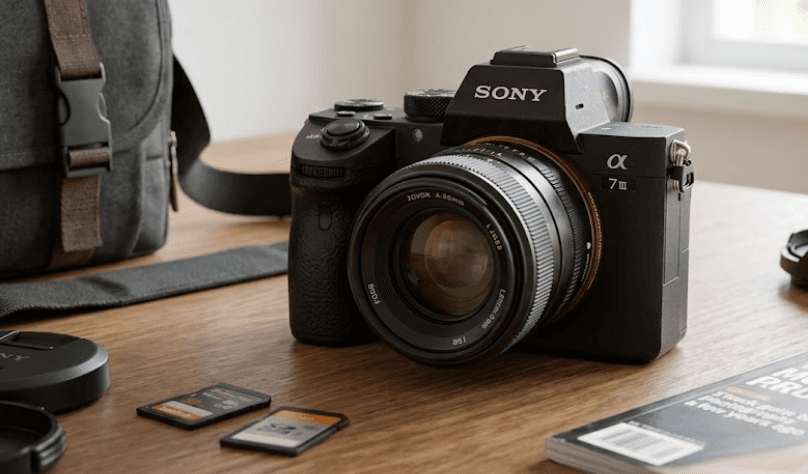
TL;DR The used Sony A7 III is still a capable full-frame camera in 2026, particularly for photographers who want strong image quality, dependable autofocus, in-body stabilization, and a mature Sony E-mount lens ecosystem without paying for a newer body. Sony launched the A7 III in 2018, but its 24.2MP full-frame BSI sensor, 693 phase-detection AF points, 10fps continuous shooting, 5-axis stabilization, dual card slots, and 4K recording remain useful today. The bigger consideration in 2026 is not whether the A7 III can produce good photographs, because it clearly can, but whether the condition and price of a used unit make sense compared with newer cameras. Sony has since moved the A7 line forward, with the A7 V now offering a 33MP sensor, newer processing, AI subject recognition, and much faster shooting. That makes the A7 III a value-focused used purchase rather than a future-facing flagship.
Why The Sony A7 III Still Matters In 2026
The Sony A7 III is now an older camera, but its specifications still make sense for many photography workloads. It uses a 35mm full-frame Exmor R CMOS sensor with approximately 24.2 effective megapixels, supports 14-bit RAW files, and offers an ISO range that extends from ISO 50 to ISO 204800 for still photography when expanded. For portraits, weddings, travel, events, street photography, and general-purpose photography, 24.2MP remains enough resolution for high-quality images and moderate cropping. The full-frame sensor also gives photographers access to the depth-of-field and low-light advantages associated with a larger sensor format. Sony continues to provide support for the camera, with firmware version 4.04 listed as released in April 2026.
The A7 III also avoids several limitations that can make older cameras frustrating to use. It has 693 phase-detection AF points and 425 contrast-detection points, along with Eye AF and tracking features. It can shoot at up to 10 frames per second with autofocus and auto-exposure tracking, which remains useful for moving subjects. Its NP-FZ100 battery is another major advantage. Sony rates the camera at approximately 710 still images when using the LCD or 610 with the viewfinder under CIPA testing. That does not mean every real-world user will achieve exactly those numbers, but it shows that the camera was designed around substantially better battery endurance than earlier A7 generations.
What has changed is the context around the A7 III. In 2026, buyers are no longer comparing it only with other cameras from its launch period. Newer models offer higher resolution, more advanced subject recognition, better video formats, faster processors, and more sophisticated autofocus. Sony's current A7 V, for example, uses a 33MP full-frame sensor, an updated processing system with an AI processing unit, up to 30fps blackout-free shooting with full AF/AE tracking, and up to 16 stops of dynamic range under Sony's stated conditions. The A7 III therefore makes the most sense when its used price creates enough separation from newer cameras.
Sony A7 III Key Specifications
| Feature | Sony A7 III |
|---|---|
| Sensor | 35mm full-frame Exmor R CMOS |
| Effective Resolution | Approx. 24.2MP |
| Autofocus | 693 phase-detection, 425 contrast-detection points |
| Continuous Shooting | Up to 10fps |
| Stabilization | 5-axis sensor-shift stabilization |
| Video | 4K recording, up to 100 Mbps |
| Battery | NP-FZ100 |
| CIPA Battery Rating | Approx. 610 EVF / 710 LCD shots |
| Memory Cards | Dual SD card slots |
| Weight | Approx. 650g with battery and memory card |
Sony's specifications confirm the core hardware, while independent testing from DPReview found the camera's autofocus, image quality, battery life, and 4K output to be major strengths.
Image Quality And Autofocus In 2026
Image quality remains one of the strongest reasons to consider a used Sony A7 III. Its 24.2MP back-illuminated full-frame sensor was a significant improvement over the previous A7 II generation, and the camera records both compressed and uncompressed RAW files. For photographers buying a used body for portraits, weddings, products, travel, or everyday professional work, the sensor provides enough resolution for most normal deliverables without producing unnecessarily large files. This can be particularly useful if you regularly store and edit large RAW libraries because 24MP files require less storage than the higher-resolution files produced by many newer full-frame cameras.
The autofocus system is another area where the A7 III has aged relatively well. Sony specifies 693 phase-detection AF points covering the full-frame image area, supported by 425 contrast-detection points. The camera also includes Eye AF and Lock-on AF, while DPReview found its autofocus system closely related to the technology used in Sony's more advanced A9 at the time. For portraits and moving subjects, that combination remains useful, although newer Sony bodies have significantly more advanced subject-recognition systems. The important distinction is that the A7 III still has a strong conventional autofocus system, but it does not offer the same generation of AI-assisted subject recognition found in Sony's newest cameras.
The 10fps burst rate also helps the A7 III remain relevant for action photography. Sony rates continuous shooting at up to 10fps, and DPReview found that the camera could maintain autofocus and exposure tracking at that rate. That makes it suitable for family events, pets, sports at a moderate level, and other situations where timing is important. However, buyers should not confuse the 10fps figure with the capabilities of current high-end bodies. Newer cameras can offer faster readouts, more sophisticated tracking, and higher burst rates, so the A7 III's advantage in 2026 comes from its combination of adequate speed and lower used-market cost rather than from leading-edge performance.
Video Capabilities And Limitations
The Sony A7 III remains useful for creators who primarily need 4K video rather than the newest professional video formats. Sony specifies XAVC S 4K recording, and the camera can record 4K at up to 25p in the PAL system at 100 Mbps. It can also record Full HD at up to 100p. DPReview found that its 4K/24p footage was oversampled from a wider sensor readout, producing detailed footage, while 4K/30p uses a crop. The camera also includes picture profiles such as S-Log2, S-Log3, and HLG, giving experienced users options for grading and different production workflows.
The A7 III also has useful connections for video work. Sony provides a microphone input, headphone output, HDMI output, USB Type-C connectivity, and a Multi Interface Shoe. That means the camera can be used with an external microphone and headphones for monitoring, which is important for interviews, YouTube production, and small commercial projects. The built-in 5-axis stabilization can also help when shooting handheld, although stabilization performance depends on the lens and shooting conditions. DPReview found the stabilization useful but noted that it was not class-leading compared with some alternatives.
The main limitation is age. The A7 III records 8-bit video, which restricts how aggressively footage can be pushed during color grading compared with newer cameras. It also lacks many of the newer video-oriented features found on current Sony bodies. If your work depends heavily on advanced video workflows, high-frame-rate 4K, modern subject recognition, or extensive post-production flexibility, a newer camera deserves serious consideration. For straightforward 4K content creation, interviews, travel videos, and hybrid photography, however, the A7 III can still be perfectly usable when bought at the right price.
A7 III For Photography And Video
| Area | What The A7 III Offers | 2026 Consideration |
|---|---|---|
| Photography | 24.2MP full-frame RAW | Still capable for most photography |
| Autofocus | 693 phase-detection points | Good, but newer AI AF is more advanced |
| Burst Shooting | Up to 10fps | Useful, but no longer class-leading |
| Stabilization | 5-axis IBIS | Helpful for handheld shooting |
| 4K Video | XAVC S 4K | Still useful for general video |
| Video Bit Depth | 8-bit | Limitation for heavy grading |
| Audio | Mic and headphone ports | Suitable for basic production |
| Card Slots | Dual SD | Useful for backup and overflow |
What To Check Before Buying A Used Sony A7 III
Buying a used Sony A7 III requires more attention to condition than buying a new camera. The model has been available since 2018, so the individual unit matters more than the model name. Start with the physical body and inspect the mount, grip, buttons, dials, screen, hot shoe, card-door mechanism, and battery compartment. Look for signs of impact, corrosion, excessive dust, loose controls, or repairs that have not been properly disclosed. Minor cosmetic marks are not necessarily a problem, but damage around the lens mount, card slots, or sensor area deserves much more attention. The A7 III weighs about 650g with its battery and memory card, so handling it in person can also help you identify loose or abnormal controls.
The shutter count is another useful piece of information, but it should not be the only factor in your decision. A lower shutter count does not automatically mean a camera has been better maintained, while a higher count does not automatically mean it is unusable. Ask for the camera's shutter information where available and consider it alongside the overall condition, service history, and asking price. Test the mechanical shutter, continuous shooting, autofocus, image stabilization, and card writing rather than relying only on the seller's description. Also check that both memory-card slots work, because the A7 III's dual-slot design is one of its practical strengths.
Finally, test the sensor and image files before paying. Take photographs at different apertures against a plain surface to look for unusual marks, check autofocus at different distances, test the LCD and electronic viewfinder, and record a short video clip. Check the USB connection, HDMI output if relevant to your workflow, microphone and headphone ports, and battery behavior. A current Indian used-camera listing checked during research showed how widely prices can vary: one body-only A7 III listing was shown at ₹65,089, while a used body with the 28-70mm kit lens was listed at ₹1,26,000. Both listings were marked sold out when checked, so these should not be treated as a market-wide average.
Used A7 III Inspection Checklist
| Area | What To Check |
|---|---|
| Sensor | Dust, scratches, unusual marks |
| Shutter | Operation and shutter information |
| Autofocus | AF-S, AF-C and Eye AF |
| IBIS | Stabilization works normally |
| Card Slots | Both slots recognize and write to cards |
| LCD | Touch response, brightness and damage |
| EVF | Display clarity and switching |
| Ports | USB, HDMI, microphone and headphone |
| Battery | Charging and abnormal drain |
| Body | Drops, cracks, corrosion and loose controls |
Used Sony A7 III Vs Newer Cameras
The biggest question in 2026 is not whether the A7 III is good, but whether buying an older body is more sensible for your particular workload than spending more on a newer camera. The A7 III still provides a full-frame sensor, 10fps shooting, 5-axis stabilization, dual card slots, and a strong battery. These are meaningful features for photographers who prioritize image quality and reliability over the latest autofocus and video technology. The camera also benefits from Sony's established E-mount system, giving used buyers access to a large range of compatible lenses.
The newer A7 V shows how much the A7 family has progressed. Sony's current model has a 33MP full-frame partially stacked sensor, BIONZ XR2 processing with an integrated AI processing unit, up to 759 phase-detection AF points, blackout-free shooting up to 30fps with full AF/AE tracking, and significantly more advanced video capabilities. Sony India lists the A7 V body at an MRP of ₹2,70,990. That does not make the A7 III obsolete, but it does establish a very different level of performance and pricing for buyers who want the latest technology.
For a used-camera buyer, the gap between these generations can actually be useful. If you mainly photograph people, travel, events, products, or everyday subjects and can find a clean A7 III at a substantial discount, the older camera may cover your needs without requiring you to pay for features you will rarely use. If you need advanced subject recognition, higher resolution, faster readout, modern video formats, or the longest possible ownership horizon, the newer generation becomes more relevant. The decision should therefore be based on the difference in capability and actual price, not simply on the camera's age.
A7 III Vs A Newer Sony Body
| Factor | Used Sony A7 III | Newer Sony A7 V |
|---|---|---|
| Full-Frame Sensor | Yes | Yes |
| Resolution | 24.2MP | 33MP |
| Max Burst | 10fps | Up to 30fps blackout-free |
| AF System | 693 phase-detection points | Up to 759 phase-detection points |
| AI Processing | No dedicated AI processing unit | Yes |
| IBIS | 5-axis | More advanced stabilization |
| Best Reason To Buy | Lower used cost and mature feature set | Newer AF, processing and video features |
Specifications in this table are based on Sony's published specifications for the respective models.
Who Should Buy A Used Sony A7 III In 2026?
The used Sony A7 III makes the most sense for photographers who want to enter full-frame photography without immediately paying for a current-generation body. A portrait photographer can benefit from the full-frame sensor and Eye AF, while a wedding or event photographer can make use of the 10fps burst rate, dual card slots, strong battery, and low-light capability. Travel photographers can also benefit from the relatively compact body, USB charging, stabilization, and large selection of Sony E-mount lenses. These are not theoretical benefits. They are the features that helped make the A7 III such a well-rounded camera when it launched and remain useful today.
It can also work well for someone buying a first serious hybrid camera. The camera provides manual controls, RAW shooting, interchangeable lenses, an electronic viewfinder, stabilization, external microphone and headphone connections, and a broad range of customization options. That gives a learner room to grow rather than forcing an immediate upgrade after learning exposure, autofocus, lenses, and RAW processing. However, buyers should remember that the camera's menus and interface can feel dated compared with newer Sony bodies, and its touchscreen experience is limited by today's standards. DPReview specifically noted the menu complexity and relatively weak touchscreen experience in its review.
The A7 III is less suitable when video is your primary reason for buying the camera or when you specifically need the latest autofocus and subject-recognition technology. Creators working with demanding professional video workflows may find the 8-bit recording limiting, while photographers who regularly shoot fast-moving subjects may benefit from the faster readout and newer tracking capabilities of current models. In those cases, saving money on an older body may not be worth giving up the features that directly affect the work you do.
Common Mistakes When Buying A Used A7 III
One common mistake is buying based only on the camera's reputation. The A7 III has earned a strong reputation because its original combination of image quality, autofocus, battery life, and price was compelling. That does not mean every used A7 III is a good purchase in 2026. A heavily used body with unknown history can be a worse buy than a newer camera with a higher upfront price. The condition of the specific unit, the included accessories, seller reputation, warranty or return policy, and actual asking price should all be considered together.
Another mistake is spending too much on the body and leaving too little for lenses. A full-frame camera is only part of the photography system, and the lens has a major effect on focal length, aperture, background separation, autofocus behavior, and overall image quality. The A7 III uses Sony's E-mount, giving buyers access to a large selection of lenses, but those lenses can become a substantial part of the total cost. A cheaper camera body does not necessarily create a cheaper overall setup if the buyer later needs several expensive lenses.
The third mistake is assuming that newer automatically means dramatically better photographs. Newer cameras can offer meaningful improvements in autofocus, video, processing, stabilization, resolution, and usability, but those improvements do not remove the A7 III's ability to capture high-quality images. For a photographer who mainly shoots portraits, landscapes, travel, products, or events, the A7 III's 24.2MP full-frame sensor can still produce excellent results. The important question is whether the newer features solve a problem you actually have.
Frequently Asked Questions
Q. Is the Sony A7 III still worth buying used in 2026?
Yes, it can still make sense as a used full-frame camera if the unit is in good condition and priced appropriately. Its 24.2MP sensor, 10fps shooting, 5-axis stabilization, dual card slots, strong battery, and capable autofocus remain useful. The main consideration is how its price compares with newer cameras and whether you need their newer autofocus and video features.
Q. Is the Sony A7 III a full-frame camera?
Yes. The A7 III uses a 35mm full-frame Exmor R CMOS sensor measuring approximately 35.6 × 23.8mm and has approximately 24.2 effective megapixels.
Q. How many megapixels does the Sony A7 III have?
The Sony A7 III has approximately 24.2 effective megapixels. It can record 6000 × 4000-pixel images in its full-frame 3:2 setting.
Q. Does the Sony A7 III have image stabilization?
Yes. It uses a 5-axis sensor-shift stabilization system. Sony notes that the compensation effect depends on the lens specifications.
Q. How fast can the Sony A7 III shoot?
The A7 III can shoot at up to 10 frames per second in its Hi+ continuous shooting mode. Sony also lists lower continuous shooting speeds depending on the selected mode.
Q. Is the Sony A7 III good for video?
It remains capable for general 4K video. It supports XAVC S 4K recording and Full HD recording at up to 100p. However, its 8-bit video recording is a limitation compared with newer cameras when extensive color grading is required.
Q. Does the Sony A7 III have dual card slots?
Yes. The camera has two SD memory-card slots. DPReview notes that only one slot supports the faster UHS-II format, while the other is limited to UHS-I speeds.
Q. How good is the Sony A7 III battery life?
Sony rates the A7 III at approximately 610 shots when using the electronic viewfinder and approximately 710 shots when using the LCD under CIPA testing. Actual battery life varies according to settings and usage.
Q. What should I check before buying a used Sony A7 III?
Check the sensor, shutter operation, autofocus, Eye AF, image stabilization, card slots, LCD, electronic viewfinder, battery, USB connection, HDMI port, microphone and headphone ports, and overall body condition. Testing the camera with an actual lens and memory card is preferable to relying only on photographs of the unit.
Q. Is the Sony A7 III better than a newer Sony camera?
The A7 III should not be treated as technically superior to newer Sony models. Newer cameras offer advances in resolution, autofocus, processing, stabilization, video, and subject recognition. The A7 III's main attraction in 2026 is that a well-maintained used unit can provide a mature full-frame feature set at a potentially lower cost. Sony's A7 V, for example, has a 33MP sensor and newer AI-assisted processing and autofocus capabilities.
Final Recommendation
The used Sony A7 III can still be a smart purchase in 2026, but the word "used" is more important than ever. Its 24.2MP full-frame sensor, 693 phase-detection AF points, 10fps continuous shooting, 5-axis stabilization, dual card slots, NP-FZ100 battery, and 4K recording give it a feature set that remains genuinely useful for photography and general hybrid work. Sony's continued support, including firmware 4.04 released in April 2026, also confirms that the camera has not simply disappeared from the company's support ecosystem.
The key is to avoid paying a premium simply because the A7 III has a strong reputation. In 2026, it is an older-generation camera, and Sony's newer A7 V demonstrates how far autofocus, processing, resolution, stabilization, and video capabilities have moved forward. If your work does not require those newer features, a clean A7 III can still provide a strong full-frame foundation. If you need advanced subject recognition, higher resolution, faster readout, or modern video capabilities, spending more on a newer body may be more appropriate.
For a used purchase, prioritize condition, shutter history, sensor condition, functionality, included accessories, seller reliability, warranty or return protection, and the actual price rather than buying solely because the model is popular. A well-maintained A7 III at the right price can still be a capable camera for years, while an overpriced or poorly maintained unit can remove much of the value that makes buying used attractive.