Sony ZV-E10 vs Canon 200D Mark II: Best Beginner Vlogging Camera
Sony ZV-E10 vs Canon 200D II comes down to creator-focused video features versus traditional DSLR versatility. Compare their video, autofocus, audio, battery, design, and lenses to find the better beginner vlogging camera.

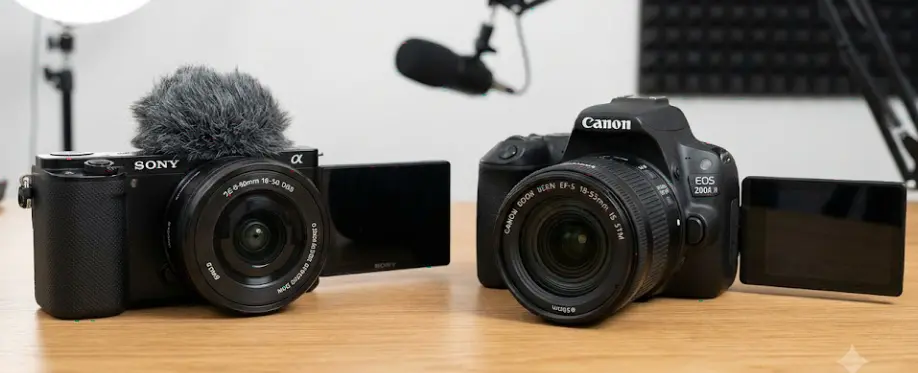
TL;DR Sony ZV-E10 vs Canon 200D Mark II is a comparison between a camera designed specifically around content creation and a lightweight DSLR built for general photography and video. The Sony ZV-E10 is the stronger choice for beginner vloggers because it offers a 24.2MP APS-C sensor, 4K video up to 30p, fast hybrid autofocus with 425 phase-detection and 425 contrast-detection points, a side-opening vari-angle screen, a dedicated microphone input, a headphone output, and features such as Product Showcase Setting and Background Defocus. The Canon EOS 200D II also has a 24.1MP APS-C sensor, a vari-angle touchscreen, Dual Pixel CMOS AF in Live View, and 4K recording, but its 4K mode uses the central portion of the sensor and switches to contrast-detection autofocus. Canon is lighter than many traditional DSLRs but still weighs around 654g with battery and memory card, compared with about 343g for the Sony. For a beginner whose main goal is YouTube, Instagram, travel videos, or talking-head content, the Sony ZV-E10 is the more practical long-term choice.
Sony ZV-E10 vs Canon 200D II: Key Differences
The Sony ZV-E10 and Canon EOS 200D II may look like reasonable alternatives for a beginner, but they approach the camera experience very differently. The Sony is a mirrorless interchangeable-lens camera created with vloggers and creators in mind, while the Canon is a DSLR designed to balance photography, everyday shooting, and video. Both use APS-C sensors and deliver around 24 megapixels for still photography, so image resolution alone does not separate them. The bigger differences appear when you start recording yourself, changing focus while speaking, monitoring audio, or carrying the camera for several hours. Sony's 343g body is dramatically lighter than Canon's approximately 654g weight with battery and memory card, which becomes noticeable when the camera is mounted on a small tripod or held at arm's length for a vlog.
The Sony ZV-E10 uses a 24.2MP APS-C Exmor CMOS sensor measuring approximately 23.5 x 15.6mm. It has no built-in electronic or optical viewfinder, because Sony designed the camera around its LCD and creator workflow. The Canon EOS 200D II uses a 24.1MP APS-C CMOS sensor and includes an optical pentamirror viewfinder with 95% coverage. That makes the Canon more familiar to someone coming from traditional photography, particularly if they prefer composing through a viewfinder. For a person who primarily takes photographs outdoors, that can still be useful. For someone recording themselves, however, the absence of a viewfinder on the Sony is hardly a disadvantage because the fully articulating display is much more relevant to framing a talking-head shot.
The basic specifications make the positioning clear. Sony gives you a smaller and lighter body with creator-focused controls, while Canon gives you the traditional DSLR experience and a built-in optical viewfinder. Neither camera is automatically better for every beginner. The important question is what you expect to shoot. If your priority is photography with occasional video, the Canon remains a sensible entry-level DSLR. If you are buying primarily to vlog, the Sony's design choices make much more sense because its controls, screen, autofocus, audio connections, and video functions are built around that workflow rather than added as secondary features.
| Feature | Sony ZV-E10 | Canon EOS 200D II |
|---|---|---|
| Camera Type | Mirrorless | DSLR |
| Sensor | 24.2MP APS-C | 24.1MP APS-C |
| 4K Video | Up to 30p | Up to 25p |
| Autofocus | 425-point phase + 425-point contrast AF | Dual Pixel CMOS AF in Live View |
| 4K Autofocus | Hybrid AF | Contrast detection |
| Screen | 3-inch vari-angle touchscreen | 3-inch vari-angle touchscreen |
| Viewfinder | None | Optical pentamirror |
| Weight | Approx. 343g | Approx. 654g |
| Microphone Input | Yes | Yes |
| Headphone Output | Yes | No |
| Best For | Vlogging and content creation | Photography and general use |
Video Quality And Vlogging Performance
Video is where the Sony ZV-E10 creates the biggest gap in this comparison. The camera can record 4K at 30p, 25p, or 24p using XAVC S, while Full HD recording goes up to 120p in NTSC mode. That gives beginners considerably more flexibility when they start experimenting with slow-motion footage or different frame rates. Sony also provides movie-focused features such as Product Showcase Setting and Background Defocus, which are useful when the camera is being used for demonstrations, talking-head videos, or product content. These features are not simply higher numbers on a specification sheet. They reduce the amount of manual adjustment a new creator needs to make before pressing record.
The Canon EOS 200D II also supports 4K recording, so it would be inaccurate to describe it as a Full HD-only camera. It can record 3840 x 2160 video at 23.98p or 25p, depending on the recording system. The important limitation is that 4K uses the central area of the image sensor, producing a substantial crop compared with Full HD recording. Canon's documentation also states that autofocus during 4K recording uses contrast detection rather than the Dual Pixel CMOS AF system available in other Live View modes. For a beginner trying to hold the camera at arm's length, that crop can make a normal kit lens feel much less wide, which is one of the biggest practical disadvantages for vlogging.
Sony's video-focused design therefore makes more sense for someone who expects to record themselves regularly. The ZV-E10 has a side-opening vari-angle screen that can face the user, and its electronic stabilization options can be used when supported by the lens and in Active mode. Canon also offers Movie Digital IS, but its 4K crop and contrast-detection autofocus change the experience when you move from photography to serious video recording. This does not make the Canon a bad camera. It simply means the Sony is better aligned with how modern beginners typically create content, especially when the camera needs to focus on a person while that person is speaking and moving around.
Autofocus And Screen Experience
Autofocus is one of the most important features for a beginner vlogger because you cannot always stop recording to manually correct focus. The Sony ZV-E10 uses Fast Hybrid AF with 425 phase-detection points and 425 contrast-detection points. Sony also lists human eye detection for movies, along with focus-area options that include Wide, Zone, Center, Flexible Spot, Expanded Flexible Spot, and Tracking. That combination gives the camera a strong foundation for keeping a person in focus while recording handheld content. For a creator who is still learning camera settings, reliable autofocus can be more useful than having a longer list of manual controls.
The Canon EOS 200D II also has a capable autofocus system, particularly when using Live View. Canon lists Dual Pixel CMOS AF and up to 3,975 selectable focus positions in Live View, along with Eye Detection AF for Live View shooting. That makes the Canon considerably more capable than its basic DSLR positioning might suggest. However, the important distinction is that its 4K video mode uses contrast-detection autofocus. This means the camera's best Live View focusing technology is not available in the same way when you move into 4K recording, which is precisely the mode a beginner vlogger may want to use.
Both cameras have touch-enabled, vari-angle screens, but the Sony's screen and overall interface are more naturally suited to self-recording. The ZV-E10's 3-inch display opens to the side and rotates, allowing you to see yourself while the camera is mounted on a tripod or held in front of you. Sony also includes a Self-Portrait Self-Timer and creator-specific controls. Canon's vari-angle touchscreen is useful for selfies, low-angle shooting, and unusual compositions, but the overall camera remains centered around the DSLR shooting experience. For someone learning to vlog, Sony removes several small frustrations before they become part of the workflow.
Audio And Connectivity
Good video can still feel amateurish when the audio is poor, which makes microphone support particularly important for beginner creators. The Sony ZV-E10 has a dedicated 3.5mm microphone input and a separate 3.5mm headphone output. That means you can connect an external microphone and monitor the recorded sound through headphones while shooting. Sony also supplies a wind screen with the camera, and its Multi Interface Shoe supports a digital audio interface. These features give a beginner room to improve audio quality without immediately moving to a more expensive camera body.
The Canon EOS 200D II also supports an external stereo microphone through its microphone terminal, and Canon lists adjustable recording levels, wind-noise reduction, and an attenuator. This is useful because the camera does not force you to depend entirely on its built-in microphone. However, Canon does not provide the same dedicated headphone monitoring connection that the Sony offers. That difference may seem small when you are buying your first camera, but it becomes more important once you start recording interviews, outdoor videos, or longer talking-head sessions where monitoring sound can prevent unusable footage.
Connectivity also contributes to the Sony's creator-first approach. The ZV-E10 supports Bluetooth and smartphone-related remote functions, while USB power supply is supported, which is useful for longer stationary recording sessions. Canon offers Wi-Fi and Bluetooth connectivity for transferring and sharing images, along with HDMI and USB connections. Both cameras can therefore fit into a beginner's broader workflow, but Sony has an advantage when the workflow is built around continuous video production rather than occasional clips alongside photography.
Battery Life And Portability
Portability is one of the clearest reasons to choose the Sony ZV-E10. Sony lists the camera at approximately 343g with the battery and memory card installed, and its dimensions are approximately 115.2 x 64.2 x 44.8mm. That makes it significantly easier to carry in a small camera bag, attach to a compact tripod, or hold while walking through a city. The difference becomes even more obvious once you add a lens, microphone, small tripod, and other accessories. A lighter starting point can make a surprisingly large difference during travel vlogging or long shooting days.
Canon lists the EOS 200D II at approximately 654g including the battery and memory card, although Canon notes that the figure for its camera kit includes the lens. The body itself is therefore not as heavy as the complete kit figure might initially suggest. Even so, the DSLR design is substantially larger and heavier than the Sony body. Canon's optical viewfinder and DSLR mirror system contribute to a traditional form factor that is comfortable for photography but less convenient when the camera spends hours being carried around or held in front of you.
Battery expectations also depend heavily on how you shoot. Sony rates the ZV-E10 at approximately 440 still images using the LCD under CIPA conditions, with approximately 125 minutes of continuous movie recording and around 80 minutes of actual movie recording under its specified test conditions. Canon uses a different battery and testing setup, so direct comparisons based only on quoted numbers can be misleading. For vlogging, carrying a spare battery or using external power is still sensible with either camera. The Sony's USB power support is particularly useful when the camera is being used as a stationary creator camera.
Lens Options And Beginner Value
Lens choice can change the character of a vlog more than the camera body itself. The Sony ZV-E10 uses Sony's E-mount, giving beginners access to a broad range of E-mount lenses. The camera is also available as the ZV-E10L kit with the E PZ 16-50mm lens. That kit lens provides a useful starting range for everyday shooting, while creators can later move to wider, brighter, or more specialized lenses as their skills develop. This makes the Sony platform particularly appealing if you expect your content to become more ambitious over time.
The Canon EOS 200D II uses the EF and EF-S lens ecosystem and is commonly sold with an EF-S 18-55mm kit lens. Canon's official specification page confirms compatibility with EF-S lenses and a 28.8-88mm-equivalent range for the 18-55mm kit lens. The larger ecosystem gives photographers plenty of possibilities, especially on the used market. However, a beginner buying primarily for 4K vlogging needs to be careful with focal length because the 200D II's 4K crop significantly reduces the field of view. A lens that feels comfortably wide in Full HD may not feel wide enough in 4K when the camera is held close to your face.
The value question therefore depends on what you plan to do after buying the camera. If you want to learn photography, experiment with lenses, and occasionally make videos, the Canon EOS 200D II can still be attractive when available at a good price. If your priority is building a vlog, YouTube channel, travel-content workflow, or product-review setup, the Sony ZV-E10 gives you more relevant features from the beginning. It is also worth remembering that both are older-generation cameras by 2026 standards, so buyers should compare current pricing and availability rather than assuming an older camera is automatically the better bargain.
| Buying Factor | Sony ZV-E10 | Canon EOS 200D II |
|---|---|---|
| Beginner Vlogging | Excellent fit | Good, with limitations |
| 4K Recording | Up to 30p | Up to 25p |
| 4K Autofocus | Hybrid AF | Contrast detection |
| Self-Shooting | Excellent | Good |
| Audio Monitoring | Headphone output | No headphone output |
| Portability | Strong | Moderate |
| Photography | Strong | Strong |
| Lens Ecosystem | Sony E-mount | Canon EF/EF-S |
| Best Use | Vlogging and creator work | Photography and mixed use |
Sony ZV-E10 Vs Canon 200D II: Which Should You Buy?
The Sony ZV-E10 is the better choice for most beginners specifically looking for a vlogging camera. Its advantage does not come from having dramatically more megapixels because both cameras sit around 24MP and use APS-C sensors. Instead, Sony wins because more of the camera's design decisions are directly useful when you are recording yourself. The 4K recording modes, hybrid autofocus, eye detection for movies, side-opening vari-angle display, dedicated microphone input, headphone output, Product Showcase Setting, Background Defocus, and much lighter body all work together to make content creation easier.
The Canon EOS 200D II remains a capable beginner camera, particularly for someone who wants to learn photography alongside video. Its 24.1MP APS-C sensor, DIGIC 8 processor, optical viewfinder, vari-angle touchscreen, Dual Pixel CMOS AF in Live View, built-in flash, and access to Canon's EF and EF-S lens ecosystem give it genuine strengths. Its 4K recording should also not be dismissed, but the central crop and contrast-detection autofocus in 4K make it less convenient for self-recording. Those limitations are much less important if you mainly shoot stills or Full HD video.
For a beginner who wants one camera for YouTube, travel vlogging, Instagram videos, product demonstrations, and talking-head content, the Sony ZV-E10 is the more sensible investment. The Canon makes more sense when photography is the priority and video is secondary. In 2026, neither camera should be purchased solely because it is an older model with a discount. Check the actual kit, lens, warranty, and current price before buying, because the lens and accessories can substantially change the final cost of a beginner setup.
Frequently Asked Questions
Q. Is the Sony ZV-E10 better than the Canon 200D II for vlogging?
Yes. The Sony ZV-E10 is better suited to vlogging because it combines 4K recording up to 30p, hybrid autofocus, movie eye detection, a vari-angle screen, microphone and headphone connections, and creator-focused features. The Canon EOS 200D II is capable of 4K, but its 4K mode uses a central sensor crop and contrast-detection autofocus.
Q. Does the Canon EOS 200D II record 4K video?
Yes. The EOS 200D II can record 4K at 23.98p or 25p. However, Canon states that 4K recording uses the central portion of the image sensor, and autofocus during 4K recording uses contrast detection.
Q. Which camera has better autofocus for vlogging?
The Sony ZV-E10 has the stronger vlogging-focused autofocus system. It uses Fast Hybrid AF with 425 phase-detection and 425 contrast-detection points and supports human eye detection during movies. The Canon also has Dual Pixel CMOS AF and Eye Detection AF in Live View, but its 4K mode switches to contrast detection.
Q. Which camera is lighter, Sony ZV-E10 or Canon 200D II?
The Sony ZV-E10 is substantially lighter. Sony lists approximately 343g including the battery and memory card, while Canon lists approximately 654g for the EOS 200D II including the battery and memory card, with the kit specification including the lens.
Q. Does the Sony ZV-E10 have a headphone jack?
Yes. The Sony ZV-E10 has a 3.5mm stereo headphone terminal as well as a 3.5mm microphone terminal. This allows creators to connect an external microphone and monitor audio while recording.
Q. Does the Canon EOS 200D II have an external microphone input?
Yes. Canon lists a microphone connection for the EOS 200D II, along with adjustable recording levels, wind-noise reduction, and an attenuator. However, it does not have the dedicated headphone output found on the Sony ZV-E10.
Q. Which camera has the better screen for self-recording?
Both cameras have vari-angle screens, but the Sony ZV-E10's screen and creator-oriented design make it particularly convenient for self-recording. Its 3-inch display opens to the side and can rotate, allowing you to monitor yourself while recording from in front of the camera.
Q. Is the Canon EOS 200D II still good for beginners?
Yes, especially for beginners who want to learn photography and occasionally record video. It has a 24.1MP APS-C sensor, DIGIC 8 processor, optical viewfinder, vari-angle touchscreen, and Dual Pixel CMOS AF in Live View. Its limitations become more noticeable when 4K vlogging is the primary use.
Q. Which camera is better for YouTube beginners?
The Sony ZV-E10 is the stronger option for most YouTube beginners because its features focus on video creation. Its autofocus, screen, audio connections, 4K recording options, lighter body, and creator-focused controls reduce the amount of extra equipment and manual setup needed at the beginning.
Q. Should I buy the Sony ZV-E10 or Canon 200D II in 2026?
For primarily vlogging and content creation, the Sony ZV-E10 is the better choice. The Canon EOS 200D II is worth considering if photography is your main priority or if you find a significantly better-priced kit with a suitable lens. Before buying either older model in 2026, compare the current price, lens included, warranty, and condition rather than choosing based on body price alone.
Final Recommendation
The Sony ZV-E10 is the better beginner vlogging camera in this comparison. The Canon EOS 200D II is still a capable entry-level DSLR, but its strengths are more evenly divided between photography and video. The Sony is much more focused on the problems a beginner creator actually faces: keeping yourself in focus, seeing yourself while recording, capturing usable audio, carrying the camera comfortably, and producing 4K footage without the Canon's major 4K crop and autofocus limitation.
Choose the Sony ZV-E10 if your priority is YouTube, travel vlogging, talking-head videos, product demonstrations, or social media content. Choose the Canon EOS 200D II if photography matters more and you specifically want an optical viewfinder and Canon's DSLR handling. For most first-time vloggers in 2026, however, the Sony is the more practical starting point and the camera that is easier to grow with as your content becomes more demanding.
Ready to upgrade your tech?
Browse our collection of quality refurbished products at unbeatable prices.