
Sony A7R VI review: resolution, autofocus, and who it's really for
The Sony A7R VI combines a 66.8MP stacked full-frame sensor, 30fps shooting, advanced autofocus, and 8K video. Here is what makes it different and who should actually buy it.

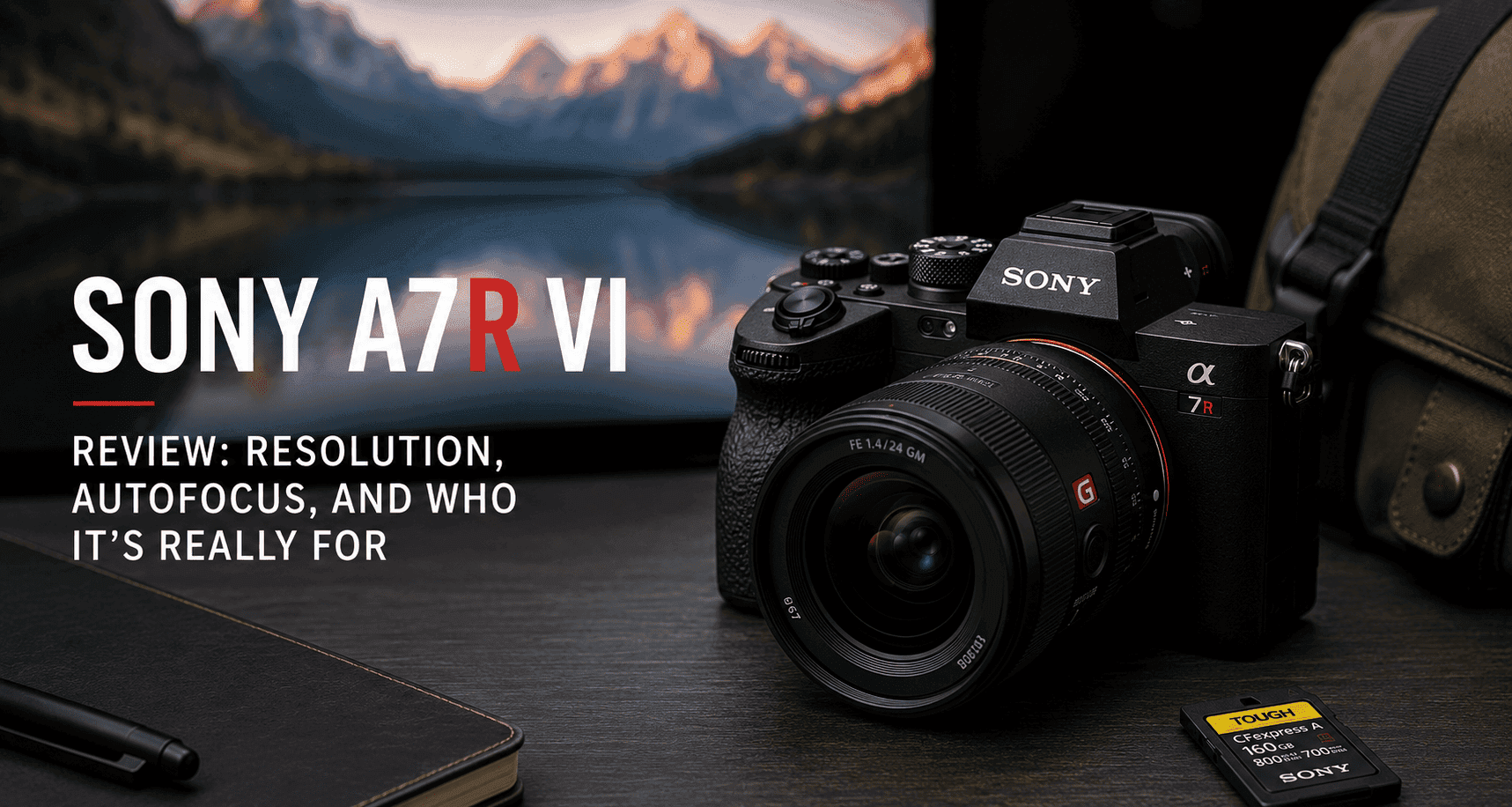
TL;DR The Sony A7R VI is a high-resolution full-frame mirrorless camera designed for photographers who need extreme detail without giving up speed. Its 66.8MP stacked Exmor RS CMOS sensor is paired with the BIONZ XR2 processor and an integrated AI processing unit, allowing up to 30fps continuous shooting with full AF and AE tracking. Its autofocus system uses 759 phase-detection points covering approximately 94% of the image area, while Sony has improved subject recognition for people, animals, birds, insects, vehicles, and aircraft. The camera also adds up to 8.5 stops of central image stabilization, 8K 30p recording, uncropped full-frame 4K 60p and 4K 120p, and a new higher-capacity battery. In India, Sony lists the body at an MRP of ₹4,70,990. The A7R VI is therefore not a general-purpose camera for everyone. It makes the most sense for professional and serious enthusiast photographers shooting landscapes, wildlife, portraits, commercial work, architecture, or high-resolution content where its combination of resolution and speed can genuinely be used.
What Makes The Sony A7R VI Different?
The Sony A7R VI continues the A7R line's focus on resolution, but the important change is that Sony has not treated resolution as the only priority. The camera uses a 66.8-megapixel full-frame, fully stacked Exmor RS CMOS sensor, making it the first A7R-series model to use a fully stacked sensor. That stacked design is important because it helps the camera read data from the sensor considerably faster than a conventional high-resolution design. Sony says the readout is up to 5.6 times faster, and that speed is what allows the A7R VI to combine its very high resolution with a 30fps electronic burst mode.
For photographers, that changes the character of the camera. Earlier high-resolution cameras were often associated with landscapes, studios, portraits, and other relatively controlled subjects because extremely large files and slower readout could make fast action less comfortable. The A7R VI is much more ambitious. It can record full-resolution bursts at up to 30fps with AF and AE tracking and a blackout-free viewfinder, giving wildlife and action photographers access to resolution that would previously have been difficult to combine with this level of shooting speed. Sony also supports Pre-Capture, which can record images from 0.03 to 1 second after the shutter button is fully pressed.
There is also a practical reason the A7R VI feels like a different kind of A7R. Sony has upgraded the battery, grip, stabilization, viewfinder, rear display, controls, and connectivity rather than simply changing the sensor. The camera uses a new 2,670mAh NP-SA100 battery rated for approximately 600 shots using the viewfinder or 710 shots using the LCD under CIPA testing. It also has a 9.44-million-dot OLED electronic viewfinder and a 3.2-inch, 2.1-million-dot four-axis multi-angle touchscreen. These improvements make the camera better suited to long professional shoots, although they also make the A7R VI a serious investment rather than a casual enthusiast purchase.
Sony A7R VI Key Specifications
| Specification | Sony A7R VI |
|---|---|
| Sensor | 66.8MP full-frame stacked Exmor RS CMOS |
| Processor | BIONZ XR2 with integrated AI processing unit |
| Continuous Shooting | Up to 30fps |
| AF Points | Up to 759 phase-detection points |
| AF Coverage | Approximately 94% of image area |
| Image Stabilization | Up to 8.5-stop central, 7-stop peripheral |
| EVF | 9.44-million-dot OLED |
| Rear Display | 3.2-inch, 2.1-million-dot, four-axis multi-angle |
| Video | 8K 30p, 4K 60p and 4K 120p |
| Battery Rating | Approx. 600 shots EVF / 710 shots LCD |
| India MRP | ₹4,70,990 |
Resolution And Image Quality
Resolution is still the main reason to buy the Sony A7R VI, and 66.8MP is not just a number for the specification sheet. A sensor with this much resolution gives photographers considerable flexibility when cropping, particularly when the original image contains enough detail and is captured with a suitable lens. That can be useful for wildlife photographers who cannot always fill the frame with a distant subject, landscape photographers who want to retain fine textures, and commercial photographers who need large files for print or detailed post-production. Sony positions the camera for landscapes, portraits, wildlife, and other demanding applications where image detail matters.
The fully stacked sensor also gives the A7R VI a different performance profile from a conventional high-resolution camera. Sony claims up to 16 stops of dynamic range at low sensitivities, although real-world dynamic range will vary with shooting conditions and processing. The camera also has an ISO range of 100 to 32,000 for still images, expandable to ISO 50 to 102,400. In practical terms, the A7R VI is built to preserve a large amount of image information, but photographers should remember that resolution cannot compensate for poor exposure, motion blur, weak lenses, or poor technique.
The high pixel count also creates a responsibility for the photographer. At 66.8MP, small focusing errors and camera movement can become more obvious when images are viewed at 100% or cropped heavily. This is where the A7R VI's stabilization becomes important. Sony rates its redesigned in-body stabilization at up to 8.5 stops in the center and 7 stops toward the periphery, although the actual benefit depends on the lens, shooting conditions, focal length, and technique. The camera also supports Pixel Shift Multi Shooting and Extended Hi-Res processing, with the latter producing an approximately 270MP image from a fourfold increase in pixel count, but these modes are better suited to controlled subjects than moving scenes.
Who Actually Benefits From 66.8MP?
The resolution makes the most sense when you regularly crop, print large photographs, need extensive editing latitude, or work professionally with detailed imagery. A landscape photographer can retain fine textures in rocks, foliage, and architecture, while a wildlife photographer can crop into a distant subject without immediately reducing an image to a small file. Commercial photographers can also benefit when clients need high-resolution images for large-format output.
For a casual photographer who mainly posts photographs to Instagram, WhatsApp, or standard social platforms, however, 66.8MP can be excessive. Most everyday viewing does not require this amount of resolution, and the larger files can increase storage requirements and processing time. That does not make the resolution a disadvantage, but it does mean you are paying for a capability you may not use.
This is one of the most important points in the Sony A7R VI review. The camera's resolution is impressive, but buyers should not automatically assume that more megapixels mean better photographs in every situation. If your work depends on speed, low-light performance, small file sizes, or straightforward social content, a lower-resolution full-frame body may offer better value.
Autofocus And Action Performance
Autofocus is where the A7R VI becomes much more interesting than a conventional high-resolution camera. Sony equips it with up to 759 phase-detection AF points covering approximately 94% of the image area for still photography. The system can focus at light levels down to EV-6, or EV-11 with Bright Monitoring enabled, and uses Sony's Real-time Recognition AF+ to improve subject tracking. The camera can recognize humans, animals, birds, insects, cars and trains, and airplanes, with an Auto option available as well.
For wildlife and action photographers, the combination of tracking and speed is the headline feature. The camera can shoot at up to 30fps with full AF and AE tracking and without viewfinder blackout. Sony says its processing system can perform up to 60 AF/AE calculations per second. That does not mean every situation will produce a perfectly sharp frame, but it gives the camera the processing capability needed to follow subjects moving through the frame at high speed. Sony has also improved recognition of distant animals and birds, which is particularly relevant when a subject occupies only a small portion of the image.
Independent testing broadly supports the idea that the A7R VI has excellent autofocus, but it is important not to oversell it. Amateur Photographer found autofocus extremely fast and accurate with static and slowly moving subjects and reported effective tracking of fast-moving subjects. However, the publication also noted that autofocus appeared somewhat less reliable with bright white subjects. PetaPixel similarly found the AF excellent but noted that its consistency was not quite at the level of Sony's more speed-focused Alpha 1 II in every situation. That distinction matters because the A7R VI is extremely capable, but it is not automatically the best Sony camera for every professional action workflow.
Autofocus Performance At A Glance
| Feature | Sony A7R VI |
| Phase Detection Points | Up to 759 |
| AF Coverage | Approx. 94% |
| AF/AE Calculations | Up to 60 per second |
| Maximum Burst | Up to 30fps |
| Subject Recognition | Human, Animal, Bird, Insect, Car/Train, Airplane |
| Low-Light AF | Down to EV-6 |
| Viewfinder During Burst | Blackout-free |
Video Features And Hybrid Shooting
The A7R VI is not purely a stills camera. Sony has made substantial improvements to its video capabilities, including 8K 30p recording using XAVC HS with 8.2K oversampling. The camera also supports full-frame 4K 60p and 4K 120p recording without cropping, with 10-bit recording and 4:2:2 colour sampling available for high-quality video workflows. Sony also adds S-Log3, S-Gamut3, and S-Gamut3. Cine support, along with S-Cinetone and imported user LUTs.
The camera's stabilization has also been designed with video in mind. Sony says the redesigned stabilization unit expands roll-direction compensation by up to two times, while Dynamic Active Mode provides stronger compensation for handheld shooting. There is also breathing compensation for supported workflows, and the camera can use Sony's Catalyst applications for additional post-production stabilization and compensation. These features make the A7R VI much more attractive to creators who need both high-resolution stills and professional video from the same body.
There are still reasons not to treat it as a video-first camera. Recording 8K creates large files and demands substantial storage and processing resources, while the 66.8MP sensor is clearly designed around the camera's still-photography identity. Sony also does not offer open-gate recording, which is a limitation for some modern hybrid workflows. For creators who primarily shoot video, a dedicated cinema or hybrid body may make more sense. The A7R VI is strongest when video is an important part of the job but high-resolution photography remains the main reason for buying the camera.
Design, Battery And Everyday Use
Sony has made several physical changes that matter when using a high-resolution camera professionally. The A7R VI has a deeper grip designed to improve stability and control, an illuminated rear panel for working in low light, and a four-axis multi-angle LCD that can move upward, downward, and sideways. The body uses magnesium alloy and has sealed seams and buttons for reliability in demanding environments. These are practical upgrades rather than headline specifications, but they become important during long shoots.
The new NP-SA100 battery is another major change. Sony rates it for approximately 600 still images using the electronic viewfinder and 710 using the LCD under CIPA conditions. That is a useful improvement for photographers who spend an entire day outdoors, although battery performance will vary depending on shooting mode, autofocus use, screen brightness, video recording, temperature, and other settings. Existing Sony users should also note that the new battery is not the same as the NP-FZ100 used by many previous Alpha models, so upgrading from an older A7R body can involve additional battery and accessory costs.
Storage and connectivity are also appropriate for a professional camera. Both memory-card slots support SD cards and CFexpress Type A cards, while two USB Type-C ports provide charging and data functionality. The camera supports Wi-Fi 6 with 2x2 MIMO, FTP delivery, wireless tethering, and Sony's Creators' App. These features make the A7R VI easier to integrate into modern workflows, especially for photographers who need to transfer, back up, or deliver images while working on location.
Sony A7R VI Price And Who Should Buy It
Sony lists the Alpha 7R VI at an MRP of ₹4,70,990 in India, including taxes. That places it firmly in the professional full-frame camera segment, and the price makes the buying decision very different from choosing a general-purpose enthusiast camera. At this level, the question is not whether the camera has enough features. It clearly does. The question is whether your work can take advantage of its resolution, speed, autofocus, video capabilities, and professional workflow features.
The A7R VI makes the most sense for professional landscape photographers, wildlife photographers, commercial shooters, portrait photographers, architectural photographers, and advanced hybrid creators who genuinely need high-resolution files. Wildlife photographers are particularly well served because the camera combines 66.8MP resolution with 30fps shooting and sophisticated subject tracking. That combination can make cropping a distant animal after a fast sequence much more practical than with a traditional high-resolution body.
It is harder to justify for casual photographers, beginners, or creators whose main output is social media. If you mostly shoot family photographs, travel snapshots, short social videos, or standard online content, the A7R VI's capabilities are likely to exceed what you need. Even photographers who already own a capable high-resolution Sony body should evaluate their actual workflow before upgrading. The A7R VI is a meaningful technological step forward, but its biggest benefits appear when speed and resolution are both essential.
Who Should Consider The Sony A7R VI?
| User Type | Verdict |
| Landscape Photographer | Excellent fit |
| Wildlife Photographer | Excellent fit |
| Commercial Photographer | Excellent fit |
| Portrait Photographer | Strong fit |
| Hybrid Photo/Video Professional | Strong fit |
| Casual Photographer | Overkill |
| Beginner | Better to start with a less expensive body |
| Video-First Creator | Consider alternatives depending on workflow |
Sony A7R VI Vs The A7R V
The A7R VI is a substantial upgrade over the A7R V, but the older model should not be dismissed simply because a newer camera exists. The A7R V uses a 61MP sensor and remains highly capable for landscapes, portraits, commercial work, and other high-resolution applications. The A7R VI moves to 66.8MP and a stacked sensor, increasing the resolution while dramatically improving readout speed and enabling 30fps shooting.
The difference becomes much more meaningful for action photographers. If you photograph birds, wildlife, sports, or fast-moving subjects, the A7R VI's stacked sensor, blackout-free 30fps shooting, improved subject recognition, and faster readout provide capabilities that are genuinely different rather than simply incremental. For a landscape photographer who shoots primarily from a tripod, however, the A7R V can still deliver extremely high-quality images, and a lower price on the older model can change the value equation considerably.
Existing Sony users should also consider their lens collection and accessories. The A7R VI uses the same Sony E-mount ecosystem, so compatible lenses remain an important part of the investment. However, the switch to the NP-SA100 battery means owners of older Alpha cameras cannot simply carry all their existing batteries forward. That makes the upgrade decision more expensive than comparing camera-body prices alone.
Frequently Asked Questions
Q. What is the resolution of the Sony A7R VI?
The Sony A7R VI has an approximately 66.8-megapixel full-frame, fully stacked Exmor RS CMOS sensor. Sony describes it as offering class-leading resolution in the Alpha line-up.
Q. How fast can the Sony A7R VI shoot?
The camera can shoot at up to 30 frames per second at full 66.8MP resolution with AF and AE tracking and a blackout-free viewfinder when using its electronic shutter in the appropriate shooting mode.
Q. How many autofocus points does the Sony A7R VI have?
The A7R VI has up to 759 phase-detection AF points for still photography, covering approximately 94% of the image area.
Q. Is the Sony A7R VI good for wildlife photography?
Yes. Its 66.8MP stacked sensor, 30fps burst shooting, subject recognition, Pre-Capture, and tracking make it particularly well suited to wildlife photography. However, independent testing suggests its autofocus is excellent rather than flawless, with some situations still challenging.
Q. Does the Sony A7R VI record 8K video?
Yes. It can record 8K 30p using XAVC HS, with 8.2K oversampling. Sony also supports full-frame 4K 60p and 4K 120p recording without cropping.
Q. How good is the Sony A7R VI's image stabilization?
Sony rates the A7R VI for up to 8.5 stops of central stabilization and 7 stops toward the periphery. Actual performance depends on the lens, focal length, shooting technique, and conditions.
Q. What battery does the Sony A7R VI use?
The camera uses the new NP-SA100 2,670mAh battery. Sony rates it for approximately 600 still images with the EVF or 710 with the LCD under CIPA testing.
Q. What is the Sony A7R VI price in India?
Sony India currently lists the A7R VI at an MRP of ₹4,70,990, including taxes. Actual retailer pricing and offers can vary.
Q. Is the Sony A7R VI better than the A7R V?
The A7R VI is the more advanced camera, particularly for action and hybrid shooting, because it adds a 66.8MP stacked sensor, faster readout, 30fps shooting, improved tracking, and newer video capabilities. The A7R V can still be the better value if you primarily need high-resolution photography and find it at a substantially lower price.
Q. Who should buy the Sony A7R VI?
The A7R VI is best suited to professional and serious enthusiast photographers who can use its combination of very high resolution and high-speed shooting. Landscape, wildlife, commercial, architecture, portrait, and hybrid photographers are the strongest candidates, while casual users are unlikely to need all of its capabilities.
Final Recommendation
The Sony A7R VI is not simply a higher-megapixel version of the previous A7R camera. Its 66.8MP fully stacked sensor changes what a high-resolution full-frame camera can do by combining extreme detail with up to 30fps shooting, advanced subject tracking, fast sensor readout, and professional video capabilities. That combination is its real selling point.
For wildlife photographers, the A7R VI is particularly compelling because resolution, autofocus, tracking, Pre-Capture, and burst speed all contribute directly to getting usable photographs of unpredictable subjects. Landscape and commercial photographers benefit from the enormous files and image quality, while hybrid professionals get 8K, uncropped 4K 60p and 4K 120p, advanced stabilization, and professional log workflows.
However, the ₹4,70,990 India MRP means this is not a camera to buy simply because the specification sheet looks impressive. If you will regularly use the 66.8MP resolution, crop heavily, photograph fast-moving subjects, or need one professional body for both high-resolution stills and serious video, the Sony A7R VI is an exceptionally capable choice. If your photography is mostly casual, social, or travel-focused, a less expensive full-frame camera will likely deliver better value.
The bottom line: buy the Sony A7R VI for its combination of resolution and speed, not resolution alone. That is what makes it a genuinely different high-end camera and the reason it is most suitable for photographers whose work demands both extreme detail and fast, reliable shooting.






