
Sony A7 III vs Canon 6D Mark II vs Nikon D750: Budget Full-Frame Showdown
Sony A7 III, Canon 6D Mark II, and Nikon D750 remain interesting full-frame options in 2026. Here is how they compare on image quality, autofocus, video, handling, and value.

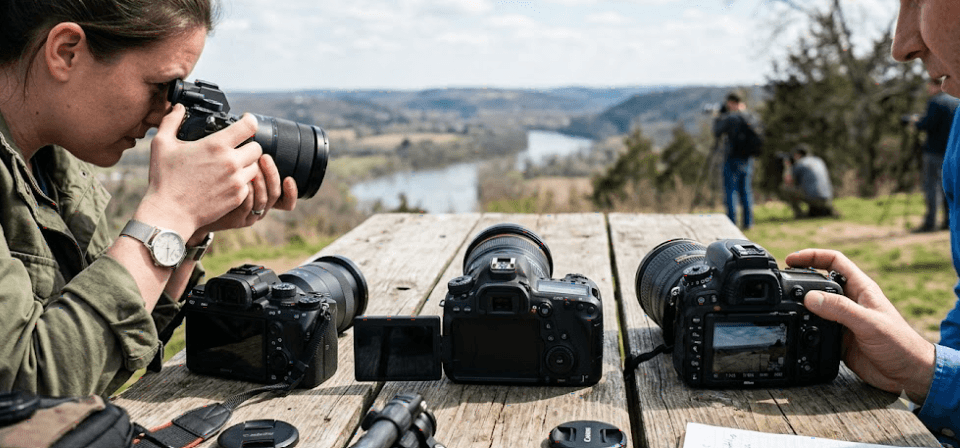
TL;DR The Sony A7 III is the strongest overall choice between the Sony A7 III, Canon 6D Mark II, and Nikon D750 if you are shopping for an affordable full-frame camera in 2026. Its 24.2MP full-frame sensor, 10fps continuous shooting, 693 phase-detection AF points, 5-axis in-body stabilization, dual card slots, and 4K recording give it a much more modern feature set than the two older DSLRs. The Canon EOS 6D Mark II remains attractive for photographers who prefer Canon's DSLR handling, optical viewfinder, fully articulating touchscreen, and large EF lens ecosystem. At the same time, the Nikon D750 is still a capable choice for photographers who prioritize traditional DSLR ergonomics, dependable still-image quality, and access to Nikon F-mount lenses. Since all three are older models, however, condition, shutter count, battery health, lens availability, and seller reputation matter heavily when buying used or refurbished.
Sony A7 III vs Canon 6D Mark II vs Nikon D750
The Sony A7 III, Canon EOS 6D Mark II, and Nikon D750 come from different stages of the full-frame camera market, but they are still interesting comparisons for buyers trying to enter full-frame photography without paying current flagship prices. The Sony A7 III was introduced as a full-frame mirrorless hybrid, while the Canon 6D Mark II and Nikon D750 are full-frame DSLRs built around optical viewfinders. That difference changes more than the size of the camera. It affects autofocus behavior, battery expectations, video capabilities, handling, lens choices, and how naturally each camera fits into a modern hybrid photography workflow.
The Sony A7 III has a 24.2MP back-illuminated full-frame CMOS sensor and uses Sony's E-mount system. Its manufacturer specifications list 693 phase-detection AF points and up to 10fps continuous shooting with AF and AE tracking. Sony also gives the camera 5-axis in-body image stabilization and 4K movie recording, making it considerably more versatile for buyers who want both photography and video from one body.
The Canon EOS 6D Mark II and Nikon D750 approach the same full-frame goal differently. Canon uses a 26.2MP full-frame CMOS sensor and a 45-point all-cross-type optical-viewfinder autofocus system, while Nikon uses a 24.3MP FX-format CMOS sensor and can shoot at up to 6.5fps. Both are capable stills cameras, but their DSLR architecture means they do not offer the same combination of mirrorless autofocus coverage, electronic preview, and 4K recording found on the A7 III.
Core Specifications Compared
| Feature | Sony A7 III | Canon 6D Mark II | Nikon D750 |
|---|---|---|---|
| Camera Type | Full-frame mirrorless | Full-frame DSLR | Full-frame DSLR |
| Sensor | 24.2MP full-frame | 26.2MP full-frame | 24.3MP FX |
| Autofocus | 693 phase-detection points + 425 contrast-detection points | 45-point all-cross-type AF | 51-point AF system |
| Continuous Shooting | Up to 10fps | Up to 6.5fps | Up to 6.5fps |
| Stabilization | 5-axis in-body stabilization | No sensor-shift IBIS | No sensor-shift IBIS |
| Video | 4K | Full HD up to 60p | Full HD up to 60p |
| Viewfinder | Electronic | Optical | Optical |
| Card Slots | Dual | Single | Dual |
| Lens Mount | Sony E | Canon EF | Nikon F |
Image Quality and Sensor Performance
All three cameras use full-frame sensors, which is the biggest reason they remain relevant to buyers considering older cameras. A full-frame sensor gives photographers a larger imaging area than APS-C and smaller formats, which can be useful for low-light photography, depth-of-field control, and achieving a particular full-frame look with compatible lenses. The difference between 24.2MP, 26.2MP, and 24.3MP is relatively small in everyday photography, so buyers should not choose among these cameras based only on megapixel count.
The Sony A7 III uses a 24.2MP back-illuminated full-frame CMOS sensor, while the Canon 6D Mark II uses a 26.2MP full-frame CMOS sensor. Nikon's D750 uses a 24.3MP FX-format CMOS sensor. In practical terms, all three provide enough resolution for large prints, cropping, portraits, landscapes, events, and general enthusiast photography. Canon's extra resolution does not automatically make it the better camera, because sensor output is only one part of the overall shooting experience.
Where the cameras begin to separate is in how much control they give you before and after pressing the shutter. The A7 III's mirrorless design lets you use an electronic viewfinder to preview exposure and other image characteristics before taking a photograph, while the Canon and Nikon provide traditional optical viewing. Some photographers prefer the natural, lag-free experience of an optical viewfinder, while others find the electronic preview of a mirrorless camera much more useful. This is less about image quality and more about the shooting style you prefer.
Which Camera Is Better for Photography?
For straightforward still photography, the Nikon D750 remains a surprisingly strong option. Its 24.3MP FX sensor delivers the resolution expected from a full-frame camera, and its DSLR body provides the familiar handling many photographers still prefer. The Canon 6D Mark II adds a slightly higher-resolution 26.2MP sensor and a fully articulating touchscreen, which can be useful for portraits, travel photography, and unusual shooting angles. Neither camera should be dismissed simply because it is older.
The Sony A7 III has the biggest advantage when photography involves moving subjects. Its 693 phase-detection AF points provide substantially broader autofocus coverage than the 45-point optical-viewfinder system of the 6D Mark II. Sony also rates the A7 III for continuous shooting at up to 10fps with AF and AE tracking. That combination makes it much better suited to action, wildlife, events, and situations where subjects move unpredictably through the frame.
This does not mean the Canon or Nikon are poor cameras for moving subjects. They can still produce excellent results when paired with the right lens and used by a photographer who understands their autofocus systems. The difference is that the Sony gives you a more modern autofocus architecture and faster burst shooting. For someone buying one full-frame body to cover several types of photography in 2026, that flexibility gives the A7 III a meaningful advantage.
Autofocus and Shooting Speed
Autofocus is one of the clearest areas where the Sony A7 III shows how much mirrorless technology had progressed by the time it launched. Sony specifies 693 phase-detection AF points across the full-frame area, together with 425 contrast-detection points. The camera's Fast Hybrid AF system is designed to combine both methods, giving it broad coverage and fast subject acquisition. It can also shoot at up to 10fps with AF and AE tracking, which gives it a considerable advantage over the older DSLRs in this comparison.
The Canon 6D Mark II uses a 45-point all-cross-type autofocus system through its optical viewfinder. Canon describes the system as a wide-area AF arrangement designed to track subjects accurately, and it also supports Dual Pixel CMOS AF during live view. This means the camera's autofocus experience changes depending on whether you are using the optical viewfinder or the rear screen. That distinction is important because the 6D Mark II is more capable in live view than its basic 45-point optical-viewfinder specification might suggest.
The Nikon D750 uses Nikon's Multi-CAM 3500 II autofocus system with 51 focus points and remains a capable DSLR for general photography. Its 6.5fps maximum continuous shooting speed is respectable for its generation and sufficient for portraits, street photography, travel, weddings, and moderate action. However, when the comparison is strictly about autofocus coverage and burst performance, the A7 III is the more modern choice.
Autofocus Comparison
| Feature | Sony A7 III | Canon 6D Mark II | Nikon D750 |
|---|---|---|---|
| AF Architecture | Hybrid phase + contrast | Phase AF + Dual Pixel CMOS AF in Live View | Phase-detection DSLR AF |
| AF Points | 693 phase + 425 contrast | 45 optical-viewfinder points | 51 points |
| Maximum Burst | 10fps | 6.5fps | 6.5fps |
| Best Fit | Action, events, hybrid shooting | Portraits, travel, general photography | General still photography |
Video and Hybrid Shooting
Video is another area where the Sony A7 III has a clear technical advantage. Sony lists 4K HDR movie recording for the camera, giving it a much stronger position for creators who want to photograph and record video with the same body. The A7 III also combines 4K recording with 5-axis in-body stabilization, which can make handheld shooting more practical when compatible shooting conditions and settings are used.
The Canon 6D Mark II is much more limited as a video camera. Canon specifies Full HD recording up to 60p, rather than 4K recording, although its Dual Pixel CMOS AF can make live-view focusing useful for video and casual content creation. This makes the 6D Mark II a more natural choice for someone whose priority is still photography and who only occasionally records Full HD clips.
The Nikon D750 is similarly oriented toward still photography. Nikon lists Full HD 1080p recording up to 60p, which is perfectly usable for basic video work but clearly behind the 4K capability of the Sony. If you are buying in 2026 and expect to shoot YouTube videos, travel footage, interviews, reels, or hybrid content regularly, the A7 III is the more sensible long-term choice of these three.
Video Capability at a Glance
| Camera | Maximum Video Resolution | Best Video Use |
|---|---|---|
| Sony A7 III | 4K | Hybrid photography and video |
| Canon 6D Mark II | Full HD 60p | Casual video and Full HD content |
| Nikon D750 | Full HD 60p | Basic video and photography-focused use |
Handling, Battery, and Everyday Use
The physical experience is where the DSLR models can still appeal strongly. The Canon 6D Mark II and Nikon D750 provide optical viewfinders, which show the scene directly through the lens rather than displaying an electronic feed. For photographers who learned on DSLRs or simply prefer their traditional feel, that can make the shooting experience more intuitive. The Canon also has a vari-angle touchscreen, giving it a useful advantage for low-angle, high-angle, and self-facing compositions.
The Sony A7 III takes a different approach with its electronic viewfinder and mirrorless body. It is generally more compact than a traditional DSLR body, although the final size and weight of a camera system depend heavily on the lens attached. Sony also gives the A7 III dual card slots, which is useful for photographers who want additional storage flexibility or redundancy. The camera is rated by Sony for approximately 710 still images per charge when using the LCD, which is strong for a mirrorless full-frame body of its generation.
The Nikon D750 also benefits from dual SD card slots, while the Canon 6D Mark II has a single card slot. This is an important consideration for wedding photographers, event shooters, and anyone working with irreplaceable images. When buying any of these cameras used in 2026, however, battery condition becomes just as important as the original manufacturer's rating. An older camera with a heavily used battery may not deliver the same endurance as a well-maintained example.
Lens Ecosystem and Long-Term Value
A full-frame camera is only as useful as the lens system you can realistically build around it. Sony's A7 III uses the E-mount, which gives buyers access to Sony's FE full-frame lenses as well as a broad third-party ecosystem. That is a major reason the A7 III continues to make sense for buyers entering the used full-frame market. You can start with a relatively affordable prime or zoom and expand the system later without replacing the camera body immediately.
The Canon 6D Mark II uses the EF mount, which is one of the most established full-frame DSLR lens systems. The used market offers a large range of Canon EF lenses from Canon and third-party manufacturers, and this can make the 6D Mark II particularly attractive when a buyer already owns compatible Canon glass. However, buyers should remember that Canon's current mirrorless full-frame system is based around the RF mount, so the long-term direction of Canon's interchangeable-lens ecosystem is different from the one represented by the 6D Mark II.
The Nikon D750 uses the F mount and benefits from Nikon's extensive history of full-frame and film-era lenses. This can be especially useful for photographers who already own Nikon F-mount glass. In 2026, however, the condition and price of used lenses should be considered carefully because the market has shifted strongly toward mirrorless systems. The cheapest camera body is not necessarily the cheapest system if compatible lenses are difficult or expensive to find.
Lens System Comparison
| Camera | Mount | Main Advantage |
|---|---|---|
| Sony A7 III | Sony E | Modern mirrorless ecosystem and strong third-party support |
| Canon 6D Mark II | Canon EF | Huge established DSLR lens ecosystem |
| Nikon D750 | Nikon F | Extensive Nikon legacy lens compatibility |
Price, Used Value, and Buying in 2026
Calling these three cameras budget full-frame options requires some context. None of them should be treated as a current-generation budget camera, because they are older models and are now primarily relevant through the used, refurbished, or remaining-stock market. Prices can vary substantially depending on shutter count, body condition, included accessories, lens bundles, battery condition, and seller reputation. That makes a fixed 2026 price comparison less useful than evaluating what you actually receive for the money.
The Sony A7 III generally deserves the strongest consideration when the price difference between a clean used example and an older DSLR is reasonable. Its combination of 24.2MP full-frame imaging, 10fps shooting, modern autofocus, 5-axis stabilization, dual card slots, and 4K recording gives it capabilities that remain useful even though newer Sony bodies have surpassed it. Current camera-market coverage continues to describe the A7 III as a budget-conscious full-frame option despite newer A7 generations being available.
The Canon 6D Mark II and Nikon D750 become more compelling when they are significantly cheaper or when the buyer already owns compatible lenses. A photographer with several Canon EF lenses may save more by choosing a 6D Mark II than by switching systems. The same logic applies to a Nikon user with a collection of F-mount lenses. In other words, the cheapest body is not automatically the best value. Your existing gear can change the calculation considerably.
Best Value by Buyer Type
| Buyer Type | Best Choice | Why |
|---|---|---|
| Best Overall | Sony A7 III | Strongest combination of AF, video, stabilization, and speed |
| DSLR Photographer | Nikon D750 | Excellent stills performance and traditional handling |
| Canon User | Canon 6D Mark II | Strong choice if you already own EF lenses |
| Video Creator | Sony A7 III | 4K recording and in-body stabilization |
| Portrait Photographer | Canon 6D Mark II | Full-frame sensor and useful vari-angle touchscreen |
| Action Photographer | Sony A7 III | 10fps shooting and broad phase-detection AF |
What Should You Check Before Buying Used?
The condition of the individual camera matters enormously when buying an older full-frame model. Start with the shutter count, sensor condition, LCD, viewfinder, buttons, dials, card slots, battery compartment, and lens mount. A camera that has been professionally maintained and lightly used can be a much better purchase than a cheaper body that has spent years in demanding environments. Check sample images at different ISO settings and inspect them for unusual spots, lines, or other abnormalities.
Battery health deserves particular attention because these cameras are several years old. Even when the camera itself works perfectly, an aging battery can reduce practical shooting time and add replacement costs. You should also check whether the charger and original accessories are included, particularly if you are buying from an individual seller. For refurbished purchases, ask whether the body has been inspected and whether any warranty or return window is provided.
Finally, check the lens before judging the complete deal. A cheap full-frame body paired with a poor or damaged lens is not necessarily good value. Look for fungus, haze, scratches, loose zoom rings, damaged focus mechanisms, and autofocus issues. If possible, test the complete body-and-lens combination before paying. With cameras this old, buying condition matters almost as much as the specification sheet.
Frequently Asked Questions
Q. Is the Sony A7 III better than the Canon 6D Mark II?
For most buyers in 2026, the Sony A7 III is the more capable overall camera. It has a 24.2MP full-frame sensor, 693 phase-detection AF points, up to 10fps shooting, 5-axis stabilization, and 4K recording. The Canon 6D Mark II remains attractive for photographers who prefer DSLR handling, Canon EF lenses, and its vari-angle touchscreen.
Q. Is the Nikon D750 still worth buying in 2026?
Yes, if you find a clean example at the right price. Its 24.3MP FX sensor, 6.5fps shooting, optical viewfinder, and established F-mount system still make it a capable stills camera. It is less attractive for buyers who need modern autofocus or 4K video.
Q. Which camera has the highest resolution?
The Canon 6D Mark II has the highest stated resolution of the three at 26.2MP. The Nikon D750 has 24.3MP, while the Sony A7 III has 24.2MP. The differences are relatively small, so resolution alone should not determine your purchase.
Q. Which camera is best for video?
The Sony A7 III is the clear choice of these three for video because it supports 4K recording. The Canon 6D Mark II and Nikon D750 are limited to Full HD recording up to 60p.
Q. Which camera has the fastest continuous shooting speed?
The Sony A7 III is the fastest, with continuous shooting up to 10fps. The Canon 6D Mark II and Nikon D750 both reach up to 6.5fps under their respective specifications.
Q. Which camera has the best autofocus?
The Sony A7 III has the most advanced autofocus system in this comparison, with 693 phase-detection and 425 contrast-detection points. The Canon 6D Mark II has a 45-point all-cross-type optical-viewfinder AF system, while the Nikon D750 uses a 51-point DSLR AF system.
Q. Does the Sony A7 III have image stabilization?
Yes. The Sony A7 III has 5-axis in-body image stabilization. This is an important advantage over the Canon 6D Mark II and Nikon D750, which do not have sensor-shift in-body stabilization.
Q. Which camera is best for beginners?
The best choice depends on what you already own and what you want to learn. The Sony A7 III is the strongest all-round option if you want photography and video, while the Canon 6D Mark II and Nikon D750 can be easier choices for photographers who prefer traditional DSLR controls and optical viewfinders.
Q. Should I buy a used Sony A7 III in 2026?
A used Sony A7 III can still make sense if the body is in good condition and the price reflects its age. Its autofocus, stabilization, dual-card design, 10fps shooting, and 4K video keep it useful, although newer cameras offer more advanced features.
Q. Which is better for professional photography, the A7 III, 6D Mark II, or D750?
The Sony A7 III is the strongest overall choice because it combines fast autofocus, 10fps shooting, 5-axis stabilization, dual card slots, and 4K video. However, professional photographers who already own extensive Canon EF or Nikon F lenses may find the 6D Mark II or D750 more economical.
Final Recommendation
The Sony A7 III is the best overall choice in this full-frame showdown for most buyers in 2026. Its 24.2MP full-frame sensor is not dramatically higher in resolution than the Canon 6D Mark II or Nikon D750, but the complete package is much more modern. Its 693 phase-detection AF points, 10fps continuous shooting, 5-axis stabilization, dual card slots, and 4K recording make it the most versatile camera here. Sony's official specifications support these core advantages.
The Canon 6D Mark II makes more sense if you prioritize traditional DSLR handling or already own Canon EF lenses. Its 26.2MP full-frame sensor, 45-point all-cross-type AF system, and vari-angle touchscreen give it a useful combination for portraits, travel, family photography, and general stills.
The Nikon D750 remains a good choice for photographers who want a traditional full-frame DSLR and can find a well-maintained body at a significantly lower price. Its 24.3MP FX sensor and 6.5fps continuous shooting remain perfectly usable for still photography, but its Full HD video and older autofocus architecture make it less versatile than the A7 III.
For a buyer starting from scratch, the Sony A7 III is the safest recommendation. For an existing Canon or Nikon user, however, the lens collection can change the answer. In the 2026 used and refurbished market, buy the best-conditioned system you can afford rather than simply choosing the camera with the lowest sticker price.
Ready to upgrade your tech?
Browse our collection of quality refurbished products at unbeatable prices.






