
Sony A7 III vs A6600: Full Frame vs APS-C: Which Fits Your Shoot?
Sony A7 III vs A6600 comes down to full-frame image quality versus APS-C portability. Compare their sensors, autofocus, video, battery, lenses, and shooting needs to find the better fit.

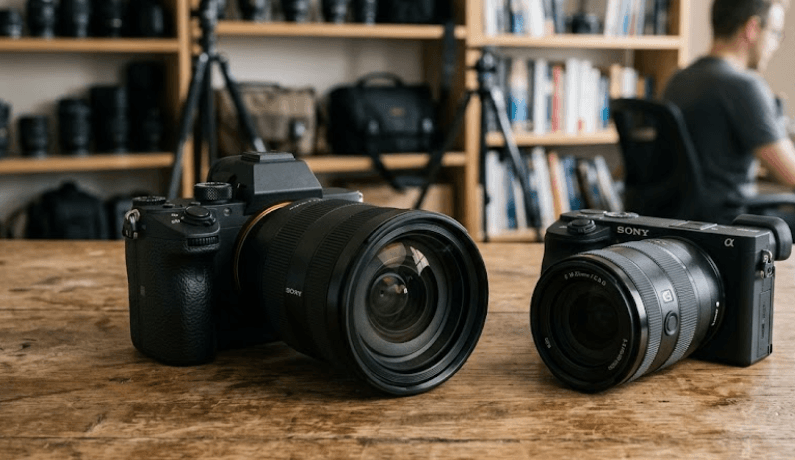
TL;DR Sony A7 III vs A6600 is less about which camera is universally better and more about what you shoot and how you want to carry your kit. The Sony A7 III uses a 24.2MP full-frame sensor, while the A6600 uses a 24.2MP APS-C sensor, so both produce similarly sized files but deliver a different shooting experience. The A7 III is the stronger choice for portraits, weddings, events, low-light photography, and situations where you want more control over background blur. The A6600 is smaller and lighter, has excellent battery life, and gives telephoto lenses extra effective reach because of its APS-C crop. Both offer 10 fps-class continuous shooting, in-body stabilization, 4K recording, and Sony E-mount compatibility, making them capable cameras even though they target different users.
Sony A7 III vs A6600: Key Differences
The biggest difference between the Sony A7 III and Sony A6600 is the sensor, not the megapixel count. The A7 III uses a 35mm full-frame 24.2MP Exmor R CMOS sensor, while the A6600 uses a 24.2MP APS-C Exmor CMOS sensor measuring approximately 23.5 x 15.6mm. Because both cameras are around 24MP, it can be tempting to assume that their image quality is almost identical, but sensor size changes how each camera handles light, depth of field, and lens framing. The larger full-frame sensor in the A7 III gives photographers more flexibility when shooting in difficult lighting and when creating a shallow depth of field.
The difference becomes more noticeable when you move beyond basic daylight photography. The A7 III is designed around the full-frame E-mount system, while the A6600 uses Sony's APS-C format. Both cameras support interchangeable E-mount lenses, but the framing changes because the A6600 applies the APS-C crop factor. A 50mm lens therefore gives you a noticeably tighter field of view on the A6600 than it does on the A7 III. That can be useful for wildlife and distant subjects, but it can also make it harder to achieve a genuinely wide field of view unless you choose an appropriate APS-C lens.
The cameras also differ physically. Sony lists the A7 III at approximately 650g with its battery and memory card, while the A6600 is approximately 503g in the same measurement. That is a difference of about 147g before you account for the lenses you carry. The A6600 is also physically smaller, which makes it attractive for travel, street photography, and long shooting days where a lighter bag matters. The A7 III is larger and heavier, but that extra size can feel more comfortable when you are using larger full-frame lenses or shooting for long periods.
| Feature | Sony A7 III | Sony A6600 |
|---|---|---|
| Sensor | 35mm Full Frame | APS-C |
| Effective Resolution | 24.2MP | 24.2MP |
| Sensor Type | Exmor R CMOS | Exmor CMOS |
| Continuous Shooting | Up to 10 fps | Up to 11 fps |
| In-Body Stabilization | 5-axis | 5-axis |
| Maximum 4K Recording | 4K 30p | 4K 30p |
| Battery Rating | Up to 710 shots via LCD | Up to 810 shots via LCD |
| Weight With Battery/Card | Approx. 650g | Approx. 503g |
| Lens Mount | Sony E-mount | Sony E-mount |
Image Quality and Low Light
For pure image quality, the A7 III has the advantage because its full-frame sensor gives it more physical sensor area to work with. That does not mean every photograph from the A7 III will automatically look better than one from the A6600. In good daylight with a capable lens, both cameras can produce detailed 24MP images that are more than sufficient for social media, web publishing, prints, and many professional assignments. The difference becomes more meaningful when lighting gets difficult or when you want a particular visual style rather than simply a sharp photograph.
Low-light photography is one of the areas where the A7 III makes the strongest case for choosing full frame. Its 35mm sensor is larger than the A6600's APS-C sensor, giving the A7 III an advantage when you need to work with available light and maintain image quality at higher sensitivities. This can matter during weddings, indoor events, evening street photography, concerts, or portraits shot near sunset. The A7 III also has a standard ISO range of 100 to 51200, expandable to ISO 50 to 204800 for still images, while Sony lists the A6600's standard still-image ISO range as ISO 100 to 32000, expandable to ISO 50 to 102400.
Depth of field is another important difference that is easy to miss when comparing specifications. A full-frame camera can make it easier to achieve a shallow depth of field with the same framing and aperture, which is why the A7 III is particularly attractive for portraits, weddings, and cinematic-looking stills. The A6600 can still produce attractive background separation, especially with a fast prime lens, but the smaller sensor changes the relationship between focal length, aperture, and framing. If your priority is strong subject isolation and a full-frame look, the A7 III is the more natural choice. If you prefer keeping more of the scene in focus or want a compact system, the A6600 remains highly capable.
Image Quality at a Glance
The practical difference is therefore not about 24.2MP versus 24.2MP. Both cameras have essentially the same effective resolution, but they use that resolution on different sensor formats. The A7 III's full-frame sensor gives it an advantage for low-light work and shallow depth of field, while the A6600's APS-C sensor makes the body smaller and provides a tighter field of view with the same focal length.
Autofocus and Shooting Performance
Autofocus is one area where neither camera feels like an obvious weak choice. The A7 III uses a Fast Hybrid AF system with 693 phase-detection points and 425 contrast-detection points, while the A6600 also uses Fast Hybrid AF with 425 phase-detection points and 425 contrast-detection points. The A7 III's larger number of phase-detection points gives it a denser autofocus coverage specification, but the A6600 was also designed as a fast, capable APS-C camera with sophisticated tracking and Eye AF features. For everyday photography, both can focus quickly enough for portraits, travel, street photography, and many moving subjects.
The A6600 has a small advantage on paper when it comes to maximum continuous shooting speed, with Sony rating it at up to 11 fps. The A7 III can shoot at up to 10 fps with AF and AE tracking. That difference is too small to make the A6600 automatically better for sports or wildlife, especially because real-world performance depends on lens choice, autofocus settings, subject movement, shutter speed, and shooting conditions. The A7 III's full-frame sensor and broader full-frame lens selection can still make it the better long-term choice for photographers building a professional system around events, portraits, or demanding assignments.
For wildlife and birds, the A6600 has one particularly practical advantage: its APS-C sensor gives lenses a narrower field of view compared with full frame. A 400mm lens, for example, frames a distant subject more tightly on the A6600 than it would on the A7 III. This does not mean the lens physically becomes 600mm, but the approximately 1.5x crop factor gives you a field of view similar to what a 600mm lens would provide on full frame. That can be useful when you are trying to fill the frame with a distant bird without moving closer. The A7 III, however, remains more versatile if you regularly move between wildlife, portraits, events, and low-light work.
| Shooting Need | Better Fit | Why |
|---|---|---|
| Portraits | A7 III | Full-frame sensor and easier shallow depth of field |
| Weddings | A7 III | Strong low-light capability and full-frame system |
| Wildlife | A6600 | APS-C framing provides extra effective reach |
| Street Photography | A6600 | Smaller and lighter body |
| Sports | Tie | Both offer fast continuous shooting |
| Travel | A6600 | Lower body weight and compact dimensions |
| Events | A7 III | Full-frame sensor and broader lens options |
Video and Stabilization
Both cameras can record 4K video, but their video specifications are not identical in every detail. Sony lists the A7 III as capable of recording 4K at up to 30p, while the A6600 also records 4K at up to 30p. Both cameras can therefore serve as capable options for creators who want to record travel footage, interviews, YouTube videos, behind-the-scenes content, or general video projects without moving immediately to a dedicated cinema camera.
Both cameras also include 5-axis in-body image stabilization, which is useful when shooting handheld. Stabilization does not eliminate the need for good shooting technique, and it does not freeze subject movement, but it can reduce the effect of camera shake when photographing static subjects or recording handheld footage. The A6600's lighter body makes handheld travel shooting comfortable, while the A7 III's larger body can provide a more substantial grip when paired with bigger full-frame lenses.
For creators choosing between these two cameras in 2026, it is important not to buy either model purely because it has 4K on the specification sheet. Both are older camera designs, so newer Sony models offer more advanced video features and newer autofocus technologies. The A7 III remains compelling when you specifically want an affordable entry into Sony full frame, while the A6600 makes more sense if compact size, battery life, and the APS-C lens system are higher priorities. For serious video-first buyers, comparing newer bodies may be more sensible than choosing solely between these two older models.
Battery Life and Portability
Battery life is one of the A6600's strongest practical advantages. Sony rates the camera for approximately 810 still images when using the LCD monitor and approximately 720 shots through the electronic viewfinder under the CIPA standard. The A7 III is rated for approximately 710 shots using the LCD and approximately 610 shots using the viewfinder. These are standardized estimates rather than guarantees for every shooting situation, but they show that the A6600 can deliver longer rated battery life despite being the smaller camera.
The size difference is equally relevant when you build a complete kit. The A6600 weighs approximately 503g with the battery and memory card, compared with approximately 650g for the A7 III. A difference of 147g may not sound dramatic when you look only at the camera body, but the gap can become more noticeable when you add multiple lenses, spare batteries, memory cards, and accessories. This is why the A6600 can be particularly appealing to travelers and street photographers who want interchangeable-lens flexibility without carrying a large full-frame setup.
The A7 III still has a portability advantage over many larger professional full-frame cameras, but it is not as compact as the A6600. The choice therefore depends on whether you see portability as a major part of your photography. If you regularly hike, travel, commute, or walk around a city for hours with the camera in your bag, the A6600's lower weight can make a real difference. If you are mostly shooting from a controlled location and prioritize sensor performance, the A7 III's additional size is easier to justify.
Lens Compatibility and System Choice
Both cameras use Sony's E-mount, so they belong to the same broad lens ecosystem. However, you need to understand the difference between full-frame and APS-C lenses before building your kit. Sony states that APS-C E-mount lenses attached to a full-frame Sony camera will record APS-C-sized images. This means you can physically use compatible APS-C E-mount lenses on the A7 III, but the camera will use a cropped portion of its full-frame sensor.
The reverse situation is more useful for someone considering an upgrade path. Full-frame E-mount lenses can be used on the A6600, where the APS-C sensor produces a narrower field of view. This can give you flexibility if you eventually move from the A6600 to a full-frame Sony body. However, full-frame lenses are often larger and heavier than APS-C alternatives, which can reduce some of the size advantage that makes the A6600 attractive in the first place. Your lens choices therefore matter almost as much as the camera body when deciding between these systems.
For someone starting fresh, the better approach is to choose the sensor format before buying several lenses. If you know you want full-frame photography, investing in full-frame lenses around the A7 III can make more sense. If you prioritize a compact setup, APS-C lenses paired with the A6600 can keep the overall kit smaller. This is particularly relevant for travel and street photography, where carrying a compact body with a small prime or zoom can be more enjoyable than carrying a heavier full-frame combination.
| Lens Strategy | A7 III | A6600 |
|---|---|---|
| Full-Frame E-Mount Lens | Native full-frame use | Works with APS-C field of view |
| APS-C E-Mount Lens | Uses cropped APS-C area | Native APS-C use |
| Compact Lens Kit | Possible, but often larger | Strong advantage |
| Wildlife Reach | Requires longer focal length | APS-C crop helps framing |
| Long-Term Full-Frame Upgrade | Already full frame | Full-frame lenses can support future upgrade |
Which Camera Fits Your Shooting Style?
The A7 III is the stronger choice if your photography revolves around portraits, weddings, indoor events, low-light scenes, or professional assignments where full-frame performance matters. Its 24.2MP sensor may not sound dramatically different from the A6600's 24.2MP sensor, but the larger sensor changes how you can work with light and depth of field. Its 693 phase-detection AF points, 10 fps continuous shooting, 5-axis stabilization, dual card slots, and 4K recording also give it a well-rounded specification set for serious photography.
The A6600 is the better fit if you value a smaller kit, longer rated battery life, and APS-C reach. At approximately 503g, it is significantly lighter than the A7 III, while its 810-shot CIPA rating through the LCD gives it an advantage for long days away from a charger. Its 24.2MP APS-C sensor, 11 fps continuous shooting, 5-axis stabilization, and 4K recording make it capable enough for travel, street photography, wildlife, content creation, and everyday shooting.
There is also a financial and upgrade consideration in 2026. Both cameras have been on the market for years, so buying either one makes the most sense when you find a good deal on a clean body and understand its limitations compared with newer generations. Sony continues to provide support resources and firmware information for the A7 III, including a firmware update listed in April 2026, which confirms that the camera remains supported. The smarter purchase is therefore not necessarily the newest-looking body, but the one that gives you the sensor format, lens ecosystem, portability, and shooting performance you actually need.
Frequently Asked Questions
Q. Is the Sony A7 III better than the Sony A6600?
The A7 III is better if your priority is full-frame image quality, low-light photography, and shallow depth of field. The A6600 is better if you prioritize a lighter body, longer rated battery life, and the tighter framing provided by its APS-C sensor.
Q. Does the A7 III have a full-frame sensor?
Yes. The Sony A7 III uses a 35mm full-frame 24.2MP Exmor R CMOS sensor measuring approximately 35.6 x 23.8mm.
Q. Is the Sony A6600 an APS-C camera?
Yes. The A6600 uses a 24.2MP APS-C Exmor CMOS sensor measuring approximately 23.5 x 15.6mm.
Q. Which camera is better for low-light photography, the A7 III or A6600?
The A7 III is the better choice for low-light photography because its full-frame sensor provides a larger imaging area and its ISO range is higher. The difference becomes especially useful for indoor events, night photography, weddings, and other situations where available light is limited.
Q. Which camera is better for wildlife photography?
The A6600 can be an excellent wildlife choice because its APS-C sensor provides a tighter field of view with the same lens. This can make distant subjects easier to frame without carrying an even longer lens. The A7 III remains the better option if you also need strong full-frame low-light performance.
Q. Which camera has better battery life?
The A6600 has the higher CIPA-rated battery life. Sony rates it at approximately 810 shots using the LCD and 720 shots using the viewfinder, compared with approximately 710 and 610 shots respectively for the A7 III.
Q. Is the A7 III heavier than the A6600?
Yes. The A7 III weighs approximately 650g with its battery and memory card, while the A6600 weighs approximately 503g with its battery and memory card.
Q. Can I use the same Sony E-mount lenses on both cameras?
Many E-mount lenses can be used across both cameras, but the sensor format matters. Full-frame lenses work on the A6600 with its APS-C field of view, while APS-C lenses on the A7 III result in APS-C-sized images.
Q. Which camera is better for portraits?
The A7 III is generally the better choice for portraits because its full-frame sensor makes it easier to achieve shallow depth of field and strong subject separation. The A6600 can still produce excellent portraits, particularly when paired with a fast prime lens.
Q. Which camera should I buy for travel photography?
The A6600 is the more practical travel choice if minimizing weight is important. Its approximately 503g body, smaller dimensions, long rated battery life, and APS-C lens options can make it easier to carry for long periods. The A7 III is worth choosing when full-frame image quality and low-light performance are more important than having the lightest kit.
Final Recommendation
The Sony A7 III is the better overall camera if your priority is image quality, low-light shooting, portraits, weddings, events, and building a full-frame Sony system. Its 24.2MP full-frame sensor, 693 phase-detection AF points, 10 fps continuous shooting, 5-axis stabilization, dual card slots, and 4K recording give it a combination that remains highly capable in 2026. It is the camera to choose when you want the benefits of full frame and are comfortable carrying a somewhat larger body and lens setup.
The Sony A6600 is the smarter choice when portability is a major part of the buying decision. Its 24.2MP APS-C sensor, approximately 503g body weight, 810-shot LCD battery rating, 11 fps continuous shooting, 5-axis stabilization, and 4K recording make it a strong travel, street, wildlife, and everyday camera. It gives up some full-frame advantages, but in return you get a smaller system and the useful reach of the APS-C format.
If you are choosing between the two without a specific specialization, the A7 III is the better long-term pick for photographers who want to move deeper into full-frame photography. If your priority is carrying less gear and still getting strong image quality, the A6600 is the more practical choice. In simple terms, choose the A7 III for full-frame performance and the A6600 for portability and APS-C flexibility.
Ready to upgrade your tech?
Browse our collection of quality refurbished products at unbeatable prices.






