
Sony A6400 vs Canon 90D vs Nikon D7500: Best APS-C Camera
Sony A6400, Canon 90D, and Nikon D7500 offer different strengths in the APS-C segment. Compare their sensors, autofocus, video, battery life, design, and usability to find the right camera for your needs.

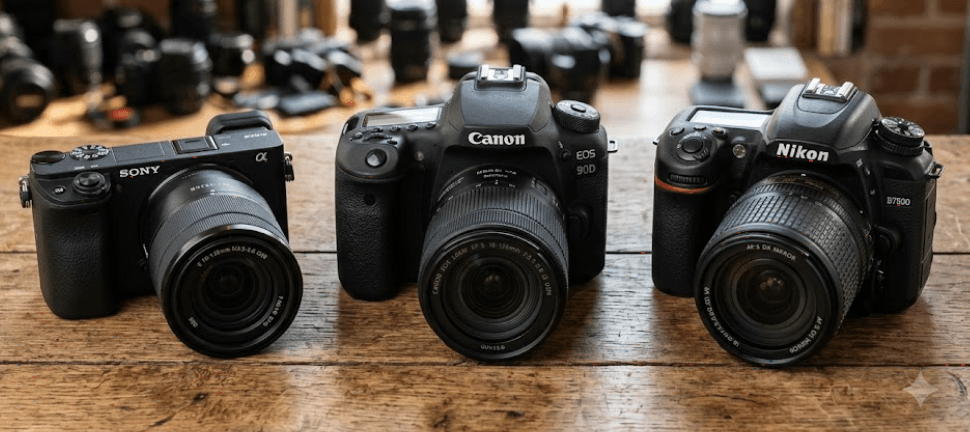
TL;DR The Sony A6400, Canon EOS 90D, and Nikon D7500 remain interesting APS-C cameras because they approach photography differently. The A6400 is the most compact mirrorless option, with a 24.2MP sensor, fast hybrid autofocus, 11fps continuous shooting, and 4K recording. The Canon EOS 90D offers the highest resolution at 32.5MP, a strong 10fps burst rate, a vari-angle touchscreen, and excellent battery life, while the Nikon D7500 uses a 20.9MP sensor, 8fps shooting, a rugged DSLR body, and an impressive 950-shot CIPA battery rating. For most buyers who want a smaller body and modern autofocus, the Sony A6400 is the most versatile choice, while the Canon 90D is better suited to photographers who value resolution and DSLR handling, and the Nikon D7500 remains a strong option for wildlife and action photographers who prioritize battery life and a traditional optical viewfinder.
Sony A6400 vs Canon 90D vs Nikon D7500
The Sony A6400, Canon EOS 90D, and Nikon D7500 all use APS-C sensors, but they were designed around very different shooting experiences. The Sony A6400 is a mirrorless camera built around portability, electronic viewing, and advanced autofocus, while the Canon EOS 90D and Nikon D7500 are traditional DSLRs with optical viewfinders and larger bodies. That difference is important because the best APS-C camera is not decided by megapixel count alone. Your choice depends on whether you value portability, autofocus, battery life, resolution, video, or the feel of a conventional DSLR. Sony lists the A6400 with a 24.2MP APS-C sensor, 425 phase-detection AF points, Real-time Tracking, and 11fps continuous shooting.
The Canon EOS 90D takes a different approach. It has a 32.5MP APS-C CMOS sensor, DIGIC 8 processing, a traditional optical pentaprism viewfinder, and up to 10fps continuous shooting through the optical viewfinder. Canon also gives it a 45-point all-cross-type autofocus system when using the optical viewfinder, while Dual Pixel CMOS AF is available in Live View. This combination makes the 90D particularly appealing to photographers who want detailed still images and the familiar handling of a DSLR. Its 3-inch vari-angle touchscreen is also useful for low-angle, high-angle, and video shooting.
The Nikon D7500 is also a DSLR, but it sits closer to Nikon's enthusiast action and wildlife philosophy. It uses a 20.9MP DX-format sensor and the EXPEED 5 processor, with continuous shooting at up to 8fps and a 51-point autofocus system. Nikon also gives it weather sealing, a deep grip, and a long-rated battery life of approximately 950 shots per charge. It is heavier than the Sony A6400 and has fewer megapixels than the Canon 90D, but those numbers do not tell the whole story. The D7500's optical viewfinder, rugged construction, long battery life, and strong telephoto ecosystem can make it a practical tool for photographers who spend long periods outdoors.
Key Specifications Compared
| Specification | Sony A6400 | Canon EOS 90D | Nikon D7500 |
|---|---|---|---|
| Camera type | Mirrorless | DSLR | DSLR |
| Sensor | 24.2MP APS-C | 32.5MP APS-C | 20.9MP DX |
| Continuous shooting | Up to 11fps | Up to 10fps | Up to 8fps |
| Autofocus | 425 phase-detection points | 45-point optical AF, Dual Pixel AF in Live View | 51-point AF |
| Video | 4K up to 30p | 4K up to 30p | 4K up to 30p |
| Viewfinder | Electronic | Optical | Optical |
| Screen | 3-inch tilting touchscreen | 3-inch vari-angle touchscreen | 3.2-inch tilting touchscreen |
| Battery rating | Approx. 360 shots EVF / 410 LCD | Approx. 1,300 shots | Approx. 950 shots |
| Weight | Approx. 403g | Approx. 701g | Approx. 640g body only |
Specifications are based on manufacturer data. Weight figures are not directly equivalent because manufacturers use different measurement conventions.
Image Quality And Sensor Performance
The Canon EOS 90D has the clear advantage on resolution, with a 32.5MP APS-C sensor compared with 24.2MP on the Sony A6400 and 20.9MP on the Nikon D7500. That additional resolution can be useful when you crop heavily or want to retain more detail in large prints. It is particularly relevant for wildlife and landscape photography, where you may want to crop into a distant subject after taking the photograph. However, more megapixels do not automatically mean better image quality. Lens quality, lighting, focusing accuracy, exposure, and processing all have a major impact on the final photograph.
The Sony A6400 takes a more balanced approach with its 24.2MP sensor. Its advantage is not resolution but the combination of image quality, autofocus, compactness, and shooting speed. Sony's APS-C sensor offers an ISO range of 100 to 32,000 for still photography, expandable to ISO 102,400, while its autofocus system combines phase and contrast detection. This makes the A6400 especially appealing when you photograph people, pets, street scenes, or moving subjects and need the camera to acquire focus quickly.
The Nikon D7500 has the lowest resolution of the three at 20.9MP, but it is not necessarily the weakest performer. Nikon designed the D7500 around the same 20.9MP DX sensor generation and EXPEED 5 processing philosophy used in its higher-end D500. Its native ISO range reaches 51,200 and can be expanded further, while its 51-point autofocus system and 8fps burst shooting make it well suited to demanding still photography. For someone photographing wildlife, sports, or outdoor subjects, the D7500's overall system can be more important than simply having the highest megapixel count.
Sensor Comparison
| Camera | Resolution | Main Advantage |
|---|---|---|
| Canon EOS 90D | 32.5MP | Highest detail and cropping flexibility |
| Sony A6400 | 24.2MP | Balanced image quality and modern autofocus |
| Nikon D7500 | 20.9MP | Strong high-ISO performance and action-oriented design |
Autofocus And Shooting Performance
Autofocus is where the Sony A6400 has a particularly strong argument. Sony built the camera around its Fast Hybrid AF system, with 425 phase-detection and 425 contrast-detection points and Real-time Tracking. It can shoot at up to 11fps, giving it an advantage in burst shooting over the Nikon D7500 and a small advantage over the Canon 90D's 10fps optical-viewfinder rate. For everyday photography, the A6400's combination of tracking and compact size makes it easy to carry and quick to use.
The Canon EOS 90D is still a capable action camera, particularly when used through its optical viewfinder. Canon specifies up to 10fps continuous shooting and a 45-point cross-type autofocus system for optical-viewfinder shooting. In Live View, Dual Pixel CMOS AF provides sensor-based autofocus and supports face detection and tracking features. This makes the 90D versatile because photographers can switch between traditional DSLR shooting and a more modern Live View experience depending on the situation.
The Nikon D7500 offers up to 8fps continuous shooting and a 51-point autofocus system. While that is slower than the other two cameras on paper, the D7500 was designed for photographers who need reliable performance in action-oriented situations. Its optical viewfinder gives the traditional DSLR experience, while its deep grip and weather-sealed body make it comfortable for longer outdoor sessions. The D7500 can therefore make more sense for a photographer who spends hours photographing wildlife or sports rather than someone primarily looking for the smallest possible camera.
Video Features And Everyday Usability
All three cameras can record 4K video, but their overall video experience is different. The Sony A6400 records 4K at up to 30p and includes features such as picture profiles, S-Log2, S-Log3, HLG, a microphone input, and a 180-degree tilting LCD screen. That combination makes it attractive to creators who want a compact hybrid camera for photography and video. Sony also designed the A6400 around fast autofocus during movie recording, which can be particularly useful when filming people or moving subjects.
The Canon EOS 90D records 4K UHD at up to 30p and Full HD at up to 120p for slow-motion footage. It also has a vari-angle touchscreen, microphone input, and headphone output, giving creators useful monitoring and audio options. Canon's Dual Pixel CMOS AF works in Live View, which is important when the camera is being used for video rather than through the optical viewfinder. For someone who wants a DSLR that can also function as a capable video camera, the 90D remains a flexible option.
The Nikon D7500 can also record 4K UHD at 30p, 25p, and 24p, along with Full HD recording at higher frame rates. Its 3.2-inch tilting touchscreen is larger than the screens on the Sony and Canon, but its overall video system is less modern than what you get from the mirrorless A6400. This does not make the Nikon unusable for video, but it does mean that buyers focused heavily on content creation may find the Sony or Canon more convenient. The D7500 makes more sense when still photography, battery life, and DSLR handling remain the priorities.
Video Comparison
| Feature | Sony A6400 | Canon EOS 90D | Nikon D7500 |
|---|---|---|---|
| 4K recording | Up to 30p | Up to 30p | Up to 30p |
| Full HD high frame rate | Up to 120p | Up to 120p | Up to 60p |
| Microphone input | Yes | Yes | Yes |
| Headphone output | No | Yes | Yes |
| Screen movement | 180-degree tilting | Vari-angle | Tilting |
| Best suited to | Hybrid creators | Photography and video | Still photography |
Battery Life And Camera Design
Battery life is one area where the DSLRs have a clear practical advantage. Canon rates the EOS 90D for approximately 1,300 shots under its specified testing conditions, while Nikon rates the D7500 at approximately 950 shots using its EN-EL15a battery. The Sony A6400 is rated for approximately 360 shots through the electronic viewfinder or approximately 410 shots using the LCD under CIPA conditions. These figures are not a guarantee of real-world performance, but they show why DSLR users can often spend longer shooting without changing batteries.
The trade-off is size and weight. The Sony A6400 is significantly lighter, making it more attractive for travel photography, street photography, everyday carrying, and situations where you do not want a large camera bag. Canon lists the EOS 90D at approximately 701g, while Nikon lists the D7500 at approximately 640g for the camera body alone. Both DSLRs are substantially larger than the A6400, although the larger bodies also provide deeper grips and more physical controls.
The D7500 also has a rugged, weather-sealed body, while Canon describes the EOS 90D as having water and dust resistance. The Sony A6400 is built as a compact interchangeable-lens camera and is particularly attractive when portability matters more than DSLR-style handling. This is why there is no universal winner here. A traveler may prefer the A6400, while a wildlife photographer who spends an entire day outdoors may appreciate the battery capacity and grip of the D7500 or 90D.
Which APS-C Camera Should You Choose?
The Sony A6400 is the strongest overall choice for buyers who want a modern, compact APS-C camera that can handle both photography and video. Its 24.2MP sensor is detailed enough for most users, while 11fps shooting and Sony's fast hybrid autofocus make it particularly useful for moving subjects. The camera's biggest advantage is how much capability it puts into a relatively small body. For travel photographers, content creators, students, and enthusiasts upgrading from a smartphone, that combination makes the A6400 easy to recommend.
The Canon EOS 90D is the better choice if resolution and DSLR handling are your priorities. Its 32.5MP APS-C sensor gives you the highest resolution of these three cameras, while its 10fps shooting, optical viewfinder, vari-angle touchscreen, and approximately 1,300-shot battery rating create a strong package for serious still photography. It is particularly appealing if you already own compatible Canon EF or EF-S lenses and want to continue using that equipment rather than moving to a different lens ecosystem.
The Nikon D7500 remains the most specialized option of the three. Its 20.9MP resolution is lower, and its 8fps burst rate trails the Sony and Canon, but its 51-point AF system, 950-shot battery rating, rugged weather-sealed construction, and optical viewfinder make it a sensible choice for outdoor and action photography. Nikon also continues to list the D7500 in its India line-up, where the current official body-only listing shows an offer price of ₹71,950, although camera prices can change.
Best Camera By Use Case
| Use Case | Best Choice | Why |
|---|---|---|
| Overall | Sony A6400 | Compact body, fast AF, 11fps shooting |
| Highest Resolution | Canon EOS 90D | 32.5MP APS-C sensor |
| Travel | Sony A6400 | Smallest and lightest body |
| Wildlife | Nikon D7500 | Rugged body, long battery, 51-point AF |
| Video And Vlogging | Sony A6400 | 4K, strong AF, compact design |
| Long Outdoor Shoots | Canon EOS 90D | Approximately 1,300-shot battery rating |
| DSLR Experience | Canon EOS 90D | Optical viewfinder and vari-angle screen |
| Value For Existing Nikon Users | Nikon D7500 | Strong F-mount ecosystem and DSLR handling |
Frequently Asked Questions
Q. Is the Sony A6400 better than the Canon 90D?
The Sony A6400 is better if you prioritize compactness, autofocus, portability, and mirrorless shooting. The Canon EOS 90D is better if you want higher 32.5MP resolution, an optical viewfinder, DSLR handling, and longer battery life.
Q. Which camera has the highest megapixel count?
The Canon EOS 90D has the highest resolution of the three with a 32.5MP APS-C sensor. The Sony A6400 has 24.2MP, while the Nikon D7500 has 20.9MP.
Q. Which camera is best for wildlife photography?
The Nikon D7500 is a strong wildlife option because of its 51-point autofocus system, 8fps continuous shooting, rugged body, and approximately 950-shot battery rating. The Canon 90D is also compelling because of its 32.5MP sensor and 10fps burst rate.
Q. Which camera is best for video?
The Sony A6400 is the strongest choice for most hybrid creators because it combines 4K recording, fast autofocus, a 180-degree tilting screen, and a compact mirrorless body. The Canon EOS 90D is also capable, particularly because it supports 4K recording and Full HD up to 120p.
Q. Does the Sony A6400 have an APS-C sensor?
Yes. The Sony A6400 uses an APS-C Exmor CMOS sensor measuring approximately 23.5 x 15.6mm and has approximately 24.2 effective megapixels.
Q. Is the Canon 90D still a good camera?
Yes. The EOS 90D remains a capable APS-C DSLR, particularly for photographers who value its 32.5MP sensor, 10fps shooting, optical viewfinder, long battery life, and extensive EF/EF-S lens compatibility.
Q. Is the Nikon D7500 good for beginners?
The Nikon D7500 can work well for beginners who are serious about learning photography, but its DSLR controls and larger body may feel less straightforward than a modern entry-level mirrorless camera. Its strengths become more valuable as you learn manual exposure, autofocus modes, and interchangeable-lens photography.
Q. Which camera has the best battery life?
The Canon EOS 90D has the highest manufacturer-rated battery life at approximately 1,300 shots under Canon's testing conditions. The Nikon D7500 is rated at approximately 950 shots, while the Sony A6400 is rated at approximately 360 shots using the EVF or 410 shots using the LCD.
Q. Which camera is the lightest?
The Sony A6400 is the lightest of the three. Sony lists the camera at approximately 403g with battery and memory card, while the Canon EOS 90D is approximately 701g and the Nikon D7500 is approximately 640g body only.
Q. Which is the best APS-C camera between the Sony A6400, Canon 90D, and Nikon D7500?
For most buyers, the Sony A6400 is the best overall choice because it offers a strong balance of image quality, autofocus, burst shooting, 4K video, and portability. The Canon EOS 90D is the better pick for high-resolution stills and long battery life, while the Nikon D7500 is particularly attractive for wildlife, outdoor photography, and photographers who prefer a rugged DSLR body.
Final Recommendation
If you want one APS-C camera that is easiest to carry, fast to focus, and versatile enough for both photography and video, the Sony A6400 is the best overall choice among these three. Its 24.2MP sensor, 11fps continuous shooting, advanced tracking autofocus, 4K recording, and compact mirrorless body give it the most balanced package for modern everyday shooting.
The Canon EOS 90D is the better alternative for photographers who care about resolution, DSLR handling, and battery life. Its 32.5MP sensor and approximately 1,300-shot battery rating make it particularly attractive for wildlife, landscapes, and long shooting sessions. The Nikon D7500 makes the most sense for photographers who value its rugged build, 51-point AF system, long battery life, and traditional Nikon DSLR experience.
So, if the priority is overall versatility and portability, choose the Sony A6400. If you want maximum resolution and DSLR battery life, choose the Canon EOS 90D. If your priority is rugged outdoor and wildlife photography, the Nikon D7500 remains a strong choice.
Ready to upgrade your tech?
Browse our collection of quality refurbished products at unbeatable prices.






