
Sony A6100 vs Canon 200D: Entry-Level Mirrorless vs DSLR
Sony A6100 vs Canon 200D compares two beginner-friendly APS-C cameras, covering autofocus, image quality, video, battery, size, lenses, and everyday usability.

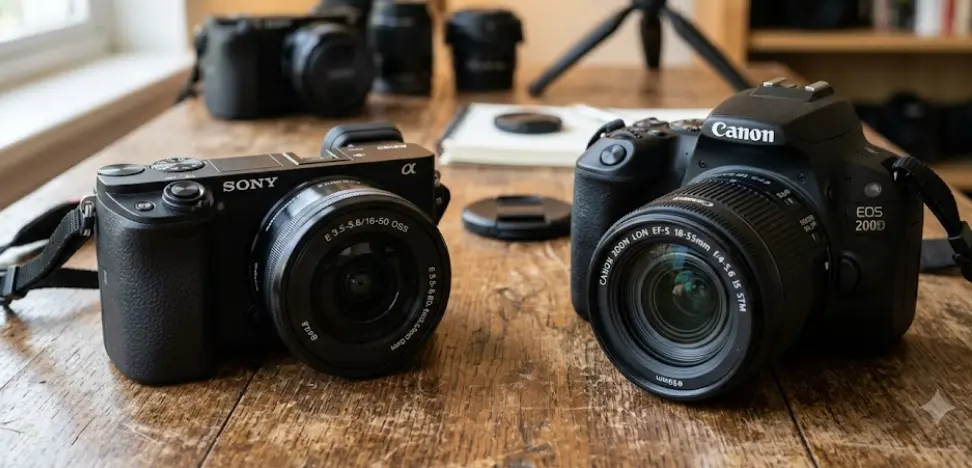
TL;DR The Sony A6100 and Canon 200D both use 24.2MP APS-C sensors, but they take very different approaches to entry-level photography. The Sony A6100 is a compact mirrorless camera with a 425-point hybrid autofocus system, 11fps continuous shooting, 4K video, an electronic viewfinder, and a 396g body. The Canon 200D is a compact DSLR with a traditional optical viewfinder, 9-point autofocus through the viewfinder, 5fps shooting, and Full HD video, while its Live View system uses Canon's Dual Pixel autofocus. The A6100 is the more modern option for buyers who want fast autofocus, video capability, and a smaller body, while the 200D remains relevant mainly when its DSLR handling, optical viewfinder, or access to the established Canon EF and EF-S lens ecosystem is more important.
Sony A6100 Vs Canon 200D: Key Differences
The Sony A6100 and Canon 200D were designed for beginners, but they represent two different stages of camera design. The A6100 is a mirrorless camera introduced in 2019, while the Canon 200D, also known as the EOS Rebel SL2 in some markets, was introduced in 2017 as a compact DSLR. Both use APS-C sensors with approximately 24.2MP resolution, so the basic image-resolution numbers are surprisingly close. The bigger differences appear when you look at autofocus, video, continuous shooting, viewfinder technology, and physical design.
The Sony A6100 uses an electronic viewfinder and a 3-inch tilting touchscreen, while the Canon 200D uses an optical viewfinder and a fully articulating 3-inch touchscreen. That distinction changes the shooting experience. With the Sony, the electronic viewfinder can display exposure and other shooting information before you take the picture. With the Canon, the optical viewfinder gives you a direct view through the lens without an electronic preview. For someone learning photography, both approaches can work well, but they encourage slightly different ways of shooting.
The age difference is also important when comparing these cameras in 2026. The Canon 200D is no longer a new-generation DSLR, so buyers are more likely to encounter it through the used, refurbished, or older-stock market. The Sony A6100 is also not a new camera by 2026 standards, but Sony continues to list the model and its specifications in India. This means the comparison is less about choosing between two current launches and more about deciding whether you want a compact mirrorless system or an older compact DSLR.
Sony A6100 Vs Canon 200D Specifications
| Feature | Sony A6100 | Canon 200D |
|---|---|---|
| Camera Type | Mirrorless | DSLR |
| Sensor | 24.2MP APS-C CMOS | 24.2MP APS-C CMOS |
| Lens Mount | Sony E-mount | Canon EF/EF-S |
| Viewfinder | Electronic | Optical |
| Autofocus | 425-point hybrid AF | 9-point viewfinder AF |
| Live View AF | Hybrid AF with tracking and Eye AF | Dual Pixel CMOS AF |
| Continuous Shooting | Up to 11fps | Up to 5fps |
| Video | 4K | Full HD 1080p |
| Screen | 3-inch tilting touchscreen | 3-inch fully articulating touchscreen |
| Weight | Approx. 396g | Approx. 453g |
| Battery Rating | Approx. 420 shots with LCD | Approx. 650 shots with optical viewfinder |
The specifications show why the two cameras can feel very different despite having the same headline megapixel count. The A6100 has a clear advantage in autofocus coverage, burst shooting, and video resolution, while the Canon 200D offers the familiar optical-viewfinder experience and a strong battery rating when shooting through the viewfinder. Sony's official specifications list 425 phase-detection and 425 contrast-detection AF points, while Canon's 200D uses a 9-point viewfinder AF system and Dual Pixel AF in Live View.
Image Quality And Sensor Performance
Image quality is not determined by megapixels alone, and that is especially important in a Sony A6100 vs Canon 200D comparison. Both cameras use APS-C sensors with approximately 24.2MP effective resolution, giving them enough detail for everyday photography, portraits, travel images, family photographs, and many forms of content creation. The similar resolution also means you should not choose between these cameras simply because one appears to have a larger megapixel number. Their image output depends on the lens, exposure, autofocus accuracy, processing, and the photographer's technique.
The Sony A6100 uses a 24.2MP APS-C Exmor CMOS sensor and supports RAW capture, giving beginners room to learn editing later. The camera also provides an ISO range of 100 to 32000 for still images, with expansion available to ISO 51200. The Canon 200D also uses a 24.2MP APS-C CMOS sensor and has a native ISO range that reaches 25600. In practical terms, both cameras can produce good results in daylight and controlled indoor environments, while lens choice becomes increasingly important as the available light falls.
The bigger difference comes from how easily each camera helps you capture that image. The A6100's autofocus system is designed to track subjects across a broad portion of the frame, and Sony includes Real-time Tracking and Eye AF features. The Canon 200D's viewfinder autofocus is much more limited, although its Dual Pixel CMOS AF makes Live View shooting considerably more capable than the nine-point viewfinder system suggests. For beginners photographing moving people, pets, or children, autofocus behavior can matter more than the small differences in image processing between two similarly resolved APS-C sensors.
Image Quality At A Glance
| Factor | Sony A6100 | Canon 200D |
|---|---|---|
| Sensor Resolution | 24.2MP | 24.2MP |
| Sensor Format | APS-C | APS-C |
| RAW Capture | Yes | Yes |
| Native ISO | 100–32000 | 100–25600 |
| Low-Light Potential | Strong with suitable lens | Strong with suitable lens |
| Main Advantage | Autofocus and tracking | Familiar DSLR shooting experience |
Autofocus And Shooting Performance
Autofocus is one of the biggest differences between these cameras. The Sony A6100 uses a Fast Hybrid AF system with 425 phase-detection and 425 contrast-detection points. Sony also specifies a claimed 0.02-second autofocus acquisition time and includes Real-time Tracking, Human Eye AF, and Animal Eye AF. This gives the camera a very modern autofocus system for an entry-level model and makes it particularly useful when the subject is moving or when you want the camera to handle focus while you concentrate on composition.
The Canon 200D approaches autofocus differently. When using its optical viewfinder, it has a 9-point autofocus system, which is significantly less extensive than the A6100's 425-point system. However, switching to Live View activates Canon's Dual Pixel CMOS AF technology, which makes focusing on the rear touchscreen much more capable. This distinction is important because simply saying that the Canon has only nine autofocus points does not tell the entire story. The shooting method changes the autofocus experience substantially.
Continuous shooting also favors the Sony. The A6100 can shoot at up to 11 frames per second, while the Canon 200D reaches up to 5 frames per second. That difference becomes useful when photographing sports, pets, children, events, or other unpredictable movement. Five frames per second is still usable for casual action, but the A6100 gives you more opportunities to capture the exact moment you want. For beginners interested in action photography, this is one of the clearest functional differences between the two cameras.
Autofocus And Speed Comparison
| Feature | Sony A6100 | Canon 200D |
|---|---|---|
| Viewfinder AF | 425-point hybrid system | 9-point system |
| Live View AF | Hybrid AF | Dual Pixel CMOS AF |
| Eye AF | Human and animal | Available in Live View |
| Tracking | Real-time Tracking | Subject tracking in Live View |
| Burst Rate | Up to 11fps | Up to 5fps |
Video And Content Creation
Video is another area where the Sony A6100 has a substantial specification advantage. It can record 4K video, while the Canon 200D is limited to Full HD 1080p. For someone buying a camera in 2026, that difference matters because 4K has become common for YouTube videos, travel content, product videos, tutorials, and social-media production. The A6100 also has a microphone input, allowing users to connect an external microphone rather than relying entirely on the camera's built-in microphones.
The Sony's 180-degree tilting touchscreen also makes it easier to frame yourself for certain types of content. This does not automatically make it a dedicated vlogging camera, but it gives creators more flexibility when setting up a shot. The A6100 can also record Full HD at higher frame rates, which can be useful for slow-motion footage. Its compact body makes it easier to carry alongside a small lens when travelling or shooting outside the home.
The Canon 200D is still capable of producing useful video for beginners, particularly if Full HD is enough for the intended use. Its fully articulating touchscreen is actually more flexible than the A6100's tilting screen for certain front-facing setups. The Canon also includes an external microphone input. However, if video resolution and modern autofocus features are major priorities, the A6100 is the more technically capable platform between these two cameras.
Video Features Comparison
| Video Feature | Sony A6100 | Canon 200D |
|---|---|---|
| Maximum Resolution | 4K | Full HD 1080p |
| Maximum Full HD Frame Rate | Up to 120fps | Up to 60fps |
| Microphone Input | Yes | Yes |
| Screen Movement | Tilting, 180-degree capable | Fully articulating |
| Best Fit | 4K creators and hybrid users | Casual Full HD video |
Size, Battery Life, And Everyday Handling
The Sony A6100 is smaller and lighter than the Canon 200D when comparing camera bodies with their batteries and memory cards. Sony lists the A6100 at approximately 396g, while the Canon 200D weighs around 453g. The difference is not enormous, but it can become noticeable when you carry the camera, spare batteries, and multiple lenses during a full day of travel. The mirrorless design also allows Sony to keep the body relatively compact because it does not require the optical mirror and prism arrangement used by a DSLR.
Battery life, however, is one area where the DSLR design can still be attractive. The Canon 200D is rated for approximately 650 shots when using its optical viewfinder, while Sony rates the A6100 at approximately 420 shots using the LCD monitor and around 380 shots through the electronic viewfinder. These figures use different shooting methods, so they should not be treated as a perfectly controlled laboratory comparison. Still, they illustrate why optical-viewfinder DSLRs can remain attractive to photographers who want long shooting sessions without changing batteries frequently.
Handling ultimately comes down to personal preference. The A6100 gives you a smaller body, electronic preview, touchscreen controls, and a modern mirrorless shooting experience. The Canon 200D gives you the physical feel of a traditional DSLR, an optical viewfinder, and a fully articulating display. If you learned photography using a DSLR, the Canon may feel familiar immediately. If you want a lighter system with newer autofocus and video features, the Sony's design is easier to justify.
Lens Ecosystem And Long-Term Use
Lens choice should be part of the decision before buying either camera. The Sony A6100 uses the E-mount, giving you access to Sony's APS-C lenses as well as a broad selection of compatible third-party lenses. This gives the camera a flexible upgrade path for someone who starts with a basic kit lens and later wants a faster prime lens, wider lens, telephoto lens, or specialist option. Because the camera is mirrorless, the E-mount system is also closely connected to Sony's wider mirrorless ecosystem.
The Canon 200D uses the EF/EF-S mount, which gives buyers access to a very large established family of Canon DSLR lenses. This can be particularly interesting in the used and refurbished market, where older Canon lenses can be easier to find at lower prices than newer mirrorless equivalents. However, buyers should remember that the 200D itself is an older DSLR platform, so buying into the system in 2026 should be based on the lenses and shooting experience you actually want rather than assuming that a DSLR automatically offers a newer upgrade path.
For a beginner, the best approach is to consider the camera body and lens as one purchase rather than treating the body as the entire system. A slightly older camera paired with a good lens can produce better results than a newer body paired with an unsuitable lens. If you already own Canon EF or EF-S lenses, the 200D can therefore become a different proposition from someone starting from zero. Likewise, someone already invested in Sony E-mount lenses has a practical reason to stay with the A6100.
Lens System Comparison
| Factor | Sony A6100 | Canon 200D |
|---|---|---|
| Mount | Sony E | Canon EF/EF-S |
| System Type | Mirrorless | DSLR |
| Used Lens Market | Broad | Very broad |
| Upgrade Potential | Strong within Sony E system | Strong for existing EF/EF-S users |
| Key Consideration | Modern mirrorless ecosystem | Established DSLR lens availability |
Sony A6100 Vs Canon 200D: Which One Fits You?
The Sony A6100 makes more sense for beginners who want a camera that can grow with photography, video, and content creation. Its 425-point autofocus system, Real-time Tracking, Eye AF, 11fps continuous shooting, 4K recording, microphone input, and relatively compact 396g body make it versatile for travel, portraits, family photography, and video. It also has a 180-degree-capable tilting screen and electronic viewfinder, which can make certain shooting situations easier to understand as you learn.
The Canon 200D is more appealing when the DSLR experience itself is part of the reason you are buying the camera. Its optical viewfinder provides a direct view of the scene, its battery rating is strong when using that viewfinder, and its fully articulating touchscreen is useful for low-angle, high-angle, and front-facing shooting. Its 24.2MP APS-C sensor remains capable for photography, but its 9-point optical-viewfinder autofocus and 1080p video show its age compared with the A6100.
Price also needs careful consideration in 2026 because neither camera should be evaluated solely from its original launch positioning. The Sony A6100 continues to appear in Sony India's current product documentation, while the Canon 200D is an older model. If a refurbished Canon 200D is substantially cheaper and comes with a useful lens, it can still make sense for photography beginners. If the prices are relatively close, the A6100's autofocus, burst shooting, video resolution, and smaller body make the comparison much more interesting.
Sony A6100 Vs Canon 200D Buying Guide
| Buyer Type | More Suitable Option | Main Reason |
|---|---|---|
| Beginner photographer | Sony A6100 | Modern AF and compact body |
| Beginner videographer | Sony A6100 | 4K recording |
| Action photography | Sony A6100 | 11fps shooting and tracking |
| Traditional DSLR user | Canon 200D | Optical viewfinder |
| Long battery sessions | Canon 200D | Higher optical-viewfinder CIPA rating |
| Existing Canon EF/EF-S owner | Canon 200D | Lens compatibility |
| Existing Sony E-mount owner | Sony A6100 | Lens compatibility |
| Refurbished-budget buyer | Canon 200D | Older body may cost less |
Common Mistakes When Choosing Between Them
One common mistake is comparing only the 24.2MP sensor resolution and assuming the cameras will perform almost identically. Resolution is important, but autofocus, lens selection, shooting speed, video capability, and handling have a much larger effect on the experience. The Sony A6100 and Canon 200D can both produce detailed photographs, but the Sony is designed to help the camera keep up with moving subjects more effectively, while the Canon's strongest traditional advantage is its optical-viewfinder shooting experience.
Another mistake is assuming that the Canon 200D's nine autofocus points mean it has poor autofocus in every situation. That specification applies to the optical viewfinder system. When shooting through Live View, the 200D uses Dual Pixel CMOS AF, which is a substantially different autofocus system. Similarly, it would be inaccurate to describe the Sony A6100 simply as a 425-point camera without mentioning its tracking and Eye AF features, because those technologies are a major part of why its autofocus is useful.
The final mistake is ignoring the condition and price of an older camera. In 2026, a Canon 200D purchased used or refurbished should be checked for shutter condition, battery health, sensor cleanliness, lens condition, screen operation, ports, and general physical wear. The same principle applies to an older A6100, although its continued presence in Sony's product documentation makes it easier to research as a model. With either camera, the actual lens included in the deal can significantly change the overall value.
Frequently Asked Questions
Q. Which camera has better autofocus, Sony A6100 or Canon 200D?
The Sony A6100 has the more advanced autofocus system overall. It uses 425 phase-detection and 425 contrast-detection points, along with Real-time Tracking and Eye AF. The Canon 200D has nine autofocus points through its optical viewfinder, although its Live View mode uses Dual Pixel CMOS AF.
Q. Does the Sony A6100 have a better sensor than the Canon 200D?
Both cameras use 24.2MP APS-C sensors, so there is no major resolution difference. The Sony A6100's newer processing and autofocus system give it advantages in certain shooting situations, but image quality also depends heavily on the lens, exposure, and shooting technique.
Q. Is the Canon 200D still worth buying in 2026?
The Canon 200D can still be useful for photography, particularly when purchased refurbished or used at an appropriate price. However, it is an older DSLR, so buyers should compare its condition and price against newer mirrorless alternatives before purchasing.
Q. Does the Sony A6100 record 4K video?
Yes. The Sony A6100 can record 4K video and also supports Full HD recording at higher frame rates. The Canon 200D records Full HD video up to 60fps and does not offer 4K recording.
Q. Which camera is lighter, Sony A6100 or Canon 200D?
The Sony A6100 is lighter. Sony lists the camera at approximately 396g with the battery and memory card, while the Canon 200D weighs approximately 453g with its battery and card.
Q. Which camera has better battery life?
The Canon 200D has a higher published CIPA rating when using its optical viewfinder, at approximately 650 shots. Sony rates the A6100 at approximately 420 shots using the LCD and 380 shots using the viewfinder. Actual battery life varies with shooting conditions and camera settings.
Q. Can the Canon 200D be used for professional photography?
Yes. A camera does not need to be a professional model to produce professional-looking photographs. The Canon 200D can produce high-quality images with appropriate lenses and technique, although its older autofocus, burst rate, and video specifications may limit it for certain demanding assignments.
Q. Is the Sony A6100 good for beginners?
Yes. The A6100 is designed as an entry-level mirrorless camera and combines automatic shooting modes with more advanced manual controls. Its autofocus tracking and Eye AF can also reduce the amount of manual focus work a beginner needs to do.
Q. Which camera is better for sports and moving subjects?
The Sony A6100 is better suited to this type of photography based on its specifications. Its autofocus tracking system and up to 11fps continuous shooting give it considerably more flexibility than the Canon 200D's up to 5fps burst rate and nine-point optical-viewfinder autofocus system.
Q. Which camera should a Canon lens owner choose?
Someone who already owns compatible Canon EF or EF-S lenses may find the Canon 200D more convenient because those lenses can be used directly with the camera. However, the decision should also consider the age of the body and whether the existing lenses are the reason for staying with the DSLR system.
Final Recommendation
The Sony A6100 is the more modern and versatile choice between these two cameras, particularly for someone starting from scratch in 2026. Its 24.2MP APS-C sensor is paired with a much more advanced autofocus system, 11fps continuous shooting, 4K video, Eye AF, Real-time Tracking, and a lighter 396g body. Those features make it useful not only for learning photography but also for travel, family photography, action, and content creation.
The Canon 200D still has a place for buyers who specifically want a compact DSLR, an optical viewfinder, strong battery performance through that viewfinder, or compatibility with existing EF and EF-S lenses. Its 24.2MP APS-C sensor remains capable, and Dual Pixel AF makes Live View considerably more useful than its nine-point optical-viewfinder autofocus specification suggests. The important point is to buy it based on its actual used or refurbished price and condition rather than treating it as a current-generation DSLR.
For most first-time buyers choosing between the two without an existing lens collection, the Sony A6100 provides the broader feature set and a more future-facing shooting experience. The Canon 200D becomes more compelling when its lower second-hand price, optical viewfinder, battery life, or existing Canon lens compatibility outweigh the benefits of the Sony's newer mirrorless features.






