Sony A6100 vs A6400: Which Entry-Level Sony Should You Rent?
Sony A6100 and A6400 offer similar 24.2MP APS-C image quality, but the A6400 adds stronger video features and a more durable build. Here is which one you should rent.

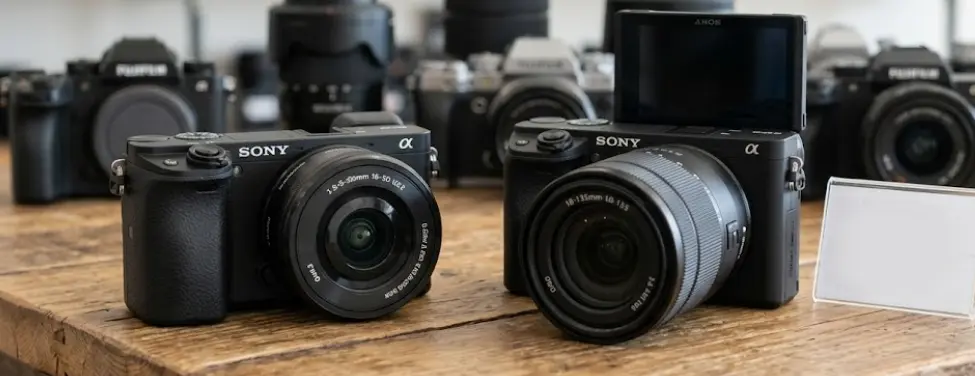
TL;DR The Sony A6100 and A6400 are remarkably close in core image quality because both use 24.2MP APS-C sensors and offer Sony’s fast hybrid autofocus system, but the A6400 is the better rental choice when your shoot involves serious video, frequent outdoor use, or more advanced colour grading. The A6100 is the smarter pick when you want a capable, lightweight Sony body for photography, travel, casual content creation, or a short-term project where keeping rental costs under control matters more than having every advanced feature. Both support 4K recording, 11fps continuous shooting, Real-time Tracking, and Real-time Eye AF, so neither camera is a weak option. The real difference is how much you value the A6400’s additional video controls, stronger body construction, and more enthusiast-focused handling.
Sony A6100 vs A6400: Key Differences
The Sony A6100 and A6400 belong to the same APS-C mirrorless family, and that is why comparing them can initially feel confusing. They share a 24.2MP APS-C Exmor CMOS sensor, Sony E-mount compatibility, a 425-point phase-detection and 425-point contrast-detection autofocus system, and continuous shooting at up to 11 frames per second. Both also support Real-time Tracking and Real-time Eye AF, which means the cheaper A6100 is not simply an entry-level camera with basic autofocus. For photography, especially portraits, travel, street photography, family events, and general-purpose shooting, the two cameras can produce very similar results when paired with the same lens.
The biggest differences become more noticeable when you move beyond the sensor and basic autofocus system. Sony positions the A6400 as a more advanced APS-C body, with features such as high-speed continuous shooting, 4K HDR movie recording using HLG, and more advanced video controls. The A6100, meanwhile, is designed to make Sony’s autofocus and image quality accessible without loading the body with every enthusiast-oriented feature. This distinction matters more when you are renting rather than buying because you only need to pay for features that your specific shoot actually requires.
There is also a physical difference in how the two cameras are positioned. The A6100 weighs approximately 396g with its battery and memory card, making it particularly easy to carry for travel or long shooting days. The A6400 is slightly heavier and is built as the more enthusiast-focused option. Neither camera has in-body image stabilization, so lens choice becomes particularly important if you plan to shoot handheld video or low-light photography. That means a rental decision should consider the lens just as carefully as the camera body.
Sony A6100 vs A6400 Specifications
| Feature | Sony A6100 | Sony A6400 |
|---|---|---|
| Sensor | 24.2MP APS-C CMOS | 24.2MP APS-C CMOS |
| Autofocus | 425 phase + 425 contrast points | 425 phase + 425 contrast points |
| Continuous Shooting | Up to 11fps | Up to 11fps |
| Video | 4K up to 30p | 4K up to 30p |
| Slow Motion | Full HD up to 120p | Full HD up to 120p |
| Display | 3-inch tilting touchscreen | 3-inch tilting touchscreen |
| Lens Mount | Sony E-mount | Sony E-mount |
| Battery Rating | Up to 420 shots with LCD | Approx. 410 shots with LCD |
| Body Positioning | Entry-level APS-C | Advanced APS-C |
The specifications show why the decision is not simply about choosing the camera with the larger number. In several fundamental areas, the cameras are effectively matched. The A6100's 24.2MP sensor, 11fps burst shooting, 4K recording, and fast autofocus already cover a wide range of rental requirements. The A6400 earns its higher position through additional features and construction rather than a dramatic jump in basic resolution.
Image Quality and Autofocus
For still photography, the Sony A6100 and A6400 are much closer than their model numbers might suggest. Both cameras use a 24.2MP APS-C Exmor CMOS sensor, so there is no huge resolution advantage for the A6400. If you rent both with the same lens and shoot under comparable conditions, the lens, exposure, lighting, and your processing workflow will have a major influence on the final image. This makes the A6100 particularly attractive for renters who simply need clean, detailed photographs without paying extra for features they may never use.
Autofocus is another area where the cheaper camera holds up surprisingly well. Sony gives the A6100 425 phase-detection and 425 contrast-detection AF points, along with Real-time Tracking and Real-time Eye AF. The A6400 also uses a 425-point phase-detection and 425-point contrast-detection system and is marketed around its fast and precise subject tracking. In practical terms, both cameras are capable of following people and maintaining focus during everyday shooting, which is especially useful for events, portraits, travel photography, and social media content where subjects do not always stay still.
The important rental takeaway is that you should not choose the A6400 simply because you assume its autofocus will produce dramatically sharper photographs. The A6100 already has a highly capable autofocus system. The A6400 becomes more compelling when autofocus is combined with its broader feature set and more advanced video capabilities. If your project is primarily photography, the A6100 can therefore offer much of the performance you actually need without making the rental unnecessarily expensive.
Video Features and Content Creation
Video is where the Sony A6400 starts to make a stronger case for itself. Both cameras can record 4K video, including 4K recording at up to 30p, and both can record Full HD slow-motion footage at up to 120fps. The A6100 also provides a microphone input, which means it can work with an external microphone instead of forcing you to rely entirely on the camera's built-in stereo microphone. For YouTube videos, interviews, travel content, and short-form productions, that already makes the A6100 considerably more useful than a basic point-and-shoot camera.
The A6400 goes further for creators who expect to grade footage or need more control over the final look. Sony lists Picture Profile support on the A6400, including options associated with advanced video workflows, as well as HLG support for HDR recording. The A6100's official specification page, by comparison, lists Picture Profile as unavailable. This is one of the clearest reasons to rent the A6400 for a professional or semi-professional video project, because the additional profiles give you more flexibility than the A6100's simpler video setup.
There is another practical point that renters often overlook: audio and stabilization. Neither body provides in-body image stabilization, so a stabilized lens, tripod, monopod, or gimbal can become important for video. Both cameras have a 3.5mm microphone input, but the overall video workflow is still influenced heavily by the lens and accessories you rent. If you are shooting a talking-head video in a controlled room, an A6100 with a suitable lens and microphone may be perfectly adequate. For a commercial shoot, event production, or footage that will undergo colour grading, the A6400 is the safer choice.
Which Camera Makes More Sense for Video?
| Shooting Requirement | Better Rental Choice | Reason |
|---|---|---|
| Casual YouTube videos | A6100 | Capable 4K and microphone input |
| Travel videos | A6100 | Lighter body and capable autofocus |
| Professional video | A6400 | More advanced video controls |
| Color grading | A6400 | Picture Profile support |
| HDR workflow | A6400 | HLG support |
| Slow-motion clips | Both | Full HD recording up to 120p |
| Handheld video | Neither alone | Consider a stabilized lens or support |
Design, Handling, and Rental Durability
The A6100 is particularly appealing when portability is important. Sony lists the body at approximately 396g including the battery and memory card, which makes it easy to carry with a compact lens. This is useful for travel shoots, college projects, street photography, and events where you may be holding the camera for several hours. The 180-degree tilting touchscreen also makes the A6100 practical for self-recording and high- or low-angle compositions.
The A6400 is the more enthusiast-oriented body, and its construction is one of the reasons it continues to make sense as a rental option. Sony describes the A6400 as lightweight, compact, and sturdily built, while its feature set is positioned closer to the advanced end of the APS-C range. For rental users working outdoors, handling the camera frequently, or changing settings throughout a shoot, those differences can matter more than the relatively small difference in sensor specifications.
This is also where you should be careful about internet claims surrounding weather sealing. The A6400 is generally regarded as having dust- and moisture-resistant construction, but that should not be interpreted as waterproofing. The A6100 should be treated more conservatively when shooting in rain or dusty conditions. If your rental involves unpredictable outdoor conditions, the A6400 is the more sensible body, but a rain cover and sensible handling are still necessary. The safest approach is never to treat either camera as a waterproof camera simply because it has some degree of environmental protection.
Rental Value and Lens Choice
When renting a camera, the body price is only one part of the decision. A camera that costs slightly more per day can be better value if it prevents you from needing another body, external recorder, or additional accessories. This is particularly relevant with the A6400 because its advanced video controls can make it more suitable for projects where you need greater control over the footage. On the other hand, paying extra for those capabilities makes little sense if you are simply photographing a trip or family event. Rental listings also show that daily rates vary considerably depending on the lens and bundle included.
The lens can have a larger impact on the final result than the difference between these two bodies. Sony's E-mount ecosystem gives both cameras access to a wide range of compatible lenses, from compact kit zooms to wide-angle, portrait, telephoto, and fast-aperture options. For example, Sony's E PZ 16-50mm lens is designed as a compact power zoom and includes Optical SteadyShot, which can be useful for handheld shooting because neither the A6100 nor A6400 has in-body stabilization.
For a rental, therefore, it makes sense to choose the body and lens as one package. A creator shooting talking-head videos may benefit from a fast lens and external microphone, while a travel photographer may prefer a compact zoom. Someone photographing sports or wildlife should prioritize a suitable telephoto lens and fast autofocus. The A6400 is the better body when you need its additional capabilities, but the A6100 can be the better value when the lens and lighting do most of the creative work.
Which Sony Should You Rent?
The Sony A6100 is the better choice when your priority is straightforward photography, travel, casual content creation, or getting strong Sony autofocus without paying for features you may not use. Its 24.2MP APS-C sensor, 11fps continuous shooting, 425-point phase-detection and contrast-detection autofocus, 4K video, microphone input, and 180-degree touchscreen give it a surprisingly complete feature set for an entry-level body. Sony also rates it for approximately 420 still images when using the LCD, which is useful for longer shooting sessions.
The A6400 is the better rental when the project demands more control. Its advanced video features, including Picture Profiles and HLG, make it more appropriate for creators who intend to grade footage or need a more flexible video workflow. It is also the better choice when you expect more demanding outdoor use and want the sturdier body design. The A6400 does not suddenly make every photograph better than an A6100 photograph, but its additional capabilities can make the overall shooting experience more suitable for professional work.
If the rental price difference is small, the A6400 is the safer all-purpose rental because it gives you more room to grow during the shoot. If the A6100 is significantly cheaper and your project is mainly photography, there is little reason to spend extra simply for the model number. For most first-time renters, the smarter approach is to identify the shoot first, select the lens second, and then decide whether the A6400's extra features are actually worth paying for.
Frequently Asked Questions
Q. Is the Sony A6400 better than the A6100?
The A6400 is the more advanced camera, particularly for video and demanding shooting conditions, but it does not have a major resolution advantage. Both use 24.2MP APS-C sensors and offer 425 phase-detection and 425 contrast-detection AF points.
Q. Which camera is better for beginners, the A6100 or A6400?
The A6100 is generally the easier recommendation for beginners because it provides strong autofocus, good image quality, 4K video, and a compact body without requiring you to pay for as many advanced features.
Q. Does the Sony A6100 shoot 4K video?
Yes. The A6100 can record 4K video at up to 30p, along with Full HD recording at frame rates up to 120p for slow-motion work.
Q. Does the Sony A6400 have better autofocus than the A6100?
Both cameras have very capable autofocus systems with 425 phase-detection and 425 contrast-detection points, along with Sony's Real-time Tracking and Eye AF features. The A6400 has a broader enthusiast-oriented feature set, but the A6100's autofocus is already highly capable.
Q. Which camera is better for YouTube videos?
The A6400 is preferable when you need Picture Profiles and more advanced control over your footage. The A6100 is still a capable choice for straightforward YouTube production because it supports 4K recording and has a microphone input.
Q. Does the Sony A6100 have a microphone input?
Yes. Sony lists a 3.5mm stereo microphone input on the A6100, allowing you to connect an external microphone for better-quality recorded audio.
Q. Does the A6400 have in-body image stabilization?
No. Neither the A6100 nor the A6400 provides in-body image stabilization, so a stabilized lens or external support can be useful for handheld video and low-light shooting.
Q. Which Sony camera should I rent for travel photography?
The A6100 is an excellent travel rental because it is compact, weighs approximately 396g with battery and memory card, and offers strong autofocus and 24.2MP image output. A compact stabilized lens can make the package even more practical.
Q. Is the A6400 worth renting instead of the A6100?
It is worth the extra rental cost when you need its advanced video controls, Picture Profiles, HLG support, or sturdier enthusiast-oriented construction. If your shoot is mainly casual photography, the A6100 can provide better value.
Q. Which camera should I rent for professional video?
The A6400 is the stronger choice between these two because its Picture Profiles and HLG support provide more flexibility for advanced video workflows. For demanding professional productions, however, you should also consider a more video-focused Sony body if the budget allows.
Final Recommendation
The Sony A6400 is the better overall rental for a serious shoot, especially when video, outdoor shooting, or advanced control is involved. Its 24.2MP APS-C sensor is not fundamentally higher-resolution than the A6100, so the reason to choose it is its broader feature set rather than a dramatic image-quality advantage. Picture Profiles, HLG support, fast autofocus, 4K recording, and the more enthusiast-focused construction make it the safer option when you are unsure what the shoot may demand.
The Sony A6100 is the better value rental for travel, portraits, everyday photography, college projects, family events, and straightforward content creation. Its 24.2MP sensor, 11fps burst shooting, excellent autofocus, 4K recording, microphone input, and lightweight 396g body already cover a lot of real-world shooting situations.
Ultimately, rent the A6100 if you want capable photography at the lowest practical rental cost, and choose the A6400 if you need more video flexibility and a more advanced shooting experience. If the rental price difference is small, the A6400 is the safer all-round choice. If the difference is substantial, put the savings toward a better lens, because the lens you put in front of either 24.2MP APS-C sensor can have a much bigger creative impact than the difference between these two camera bodies.
Ready to upgrade your tech?
Browse our collection of quality refurbished products at unbeatable prices.