Razer Blade 16 (2026) review: Core Ultra 9 386H and RTX 50-series
The Razer Blade 16 (2026) combines Intel's Core Ultra 9 386H with up to an RTX 5090, a 240Hz OLED display, and a slim premium chassis. Here is how it performs in gaming, productivity, battery life, and everyday use.

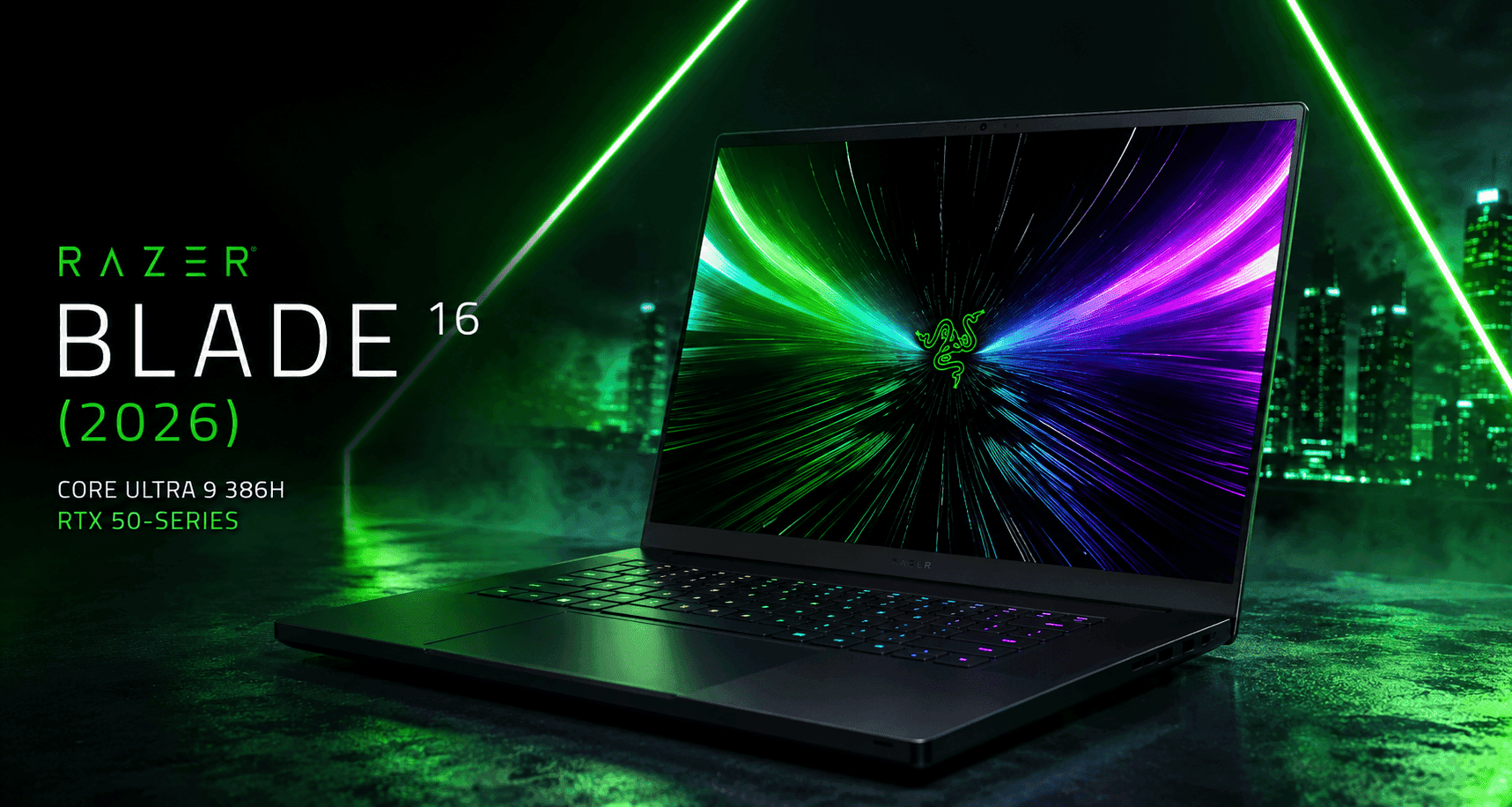
TL;DR The Razer Blade 16 (2026) is a premium gaming laptop built around Intel's Core Ultra 9 386H and Nvidia's RTX 50-series graphics, with the top configuration pairing the processor with an RTX 5090, 32GB LPDDR5X memory, a 2TB SSD, and a 16-inch 2560 x 1600 240Hz OLED display. In testing, it delivers strong gaming performance, excellent display quality, and unusually good battery life for a high-end gaming laptop, although its thin design means the CPU can fall behind thicker competitors in heavily multi-threaded workloads. The bigger concern is price: the RTX 5090 configuration tested by Tom's Hardware costs $4,899.99, while cheaper RTX 5070 Ti and RTX 5080 versions are available.
Razer Blade 16 (2026) Design And Build Quality
The Razer Blade 16 (2026) continues with the minimalist design that has made the Blade family stand out among gaming laptops. Instead of using an aggressive gaming aesthetic, Razer keeps the chassis clean and understated, with a CNC-machined aluminium construction and a relatively thin profile. Razer lists the 2026 Blade 16 at just 14.9mm thick, although the exact dimensions and weight can vary slightly depending on how they are measured. Tom's Hardware measured its review unit at 0.69 inches thick and 4.71 pounds, which is still impressively compact for a laptop carrying an RTX 5090.
That design becomes more impressive when you remember what is inside. The Blade 16 can accommodate an RTX 5090 Laptop GPU, a 90Wh battery, a vapor-chamber cooling system, and a large 16-inch OLED panel without turning into a desktop replacement. The keyboard also includes per-key RGB lighting, while the glass precision touchpad gives the machine a more premium feel than many conventional gaming laptops. Razer's approach is clearly aimed at buyers who want one laptop that can sit comfortably in an office or classroom without looking like a traditional gaming machine.
Connectivity is another strong part of the design. The 2026 model includes Thunderbolt 5, Thunderbolt 4, USB-A ports, HDMI 2.1, a UHS-II SD card reader, and a 3.5mm audio jack. That combination is particularly useful for creators who may connect external displays, storage drives, cameras, and other accessories. The main compromise is that the thin chassis has less room for cooling than bulkier gaming laptops, which becomes important when you push the CPU and GPU at the same time.
Razer Blade 16 (2026) Key Specifications
| Specification | Razer Blade 16 (2026) |
|---|---|
| Processor | Intel Core Ultra 9 386H |
| GPU | Up to Nvidia GeForce RTX 5090 Laptop GPU |
| GPU VRAM | Up to 24GB GDDR7 |
| Display | 16-inch 2560 x 1600 OLED |
| Refresh Rate | 240Hz |
| Memory | Up to 64GB LPDDR5X-9600 |
| Storage | Up to 2TB SSD |
| Battery | 90Wh |
| Connectivity | Thunderbolt 5, Thunderbolt 4, USB-A, HDMI 2.1, SD reader |
| Operating System | Windows 11 Home |
Razer's official specifications confirm that the 2026 Blade 16 is available with RTX 5060, 5070, 5070 Ti, 5080, and 5090 configurations, while memory options include 16GB, 32GB, and 64GB.
Core Ultra 9 386H Performance And RTX 50-Series Gaming
The biggest internal change for the Razer Blade 16 (2026) is the move to Intel's Core Ultra 9 386H. The processor is based on Intel's Panther Lake architecture and has 16 cores and 16 threads, split across four Performance cores, eight Efficient cores, and four Low Power Efficient cores. Its maximum turbo frequency reaches 4.9GHz. This is a different design philosophy from the higher-power HX processors found in some thicker gaming laptops, and that distinction explains both the Blade's efficiency advantage and some of its performance limitations.
The RTX 5090 Laptop GPU is where the Blade 16 becomes a serious gaming machine. The configuration tested by Tom's Hardware used the RTX 5090 with 24GB of GDDR7 memory, while Razer officially rates the 2026 Blade 16 for up to 165W GPU power. Independent testing showed strong results across several games. In Shadow of the Tomb Raider, the review unit produced 182 FPS at 1080p and 133 FPS at 1600p. In Cyberpunk 2077 with Ultra ray tracing, it reached 65 FPS at 1080p and 42 FPS at 1600p.
The interesting part is that the RTX 5090 does not always translate into class-leading results because the thin chassis and lower-power CPU can become limiting factors. In Red Dead Redemption 2, for example, Tom's Hardware recorded 94 FPS at 1080p and 71 FPS at 1600p, behind the previous Blade 16 and thicker competitors using higher-power CPUs. At the same time, the laptop performed strongly in Borderlands 3, reaching 175 FPS at 1080p and 126 FPS at 1600p. In other words, the Blade 16 is fast, but buyers should not assume that an RTX 5090 automatically means it will beat every thicker RTX 5080 or RTX 5090 laptop in every workload.
Gaming Performance At A Glance
| Game | 1080p Result | 1600p Result |
| Shadow of the Tomb Raider | 182 FPS | 133 FPS |
| Cyberpunk 2077, RT Ultra | 65 FPS | 42 FPS |
| Far Cry 6, Ultra | 106 FPS | 108 FPS |
| Red Dead Redemption 2, Medium | 94 FPS | 71 FPS |
| Borderlands 3, Badass | 175 FPS | 126 FPS |
These are Tom's Hardware test results from its Core Ultra 9 386H and RTX 5090 review configuration, so they should not be treated as guaranteed results for every Blade 16 configuration or every game.
240Hz OLED Display And Everyday Experience
The display is arguably the strongest part of the Razer Blade 16 (2026) outside of its design. The laptop uses a 16-inch 2560 x 1600 OLED panel with a 240Hz refresh rate and a 16:10 aspect ratio. Razer lists a 0.2ms response time, 100% DCI-P3 coverage, factory calibration, and HDR brightness of up to 1100 nits. That combination makes the panel suitable not only for gaming but also for photo editing, video work, and everyday productivity.
The 240Hz refresh rate is particularly useful for competitive games where high frame rates can make motion feel smoother. At the same time, the 1600p resolution gives the screen more workspace than a conventional 1080p gaming panel. The OLED technology also delivers deep blacks and strong contrast, making games and movies look more immersive. Tom's Hardware specifically praised the 16-inch 1200p OLED display in its review, while the 2026 model's official specification confirms the 2560 x 1600, 240Hz OLED configuration.
There is one practical issue to remember. The glossy OLED surface can reflect surrounding light, which can become distracting if you use the laptop near windows or under strong indoor lighting. Tom's Guide specifically noted glare and reflections during testing. The display is therefore excellent for image quality, but buyers who frequently work outdoors or in bright rooms should consider the glossy finish before buying.
Display Specifications
| Feature | Razer Blade 16 (2026) |
| Size | 16 inches |
| Resolution | 2560 x 1600 |
| Panel | OLED |
| Refresh Rate | 240Hz |
| Response Time | 0.2ms |
| Color Coverage | 100% DCI-P3 |
| HDR | Up to 1100 nits |
| Aspect Ratio | 16:10 |
Battery Life, Thermals, And Noise
Gaming laptops are usually associated with poor battery life, but the Blade 16 (2026) challenges that expectation. The laptop has a 90Wh battery, and the lower-power Core Ultra 9 386H plays an important role in its efficiency. Tom's Hardware recorded nearly 13 hours of non-gaming battery life in its testing, while Tom's Guide and other reviewers also highlighted the Blade 16's unusually strong endurance for a laptop with this level of gaming hardware.
That does not mean you should expect 13 hours while gaming. The RTX 5090 is a high-power discrete GPU, and demanding games will drain the battery far faster. The more realistic advantage is that the Blade 16 can behave like a productive everyday laptop when you are browsing, writing, watching videos, or working away from a charger. That makes its thin design more meaningful because you are not sacrificing portability every time you leave the desk.
Thermals are the trade-off. During extended gaming, the RTX 5090 in Tom's Hardware's testing reached 87 degrees Celsius, while the laptop's fans became very loud under sustained gaming loads. This is not unusual for a thin high-performance gaming laptop, but it is something buyers should understand before spending premium money. The Blade 16 gives you a much slimmer chassis than many competitors, but physics still applies when you push an RTX 5090 hard.
Battery And Cooling Highlights
| Feature | Razer Blade 16 (2026) |
| Battery | 90Wh |
| Non-gaming battery testing | Nearly 13 hours in Tom's Hardware testing |
| Cooling | Vapor chamber |
| RTX 5090 Maximum TGP | Up to 165W officially |
| Gaming noise | High under sustained load |
| Best Use | Plugged-in gaming, mobile productivity |
Razer's official specification lists up to 165W GPU power for the 2026 Blade 16, while independent testing can show different power behaviour depending on the configuration and test conditions.
Price, Configurations, And Value
The Razer Blade 16 (2026) is not a value gaming laptop. The configuration tested by Tom's Hardware, with the Core Ultra 9 386H, RTX 5090, 32GB LPDDR5X memory, 2TB SSD, and 240Hz 1600p OLED display, was priced at $4,899.99. Razer's current product page also lists the same top configuration at $4,899.99, while lower configurations are available with GPUs such as the RTX 5070, RTX 5070 Ti, and RTX 5080.
Tom's Hardware reported that keeping the Core Ultra 9 386H while moving to an RTX 5070 Ti, 32GB memory, and 1TB SSD reduced the tested configuration's price to $3,499.99. An RTX 5080 version with otherwise similar specifications was listed at $3,999.99. This makes the lower configurations much easier to justify if you want the Blade chassis and OLED display without paying the full RTX 5090 premium.
Indian buyers should be especially careful with pricing. The sources reviewed for this article confirm the US pricing and official Razer specifications, but they do not establish a consistent official Indian retail price for the 2026 Blade 16. Third-party import listings can be substantially higher and may involve different warranty or regional-support considerations. One current India-facing listing, for example, showed an imported RTX 5090 configuration at around ₹9.75 lakh, but that is not an official Razer India price and should not be treated as the standard Indian MSRP.
Razer Blade 16 (2026) Configuration Comparison
| Configuration | Key Hardware | Reported Price |
| RTX 5070 Ti | Core Ultra 9 386H, 32GB, 1TB | $3,499.99 |
| RTX 5080 | Core Ultra 9 386H, 32GB, 1TB/2TB class configuration | $3,999.99 |
| RTX 5090 | Core Ultra 9 386H, 32GB, 2TB | $4,899.99 |
Pricing is based on the configurations reported by Tom's Hardware and Razer's current US store listing, not Indian retail pricing.
Who Should Buy The Razer Blade 16 (2026)?
The Razer Blade 16 (2026) makes the most sense for someone who wants a premium laptop that can move between gaming and professional work without looking like a traditional gaming machine. The RTX 5090 configuration has enough graphics power for demanding games and creative workloads, while the 16-inch OLED display is useful for video editing, photography, design, and entertainment. The large selection of ports, SD card reader, strong keyboard, and premium chassis also make it more versatile than a machine designed purely for gaming.
It is also a strong option for people who travel with their gaming laptop. The 14.9mm profile and roughly 4.71-pound measured weight are unusually restrained for this class of hardware. The 90Wh battery and efficient Core Ultra 9 386H further improve its usefulness away from a power outlet. However, buyers should remember that the RTX 5090's full gaming performance still requires substantial power, and the cooling fans can become loud during demanding sessions.
The laptop is harder to recommend to buyers who care primarily about maximum performance per dollar. A thicker gaming laptop can sometimes use a higher-power CPU and cooling system to deliver better multi-threaded or sustained performance at a lower price. Tom's Hardware specifically found the Blade 16 behind some competitors in multi-threaded productivity, while PC Gamer also noted that cheaper alternatives can offer stronger raw performance.
Best Fit By User Type
| User Type | Verdict |
| Premium gamers | Excellent fit |
| Competitive gamers | Excellent, especially with the 240Hz OLED |
| Content creators | Excellent |
| Frequent travelers | Very good |
| Productivity-focused users | Very good, but expensive |
| Maximum performance-per-dollar buyers | Look at thicker alternatives |
| Budget gamers | Not recommended |
Frequently Asked Questions
Q. What processor does the Razer Blade 16 (2026) use?
The reviewed 2026 configuration uses Intel's Core Ultra 9 386H, a 16-core, 16-thread Panther Lake processor with a maximum turbo frequency of 4.9GHz.
Q. Which GPU is available in the Razer Blade 16 (2026)?
The 2026 Blade 16 is available with Nvidia RTX 50-series Laptop GPUs, ranging from the RTX 5060 up to the RTX 5090, depending on configuration.
Q. How good is the RTX 5090 version for gaming?
It is a very capable gaming laptop, with strong results in demanding games. However, thicker laptops with higher-power CPUs and cooling can outperform it in some workloads, so the RTX 5090 name alone does not guarantee the highest performance in every game.
Q. Does the Razer Blade 16 (2026) have an OLED display?
Yes. The 2026 Blade 16 offers a 16-inch 2560 x 1600 OLED display with a 240Hz refresh rate, 0.2ms response time, and 100% DCI-P3 coverage.
Q. How long does the Razer Blade 16 (2026) battery last?
Tom's Hardware recorded nearly 13 hours of non-gaming battery life in its testing. Actual runtime will vary considerably depending on brightness, workload, GPU use, and power settings.
Q. Is the Razer Blade 16 (2026) good for content creation?
Yes. The high-resolution OLED display, 100% DCI-P3 coverage, RTX 50-series graphics, SD card reader, and powerful processor make it well suited to photo and video workflows.
Q. Is the Razer Blade 16 (2026) good for travel?
It is unusually portable for a high-performance gaming laptop. Razer lists the chassis at 14.9mm thick, while Tom's Hardware measured its review unit at 4.71 pounds.
Q. Does the Razer Blade 16 (2026) get hot?
Like other thin high-performance gaming laptops, it can become hot and loud under sustained gaming loads. Tom's Hardware measured the RTX 5090 at 87 degrees Celsius during its stress testing and noted very loud fans during gaming.
Q. How much does the Razer Blade 16 (2026) cost?
The Core Ultra 9 386H and RTX 5090 configuration tested by Tom's Hardware costs $4,899.99 in the US. Cheaper RTX 5070 Ti and RTX 5080 configurations are also available.
Q. Is the Razer Blade 16 (2026) worth buying?
It is worth considering if you specifically want a slim premium chassis, excellent 240Hz OLED display, strong RTX 50-series gaming performance, and good battery life. It is less compelling if your priority is maximum performance per dollar, because thicker competitors can deliver stronger sustained performance for less money.
Final Recommendation
The Razer Blade 16 (2026) is one of the most polished premium gaming laptops of 2026, but it is not a straightforward recommendation for everyone. The combination of the Core Ultra 9 386H, RTX 5090, 240Hz OLED display, 90Wh battery, and slim aluminium chassis gives it a rare mix of gaming performance, portability, and everyday usability. Its battery life is particularly impressive for a laptop in this performance class, while the OLED panel makes it equally attractive for gaming and creative work.
The catch is price. At $4,899.99 for the RTX 5090 configuration, you are paying a substantial premium for Razer's design, portability, display, and overall refinement. Thicker competitors can deliver better sustained CPU performance and sometimes better performance per dollar. For most buyers, the RTX 5070 Ti or RTX 5080 configuration is therefore easier to justify than the RTX 5090 model unless you specifically need the additional GPU headroom and 24GB of VRAM.
Our recommendation: Buy the Razer Blade 16 (2026) if you want a premium, portable gaming laptop that also works as a high-end creative and productivity machine. If raw performance per dollar matters more than the thin design and premium experience, look at a thicker RTX 5080 or RTX 5090 gaming laptop instead.