
RAM and DDR5 Price Crisis Explained: Why Laptop Prices Are Rising in 2026
DDR5 and RAM prices are rising in 2026 as AI data centers compete for memory supply. Here is why laptop prices are under pressure and what buyers should do.

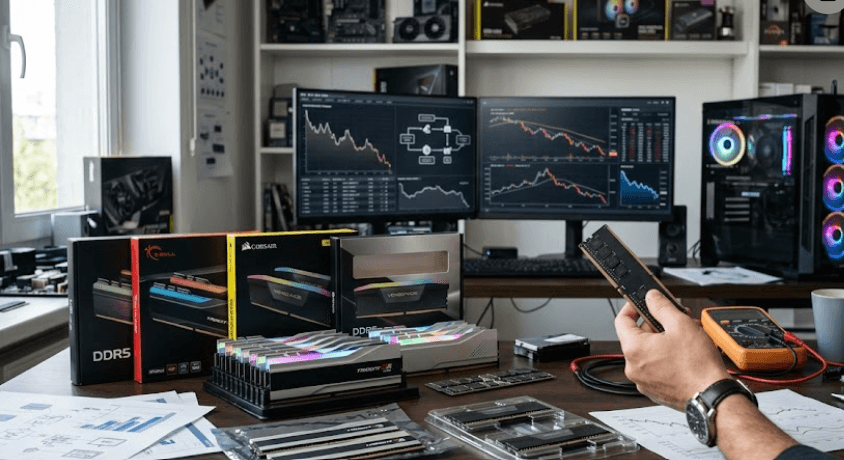
TL;DR RAM and DDR5 prices have become a major factor in laptop pricing in 2026 as the memory industry deals with unusually strong demand from AI data centers, tight DRAM supply, and manufacturers prioritizing higher-margin server memory. TrendForce expects conventional DRAM contract prices to rise another 13% to 18% in the third quarter of 2026, although the rate of increase has slowed as consumer demand reaches affordability limits. This does not mean every laptop will suddenly become more expensive by the same percentage, because brands can absorb some costs, change configurations, or adjust pricing at different times. However, the pressure is real, and buyers may see higher prices, fewer high-RAM configurations at lower price points, or weaker value when comparing new laptops in 2026.
Why RAM Prices Are Rising In 2026
The current RAM price crisis is not simply a case of retailers deciding to charge more. It starts much higher up the supply chain, where semiconductor manufacturers have to decide how limited production capacity is allocated between different types of memory. AI data centers are demanding enormous quantities of high-performance memory, particularly high-bandwidth memory used alongside AI accelerators. At the same time, conventional DRAM used in PCs and laptops is also facing tighter supply. TrendForce reported in July 2026 that conventional DRAM contract prices were expected to rise 13% to 18% quarter over quarter in Q3 2026, while NAND Flash prices were forecast to rise 10% to 15%.
The important point is that AI does not necessarily use the exact same consumer DDR5 modules found in a typical laptop. Instead, the AI boom is affecting the broader memory manufacturing ecosystem. HBM and other advanced memory products compete for manufacturing resources, while suppliers have strong incentives to prioritize products with better margins and long-term enterprise demand. Micron, for example, has been benefiting from strong AI-driven memory demand and has announced major investments aimed at expanding future semiconductor and memory capabilities.
That supply pressure eventually reaches consumer electronics. Laptop manufacturers purchase memory as a component, so a sustained increase in memory costs can raise the cost of producing a laptop. Brands then have several choices: absorb some of the increase, raise retail prices, reduce discounts, change RAM configurations, or make other adjustments to protect margins. TrendForce had already warned in late 2025 that rising memory prices could push notebook manufacturers toward higher prices or specification changes in 2026.
What Is Driving The Memory Shortage?
The current situation is best understood as a supply-and-demand problem rather than a single shortage event. AI infrastructure is increasing demand for memory at a rapid pace, while semiconductor manufacturing capacity cannot be expanded instantly. Building and qualifying new semiconductor production capacity takes years, which means manufacturers cannot simply add enough output overnight to eliminate a sudden demand imbalance. This is one reason analysts expect elevated memory pricing to remain a concern beyond the immediate quarter.
| Factor | Impact On Laptop Buyers |
|---|---|
| AI data-center demand | Increases pressure on global memory supply |
| Tight DRAM supply | Raises component costs |
| Higher server-memory demand | Can reduce flexibility for consumer supply |
| Rising DDR5 costs | Can increase laptop manufacturing costs |
| Higher NAND prices | Can also affect SSD-equipped laptops |
| Limited new manufacturing capacity | Makes quick price relief difficult |
How DDR5 Prices Affect Laptop Prices?
DDR5 is now widely used across modern laptops, particularly newer Intel and AMD systems, but the impact of higher DDR5 prices is not identical across every product. A laptop with 16GB of memory does not automatically become 16% more expensive because DRAM contract prices rise 16%. Memory is only one component of a complete laptop, alongside the processor, display, SSD, battery, chassis, cooling system, motherboard, and other components. Retail pricing also depends on brand strategy, inventory, promotions, currency movements, and distribution costs.
The more visible impact can be the changing value of a laptop rather than a simple price increase. A manufacturer may keep a laptop close to its previous price but offer a different RAM configuration, reduce promotional discounts, or position a higher-memory model at a higher tier. This matters because buyers often compare laptops by headline specifications. If 16GB remains standard but 32GB configurations become significantly more expensive, shoppers who need more memory may feel the impact more directly.
Current Indian laptop listings show why this comparison needs to be made model by model. For example, recent Indian price listings include 16GB DDR5 laptops across gaming and mainstream categories, with several models priced between roughly ₹55,000 and ₹90,000 depending on the processor, GPU, display, and other hardware. These prices should not be treated as evidence that RAM alone determines laptop pricing, but they show that DDR5-equipped laptops continue to span a wide range of configurations.
Why 16GB And 32GB Laptops Matter More?
For most mainstream users, 16GB remains a practical target in 2026, particularly for browsing, office applications, online meetings, study, and general productivity. Users working with heavier creative applications, virtual machines, large datasets, or demanding multitasking may benefit from 32GB or more. The RAM price crisis therefore becomes more important as your required memory capacity increases because moving to a higher-capacity configuration can become disproportionately expensive.
| Laptop Use | Practical RAM Target In 2026 |
| Basic browsing and office work | 8GB to 16GB |
| College and productivity | 16GB |
| Gaming | 16GB to 32GB |
| Photo and video editing | 16GB to 32GB |
| Programming and development | 16GB to 32GB |
| Virtual machines and heavy workloads | 32GB or more |
These are practical buying guidelines rather than fixed requirements. A well-optimized system with 16GB can remain perfectly usable for years, while a poorly balanced laptop with 32GB can still feel slow because of a weak processor, slow storage, poor cooling, or another bottleneck.
Why AI Is Affecting Consumer Memory?
The connection between AI and laptop RAM prices is often oversimplified. It is not accurate to say that AI companies are simply buying all the DDR5 RAM used in consumer laptops. The more important issue is that AI infrastructure has created enormous demand for advanced memory, particularly HBM, while also increasing demand for conventional DRAM and storage across data-center systems. This changes the economics of memory manufacturing and encourages suppliers to prioritize products and customers that generate stronger returns.
The effect is already visible in industry forecasts. TrendForce reported that strong AI server demand was continuing to support memory prices in 2026, while consumer markets were beginning to face affordability limits. The same forecast projected conventional DRAM contract prices to rise 13% to 18% in Q3 2026, although that was a much slower increase than the previous quarter. This distinction is important because it shows that prices are still under pressure, but the rate of increase is not necessarily accelerating indefinitely.
Memory manufacturers are also investing heavily in future capacity. Micron announced a $10 billion AI memory research laboratory in Boise in August 2026 and has separately outlined major manufacturing investments. These investments can eventually improve supply, but new semiconductor capacity takes time to come online. That means consumers should not assume that a major investment announced today will immediately translate into cheaper DDR5 modules or cheaper laptops tomorrow.
Why The Crisis Can Last Beyond 2026?
The biggest reason for caution is the time required to expand semiconductor manufacturing. Memory markets are cyclical, and prices can eventually fall when supply catches up with demand. However, the current AI infrastructure buildout is creating a particularly strong source of demand, while manufacturers are balancing consumer DRAM against server memory and HBM production.
This does not mean laptop prices will rise continuously throughout 2026. In fact, current evidence suggests that consumer affordability is already limiting how aggressively prices can rise. TrendForce's Q3 forecast specifically points to more moderate increases because customers in consumer electronics are resisting record-high component costs.
For buyers, this means the market may become more uneven rather than simply more expensive. Some laptops may see noticeable price increases, while others may remain stable because manufacturers absorb costs or use older inventory. Premium laptops may also handle component increases differently from budget models because their overall pricing has more room to absorb changes.
What The RAM Crisis Means For Laptop Buyers?
The most important change for shoppers is that specifications need to be evaluated against price more carefully than before. A laptop advertised with 32GB RAM may look attractive, but if it costs substantially more than a 16GB model with a better processor and display, the extra memory may not provide the best overall value for your workload. Similarly, a cheap laptop with 8GB RAM may appear affordable but could become restrictive sooner if the memory cannot be upgraded.
Upgradeable memory deserves particular attention during this period. A laptop with accessible RAM slots can allow you to buy a lower initial configuration and increase memory later if the platform supports it. However, not every laptop provides this flexibility. Many thin-and-light machines use soldered LPDDR memory for design and efficiency reasons, meaning the RAM capacity must be selected when you purchase the laptop.
The current memory shortage makes this decision more important because paying for adequate RAM upfront can protect you against future upgrade costs. At the same time, there is no reason to automatically buy the maximum available capacity. If your workload is mainly Chrome, Microsoft Office, streaming, messaging, and occasional photo editing, 16GB may be enough. If you regularly use professional creative software, development environments, virtual machines, or large datasets, 32GB can be a more sensible long-term choice.
Should You Buy A Laptop Now?
| Buyer Situation | Sensible Approach |
| Need a laptop immediately | Buy based on current value rather than waiting indefinitely |
| Mostly productivity | Prioritize a balanced 16GB configuration |
| Heavy creative work | Consider 32GB if the price premium is reasonable |
| Gaming | Compare 16GB and 32GB based on the specific games and workload |
| Long-term ownership | Consider upgradeability or adequate RAM upfront |
| Tight budget | Avoid paying a large premium solely for extra RAM |
The market does not currently provide a reliable reason to assume that waiting a few months will guarantee dramatically lower laptop prices. Memory prices remain elevated, and TrendForce's latest outlook still expects conventional DRAM prices to rise in Q3 2026, even though the rate has slowed. If you need a laptop for work, college, or an important project, waiting solely for a hypothetical RAM price correction may not make financial sense.
On the other hand, buyers who do not need a laptop immediately can monitor discounts and compare older-generation models. Retailers may still offer strong deals on existing inventory, and a previous-generation laptop with 16GB RAM, a capable processor, and upgradeable memory can sometimes provide better value than a newer model with a higher launch price.
How To Get Better Value During The RAM Crisis?
The smartest approach in 2026 is to evaluate the complete laptop rather than treating RAM as the only important specification. A laptop with 16GB RAM, a strong processor, a fast SSD, and good thermals can be a better purchase than a machine with 32GB RAM paired with weaker hardware. The same principle applies to gaming laptops, where GPU performance often has a much larger impact on gaming performance than moving from 16GB to 32GB.
You should also check whether the laptop uses upgradeable SODIMM memory or soldered memory before buying. If the RAM is upgradeable, you have more flexibility to start with a lower capacity and increase it later. If it is soldered, choose the configuration more carefully because you generally cannot replace the onboard memory with a larger module later. This is particularly important for thin-and-light laptops where soldered LPDDR memory is common.
Finally, compare the exact configuration rather than relying on the laptop family name. Two laptops with the same processor can have different RAM capacities, storage, displays, cooling systems, and GPUs. Indian price listings already show significant variation between DDR5 laptops, even within similar price bands. During a memory price crisis, configuration-level comparison becomes even more important because a small change in RAM or SSD capacity can significantly alter the value of a particular deal.
What To Check Before Buying?
| Check | Why It Matters |
| RAM capacity | Determines multitasking headroom |
| RAM type | DDR5 and LPDDR5X have different platform designs |
| Upgradeability | Determines whether RAM can be expanded later |
| SSD capacity | NAND prices are also under pressure |
| Processor | Prevents overspending on memory while ignoring CPU performance |
| GPU | Critical for gaming and GPU-heavy creative work |
| Current price | Memory costs are making pricing more volatile |
The broader market evidence supports being selective rather than panicking. Memory prices are under genuine pressure, but consumer demand is also pushing back against higher prices. TrendForce expects slower growth in DRAM prices in Q3 2026 than in the previous quarter, while reports from the PC market indicate that elevated memory costs are already affecting shipments and pricing decisions.
For Indian buyers, this means the best strategy is not necessarily to buy the most expensive laptop available today. Instead, look for a well-balanced configuration that provides enough RAM for your actual workload, preferably with upgradeability when possible. A good discount on a previous-generation model can also be more valuable than paying a premium for a newer laptop simply because it carries a higher RAM number.
Frequently Asked Questions
Q. Why are RAM prices rising in 2026?
RAM prices are rising mainly because memory demand has increased sharply while supply remains tight. AI data centers are a major source of demand, particularly for high-performance memory, while conventional DRAM used in PCs is also under pricing pressure. TrendForce expects conventional DRAM contract prices to rise 13% to 18% in Q3 2026.
Q. Is DDR5 RAM more expensive in 2026?
Yes, DDR5 pricing has come under significant pressure in 2026. Industry reports show strong DDR5 demand and tight supply, while retail DDR5 prices have experienced substantial increases compared with earlier periods. However, the exact price varies by capacity, speed, region, retailer, and module type.
Q. Are laptop prices rising because of the RAM shortage?
Memory costs are one factor putting upward pressure on laptop prices, but they are not the only factor. Processor costs, SSD prices, displays, manufacturing, logistics, currency movements, and brand pricing decisions also influence the final price. TrendForce has specifically warned that higher memory costs can pressure notebook manufacturers to raise prices or change configurations.
Q. Will laptop RAM prices fall in 2026?
There is no reliable guarantee that RAM prices will fall substantially during 2026. Current forecasts still show conventional DRAM prices increasing in Q3, although the pace of growth has slowed as consumer affordability limits demand. Longer-term price relief depends on supply expansion and how AI-related memory demand develops.
Q. Should I buy a 16GB or 32GB laptop in 2026?
For general productivity, college work, browsing, office applications, and everyday multitasking, 16GB is still a practical target. Users working with virtual machines, professional creative applications, large datasets, or heavy multitasking should consider 32GB. The important factor is whether the additional RAM provides meaningful value for your workload.
Q. Is soldered RAM a problem during the RAM price crisis?
Soldered RAM is not inherently bad, but it makes the initial configuration more important. If the laptop has soldered memory, you generally cannot upgrade it later in the same way you can with replaceable SODIMM modules. Buying enough RAM upfront can therefore be useful when memory prices are volatile.
Q. Does AI directly use DDR5 laptop RAM?
Not in the simple sense that AI companies are buying all consumer DDR5 modules. AI systems rely heavily on specialized memory such as HBM, but the broader demand for AI infrastructure affects memory manufacturing capacity, supply allocation, and pricing across the industry. This broader market pressure can eventually affect conventional DRAM used in laptops.
Q. Is 8GB RAM enough for a laptop in 2026?
8GB can still work for basic tasks, particularly on lightweight systems, but 16GB is a safer target for most new Windows laptops in 2026. If you expect to keep the laptop for several years, choosing 16GB can provide more room for modern applications and multitasking.
Q. Should I wait for RAM prices to fall before buying a laptop?
If you do not urgently need a laptop, monitoring prices and discounts makes sense. However, there is no guarantee that waiting will produce a large saving because current forecasts still show memory pricing under pressure. If you need a laptop now, a well-priced model with an appropriate RAM configuration is usually a better strategy than waiting indefinitely.
Q. What is the best way to save money on a laptop during the RAM crisis?
Look for balanced configurations rather than paying a large premium for maximum RAM. Compare 16GB and 32GB models, check whether the memory is upgradeable, consider previous-generation laptops, and compare the processor, GPU, SSD, and display alongside RAM. A discounted laptop with enough memory for your workload can offer better value than a newer model with unnecessarily high RAM.
Final Recommendation
The RAM and DDR5 price crisis is a genuine issue for laptop buyers in 2026, but it should not turn into a reason to panic-buy. AI-driven demand, tight memory supply, and strong server-memory requirements are keeping pressure on the DRAM market, with TrendForce still forecasting a 13% to 18% quarterly increase in conventional DRAM contract prices for Q3 2026. At the same time, consumer affordability is beginning to limit how quickly manufacturers can pass those increases on to buyers.
For most people, the safest choice is a 16GB laptop with a strong processor and good overall configuration, while users with demanding creative, development, or professional workloads should consider 32GB. If you are choosing between soldered and upgradeable RAM, upgradeability adds useful flexibility, but a well-priced laptop with soldered memory can still be an excellent purchase if you select enough RAM from the beginning.
The bigger lesson from the 2026 memory crisis is to stop judging a laptop by one specification. RAM matters, but so do the processor, GPU, SSD, display, cooling, battery, and upgrade path. If you find a laptop that offers the right amount of memory at a sensible price, there is little reason to wait solely because you expect RAM prices to suddenly return to their older levels. The current market suggests that meaningful relief may take time, so buy for your actual workload, compare configurations carefully, and prioritize overall value over maximum RAM capacity.
Ready to upgrade your tech?
Browse our collection of quality refurbished products at unbeatable prices.