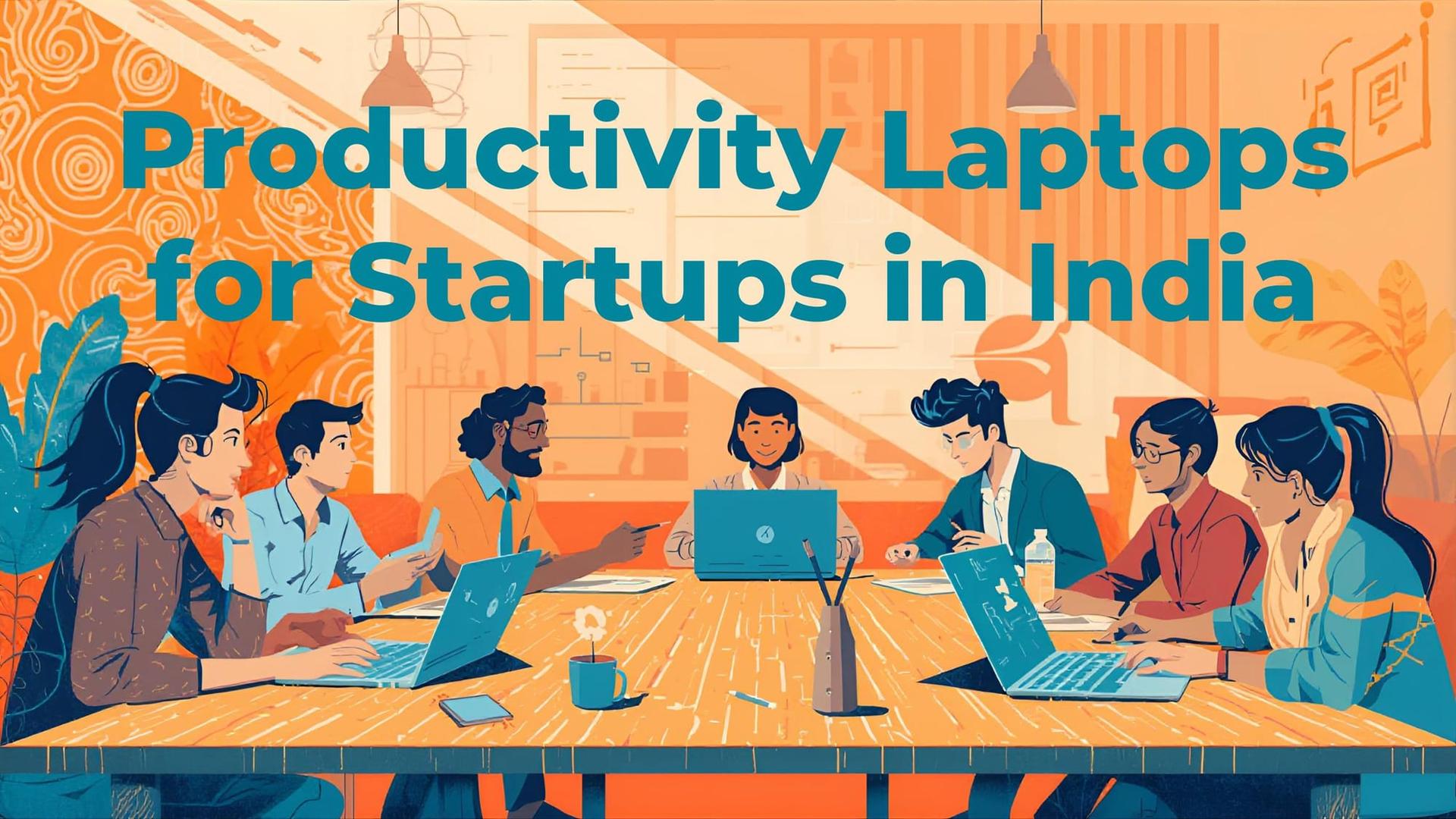
Productivity Laptops for Startups in India
Discover the best productivity laptops for startups in India for 2026, from budget to flagship options, with AI-ready performance, long battery life, multitasking power, and scalable business-focused laptop recommendations.

TL;DR Startups in India should choose productivity laptops based on real-world multitasking stability, long battery reliability, AI-ready processors, and long-term scalability instead of just spec-sheet marketing. In 2026, the smartest startup laptop combines at least 16GB RAM, fast SSD storage, Wi-Fi 6 or 6E, strong keyboard comfort, lightweight portability, fast charging, and future-ready AI copilots. Whether you are building with a lean founding team or scaling a multi-function startup, the right laptop directly improves execution speed, decision-making efficiency, and operational momentum.
Why Startup Laptop Decisions Directly Influence Execution Speed
In startup environments, laptop decisions are far more strategic than they initially appear. Early teams are constantly switching between product roadmaps, investor decks, CRM dashboards, analytics platforms, hiring workflows, customer support tools, and collaboration apps. When the laptop becomes a bottleneck, the slowdown compounds across multiple functions. This is why choosing the right productivity laptop for startups in India should be treated as an execution decision rather than a hardware expense.
The real challenge is sustained multitasking. Founders and early operators rarely use a laptop for one task at a time. It is common to keep 20+ browser tabs open alongside Slack, Notion, Google Sheets, Figma, Jira, Zoom, and multiple SaaS dashboards. A machine that slows down during these layered workflows directly impacts turnaround speed and team responsiveness. This is where productivity-focused laptops outperform generic consumer laptops because they are selected around workflow consistency instead of raw peak bursts.
Portability is equally critical in Indian startup culture. Work often shifts between co-working spaces, investor meetings, cafés, remote setups, and home offices. A lightweight chassis combined with dependable battery life ensures work continuity across locations. For founders, operators, marketers, and PMs, this flexibility directly supports faster decision-making and execution.
The Core Laptop Specifications That Actually Improve Startup Productivity
The most important laptop decision for startups is choosing the right processor class. In 2026, the sweet spot is Intel Core i5, Core Ultra 5, Core Ultra 7, AMD Ryzen 5, Ryzen 7, or Ryzen AI processors. These chips deliver the right balance of performance, battery efficiency, and AI-assisted workflow acceleration. Instead of focusing only on benchmark leadership, startups should prioritise processors that remain stable under long browser-heavy and SaaS-heavy workloads.
Memory remains equally important because modern startup work is deeply multitasking-centric. 16GB RAM should now be treated as the baseline rather than the upgrade tier. For founders running multiple dashboards, local design tools, SQL clients, light code editors, and AI copilots, 32GB becomes a much smarter long-term decision. Adequate RAM directly reduces reload delays and helps systems stay responsive during long workdays.
SSD storage is another non-negotiable requirement. Fast NVMe storage dramatically improves wake times, application launch speed, local file retrieval, and large presentation handling. Add strong keyboard ergonomics, Wi-Fi 6 or 6E, USB-C, and fast charging, and the laptop becomes a genuine productivity multiplier rather than a simple device.
Startup Productivity Laptop Requirements Table
| Startup Stage | Recommended Baseline |
|---|---|
| Early-stage founders | 16GB RAM, 512GB SSD |
| Scaling startup teams | 16GB–32GB RAM, 1TB SSD |
| Leadership and strategy | Premium ultrabook, AI-ready CPU |
| Hybrid work teams | Wi-Fi 6E, strong webcam, fast charging |
Budget Productivity Laptops for Early-Stage Startups (₹40,000–₹70,000)
For early-stage startups, the goal is maximum workflow efficiency without locking too much capital into hardware. Budget productivity laptops in this segment can comfortably handle browser-heavy SaaS workflows, finance sheets, CRM tools, documentation, video calls, and marketing dashboards. What matters most is performance consistency rather than premium materials.
The best options in this segment typically include the Dell Inspiron, Lenovo IdeaPad, and ASUS Vivobook families. These systems usually provide enough CPU headroom for business tools while maintaining comfortable keyboards and practical battery life. For founders managing multiple cross-functional tasks, this segment offers the strongest ROI because the saved capital can be redirected toward hiring, tooling, or acquisition.
The smartest way to buy in this segment is to prioritise SSD storage and upgradeable RAM. Even if the laptop begins with 8GB, the ability to scale to 16GB dramatically improves lifespan. Fast charging is another underrated advantage because startup work rarely follows predictable desk schedules.
Mid-Range Productivity Laptops for Scaling Teams (₹70,000–₹1,10,000)
As startups scale, the complexity of daily workflows increases significantly. Multiple dashboards, marketing tools, analytics stacks, finance platforms, product collaboration suites, AI copilots, and long meeting hours all place heavier demands on the laptop. This is where the mid-range category becomes the operational sweet spot.
Laptops like the HP Pavilion, Lenovo ThinkPad, and ASUS Zenbook families are particularly strong in this range because they improve thermal stability, display quality, keyboard comfort, and battery consistency. These are the systems that support startup PMs, marketers, engineers, founders, and operators who split their time between deep work and constant meetings.
Security also becomes more important at this stage. TPM 2.0, fingerprint sensors, webcam shutters, and business-grade firmware protection become meaningful additions as startups handle more customer and financial data. This makes mid-range laptops the most balanced long-term category for growing teams.
Flagship Productivity Laptops for Founders and Leadership (₹1,10,000+)
For founders, CXOs, senior PMs, and leadership teams, flagship productivity laptops create the best long-term ownership experience. At this level, the laptop is not just a work device but the central execution hub for investor meetings, board decks, hiring calls, financial planning, and cross-functional oversight.
The strongest flagship choices remain the MacBook Air, Lenovo ThinkPad X1 Carbon, and Dell XPS 13. These systems deliver exceptional portability, premium displays, stable thermals, all-day battery, and ecosystem-level continuity. For startup leaders who frequently travel or move between meetings, these advantages directly reduce friction throughout the day.
The real differentiator in 2026 is AI integration. Premium ultrabooks increasingly support local AI acceleration for smart scheduling, meeting summaries, transcription, background noise suppression, and intelligent power optimisation. These features create small but compounding productivity gains over time.
The Smartest Startup Laptop Buying Framework for 2026 and Beyond
The smartest way to buy laptops for startups is to align the hardware tier with business stage rather than aspirational specs. Early teams should optimise for ROI, scaling teams should optimise for consistency, and leadership should optimise for portability plus decision velocity. The wrong laptop tier often leads to overpaying or underpowering workflows.
Future-proofing is equally important. Prioritise AI-ready CPUs, 16GB+ RAM, Wi-Fi 6E, fast charging, upgradeability where possible, and strong battery health systems. These are the features that ensure the device remains relevant through 2027 and beyond rather than forcing early replacement cycles.
The final recommendation is simple: startups should treat laptops as productivity infrastructure. The right device improves speed, collaboration, focus, and operational confidence every single day. In early-stage environments where execution speed defines survival, this becomes one of the most important hardware decisions a founder can make.
Frequently Asked Questions
Q. What is the ideal RAM for a startup laptop in 2026?
For most startup teams, 16GB should now be treated as the minimum baseline because SaaS-heavy multitasking, AI copilots, dashboards, and long browser sessions quickly consume memory. Leadership and heavy multitaskers should strongly consider 32GB.
Q. Should founders buy flagship laptops from day one?
Not always. Early-stage founders should prioritise ROI and redirect capital toward growth. Flagship laptops make more sense when meetings, travel, investor communication, and leadership workflows dominate the day.
Q. Are AI-ready processors worth it for startups?
Yes. AI-ready CPUs improve local transcription, meeting summaries, workflow automation, and smart battery optimisation, which can create real productivity gains across startup operations.
Q. Is battery life more important than raw performance?
For most startup workflows, balanced performance with strong battery life is better than peak performance with poor endurance because work frequently happens across multiple locations.
Q. Which laptop segment is best for scaling startup teams?
The ₹70,000 to ₹1,10,000 mid-range segment is usually the sweet spot because it balances multitasking power, battery stability, portability, and business security features.
Ready to upgrade your tech?
Browse our collection of quality refurbished products at unbeatable prices.