
Nikon Z6 vs Z6 Mark II: Is the Upgrade Worth Buying For?
The Nikon Z6 II improves on the Z6 with faster shooting, better autofocus, dual card slots and stronger video features. But in 2026, the upgrade makes the most sense only when you need those specific improvements or find the Z6 II at a strong price.

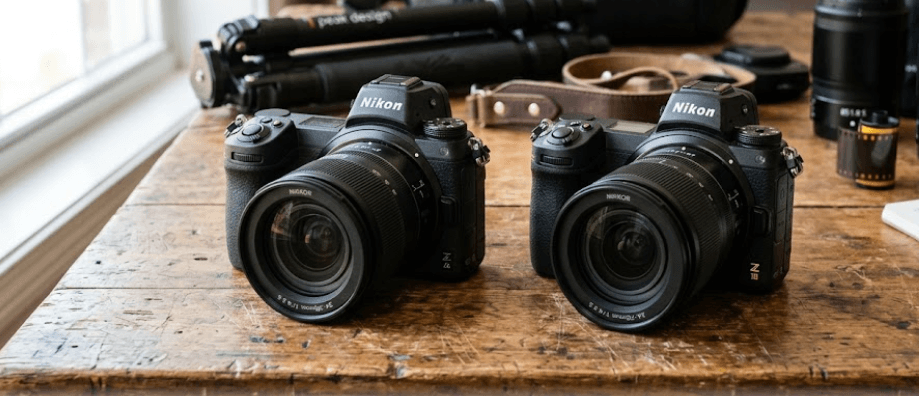
TL;DR The Nikon Z6 II is a meaningful refinement of the original Z6 rather than a completely different camera. Both use a 24.5MP full-frame BSI CMOS sensor and offer 5-axis in-body image stabilisation, so image quality remains broadly similar. The Z6 II adds dual EXPEED 6 processors, raises continuous shooting from up to 12 fps to 14 fps, improves autofocus performance in low light, adds a second memory-card slot and supports 4K/60p video after a firmware update. The biggest reason to upgrade is therefore not a dramatic jump in still-image quality. It is the stronger overall shooting experience, particularly for events, action, video and photographers who need backup storage. In 2026, however, the Z6 II should be judged against newer cameras such as the Z6 III and Z5 II rather than treated as Nikon's latest technology.
Nikon Z6 And Z6 II: What Changed?
The Nikon Z6 and Z6 II share the same basic full-frame foundation, which is why the two cameras can look surprisingly similar on a specification sheet. Both use a 24.5MP BSI CMOS sensor, Nikon Z mount and 5-axis sensor-shift vibration reduction. The original Z6 was designed as a balanced full-frame mirrorless camera for photographers and hybrid shooters, and it remains capable of producing high-quality files. The Z6 II keeps that same sensor resolution instead of chasing a higher megapixel count, so the upgrade is more about speed, processing and usability than a fundamental change in image resolution.
The biggest internal change is the move from one EXPEED 6 image processor in the Z6 to two EXPEED 6 processors in the Z6 II. Nikon used that additional processing power to increase the continuous shooting rate from approximately 12 fps to 14 fps and significantly increase the buffer capacity. That difference is useful when photographing movement because the camera can maintain a longer burst before the buffer becomes a limitation. For casual portraits or landscapes, however, the extra processing power is much less likely to change the final photograph.
The Z6 II also addresses one of the original Z6's most obvious practical limitations by adding a second card slot. The camera accepts CFexpress Type B or XQD cards in one slot and UHS-II SD cards in the other. That makes the Z6 II much more attractive for weddings, events and paid assignments where having an immediate backup is important. This is one of those upgrades that may not make a photograph look better, but it can make the camera significantly more dependable when the images cannot simply be recreated.
Nikon Z6 Vs Z6 II At A Glance
| Feature | Nikon Z6 | Nikon Z6 II |
|---|---|---|
| Sensor | 24.5MP full-frame BSI CMOS | 24.5MP full-frame BSI CMOS |
| Processor | EXPEED 6 | Dual EXPEED 6 |
| Continuous Shooting | Up to 12 fps | Up to 14 fps |
| Autofocus Points | 273 | 273 |
| Low-Light AF | Down to -3.5 EV, -6 EV with Low-Light AF | Down to -4.5 EV, -6 EV with Low-Light AF |
| Card Slots | 1 | 2 |
| Video | 4K UHD up to 30p | 4K UHD up to 60p with firmware update |
| Image Stabilisation | 5-axis sensor-shift VR | 5-axis sensor-shift VR |
The core specifications show why the Z6 II should be viewed as an evolution rather than a new generation of image sensor technology.
Image Quality And Low-Light Performance
If you are upgrading from the Z6 to the Z6 II because you expect a major improvement in still-image quality, you may be disappointed. Both cameras use a 24.5MP full-frame BSI CMOS sensor, so the basic resolution and sensor-generation characteristics are closely related. The Z6 was already a strong low-light camera, and the Z6 II does not suddenly make photographs dramatically more detailed. Your choice of lens, exposure, shooting technique and post-processing will often have a greater visible impact on the final image than the move from one body to the other.
Where the Z6 II does improve the shooting experience is autofocus. Nikon specifies a detection range of -4.5 EV for the Z6 II in standard AF conditions, extending to -6 EV when Low-Light AF is used. The original Z6 was rated to -3.5 EV, with Low-Light AF extending to -6 EV. This means the Z6 II has a measurable advantage when autofocus needs to acquire subjects in difficult lighting, although both cameras can still focus in very dark conditions when the appropriate mode and lens are used.
That distinction matters more for photographers who regularly work after sunset, inside dim venues or at events than it does for someone mainly shooting landscapes in daylight. The Z6 II also brought improved Eye-Detection AF options and expanded AF-area modes, including wider-area options for people and animals. So while the sensor itself is not the reason to upgrade, the autofocus system makes the newer body more useful for subjects that move or situations where light is limited.
Image Quality Comparison
| Area | Nikon Z6 | Nikon Z6 II |
|---|---|---|
| Resolution | 24.5MP | 24.5MP |
| Sensor Type | Full-frame BSI CMOS | Full-frame BSI CMOS |
| IBIS | 5-axis | 5-axis |
| Standard AF Detection | Down to -3.5 EV | Down to -4.5 EV |
| Low-Light AF | Up to -6 EV | Up to -6 EV |
| Main Image-Quality Advantage | Strong low-light performance | Similar image quality with better AF handling |
For pure image quality, the difference is relatively small. For difficult focusing situations, the Z6 II has the stronger case.
Autofocus And Shooting Speed
The Z6 II's autofocus system retains 273 on-sensor phase-detection points, but the dual processors allow Nikon to improve how the system handles detection, tracking and Eye-Detection AF. The camera supports human and animal eye detection, and the Z6 II adds more flexible wide-area options. This does not mean the Z6 suddenly becomes unusable for moving subjects. Instead, the Z6 II gives you more confidence and control when the subject is moving unpredictably or the light is difficult.
The difference in burst speed is also useful, particularly for sports, wildlife, children and event photography. The Z6 reaches approximately 12 fps, while the Z6 II can shoot at up to 14 fps under Nikon's specified conditions. More importantly, Nikon says the Z6 II has more than five times the buffer capacity of the Z6 in its launch specifications, with roughly 124 shots compared with approximately 35 shots under the stated testing conditions. That makes the Mark II considerably more comfortable during longer bursts.
For a landscape photographer, this improvement may barely matter. For a wedding photographer trying to capture a fleeting expression or a wildlife photographer following a fast-moving subject, it can be much more meaningful. This is one reason the Z6 II makes more sense as a professional working camera than its relatively modest sensor upgrade might suggest. The camera gives you more room to react rather than simply producing higher-resolution files.
Video Features And Practical Use
Video is another area where the Z6 II pulls ahead. The original Z6 supports 4K UHD recording up to 30p, while Nikon added 4K UHD 60p to the Z6 II through firmware version 1.10. Nikon's firmware documentation confirms that 4K/60p and 50p were added to the Z6 II's available movie options. This is important because it means buyers should not judge the Z6 II using its original launch specification alone. A properly updated Z6 II is more capable for modern 4K video workflows than the camera was when it first launched.
The Z6 II also supports 10-bit output to an external recorder with N-Log and HDR HLG workflows, while RAW video output is available through a paid service upgrade. Nikon also added support for external Blackmagic RAW recording through compatible Blackmagic Design recorders with the relevant firmware and setup. These features make the Z6 II more interesting for creators who want to build a more advanced external-recording workflow.
That does not automatically make the Z6 II the best video camera in 2026. Newer cameras in Nikon's line-up offer more advanced video capabilities, so a creator buying a camera primarily for filmmaking should compare the Z6 II with newer options rather than assuming the Mark II is still the top choice. For someone choosing specifically between a used Z6 and a Z6 II, however, the Mark II's 4K/60p capability and improved autofocus make the upgrade considerably easier to justify.
Video Comparison
| Video Feature | Nikon Z6 | Nikon Z6 II |
|---|---|---|
| 4K UHD | Up to 30p | Up to 60p |
| 4K/60p | Not available | Added via firmware |
| Full HD Slow Motion | Up to 120p | Up to 120p |
| 10-bit External Output | Yes | Yes |
| N-Log | Yes | Yes |
| RAW Video | External recorder with paid upgrade | External recorder with paid upgrade |
The Z6 II is the more versatile option for hybrid shooters, particularly when 4K/60p is part of the workflow.
Dual Card Slots And Everyday Reliability
One of the strongest reasons to choose the Z6 II is not glamorous at all. It is the second memory-card slot. The Z6 has a single XQD or CFexpress Type B-compatible slot, while the Z6 II adds a second UHS-II SD slot. This allows photographers to configure the camera for backup recording, overflow storage or different file types depending on the workflow. For a photographer shooting a paid wedding or once-in-a-lifetime event, that extra layer of redundancy can be more valuable than a small improvement in image quality.
The Z6 II also supports the MB-N11 battery grip, which adds controls for vertical shooting and can use two EN-EL15c batteries. Nikon states that the grip can provide up to a 1.9x increase in battery performance compared with using one EN-EL15c battery in the camera alone. This makes the Z6 II better suited to photographers who spend long periods shooting away from a charger or want a more substantial setup for vertical portraits and events.
These changes are easy to underestimate when looking at the cameras side by side. The Z6 II does not suddenly become a different class of camera, but it removes several practical limitations that matter when you use a camera professionally. For a casual photographer, the single-slot Z6 may still be perfectly adequate. For someone whose work depends on reliable storage and long shooting sessions, the Mark II's design is much easier to defend.
Nikon Z6 Vs Z6 II: Which One Should You Buy?
The original Z6 still makes sense when the price difference is large and your needs are straightforward. If you mainly shoot landscapes, portraits, travel, street photography or controlled video, the 24.5MP full-frame sensor remains capable. You also get 5-axis stabilisation and Nikon's Z-mount lens ecosystem, so buying an older body does not mean accepting poor image quality. The important point is that you should buy the Z6 because it offers strong value, not because you expect it to outperform the Z6 II.
The Z6 II is easier to recommend when autofocus, burst shooting, video or reliability matter. The dual processors, 14 fps burst rate, improved low-light AF, dual card slots and 4K/60p support address practical limitations that photographers can actually encounter. For wedding photographers, event shooters, wildlife photographers and hybrid creators, these improvements can save missed shots or simplify a workflow.
There is one important 2026 consideration, though. Nikon's current India lineup includes newer models such as the Z6 III and Z5 II, while Nikon continues to list the Z6 II among its products. That means a new Z6 II purchase should be evaluated against current-generation alternatives and the actual street price. If the Z6 II is only slightly cheaper than a newer camera, the older model becomes harder to justify. If you find a substantial discount, particularly on a clean used or refurbished unit, its combination of full-frame image quality, dual card slots and strong hybrid features can still be compelling.
Nikon Z6 Vs Z6 II Buying Decision
| Buyer Type | Better Choice | Why |
|---|---|---|
| Budget-conscious photographer | Z6 | Strong full-frame image quality at a lower price |
| Landscape photographer | Z6 | Sensor and stabilisation remain highly capable |
| Portrait photographer | Z6 II | Better Eye-Detection AF flexibility |
| Wedding Photographer | Z6 II | Dual cards and larger buffer |
| Wildlife Photographer | Z6 II | Faster burst and improved AF |
| Hybrid Photo/Video Creator | Z6 II | 4K/60p and stronger processing |
| Professional Event Shooter | Z6 II | Better reliability and workflow features |
| New Buyer In 2026 | Compare With Newer Models | Z6 III and Z5 II change the value equation |
Frequently Asked Questions
Q. Is the Nikon Z6 II much better than the Z6?
The Z6 II is better in speed, autofocus, buffer capacity, card redundancy and video flexibility, but it does not deliver a major jump in basic image quality because both cameras use a 24.5MP full-frame BSI CMOS sensor.
Q. Does the Nikon Z6 II have better autofocus than the Z6?
Yes. The Z6 II improves autofocus performance, particularly in low light, and offers expanded Eye-Detection and subject-detection options. Its specified AF detection range starts at -4.5 EV, compared with -3.5 EV for the Z6.
Q. Does the Nikon Z6 II have dual card slots?
Yes. The Z6 II has two card slots, with one supporting CFexpress Type B or XQD cards and the other supporting UHS-II SD cards. The original Z6 has one card slot.
Q. Can the Nikon Z6 II shoot 4K 60p?
Yes. Nikon added 4K UHD 60p and 50p recording through firmware version 1.10. The original Z6 is limited to 4K UHD up to 30p.
Q. Is the Nikon Z6 II good for wedding photography?
Yes. Its 14 fps shooting, larger buffer, improved autofocus and dual-card configuration make it better suited to weddings than the original Z6, especially when image backup is important.
Q. Is the Nikon Z6 still worth buying?
Yes, if you find it at a significantly lower price and do not need the Z6 II's additional speed, autofocus improvements, dual-card setup or 4K/60p recording. Its 24.5MP full-frame sensor remains capable for many photography applications.
Q. Does the Z6 II have the same sensor as the Z6?
Both cameras use a 24.5MP BSI CMOS full-frame sensor. The major changes in the Z6 II are around processing, autofocus, shooting speed, storage and video rather than a higher-resolution sensor.
Q. Is the Nikon Z6 II good for low-light photography?
Yes. The Z6 II has a specified AF detection range down to -4.5 EV and up to -6 EV with Low-Light AF. The sensor also retains the Z6 family's strong full-frame low-light capabilities.
Q. Does the Z6 II have better battery performance than the Z6?
The Z6 II can use the MB-N11 battery grip with two EN-EL15c batteries, and Nikon rates the combination at up to 1.9x the battery performance of one EN-EL15c battery in the camera alone. Battery performance in normal use still depends on shooting conditions and settings.
Q. Should you upgrade from the Z6 to the Z6 II in 2026?
Upgrade if you need dual card slots, faster continuous shooting, improved low-light autofocus, a larger buffer or 4K/60p. If your Z6 already meets your needs, the image-quality difference alone is not a strong reason to upgrade. In 2026, also compare the Z6 II's price with newer Nikon models before buying.
Final Recommendation
The Nikon Z6 II is the better camera, but it is not automatically the better purchase for every Z6 owner. Its 24.5MP sensor means the basic image-quality experience remains close to the original, so upgrading purely for resolution would make little sense. The real improvements are the ones you notice while shooting: dual EXPEED 6 processors, 14 fps continuous shooting, a substantially larger buffer, improved low-light autofocus, dual card slots and 4K/60p video. Those changes make the Z6 II a more complete hybrid and professional-use camera.
If you already own a Z6 and mostly shoot landscapes, portraits, travel or casual video, keep it unless you have a specific limitation that the Mark II solves. If you photograph weddings, events, wildlife or fast-moving subjects, the Z6 II is a much more convincing upgrade because its improvements directly affect the shooting workflow. The second card slot alone can also be a major reason for professionals to move up.
For someone buying in 2026, the decision is slightly different. Do not buy the Z6 II simply because it is newer than the Z6. Compare its actual price with Nikon's newer Z6 III and Z5 II, and choose the Mark II when its discount makes its proven combination of performance, reliability and full-frame image quality especially attractive. If you find a well-priced Z6 II and need its practical advantages, it remains a capable camera. If the price gap to a newer model is small, spending more on the newer generation is likely the smarter long-term decision.






