
Nikon Z50 vs Z30: Photography vs Vlogging,Which Fits Your Shoot?
The Nikon Z50 is better suited to photography and hybrid shooting, while the lighter Z30 is designed around vlogging. Compare their displays, autofocus, video features, handling, and everyday use to find the right Nikon camera for your shooting style.

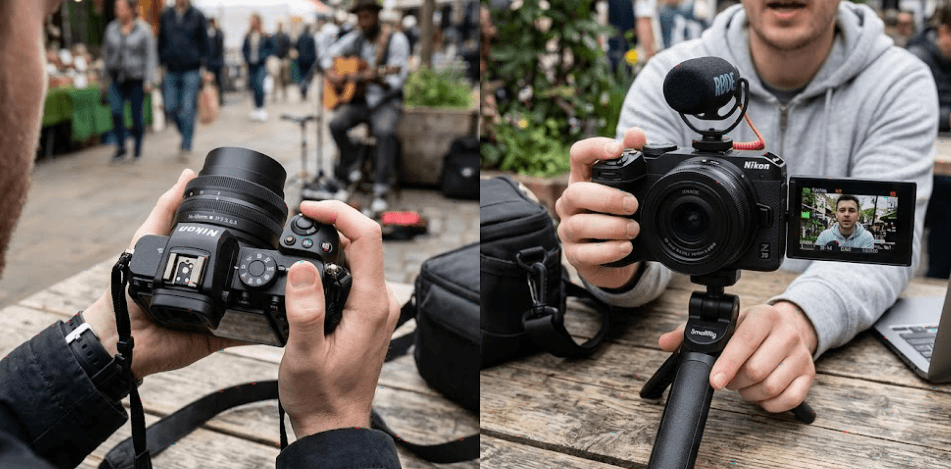
TL;DR The Nikon Z50 and Nikon Z30 share the same 20.9MP DX-format sensor, EXPEED 6 processor, Nikon Z mount, and 11 fps maximum continuous shooting speed, so their core image quality is closely related. The biggest difference comes from how they are designed to be used. The Z50 has a 2.36-million-dot electronic viewfinder, built-in flash, and a tilting 3.2-inch touchscreen, making it the stronger choice for photography and hybrid shooting. The Z30 removes the viewfinder, adds a fully articulating 3-inch touchscreen, USB-C power support, a tally light, and longer video recording capability, making it more suitable for vloggers and creators. Both cameras can record 4K video at up to 30p, but the Z30 is the more video-focused body.
Nikon Z50 Vs Z30: Key Differences
The Nikon Z50 and Z30 may look like two versions of the same camera, and in several important ways, they are closely related. Both use a 20.9MP DX-format CMOS sensor measuring 23.5 x 15.7mm and Nikon's EXPEED 6 image processor. Both also use the Nikon Z mount, allowing buyers to choose from NIKKOR Z lenses and, with an adapter, compatible F-mount lenses. This shared foundation means the difference between the two cameras is not primarily about sensor resolution or basic image quality. Instead, Nikon designed each body around a different type of user. The Z50 is more focused on still photography and hybrid shooting, while the Z30 places much more emphasis on video and vlogging.
The physical design makes that distinction easier to understand. The Z50 weighs approximately 395g with its battery and card, while the Z30 weighs approximately 350g under Nikon's published measurements. The Z30 is therefore lighter and smaller, which can make a meaningful difference when you are holding the camera at arm's length for a vlog or carrying it with a compact lens throughout the day. The Z50, however, has a deeper photography-oriented setup because it includes an electronic viewfinder and a built-in flash. Those additions make it more versatile when you are shooting outdoors, composing still photographs in bright light, or working without relying entirely on the rear display.
The biggest practical difference is the screen and viewfinder arrangement. The Z50 uses a 3.2-inch tilting touchscreen and a 0.39-inch, approximately 2.36-million-dot OLED electronic viewfinder with around 100% frame coverage. The Z30 has no electronic viewfinder but uses a 3-inch vari-angle touchscreen that can face forward, which is much more useful when you are recording yourself. Nikon also gives the Z30 a tally light and USB-C power support, both of which make sense for a creator-focused camera. In other words, the Z50 gives photographers more traditional camera controls for composing stills, while the Z30 removes features that vloggers may rarely use and puts more emphasis on self-recording.
Nikon Z50 Vs Z30 Specs
| Feature | Nikon Z50 | Nikon Z30 |
|---|---|---|
| Sensor | 20.9MP DX CMOS | 20.9MP DX CMOS |
| Processor | EXPEED 6 | EXPEED 6 |
| Viewfinder | 2.36M-dot OLED EVF | None |
| Rear Screen | 3.2-inch tilting touchscreen | 3-inch vari-angle touchscreen |
| Maximum Burst | Up to 11 fps | Up to 11 fps |
| 4K Video | Up to 30p | Up to 30p |
| Full HD | Up to 120p | Up to 120p |
| Weight | Approx. 395g | Approx. 350g |
| Battery | EN-EL25 | EN-EL25 |
| USB Power | No | Yes |
| Built-In Flash | Yes | No |
| Tally Light | No | Yes |
The specifications show why these cameras should not simply be ranked as older and newer versions of one another. They are closely related cameras with different priorities.
Nikon Z50 For Photography
The Nikon Z50 has a clear advantage for photography because it includes an electronic viewfinder. An EVF can sound like a small feature until you spend time shooting outdoors in bright sunlight or trying to compose a still image precisely. Looking through a viewfinder can make it easier to isolate your subject from distractions and maintain a traditional camera-shooting position. The Z50's 2.36-million-dot OLED EVF also provides approximately 100% frame coverage, so you can see the composition before pressing the shutter. For photographers moving from a DSLR or another interchangeable-lens camera, this makes the Z50 feel more familiar and complete.
The Z50 is also better suited to photographers who regularly switch between different types of still photography. Its 20.9MP DX sensor is capable of producing RAW files and JPEGs, while the camera can shoot continuously at up to 11 frames per second. That burst rate is useful for subjects that do not stay still, including pets, children, street scenes, and some action photography. The camera also includes a built-in flash, which gives photographers an additional option when working indoors or in situations where some extra illumination is useful. None of these features make the Z50 a professional sports camera, but together they make it a more traditional all-purpose photography body than the Z30.
The Z50's 3.2-inch tilting touchscreen is another sign of its photography-first design. It can be useful when shooting from lower or higher angles without having to put your eye directly behind the viewfinder. The screen is not as flexible as the Z30's fully articulating display, especially for self-facing video, but that is not really what the Z50 is designed around. If your main priorities are travel photography, portraits, street photography, family pictures, or learning manual camera controls, the Z50 provides the more natural shooting experience. Independent testing also describes the Z50 as the more photography-oriented option, particularly because of its EVF.
Why The Z50 Suits Photographers?
For still photographers, the combination of an EVF, tilting display, built-in flash, and 11 fps burst shooting makes the Z50 the more complete package. The camera also provides a familiar shooting experience for people who prefer holding a camera to their eye instead of composing every frame on the rear screen. This becomes especially useful when you are photographing in bright outdoor conditions or trying to maintain stable framing with a longer lens.
The Z50 is also a better choice if photography is likely to remain your primary use several years from now. You can still record 4K video at up to 30p and Full HD at up to 120p, so it is not a photography-only camera. Instead, it is a hybrid body that gives still photography a higher priority than the Z30. That makes it a sensible option for someone who wants to learn photography while retaining enough video capability for occasional YouTube videos, travel clips, or social media content.
The main limitation is that its video design feels less creator-focused than the Z30. The rear display does not fully articulate toward the user, USB power support is absent, and Nikon specifies a maximum movie recording time of 29 minutes and 59 seconds for the Z50. That does not make the camera poor for video, but it matters if you are planning long-form recording or frequent self-facing content.
Nikon Z30 For Vlogging
The Nikon Z30 is the more obvious choice for vlogging because Nikon built several of its physical features around self-recording. The fully articulating 3-inch touchscreen can face the user, making it easier to frame yourself while recording. The camera also includes a tally light that indicates when recording is active, which is particularly useful when the camera is mounted on a tripod and positioned away from you. Because the Z30 does not have an electronic viewfinder, Nikon was able to make the body smaller and lighter. At approximately 350g, it is around 45g lighter than the Z50, which can matter when you are carrying it for long periods or holding it during a walking vlog.
The Z30 also has several practical video advantages. Nikon specifies 4K UHD recording at 30p, 25p, and 24p, along with Full HD recording up to 120p for slow-motion footage. The camera supports external microphones and includes a 3.5mm microphone input, which is important because audio quality can make a bigger difference to a vlog than moving from one camera body to another. Nikon also provides USB-C power support, allowing the camera to receive power from an external source. This is useful for creators recording at a desk, streaming, or producing longer sessions where battery capacity alone may not be enough.
Recording duration is another important difference. Nikon states that the Z30 can record 4K video for up to 125 minutes, subject to conditions, while the Z50's published maximum movie recording time is 29 minutes and 59 seconds. The 125-minute figure should not be interpreted as a guarantee that every 4K recording will run for that long, because temperature, battery condition, settings, and other factors can affect recording time. Independent testing has also found that the Z30 can encounter overheating limitations during extended 4K recording, so creators planning long continuous sessions should still consider the shooting environment.
Why The Z30 Suits Creators
The Z30 makes the most sense when the camera is primarily a video tool. A creator recording YouTube videos, travel vlogs, product demonstrations, tutorials, or social media content can benefit from seeing themselves on the fully articulating screen. The absence of an EVF is less important in this situation because video creators generally compose through the rear display anyway. Removing the viewfinder also helps keep the camera compact and lighter.
The camera's autofocus system is another reason it works well for beginner creators. Nikon lists 209 autofocus areas and face and eye detection for people and animals, while the Z30 is designed to make subject tracking accessible without requiring extensive manual focusing knowledge. This is useful when you are filming yourself or another person and need the camera to maintain focus as the subject moves. It does not turn the Z30 into a cinema camera, but it gives beginners a relatively straightforward way to start producing interchangeable-lens video.
The Z30 is not limited to video, either. It uses the same 20.9MP DX-format sensor and EXPEED 6 processor as the Z50 and can capture RAW photographs. It can therefore work as a compact stills camera when needed. The compromise is that photographers have to compose through the rear screen because there is no viewfinder, and there is no built-in flash. For a creator who occasionally takes photographs, that is usually an acceptable trade-off. For someone who primarily takes photographs, it can become a limitation much sooner.
Image Quality And Autofocus
When comparing the Nikon Z50 vs Z30 for basic image quality, the difference is much smaller than the body design might suggest. Both cameras use the same 20.9MP DX-format sensor and EXPEED 6 processor, so neither camera has a fundamental resolution advantage over the other. Both can capture 12-bit or 14-bit NEF RAW files as well as JPEG images, giving photographers flexibility when editing photographs later. This makes the decision less about which camera takes sharper photographs and more about which camera provides the shooting experience you actually need.
Autofocus is similarly close because both cameras use Nikon's hybrid autofocus system with up to 209 focus areas. The Z30 is particularly focused on people and pets, with Nikon highlighting face and eye detection for both photography and video. The Z50 also gained eye-detection autofocus for video through a firmware update, which is an important detail because older comparisons can make the Z50 appear more limited than it is today. Nikon's own support documentation confirms that firmware version 2.40 added eye-detection autofocus during movie recording on the Z50.
For everyday photography, both cameras can therefore produce very similar results when paired with the same lens and used under comparable conditions. Lens choice will often have a greater effect on the final image than choosing between these two bodies. The Z50's advantage is that its EVF and physical design make it easier to use as a dedicated stills camera, while the Z30's fully articulating display and lighter body make it easier to use as a creator-focused camera. That distinction is more important than trying to find a major sensor-quality difference that is not really there.
Photography Vs Vlogging
| Shooting Need | Nikon Z50 | Nikon Z30 |
|---|---|---|
| Travel photography | Excellent fit | Good fit |
| Portrait photography | Better fit | Good fit |
| Street photography | Better fit | Good fit |
| Vlogging | Good | Better fit |
| Self-facing video | Limited | Excellent fit |
| Long recording sessions | More limited | Better suited |
| External microphone use | Supported | Supported |
| Beginner photography | Better fit | Good fit |
| Beginner vlogging | Good fit | Better fit |
| Hybrid photography and video | Better overall balance | Video-focused balance |
The important takeaway is that the Z30 is not simply a lower-quality Z50. It is a different interpretation of the same basic camera platform, with features shifted toward creators.
Size, Battery, and Everyday Handling
The Z30's smaller body gives it a clear advantage for creators who carry their camera everywhere. Nikon lists the Z30 at approximately 128 x 73.5 x 59.5mm and 350g, compared with approximately 126.5 x 93.5 x 60mm and 395g for the Z50. The difference is not dramatic on a specification sheet, but the Z30's lower weight and slimmer overall profile can make it more comfortable when paired with a compact lens. This is especially relevant for vloggers who may hold the camera at arm's length, place it on a small tripod, or carry it alongside other creator equipment.
Both cameras use Nikon's EN-EL25 rechargeable battery, so neither camera has a completely different battery platform. The Z30 does have an important practical advantage for video because it supports USB power through USB-C. That allows creators to power the camera from an external source during compatible recording situations. The Z50 does not offer the same USB power capability according to Nikon's comparison documentation. For someone recording long desk-based videos, tutorials, or livestream-style content, this can make the Z30 considerably more convenient.
Handling is ultimately where the cameras separate most clearly. The Z50 feels more like a conventional interchangeable-lens camera because of its EVF, built-in flash, and photography-oriented controls. The Z30 feels more like a creator camera because its screen flips forward, its tally light makes recording status obvious, and its body is designed around compactness. Neither approach is universally better. If you spend most of your time behind the camera, the Z50's design is more useful. If you spend most of your time in front of it, the Z30's design makes more sense.
Nikon Z50 Vs Z30: Which Should You Buy?
The Nikon Z50 is the better choice for buyers whose main priority is photography. Its electronic viewfinder makes composing still images more natural, particularly outdoors, while the tilting touchscreen provides additional flexibility for unusual shooting angles. The built-in flash is another advantage for photographers who want an integrated lighting option without carrying an external unit. Combined with the 20.9MP sensor, 11 fps burst shooting, RAW support, and 4K video, the Z50 offers a strong balance for someone who wants one camera for photographs and occasional video.
The Nikon Z30 is the stronger choice for vloggers and video-first creators. Its fully articulating screen is much better for self-recording, while the tally light, USB-C power support, external microphone support, and longer published recording limit all fit a creator workflow. The 350g body also makes it easier to carry around for extended periods. Its 20.9MP sensor means you are not giving up the fundamental image-quality platform used by the Z50, but you are giving up the electronic viewfinder and built-in flash to get a more video-oriented design.
The most important point in the Nikon Z50 vs Z30 comparison is therefore not which camera has more megapixels or a faster processor. They share those core foundations. The real decision is whether you want a camera designed primarily around looking through it or one designed primarily around looking at its screen while you record. For photography, the Z50 is the more complete choice. For vlogging, the Z30 is the more purpose-built option. For someone who wants to do both but expects photography to remain the main activity, the Z50 is the safer pick. For someone whose camera will spend most of its life recording video, the Z30 is easier to justify.
Frequently Asked Questions
Q. Is the Nikon Z50 better than the Z30 for photography?
Yes. The Z50 is better suited to photography because it has a 2.36-million-dot electronic viewfinder, a 3.2-inch tilting touchscreen, and a built-in flash. Both cameras use a 20.9MP DX sensor and EXPEED 6 processor, so the main advantage comes from the Z50's shooting experience rather than a major sensor difference.
Q. Is the Nikon Z30 better for vlogging?
Yes. The Z30 is specifically designed with creators in mind and includes a fully articulating touchscreen, tally light, USB-C power support, external microphone support, and a published movie recording limit of up to 125 minutes. These features make it more convenient for self-facing video and longer recording sessions.
Q. Do the Nikon Z50 and Z30 have the same sensor?
Yes. Both cameras use a 20.9MP DX-format CMOS sensor measuring 23.5 x 15.7mm and use Nikon's EXPEED 6 processor. This means the two cameras share the same fundamental imaging platform.
Q. Does the Nikon Z30 have an electronic viewfinder?
No. The Nikon Z30 does not have an electronic viewfinder. It relies on its 3-inch vari-angle touchscreen for composition. The Nikon Z50, by comparison, has a 0.39-inch OLED electronic viewfinder with approximately 2.36 million dots and around 100% frame coverage.
Q. Can the Nikon Z50 record 4K video?
Yes. The Nikon Z50 can record 4K UHD video at up to 30p, along with Full HD recording at up to 120p. Its published maximum movie recording time is 29 minutes and 59 seconds.
Q. Can the Nikon Z30 record 4K video?
Yes. The Nikon Z30 records 4K UHD video at up to 30p and Full HD video at up to 120p. Nikon specifies up to 125 minutes of movie recording under applicable conditions, although actual recording time can vary with temperature, settings, battery condition, and other factors.
Q. Which camera is lighter, the Nikon Z50 or Z30?
The Nikon Z30 is lighter. Nikon lists the Z30 at approximately 350g, compared with approximately 395g for the Z50 when measured with the battery and memory card under Nikon's stated conditions. The difference makes the Z30 particularly attractive for handheld vlogging and travel.
Q. Does the Nikon Z30 have better autofocus than the Z50?
The two cameras are closely related in autofocus hardware, with up to 209 autofocus areas. However, the Z30 is more creator-focused and includes people and animal face and eye detection. The Z50 also received eye-detection autofocus for movie recording through a firmware update, so older comparisons may not reflect its current capabilities.
Q. Can the Nikon Z30 take good photographs?
Yes. The Z30 uses the same 20.9MP DX sensor and EXPEED 6 processor as the Z50 and supports RAW photography. It can produce high-quality still images, but the lack of an electronic viewfinder and built-in flash makes it less suitable for photographers who prioritize traditional still-photography handling.
Q. Should I buy the Nikon Z50 or Z30 for both photography and video?
Choose the Z50 if photography is your primary activity and video is secondary. Choose the Z30 if video and vlogging make up most of your work and you only need still photography occasionally. For a balanced photography-first hybrid setup, the Z50 is the more complete option, while the Z30 is the more creator-focused choice.
Final Recommendation
The Nikon Z50 is the better overall choice if your shooting routine is centered on photography, travel, portraits, street images, or a mix of photographs and occasional video. Its electronic viewfinder, tilting touchscreen, built-in flash, 11 fps burst capability, and 20.9MP DX sensor give it the more traditional and flexible photography experience. It also remains capable of 4K video, so choosing the Z50 does not mean giving up video completely.
The Nikon Z30 is the better buy if your priority is vlogging, YouTube, social media content, tutorials, or self-facing video. Its fully articulating screen, tally light, USB-C power support, external microphone compatibility, lighter body, and longer published recording capability make it more convenient for a creator-first workflow. Independent testing also identifies the Z30 as the more video-oriented camera, while the Z50 remains the stronger option for stills photographers.
If you are still unsure, use one simple rule: choose the Nikon Z50 if you mostly shoot behind the camera, and choose the Nikon Z30 if you mostly shoot yourself. The two cameras share much of their core imaging hardware, so the right choice comes down to the shooting experience, not a major difference in basic image quality.
Ready to upgrade your tech?
Browse our collection of quality refurbished products at unbeatable prices.






