Nikon Z5 vs Z5 Mark II: What's New in the Refresh?
The Nikon Z5 II keeps the Z5's 24MP full-frame foundation but adds a BSI sensor, EXPEED 7, better autofocus, faster shooting, a brighter EVF, and improved video.

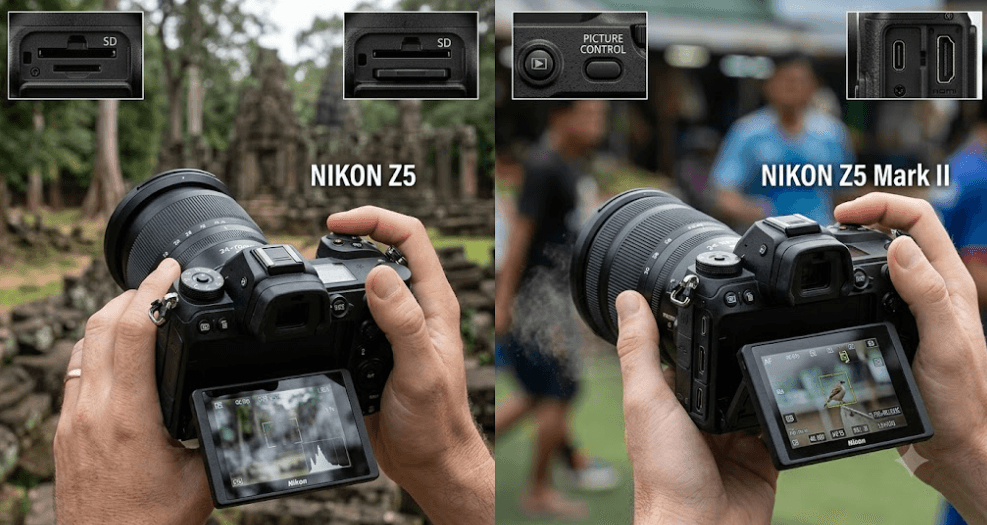
TL;DR The Nikon Z5 II is a substantial refresh rather than a simple cosmetic update. Both cameras use a roughly 24MP full-frame sensor and retain Nikon's Z-mount, in-body stabilization, dual SD card slots, and familiar body design, but the Z5 II upgrades the core processing and shooting experience. It moves from EXPEED 6 to EXPEED 7, adds a BSI CMOS sensor, expands subject detection from two categories to nine, improves low-light autofocus, raises continuous shooting dramatically, adds a brighter 3.69-million-dot electronic viewfinder, replaces the original Z5's tilting screen with a higher-resolution vari-angle display, and significantly improves video capabilities. The original Z5 can still make sense when available at a substantially lower price, especially for primarily stills-focused photographers, but the Z5 II is the more capable choice for buyers who want stronger autofocus, action shooting, hybrid photo-video performance, and a camera that feels more current.
Nikon Z5 And Z5 II: What Changed?
The Nikon Z5 arrived in 2020 as a relatively affordable full-frame mirrorless camera aimed at photographers who wanted Nikon's FX-format image quality without moving into the company's more expensive models. The Z5 already had several features that made it attractive, including a 24.3MP full-frame sensor, five-axis in-body vibration reduction, a 3.69-million-dot electronic viewfinder, a 3.2-inch touchscreen, and dual UHS-II SD card slots. Its biggest weakness was not image quality but speed. With a maximum continuous shooting rate of 4.5 frames per second and heavily cropped 4K video, the Z5 was clearly designed more around general photography than demanding hybrid work.
The Nikon Z5 II, announced in April 2025, keeps the basic full-frame concept but updates almost everything that determines how quickly the camera responds. Nikon moved to the EXPEED 7 processor and a back-illuminated CMOS sensor, bringing the Z5 II much closer to the technology used in more advanced Nikon bodies. The camera also receives a major autofocus upgrade, with subject detection expanding from people and animals on the original Z5 to nine subject types, including birds, cars, motorcycles, bicycles, trains, and airplanes. Nikon also rates the Z5 II's low-light AF detection down to -10 EV, compared with -4.5 EV for the Z5.
The important point is that the Z5 II does not dramatically increase resolution. Both cameras remain around the 24MP mark, so you should not expect the Mark II to produce dramatically larger files simply because it is newer. The real upgrade is performance. The newer processor, BSI sensor, autofocus system, faster burst modes, improved display, brighter EVF, and expanded video features make the Z5 II feel like a much more modern camera while preserving the original Z5's basic full-frame philosophy.
Nikon Z5 vs Z5 II At A Glance
| Feature | Nikon Z5 | Nikon Z5 II |
|---|---|---|
| Launch year | 2020 | 2025 |
| Sensor | 24.3MP full-frame CMOS | Approx. 24MP BSI CMOS |
| Processor | EXPEED 6 | EXPEED 7 |
| Subject detection | People, animals | 9 subject types |
| Low-light AF | -4.5 EV | -10 EV |
| Mechanical burst shooting | 4.5 fps | Up to 11 fps RAW in independent testing |
| High-speed modes | Not available | Up to 14 fps extended, 30 fps JPEG |
| EVF | 3.69M dots, 1000 cd/m² | 3.69M dots, up to 3000 cd/m² |
| Rear display | 3.2-inch, 1.04M-dot tilting | 3.2-inch, 2.1M-dot vari-angle |
| 4K video | 30p with crop | 30p full-width, 60p with 1.5x crop |
| Full HD | Up to 60p | Up to 120p |
| IBIS | 5-axis, 5 stops | 5-axis, up to 7.5 stops center |
| Card slots | Dual UHS-II SD | Dual UHS-II SD |
The figures above show why calling the Z5 II a minor refresh would undersell the changes. Nikon has kept the familiar resolution and general body concept, but upgraded the areas that most directly affect responsiveness, focusing, shooting speed, and hybrid use. Nikon's own comparison confirms the processor, autofocus, display, EVF, stabilization, burst, and video differences.
Sensor And Image Quality
The sensor change is one of the less obvious but more important upgrades in the Nikon Z5 II. The original Z5 uses a 24.3MP full-frame CMOS sensor, while the Z5 II moves to a back-illuminated CMOS design with roughly 24MP resolution. That means the two cameras are still aimed at photographers who value balanced full-frame image quality rather than extremely high pixel counts. The Z5 II's BSI design and newer processing are intended to improve performance, particularly in challenging lighting, rather than simply increasing the number of pixels on the sensor.
For everyday photography, the difference is therefore less about suddenly getting dramatically more detailed photographs and more about the camera being better equipped to deal with difficult situations. The Z5 already produced strong full-frame images, and the Z5 II builds on that foundation. Independent testing notes that the newer sensor has faster readout than the original Z5's sensor, which is particularly useful for video and high-speed shooting. However, it is important not to confuse this with the kind of extremely fast sensor readout found in Nikon's higher-end Z6III.
This makes the Z5 II particularly attractive to photographers who shoot a mixture of landscapes, portraits, travel, events, and low-light scenes. If your photography consists mostly of static subjects and you are already happy with the image quality of the Z5, the sensor change alone is not a compelling reason to upgrade. The value becomes much clearer when the newer sensor is considered alongside EXPEED 7, improved autofocus, faster shooting, and better video.
Image Quality Differences
| Area | Nikon Z5 | Nikon Z5 II |
|---|---|---|
| Resolution | 24.3MP | Approx. 24MP |
| Sensor type | CMOS | BSI CMOS |
| Full-frame format | Yes | Yes |
| Image stabilization | 5-axis | 5-axis |
| Low-light AF detection | -4.5 EV | -10 EV |
| Main improvement | Established image quality | Faster processing and improved low-light performance |
The takeaway is simple: the Z5 II is not designed to win because it has dramatically more megapixels. It wins because Nikon has improved the system surrounding the sensor. For buyers comparing the two cameras purely for still-image resolution, the difference is relatively small. For buyers who want better autofocus, faster operation, and stronger hybrid performance, the Mark II is considerably more interesting.
Autofocus And Shooting Speed
Autofocus is arguably the biggest practical improvement in the Nikon Z5 II. The original Z5 can detect people and animals, which is useful for portraits, family photography, and basic wildlife work, but the system is much more limited than Nikon's newer autofocus technology. The Z5 II uses EXPEED 7 and adds recognition for nine categories, including people, dogs, cats, birds, cars, motorcycles, bicycles, trains, and airplanes. Nikon also says its low-light AF detection reaches -10 EV, compared with -4.5 EV on the original Z5.
Shooting speed is an even bigger difference. The Z5 is limited to 4.5 frames per second at full resolution, which is adequate for portraits, landscapes, travel photography, and everyday subjects but can become restrictive when photographing sports, wildlife, children, or unpredictable movement. The Z5 II is dramatically faster. Independent testing found it can shoot RAW images at up to 11 frames per second using its mechanical shutter, while Nikon lists an extended high-speed mode reaching approximately 14 fps and a 30 fps JPEG-only mode with pre-capture capabilities.
This is where the refresh changes the type of photographer the camera can realistically serve. A Z5 owner who mainly photographs landscapes may not care about 11 or 14 fps. Someone photographing a bird taking flight, a child running toward the camera, or an event where moments happen quickly will notice the difference immediately. The Z5 II is therefore not merely faster on a specification sheet. Its autofocus and burst performance make it substantially more versatile.
Autofocus And Burst Comparison
| Feature | Nikon Z5 | Nikon Z5 II |
|---|---|---|
| Processor | EXPEED 6 | EXPEED 7 |
| Subject detection | People and animals | 9 subject types |
| Low-light AF detection | -4.5 EV | -10 EV |
| Standard maximum burst | 4.5 fps | Up to 11 fps RAW |
| Extended high-speed mode | No equivalent | Approx. 14 fps |
| Pre-capture | No | Yes |
| JPEG high-speed mode | No | Approx. 30 fps |
The Z5 II is therefore the clear winner for moving subjects. The original Z5 remains capable for slower-paced photography, but if autofocus performance and shooting speed are high on your priority list, the Mark II's improvements justify paying more for the newer body.
Display And Viewfinder Improvements
The rear display is another area where the Z5 II receives a meaningful physical upgrade. Both cameras use a 3.2-inch rear screen, but the original Z5 has a 1.04-million-dot tilting display, while the Z5 II uses a much higher-resolution approximately 2.1-million-dot vari-angle screen. The change matters when composing from unusual angles, shooting video, working close to the ground, or recording yourself. Nikon's support documentation confirms the move from a tilting screen to a vari-angle design.
The electronic viewfinder retains the same approximately 3.69-million-dot resolution, so this is not a case where Nikon simply increased the EVF's pixel count. Instead, the Z5 II dramatically increases brightness. Nikon specifies up to 3000 cd/m² for the Z5 II compared with approximately 1000 cd/m² for the original Z5. That can make a noticeable difference when composing outdoors in bright sunlight, where a dimmer EVF can be harder to see comfortably.
The combination of the brighter EVF and higher-resolution vari-angle screen makes the Z5 II feel more modern during everyday shooting. This is particularly relevant for travel photographers and hybrid creators who move between stills and video. The original Z5's screen is still perfectly functional, but the Mark II gives you more flexibility and better visibility.
Display Comparison
| Display Feature | Nikon Z5 | Nikon Z5 II |
|---|---|---|
| EVF resolution | 3.69M dots | 3.69M dots |
| EVF brightness | Approx. 1000 cd/m² | Up to 3000 cd/m² |
| Rear screen | 3.2-inch | 3.2-inch |
| Rear resolution | 1.04M dots | 2.1M dots |
| Screen movement | Tilting | Vari-angle |
| Self-portrait mode | No | Yes |
For photographers who mostly compose through the EVF and shoot conventional stills, this upgrade may not be decisive. For video creators, vloggers, travelers, and anyone who frequently shoots from unusual angles, the Z5 II's display system is much easier to justify.
Video And Hybrid Features
Video is one of the clearest areas where the Z5 II leaves the original Z5 behind. The Z5 can record 4K video at 30p, but its 4K mode uses a significant 1.7x crop. That crop limits how wide you can shoot with a given lens and makes the camera less flexible for modern hybrid work. The Z5 II can record 4K at 30p using the full width of the sensor and can reach 4K/60p with a 1.5x crop. It also adds Full HD recording at up to 120p for slow-motion footage.
The Z5 II also adds features aimed at more serious video workflows, including 10-bit N-Log, N-Raw recording, waveform monitoring, and electronic stabilization options. Nikon's official documentation confirms internal RAW video recording and the expanded video modes. These features will not matter to everyone, but they make the Mark II a much more capable hybrid camera than the original Z5.
There are still limits. The Z5 II's 4K/60p mode carries a 1.5x crop, and its sensor readout is not as fast as the more expensive Z6III. Independent testing also notes that rolling shutter remains visible in some full-width 4K situations. So while the Z5 II is a major improvement for video, it should not be mistaken for Nikon's higher-end dedicated hybrid bodies.
Video Comparison
| Video Feature | Nikon Z5 | Nikon Z5 II |
|---|---|---|
| 4K/30p | Yes, crop | Yes, full-width |
| 4K/60p | No | Yes, 1.5x crop |
| Full HD/120p | No | Yes |
| Internal RAW video | No | Yes |
| N-Log | No | Yes |
| Waveform monitor | No | Yes |
| Electronic stabilization | Limited | Improved options |
If video is a major part of your workload, the Z5 II is the obvious choice. If you rarely record video and primarily shoot still photographs, the difference becomes less important.
Design, Stabilization, And Everyday Use
The Z5 II looks familiar because Nikon has kept much of the original Z5's ergonomic philosophy. Both cameras use a full-frame Z-mount body with dual UHS-II SD card slots and five-axis in-body stabilization. However, the Mark II is slightly thicker and heavier. Nikon lists the Z5 II at approximately 134 × 100.5 × 72mm and 700g, compared with approximately 134 × 100.5 × 69.5mm and 670g for the Z5.
The stabilization system also improves on paper. Nikon lists the Z5 at five stops of five-axis vibration reduction, while the Z5 II is rated at up to 7.5 stops at the center and six stops toward the edges under Nikon's testing conditions. The newer model also supports focus-point VR and VR lock features. This can be useful for handheld photography in lower light, although stabilization cannot freeze a moving subject.
The trade-off is that the Z5 II is not lighter than its predecessor. If your priority is a compact full-frame body for travel, the difference is worth considering, especially once a full-frame lens is attached. Still, the additional 30g is relatively minor compared with the amount of functionality Nikon has added.
Nikon Z5 vs Z5 II: Which Should You Buy?
The Nikon Z5 remains a sensible choice if you can find it at a significantly lower price and your photography is primarily stills-focused. Landscapes, portraits, travel photographs, family pictures, and general everyday shooting do not suddenly become poor on the original camera because the Z5 II exists. Its 24.3MP full-frame sensor, IBIS, dual card slots, and solid ergonomics still give it a strong foundation. The key is price. If the older Z5 is heavily discounted, the money saved could go toward a better lens, which may have a bigger impact on your photography than moving from one body to another.
The Z5 II is the better long-term purchase for most new buyers who can afford the difference. Its autofocus system is dramatically more sophisticated, its burst performance is substantially faster, its EVF is much brighter, its rear screen is more flexible, its stabilization is stronger, and its video capabilities are in another class compared with the original Z5. Those improvements also make the camera more versatile if your interests change over time.
The biggest reason to choose the Z5 II is therefore not image resolution. It is the combination of responsiveness and flexibility. The original Z5 was designed around affordable full-frame photography, while the Z5 II takes that foundation and makes it much more capable for modern hybrid shooting. If you are upgrading from an older entry-level camera, the Mark II is a meaningful step forward. If you already own a Z5 and mainly shoot static subjects, however, there is less urgency to upgrade.
Who Should Buy Each Camera?
| Buyer | Better Choice | Why |
|---|---|---|
| Budget-conscious stills photographer | Nikon Z5 | Strong full-frame fundamentals if discounted |
| Portrait photographer | Nikon Z5 II | Better AF and subject detection |
| Wildlife photographer | Nikon Z5 II | Faster bursts and animal/bird detection |
| Travel photographer | Nikon Z5 II | Better screen and low-light AF |
| Video creator | Nikon Z5 II | Better 4K and advanced video features |
| Existing Z5 owner | Depends | Upgrade mainly if speed, AF, or video matters |
| New full-frame buyer | Nikon Z5 II | More modern and versatile platform |
Frequently Asked Questions
Q. Is the Nikon Z5 II better than the Nikon Z5?
Yes. The Nikon Z5 II is substantially more capable overall, particularly for autofocus, burst shooting, low-light focusing, display flexibility, stabilization, and video. The original Z5 remains competitive for basic still photography, especially if its lower price makes it a better value.
Q. Does the Nikon Z5 II have more megapixels than the Z5?
Not by a meaningful amount. The original Z5 has a 24.3MP full-frame sensor, while the Z5 II uses an approximately 24MP BSI full-frame sensor. The major improvements are in processing, autofocus, speed, and video rather than resolution.
Q. How much faster is the Z5 II than the Z5?
The difference is significant. The Z5 is rated at 4.5 frames per second, while the Z5 II can reach up to 11 fps for RAW shooting in testing, with Nikon also listing an approximately 14 fps extended mode and 30 fps JPEG mode.
Q. Does the Z5 II have better autofocus?
Yes. The Z5 II uses EXPEED 7 and supports detection of nine subject types, compared with two categories on the original Z5. Nikon also rates the Z5 II for low-light AF detection down to -10 EV, versus -4.5 EV for the Z5.
Q. Is the Z5 II better for video?
Yes. The Z5 II supports full-width 4K/30p, 4K/60p with a 1.5x crop, Full HD/120p, and advanced options such as N-Log and internal RAW video. The original Z5's 4K/30p mode has a much heavier crop.
Q. Does the Nikon Z5 II have IBIS?
Yes. Both cameras have five-axis in-body image stabilization. Nikon rates the Z5 II at up to 7.5 stops at the center under its specified testing conditions, compared with five stops for the original Z5.
Q. Is the Z5 II heavier than the Z5?
Yes. Nikon lists the Z5 II at approximately 700g and the original Z5 at approximately 670g. The Mark II is also slightly thicker, so buyers prioritizing the lightest possible body should take that difference into account.
Q. Does the Z5 II have a better screen?
Yes. Both use a 3.2-inch rear display, but the Z5 II has approximately 2.1 million dots and a vari-angle mechanism, compared with the Z5's approximately 1.04 million-dot tilting screen.
Q. Is the Z5 still worth buying in 2026?
It can be, particularly when available at a substantially lower price. The original Z5 still provides a 24.3MP full-frame sensor, IBIS, dual UHS-II SD slots, and solid still-image performance. It becomes less attractive when its price approaches that of the considerably more capable Z5 II.
Q. Should Z5 owners upgrade to the Z5 II?
Not everyone needs to. The upgrade makes the most sense for photographers who want substantially better autofocus, faster burst shooting, stronger low-light AF, a brighter EVF, a vari-angle display, improved stabilization, or significantly better video capabilities. If you mainly photograph landscapes and static subjects, keeping the Z5 can still be reasonable.
Final Recommendation
The Nikon Z5 II is the clear winner of this comparison, but the reason is not a dramatic increase in resolution. Nikon has kept the successful full-frame foundation of the Z5 and upgraded the areas where the older camera was beginning to show its age. EXPEED 7, the BSI sensor, nine-type subject detection, -10 EV low-light AF, faster burst shooting, a brighter EVF, a higher-resolution vari-angle screen, stronger stabilization, and substantially better video make the Z5 II a much more complete camera for 2026.
For a new buyer, the Z5 II is the model to choose if the price difference is manageable. It gives you considerably more room to grow from basic photography into wildlife, events, content creation, and hybrid photo-video work. The original Z5 is still worth considering only when its price is low enough to compensate for its older autofocus, slower shooting, less flexible display, and weaker video capabilities.
The smartest way to approach the Nikon Z5 vs Z5 II decision is therefore to look at the price gap rather than simply asking which camera has better specifications. If the Z5 is heavily discounted, it remains a capable full-frame stills camera and may allow you to invest more in lenses. If the two are relatively close in price, the Z5 II is the stronger purchase because its newer technology affects almost every part of the shooting experience.
Ready to upgrade your tech?
Browse our collection of quality refurbished products at unbeatable prices.