
Nikon Z30 vs Sony ZV-E10: Which Vlogging Camera Should You Buy?
Nikon Z30 and Sony ZV-E10 are compact APS-C cameras designed for creators. Compare their video quality, autofocus, audio, stabilization, lenses, pricing, and everyday vlogging experience in India.

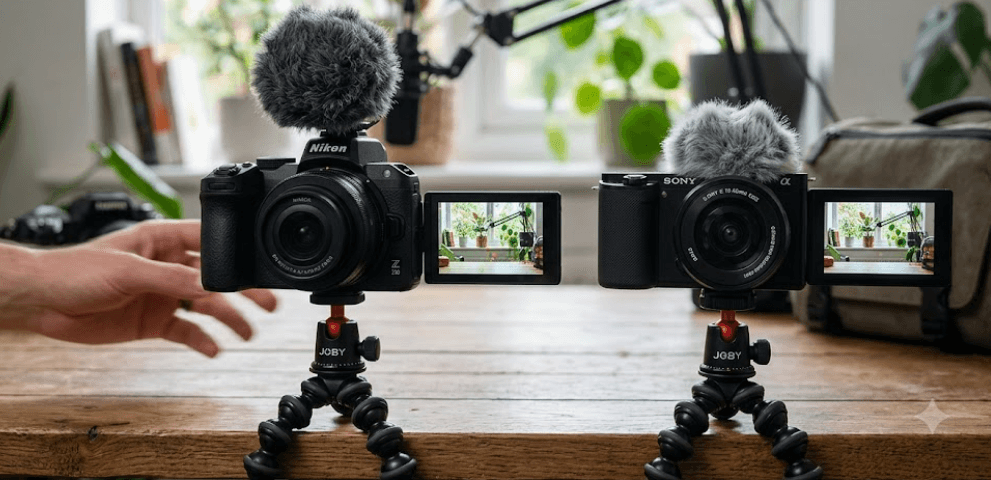
TL;DR The Nikon Z30 and Sony ZV-E10 are both designed around a simple idea: give creators interchangeable-lens image quality without making the camera difficult to carry or operate. Both use APS-C sensors, have fully articulating screens, support 4K recording at up to 30p, and offer features aimed directly at vloggers. The difference is in the details. Nikon gives the Z30 a slightly lighter body, electronic vibration reduction, a 20.9MP sensor, and access to the growing Nikon Z lens system, while Sony offers a 24.2MP sensor, a strong autofocus system, electronic Active stabilization, a headphone jack, and creator-focused controls such as Product Showcase Setting and Background Defocus. In India, Nikon currently lists the Z30 body at ₹59,895 and the 16-50mm VR kit at ₹73,495, while Sony's India materials list the ZV-E10 body at ₹59,490 and the 16-50mm kit at ₹69,990. That makes the two surprisingly close in price, so the decision comes down more to your shooting style than simply choosing the cheaper camera.
Nikon Z30 vs Sony ZV-E10: Key Differences
The Nikon Z30 and Sony ZV-E10 are closely matched in their basic approach. Both are mirrorless APS-C cameras without an electronic viewfinder, which keeps the bodies relatively compact and makes the flip-out screen the main way to compose when you are filming yourself. Nikon uses a 20.9MP DX-format CMOS sensor, while Sony uses a 24.2MP APS-C Exmor CMOS sensor. Both cameras can record 4K video at up to 30p and Full HD at up to 120p, so neither is intended to be a 4K 60p camera. That distinction is important because online comparisons sometimes accidentally mix the original ZV-E10 with the newer ZV-E10 II, which has a different specification set.
The physical design is also quite similar, but the Nikon Z30 is slightly lighter as a complete shooting body. Nikon lists approximately 405g with battery and memory card, while Sony lists approximately 343g with battery and memory card. The Z30 measures about 128 x 73.5 x 59.5mm, while the ZV-E10 measures approximately 115.2 x 64.2 x 44.8mm. In practical terms, neither is a large camera, but the Sony body is smaller and lighter, while Nikon still keeps the Z30 compact enough for handheld vlogging, travel videos, and everyday content creation.
The biggest differences start appearing once you look beyond the headline specifications. Nikon provides electronic VR for video, which can help reduce camera shake even when using lenses without built-in vibration reduction. Sony uses lens-based stabilization in Standard mode and electronic stabilization in Active mode for movies. Sony also provides a 3.5mm headphone terminal for monitoring audio, while the Z30's listed interface specifications focus on its 3.5mm stereo mini-pin microphone connection. For creators who record talking-head videos, interviews, travel content, or product videos, these small workflow differences can matter more than the megapixel count.
Core Specifications
| Feature | Nikon Z30 | Sony ZV-E10 |
|---|---|---|
| Sensor | 20.9MP DX CMOS | 24.2MP APS-C CMOS |
| Video | 4K up to 30p | 4K up to 30p |
| Full HD | Up to 120p | Up to 120p |
| Screen | 3-inch vari-angle touchscreen | 3-inch vari-angle touchscreen |
| Autofocus | 209-point hybrid AF | 425-point phase + 425-point contrast AF |
| Stabilization | Electronic VR for video | Lens-based + electronic Active mode |
| Microphone | Built-in stereo + external mic support | Built-in stereo + external mic support |
| Headphone Jack | No | Yes |
| Body Weight | Approx. 405g with battery/card | Approx. 343g with battery/card |
| Lens Mount | Nikon Z | Sony E |
Video Quality and Vlogging Performance
For everyday vlogging, both cameras are capable of producing detailed 4K footage, but neither should be treated as a high-frame-rate 4K camera. The Nikon Z30 records 3840 x 2160 video at 30p, 25p, and 24p, while Full HD recording goes up to 120p. Sony's ZV-E10 also records 4K at 30p, 25p, and 24p, with Full HD recording available up to 120p. This gives both cameras enough flexibility for YouTube videos, travel vlogs, talking-head content, tutorials, and social media production, particularly when 4K 30p is your normal delivery format.
The Nikon Z30 has an advantage when you are moving with the camera because its electronic VR can provide additional stabilization during video recording. It is not the same thing as optical stabilization in a stabilized lens or mechanical in-body image stabilization, so creators should not expect completely smooth walking footage in every situation. The Sony ZV-E10 takes a different approach, combining lens-based stabilization where supported with electronic Active mode for movie recording. The actual result will therefore depend on the lens you choose, the stabilization mode you use, and how aggressively you move while recording.
Sony also gives vloggers some useful dedicated controls. The ZV-E10 includes Product Showcase Setting and Background Defocus, which are designed to simplify common creator scenarios. Product Showcase can help when you hold an item toward the camera, while Background Defocus provides a quick way to change the look of the background. Nikon takes a more straightforward approach with the Z30, focusing on a compact body, vari-angle touchscreen, built-in stereo microphones, external microphone support, and video-focused controls. Neither camera is difficult to use, but Sony's interface is particularly shaped around the needs of vloggers.
Video Comparison
| Video Feature | Nikon Z30 | Sony ZV-E10 |
|---|---|---|
| 4K Maximum | 30p | 30p |
| Full HD Maximum | 120p | 120p |
| Flip Screen | Yes | Yes |
| Electronic Video Stabilization | Yes | Yes, Active mode |
| External Microphone | Yes | Yes |
| Headphone Monitoring | No | Yes |
| Product Showcase Mode | Not listed | Yes |
| Background Defocus | Not listed as a dedicated control | Yes |
Autofocus and Audio for Creators
Autofocus is one of the areas where the Sony ZV-E10 has a particularly strong specification. Sony lists 425 phase-detection AF points and 425 contrast-detection AF points, along with human and animal Eye AF for still images and movies. That combination is useful for creators who frequently record themselves, move around in front of the camera, or switch between their face and other subjects. The Nikon Z30 uses a hybrid phase-detection and contrast-detection AF system with 209 focus points and dedicated people and animal detection modes. Both cameras therefore offer modern autofocus rather than relying on basic single-point focusing.
For simple talking-head content, both cameras can handle the job without requiring you to manually pull focus. Sony's broader AF point specification and Eye AF implementation make it particularly attractive when your content involves frequent subject movement or changes in framing. Nikon's Z30 is also designed with creators in mind, and its AF system supports people and animal detection as well as full-time AF in video mode. In real use, however, the lens you attach, lighting conditions, subject movement, and camera settings all influence autofocus performance, so the number of focus points should not be treated as a complete measure of autofocus quality.
Audio is another area where Sony has a practical advantage for serious video workflows. Both cameras include built-in stereo microphones and allow an external microphone to be connected, but Sony also provides a 3.5mm headphone terminal. That means you can monitor recorded audio through headphones while shooting, which can be useful when recording interviews, indoor videos, or content where bad audio would be difficult to fix later. Nikon supports an external microphone through its 3.5mm microphone connection, but the Z30 does not provide the same headphone-monitoring option.
Autofocus and Audio Comparison
| Feature | Nikon Z30 | Sony ZV-E10 |
|---|---|---|
| AF System | Hybrid phase/contrast | Fast Hybrid AF |
| AF Points | 209 | 425 phase + 425 contrast |
| Human Eye AF | Yes | Yes |
| Animal Detection | Yes | Yes |
| Built-In Mic | Stereo | Stereo |
| External Mic | Yes | Yes |
| Headphone Monitoring | No | Yes |
Lens Options and Everyday Shooting
Choosing between the Nikon Z30 and Sony ZV-E10 also means choosing between two different lens ecosystems. The Z30 uses Nikon's Z mount, while the ZV-E10 uses Sony's E mount. Both systems offer interchangeable lenses, which means you are not locked into the kit lens you buy on day one. A creator can start with a compact zoom and later move to a wider lens for vlogging, a brighter prime for low-light shooting, or a longer lens for portraits and other subjects.
The standard Nikon Z30 kit with the NIKKOR Z DX 16-50mm f/3.5-6.3 VR is particularly useful for beginners because the lens covers a practical range from wide-angle to short telephoto and includes Nikon's VR stabilization. Nikon currently lists the Z30 with this lens at ₹73,495 in India. Sony's ZV-E10L kit uses the 16-50mm power zoom lens, giving beginners a similarly flexible starting point. Sony's India materials list the ZV-E10L at an MRP of ₹69,990. Prices can change, so these should be treated as current listed prices rather than permanent street prices.
The lens ecosystem becomes more important if you expect to keep the camera for several years. Sony's E-mount system gives creators a large range of compatible lenses, including many options from Sony and third-party manufacturers. Nikon's Z system has also expanded considerably, including dedicated DX lenses designed for its APS-C cameras. The better choice therefore depends partly on which lenses you expect to buy later. A creator who plans to build a small lens collection should look at the total cost of the body, kit lens, future wide-angle lens, and accessories rather than judging the camera only by its launch or current body price.
Kit Pricing in India
| Configuration | Nikon Z30 | Sony ZV-E10 |
|---|---|---|
| Body Only | ₹59,895 MRP | ₹59,490 MRP |
| 16-50mm Kit | ₹73,495 MRP | ₹69,990 MRP |
| Mount | Nikon Z | Sony E |
Battery, Portability, and Daily Use
A vlogging camera needs to be convenient enough that you actually carry it. The Z30 weighs approximately 405g with its battery and memory card, while the ZV-E10 is approximately 343g with its battery and memory card. That makes the Sony lighter by about 62g before accounting for the lens. The difference is not dramatic, but it can become noticeable when you carry the camera, lens, microphone, mini tripod, power bank, and other accessories throughout a full day.
Both cameras use rechargeable batteries and support USB power, which is useful for creators who record from a desk or carry a power bank while travelling. Sony rates the ZV-E10 at approximately 125 minutes of continuous movie recording or approximately 80 minutes of actual movie recording using the LCD under its stated CIPA conditions. Nikon specifies a maximum movie recording time of up to 125 minutes, although actual recording time can vary with battery condition, settings, and internal temperature. These figures should not be interpreted as guaranteed real-world shooting time for a full day of vlogging.
The flip-out screens on both cameras are important for self-recording because they allow you to see your framing while standing in front of the lens. The Z30 has a 3-inch vari-angle touchscreen with approximately 1.04 million dots, while the ZV-E10 has a 3-inch TFT display with approximately 921,600 dots and a fully adjustable design. For creators recording at home, outdoors, or while travelling, the screen design is arguably more important than the small resolution difference because being able to monitor framing from the front makes solo shooting much easier.
Nikon Z30 vs Sony ZV-E10: Which One Fits Your Routine?
The Nikon Z30 makes sense for creators who want a straightforward Nikon-based setup and value electronic video stabilization, a compact body, and the flexibility of the Z-mount lens system. Its 20.9MP APS-C sensor, 4K 30p recording, 120p Full HD, vari-angle touchscreen, stereo microphones, and external microphone support give it the core features needed for serious beginner and intermediate vlogging. The 16-50mm VR kit is also a practical starting point because the lens adds optical Vibration Reduction to the setup.
The Sony ZV-E10 is particularly attractive if your workflow revolves around autofocus, audio monitoring, and creator-specific controls. Its 24.2MP APS-C sensor, 425 phase-detection and 425 contrast-detection AF points, Eye AF, Product Showcase Setting, Background Defocus, 3.5mm microphone input, and 3.5mm headphone output make it well suited to people who want a camera specifically designed around vlogging. Its lower listed 16-50mm kit price in India also gives it a small pricing advantage at current MRP, although actual retailer pricing can differ.
The decision becomes much easier if you think about what you will actually record. A travel creator who wants a compact camera with electronic VR and plans to use Nikon lenses can comfortably build around the Z30. A YouTuber recording talking-head videos, product demonstrations, interviews, and self-shot content may appreciate the Sony's headphone monitoring and creator-oriented controls. Neither camera offers 4K 60p, so buyers who specifically need that frame rate should look beyond these two models rather than assuming the original ZV-E10 has the capabilities of the newer ZV-E10 II.
Best Fit at a Glance
| Your Priority | Better Fit |
|---|---|
| Compact Nikon Z system | Nikon Z30 |
| Lighter body | Sony ZV-E10 |
| Headphone monitoring | Sony ZV-E10 |
| Electronic video VR | Nikon Z30 |
| Creator-focused controls | Sony ZV-E10 |
| 4K 30p vlogging | Both |
| Full HD slow motion | Both |
| Nikon Z lens ecosystem | Nikon Z30 |
| Sony E lens ecosystem | Sony ZV-E10 |
Common Mistakes to Avoid
One common mistake is buying a camera based only on sensor megapixels. The ZV-E10 has a higher 24.2MP effective resolution than the Z30's 20.9MP, but that does not automatically mean it will produce better video for every creator. Video resolution, lens quality, autofocus, stabilization, lighting, microphone quality, and editing all contribute to the final result. For a vlogger, a good microphone and a suitable wide lens can have a much bigger practical impact than a small difference in still-image resolution.
Another mistake is assuming that both cameras provide the same stabilization simply because both have electronic stabilization options. The Nikon Z30's electronic VR works at the camera level for video, while Sony's movie stabilization combines lens-based stabilization with electronic Active mode. The result can vary depending on the lens and shooting conditions. If you intend to walk and talk frequently, it is worth testing the exact camera and lens combination rather than judging stabilization from the body specification alone.
It is also easy to overlook audio monitoring. A beginner may be satisfied with the built-in microphone, but creators who move into interviews, sponsored videos, product demonstrations, or more controlled productions often start using external microphones. Sony's headphone jack gives the ZV-E10 an important practical advantage because you can monitor audio while recording. Nikon still supports an external microphone, so the Z30 is not limited to its built-in microphones, but it does not offer the same headphone-monitoring workflow.
Frequently Asked Questions
Q. Is the Nikon Z30 better than the Sony ZV-E10 for vlogging?
The Nikon Z30 is a strong vlogging camera with 4K 30p recording, a vari-angle touchscreen, electronic VR, people and animal detection, and external microphone support. The Sony ZV-E10 adds features such as headphone monitoring, Product Showcase Setting, and a 24.2MP sensor. The better fit depends on whether you value Nikon's Z system and electronic VR or Sony's creator-focused controls and audio monitoring.
Q. Does the Nikon Z30 shoot 4K 60p video?
No. The Nikon Z30 records 4K UHD at up to 30p. It can record Full HD at up to 120p for slow-motion footage.
Q. Does the Sony ZV-E10 shoot 4K 60p video?
No. The original Sony ZV-E10 records 4K at up to 30p. The newer ZV-E10 II is a different camera and supports 4K recording at up to 60p, so its specifications should not be applied to the original ZV-E10.
Q. Which camera has better autofocus, the Nikon Z30 or Sony ZV-E10?
Both use hybrid autofocus and support subject detection, but their systems are specified differently. Nikon lists 209 focus points, while Sony lists 425 phase-detection and 425 contrast-detection points. Sony also provides human and animal Eye AF for movies.
Q. Does the Nikon Z30 have a headphone jack?
No. The Z30 supports an external microphone through its 3.5mm stereo mini-pin connection, but it does not provide the 3.5mm headphone-monitoring terminal found on the Sony ZV-E10.
Q. Does the Sony ZV-E10 have image stabilization?
The ZV-E10 supports stabilization through compatible lenses and offers electronic Active stabilization for movies. It does not have sensor-shift mechanical image stabilization in the camera body.
Q. Which camera is lighter, Nikon Z30 or Sony ZV-E10?
The Sony ZV-E10 is lighter. Sony lists approximately 343g with battery and memory card, while Nikon lists approximately 405g for the Z30 with battery and memory card.
Q. Can I change lenses on both the Nikon Z30 and Sony ZV-E10?
Yes. Both are interchangeable-lens mirrorless cameras. The Nikon Z30 uses Nikon's Z mount, while the Sony ZV-E10 uses Sony's E mount. This allows creators to change lenses as their shooting needs develop.
Q. Which camera is cheaper in India, Nikon Z30 or Sony ZV-E10?
At the current manufacturer-listed prices checked for this comparison, the Sony ZV-E10 body is listed at ₹59,490 and the ZV-E10L 16-50mm kit at ₹69,990. Nikon lists the Z30 body at ₹59,895 and the 16-50mm VR kit at ₹73,495. Retailer prices and offers can differ from these listed prices.
Q. Should I buy the Nikon Z30 or Sony ZV-E10 for YouTube?
Both can work well for YouTube because both offer APS-C sensors, flip-out screens, 4K 30p recording, external microphone support, and interchangeable lenses. The Sony ZV-E10 is particularly useful if you want headphone monitoring and dedicated vlogging controls, while the Nikon Z30 is a good fit if you prefer Nikon's Z system and want electronic VR for video.
Final Recommendation
Nikon Z30 and Sony ZV-E10 are priced and built similarly so you do not have to pick one because of one spec. Nikon Z30 offers a Nikon Z system, electronic VR, a 20.9‑megapixel APS‑C sensor, 4K video at 30 frames per second and a handy 16‑50mm VR kit. Nikon Z30 is a choice for creators who want to join Nikon’s Z lens world and like a camera that is easy to use for travel talking‑head videos and everyday shots. Nikon Z30 body is listed at ₹59,895. The 16‑50mm kit at ₹73,495 in India.
From my view Sony ZV-E10 is the creator‑focused camera in many useful ways. Sony ZV-E10 has a 24.2‑megapixel APS‑C sensor, 425 phase‑detection and 425 contrast‑detection focus points eye‑tracking for people and animals a Product Showcase Setting, Background Defocus, a mic jack and a headphone output giving vloggers a powerful set of tools without a pricier body. Sony ZV-E10 body is listed at ₹59,490. The 16‑50mm kit, at ₹69,990 though the real sale price may differ by shop and deal.
For most first-time vloggers deciding specifically between these two models, the Sony ZV-E10 is the more creator-focused choice, particularly if autofocus, audio monitoring, and dedicated vlogging controls are central to your workflow. The Nikon Z30 remains a strong alternative for buyers who prefer Nikon's Z-mount ecosystem, electronic VR, and the handling of the Nikon system. The most important thing is to buy the complete setup rather than just the body. A suitable wide lens, reliable microphone, memory card, spare battery, and small tripod can make a bigger difference to your finished videos than a small difference in camera specifications.






