
Nikon DSLR vs Nikon Mirrorless: Should You buy a D7500 or a Z6?
The Nikon D7500 and Z6 represent two different approaches to photography. Compare their sensors, autofocus, video, battery, lenses, and value before choosing one in 2026.

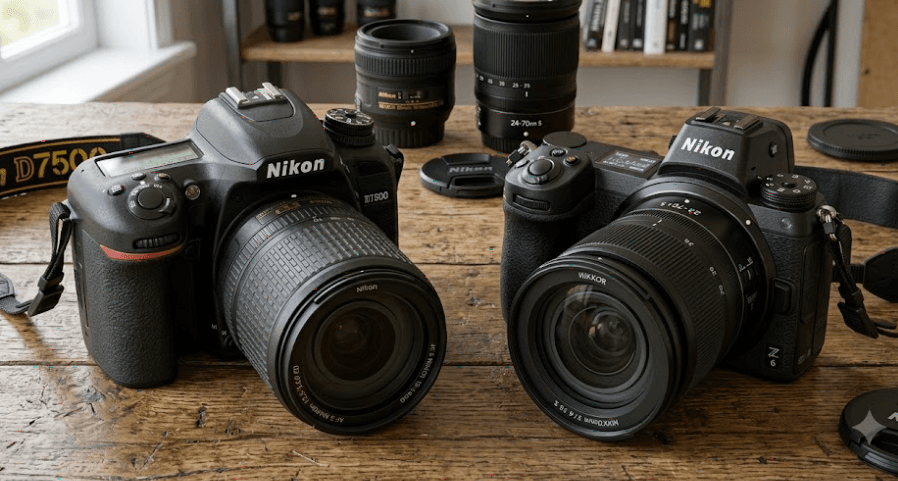
TL;DR The Nikon D7500 and original Nikon Z6 are older cameras, but both can still make sense in 2026 if you find them at the right price. The D7500 is a 20.9MP DX DSLR with an optical viewfinder, 8 fps continuous shooting, strong battery life, a built-in flash, and compatibility with Nikon F-mount lenses. The Z6 moves to a 24.5MP full-frame sensor, electronic viewfinder, Z mount, in-body image stabilization, 4K video, and faster burst shooting. For wildlife and photographers who already own compatible F-mount lenses, the D7500 can still be a practical value choice. For full-frame image quality, video, low-light work, and the advantages of a modern mirrorless design, the Z6 is the better camera. However, because Nikon's Z system has moved forward to newer models such as the Z6III, the original Z6 should be considered primarily when its used or discounted price makes sense rather than as Nikon's latest mirrorless option.
Nikon D7500 vs Z6: Key Differences
The biggest difference between the Nikon D7500 and Nikon Z6 is not simply DSLR versus mirrorless. The cameras use different sensor formats, lens mounts, viewfinder systems, and overall designs. The D7500 uses a 20.9MP DX-format APS-C sensor and Nikon F mount, while the original Z6 uses a 24.5MP FX-format full-frame sensor and Nikon Z mount. That full-frame sensor gives the Z6 a clear advantage for photographers who regularly shoot in low light, want more control over depth of field, or need the wider field of view associated with full-frame lenses. The D7500, meanwhile, has a 1.5x crop factor that can be useful when photographing distant subjects because compatible lenses provide a narrower effective field of view.
The viewfinder experience is another major difference. The D7500 has an optical pentaprism viewfinder, so you see the scene directly through the lens using the DSLR's mirror and optical system. The Z6 uses an electronic viewfinder, which can show exposure, white balance, and other changes before you take the photograph. That makes the Z6 particularly useful for photographers who prefer to preview the final image while composing. The Z6 also provides the broader design flexibility associated with mirrorless cameras, while the D7500 retains the familiar handling and direct optical viewing experience that many DSLR users still prefer.
Performance also separates the two. Nikon rates the D7500 for up to 8 frames per second, while the original Z6 can shoot at up to 12 frames per second under the appropriate settings. The D7500, however, remains a capable action and wildlife camera because its DX sensor and 8 fps burst rate work well with telephoto shooting. The Z6's faster burst capability and full-frame sensor make it more versatile across different types of photography, particularly when you also care about video and low-light performance. Neither camera should be judged solely by its maximum frame rate because autofocus behaviour, lens choice, subject movement, and shooting conditions all affect real-world results.
Key Specifications
| Feature | Nikon D7500 | Nikon Z6 |
|---|---|---|
| Camera Type | DSLR | Mirrorless |
| Sensor | 20.9MP DX CMOS | 24.5MP FX BSI-CMOS |
| Lens Mount | Nikon F | Nikon Z |
| Viewfinder | Optical pentaprism | Electronic |
| Continuous Shooting | Up to 8 fps | Up to 12 fps |
| Video | 4K UHD up to 30p | 4K UHD up to 30p |
| Image Stabilization | Lens-based VR on compatible lenses | In-body image stabilization |
| Battery Life | Approx. 950 shots | Lower than D7500 by CIPA rating |
| Body Weight | Approx. 640g | Approx. 675g with battery and card |
| Card Storage | Single SD slot | Single XQD/CFexpress Type B-compatible slot |
The specifications above show why neither camera is simply the "better Nikon" in every situation. The D7500 has the advantage in battery life and traditional DSLR handling, while the Z6 brings a full-frame sensor, mirrorless design, and in-body stabilization.
Nikon D7500 vs Z6: Image Quality
Image quality is where the Z6 has the clearest hardware advantage. Its 24.5MP full-frame BSI-CMOS sensor is physically larger than the D7500's 20.9MP DX sensor, giving the Z6 more flexibility when shooting at higher ISO settings and creating shallow depth of field. A full-frame camera can also make it easier to achieve certain wide-angle compositions because the lens does not have the same crop factor as a DX body. For portraits, weddings, indoor photography, and other situations where light can become challenging, the Z6's sensor format makes it the stronger choice.
That does not make the D7500 a poor camera for image quality. Its 20.9MP sensor remains capable of producing detailed photographs, and Nikon designed the camera around the same general generation of processing technology that helped make it a strong enthusiast DSLR. Its DX format can actually become an advantage for wildlife photographers because a telephoto lens gives a narrower angle of view compared with the same lens on a full-frame camera. If you photograph birds or distant animals, that extra reach can be more useful than the Z6's larger sensor, especially when paired with an appropriate F-mount telephoto lens.
The difference becomes more noticeable when you start editing photographs heavily. A full-frame sensor does not automatically guarantee a better photograph, because lens quality, exposure, technique, and lighting remain important. However, the Z6 gives photographers more room to work with shallow depth of field and low-light scenes. The D7500 remains perfectly capable for daylight landscapes, wildlife, travel, portraits, and everyday photography, but the Z6 is the stronger choice when image quality in difficult lighting is one of your highest priorities. That makes the Z6 more attractive to photographers who want a camera body that can grow with more demanding creative work.
Image Quality Comparison
| Area | Nikon D7500 | Nikon Z6 |
|---|---|---|
| Sensor Format | DX | Full-frame FX |
| Resolution | 20.9MP | 24.5MP |
| Low-Light Potential | Very good | Stronger overall |
| Depth of Field Control | Good | Better flexibility |
| Wildlife Reach | Strong advantage from DX crop | Requires longer lens for equivalent framing |
| Portraits | Very capable | Better full-frame flexibility |
| Landscape | Very capable | Better wide-angle potential |
For pure image-quality flexibility, the Nikon Z6 wins. For photographers who value the practical reach of a DX sensor, the D7500 can still be the smarter tool.
Nikon D7500 vs Z6: Autofocus and Speed
Autofocus is more complicated than simply counting focus points. The D7500 uses Nikon's dedicated Multi-CAM 3500 II autofocus system with 51 focus points, including 15 cross-type sensors, and supports 3D tracking and dynamic-area AF. Nikon also gives it autofocus fine-tuning, which can be useful when working with compatible F-mount lenses. This system is particularly familiar to DSLR photographers who are used to selecting focus points through an optical viewfinder and following moving subjects using traditional phase-detection autofocus.
The Z6 uses a 273-point hybrid autofocus system with phase-detection points on the imaging sensor. This gives the mirrorless camera much wider autofocus coverage across the frame than the D7500's dedicated AF module. It also means autofocus can operate directly through the main imaging sensor during live view and video. However, the original Z6's autofocus system should not be confused with the much more advanced subject-detection systems found on newer Nikon Z cameras. In 2026, the Z6 is an older-generation mirrorless camera, so buyers should keep its age in mind when comparing it with current models.
For fast-moving wildlife, the D7500 still has an interesting advantage because of its combination of 3D tracking, optical viewfinder handling, 8 fps burst shooting, and DX crop. The Z6 counters with a faster maximum burst rate and broader AF coverage, making it more versatile for general subjects and video. If you are buying specifically for wildlife and already understand DSLR autofocus, the D7500 should not be dismissed simply because it is older. If you want the broader mirrorless shooting experience, the Z6 is more appropriate.
Speed and Autofocus
| Feature | Nikon D7500 | Nikon Z6 |
|---|---|---|
| AF System | 51-point dedicated AF | 273-point hybrid AF |
| Subject Coverage | More limited | Much wider |
| Burst Speed | Up to 8 fps | Up to 12 fps |
| Tracking | 3D tracking | Subject tracking |
| Viewfinder | Optical | Electronic |
| Video AF | Live View AF | Sensor-based AF |
The important point is that the Z6's newer-looking mirrorless architecture does not automatically make it superior for every moving subject. The D7500 remains a capable action camera, particularly when its DX format and established DSLR autofocus system suit the photographer's shooting style.
Nikon D7500 vs Z6: Video and Stabilization
Video is one area where the Z6 has a particularly strong advantage over the D7500. Both cameras support 4K UHD recording, but the Z6 combines 4K capability with a mirrorless design and in-body image stabilization. The D7500 can also record 4K UHD at up to 30p, but its DSLR architecture and stabilization approach are less convenient for someone who wants to use the camera extensively for handheld video. Nikon's original Z6 was designed as a hybrid camera, making video a more central part of its appeal.
In-body image stabilization is especially useful because it can stabilize the camera with compatible lenses rather than depending entirely on optical stabilization built into the lens. That does not mean every handheld video shot will become perfectly smooth, but it can make a noticeable difference when shooting at slower shutter speeds or working without a tripod. For photographers who also create YouTube videos, travel footage, interviews, reels, or other hybrid content, this makes the Z6 considerably easier to recommend than the D7500.
The D7500 still has a place for users whose priority is primarily photography. Its 4K capability is useful for occasional video, but buying it specifically as a video-first camera in 2026 would be difficult to justify unless the price is particularly attractive. The original Z6 is also no longer Nikon's newest Z6-series camera. Nikon's current Z6III is substantially more advanced, including 6K/60p RAW recording and newer video capabilities. Therefore, the original Z6 is best viewed as an older full-frame mirrorless option rather than a current-generation video flagship.
Video Comparison
| Video Feature | Nikon D7500 | Nikon Z6 |
|---|---|---|
| 4K UHD | Yes | Yes |
| Maximum 4K Frame Rate | 30p | 30p |
| In-Body Stabilization | No | Yes |
| Mirrorless Video Workflow | No | Yes |
| Hybrid Photography | Good | Strong |
| Video-Focused Buying in 2026 | Limited value | Better, but now older |
If video is a major reason for buying the camera, choose the Z6 over the D7500. If video is only an occasional requirement and still photography dominates your work, the D7500 can still make sense at the right price.
Nikon D7500 vs Z6: Battery and Lens Choice
Battery life is an area where the D7500 has a surprisingly practical advantage. Nikon rates the D7500 at approximately 950 still photographs per charge under CIPA testing conditions. That is a strong figure for an enthusiast camera and is one reason DSLR bodies remain attractive to photographers who spend long days away from power outlets. The Z6's mirrorless design requires its electronic viewfinder and display to operate from the battery, so its endurance is lower by comparison. Actual battery life varies with shooting settings, temperature, image review, autofocus behaviour, and video use, but the D7500 has the advantage for long stills-focused shooting sessions.
Lens compatibility may be even more important than battery life. The D7500 uses Nikon F-mount and can work with a wide range of Nikon F-mount lenses, including many AF-S and other compatible NIKKOR lenses. That makes the D7500 particularly attractive to an existing Nikon DSLR owner who already has a collection of suitable glass. The Z6 uses Nikon Z mount, which gives access to Nikon's newer Z lenses. F-mount lenses can also be used on Z cameras with the appropriate FTZ or FTZ II adapter, although compatibility and autofocus behavior depend on the specific lens.
This is why the cheaper body is not always the cheaper system. Someone starting from zero has to consider the price of lenses, batteries, cards, and other accessories alongside the camera body. An existing Nikon DSLR owner with several useful F-mount lenses may find the D7500 considerably easier to justify. On the other hand, a buyer starting a new Nikon system in 2026 should think carefully before investing heavily in older F-mount equipment because Nikon's current development is centered on its Z-mount mirrorless system. The original Z6 gives you a direct entry into that newer lens ecosystem.
System Comparison
| Factor | Nikon D7500 | Nikon Z6 |
|---|---|---|
| Lens Mount | Nikon F | Nikon Z |
| Existing F-Mount Lens Value | Excellent | Works with compatible adapter |
| New-System Direction | Older DSLR system | Current Nikon mirrorless system |
| Battery Advantage | D7500 | Z6 requires more planning |
| Long-Term System Potential | More limited | Stronger |
| Best For | Existing DSLR users | New mirrorless users |
For a photographer building a system from scratch, the Z6's mount is the more forward-looking choice. For someone who already owns good F-mount lenses, the D7500 can offer considerably better value.
Nikon D7500 vs Z6: Which One Should You Buy?
The Nikon D7500 is the better choice when your priority is practical photography rather than having the newest camera technology. It remains a capable 20.9MP DX DSLR with 8 fps continuous shooting, a strong 51-point autofocus system, an optical pentaprism viewfinder, 4K UHD recording, and approximately 950-shot battery life. Wildlife photographers can also benefit from the DX crop, while existing Nikon DSLR users can continue using their F-mount lenses without changing systems.
The Nikon Z6 is the better choice for most photographers who specifically want a full-frame mirrorless camera. Its 24.5MP FX sensor, electronic viewfinder, 273-point hybrid AF system, up to 12 fps shooting, 4K UHD video, and in-body image stabilization make it a more flexible hybrid camera. It is particularly attractive for portraits, travel, low-light photography, video, and photographers who want to enter Nikon's Z-mount ecosystem.
There is one important 2026 qualification: neither camera should be purchased without considering its age. Nikon's Z6 family has progressed to newer generations, with the Z6III offering features such as 6K/60p RAW recording. The D7500 is also an older DSLR design. Therefore, the decision should come down to price and intended use. If a D7500 is substantially cheaper and you already own F-mount lenses, it can still be a sensible purchase. If the original Z6 is available at an attractive used or discounted price and you want full-frame mirrorless features, it is the stronger option. If the price difference between the original Z6 and a newer Z-series body is small, the newer body deserves serious consideration.
Nikon D7500 vs Z6 At A Glance
| Buyer Type | Better Choice | Why |
|---|---|---|
| Existing Nikon DSLR owner | D7500 | Uses F-mount lenses directly |
| Wildlife photographer | D7500 | DX reach and strong DSLR AF |
| Portrait photographer | Z6 | Full-frame sensor |
| Low-light photographer | Z6 | Full-frame sensor and IBIS |
| Video creator | Z6 | Mirrorless design and IBIS |
| New Nikon system buyer | Z6 | Z-mount ecosystem |
| Long battery life | D7500 | Approx. 950 CIPA shots |
| Full-frame photography | Z6 | 24.5MP FX sensor |
| Lowest-cost used setup | D7500 | Older DSLR bodies and F-mount lenses can be affordable |
Frequently Asked Questions
Q. Is the Nikon D7500 still worth buying in 2026?
Yes, but mainly when you find it at a good price or already own compatible Nikon F-mount lenses. Its 20.9MP DX sensor, 8 fps shooting, 51-point autofocus system, 4K UHD recording, and approximately 950-shot battery rating still make it a capable enthusiast camera.
Q. Is the Nikon Z6 better than the D7500?
For most photographers who want full-frame image quality, mirrorless features, video, and in-body stabilization, the Z6 is the stronger camera. The D7500 can still be better for certain wildlife photographers and existing F-mount users.
Q. Which has the larger sensor, the D7500 or Z6?
The Z6 has the larger sensor. It uses a 24.5MP FX full-frame sensor, while the D7500 uses a 20.9MP DX-format sensor.
Q. Which camera is better for wildlife photography?
The D7500 can be an excellent wildlife option because its DX-format sensor provides a narrower field of view with compatible lenses, effectively giving telephoto lenses more reach. Its 8 fps burst rate and 51-point autofocus system also remain useful for moving subjects.
Q. Which is better for low-light photography?
The Z6 is generally the better choice because its full-frame sensor provides greater flexibility in low-light photography, and its in-body image stabilization can help when shooting handheld. Lens choice and shooting technique still have a major effect on results.
Q. Does the Nikon Z6 have better video capabilities than the D7500?
Yes. Both cameras can record 4K UHD, but the Z6 adds in-body image stabilization and a mirrorless shooting design that makes it better suited to hybrid photo and video work.
Q. Can I use Nikon F-mount lenses on the Z6?
Compatible Nikon F-mount lenses can be used on Z-series cameras with Nikon's FTZ or FTZ II adapter. However, compatibility and autofocus functionality vary depending on the specific lens.
Q. Which camera has better battery life?
The D7500 has the advantage. Nikon rates it for approximately 950 still images per charge under CIPA testing conditions.
Q. Is the original Nikon Z6 still a good camera in 2026?
It can still be a good camera if purchased at the right price, particularly for photographers who want a full-frame mirrorless body. However, it is an older Z6 generation, and newer models such as the Z6III offer substantially more advanced features.
Q. Should I buy the D7500 or Z6 for photography?
Choose the D7500 if you value battery life, optical viewing, wildlife reach, or existing F-mount lenses. Choose the Z6 if you want full-frame performance, in-body stabilization, mirrorless handling, and a path into Nikon's Z-mount system.
Final Recommendation
The Nikon D7500 and original Z6 are still capable cameras, but they make sense for different buyers in 2026. The D7500 is the sensible choice for an existing Nikon DSLR user, a wildlife photographer who can benefit from the DX format, or anyone who finds a well-priced body with access to affordable F-mount lenses. Its 20.9MP sensor, 8 fps shooting, 51-point autofocus system, optical viewfinder, and strong battery life remain useful features rather than obsolete specifications.
The Z6 is the better overall camera if you want to move into full-frame mirrorless photography. Its 24.5MP FX sensor, 273-point hybrid AF system, 12 fps maximum continuous shooting, 4K UHD video, electronic viewfinder, and in-body stabilization give it a more versatile feature set. It is particularly well suited to photographers who shoot portraits, travel, low-light scenes, and video.
Our recommendation: Choose the Nikon Z6 if you are deciding strictly between these two cameras and the prices are reasonably close. Its full-frame sensor and mirrorless system make it the more capable all-rounder. Choose the Nikon D7500 when its lower price, excellent battery life, DX wildlife reach, or your existing F-mount lens collection makes it the more practical purchase. However, if you are buying new in 2026, do not stop at these two models. Nikon's newer Z-series cameras, including the Z6III, offer a much more modern feature set and should be considered if your budget allows.
Ready to upgrade your tech?
Browse our collection of quality refurbished products at unbeatable prices.






