
Nikon D90 vs D7500: How Far Has Nikon's Mid-Tier Come?
The Nikon D7500 is a major step forward from the D90, bringing a newer 20.9MP sensor, faster autofocus, 8 fps shooting, 4K video, and a modern touchscreen.

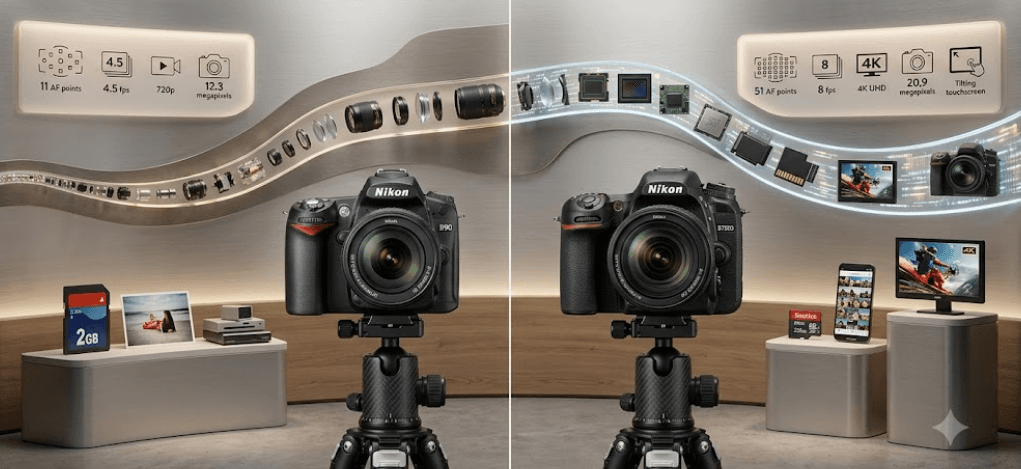
TL;DR The Nikon D90 and Nikon D7500 belong to very different generations of Nikon's DX DSLR line-up. The D90 arrived in 2008 with a 12.3MP sensor, 11-point autofocus, 4.5 fps continuous shooting, and a fixed 3-inch LCD, while the D7500 launched in 2017 with a 20.9MP sensor, 51-point autofocus, 8 fps shooting, a tilting touchscreen, and 4K UHD video. The D7500 is therefore the clear choice for buyers who want better autofocus, faster shooting, stronger high-ISO capability, and modern video features. The D90 can still make sense as an inexpensive entry into Nikon's F-mount system, particularly for basic photography, but it is no longer a competitive mid-tier DSLR by modern standards.
Nikon D90 vs D7500: What Changed?
The Nikon D90 was introduced in 2008 as a mid-class DX-format DSLR and became notable for bringing video recording to a Nikon DSLR for the first time. It used a 12.3MP CMOS sensor, EXPEED processing, an 11-point autofocus system, and continuous shooting at up to 4.5 fps. For its time, those specifications made it a serious enthusiast camera, particularly for photographers moving up from entry-level Nikon bodies. The D90 also used Nikon's F mount, giving owners access to a large range of NIKKOR lenses.
Almost nine years later, the D7500 arrived with a very different idea of what an enthusiast DSLR should deliver. Its 20.9MP DX sensor and EXPEED 5 processor were derived from technology used in Nikon's D500, while its 8 fps burst rate and deeper buffer made it much more suitable for moving subjects. Nikon also added 4K UHD recording, a tilting touchscreen, built-in Wi-Fi, Bluetooth connectivity, and improved metering and subject recognition. The result was not just a more modern version of the D90, but a camera designed around considerably faster and more demanding workflows.
The difference becomes clearer when you use the cameras rather than simply compare their megapixel counts. The D90's 12.3MP output can still produce good photographs in the right conditions, but the D7500 gives you considerably more flexibility when focusing, cropping, shooting continuously, or working with video. The D7500 also has a 100 percent viewfinder, compared with 96 percent coverage on the D90, and its rear screen is larger, tilting, and touch-sensitive. In everyday use, those changes make the D7500 feel much closer to a modern enthusiast camera.
Core Specifications Compared
| Feature | Nikon D90 | Nikon D7500 |
|---|---|---|
| Launch Year | 2008 | 2017 |
| Sensor | 12.3MP DX CMOS | 20.9MP DX CMOS |
| Processor | EXPEED | EXPEED 5 |
| Autofocus | 11-point AF | 51-point AF |
| Continuous Shooting | 4.5 fps | 8 fps |
| Viewfinder Coverage | 96% | 100% |
| Rear Display | 3-inch fixed LCD | 3.2-inch tilting touchscreen |
| Video | 720p HD | 4K UHD |
| Maximum Native ISO | ISO 3200 | ISO 51,200 |
| Storage | SD/SDHC | SD, SDHC, SDXC |
| Approx. Weight | 703g | 720g |
Specifications sourced from Nikon and DPReview.
Image Quality Has Moved Forward
The most obvious specification change is the move from 12.3MP in the D90 to 20.9MP in the D7500. More resolution does not automatically mean better photographs, but it gives the D7500 more room for cropping and allows you to retain more detail when producing larger images. The D7500's sensor is also closely related to the 20.9MP DX sensor used in Nikon's D500, which was designed around fast readout and strong overall image quality rather than simply maximizing pixel count.
High-ISO performance is another area where the generational difference becomes important. The D90's standard ISO range is considerably narrower, while the D7500 offers a native range extending to ISO 51,200 and can be expanded much further. That does not mean every photograph at ISO 51,200 will look excellent, because extreme ISO settings always involve compromises in noise and detail. It does mean the D7500 gives photographers a much wider working range when light becomes difficult, particularly for indoor events, evening photography, and action.
The D7500 therefore has the advantage for photographers who regularly crop images, shoot in changing light, or need more flexibility from a single exposure. The D90 can still produce attractive images when paired with a good lens and used in sensible lighting, and its lower resolution is not a problem for casual web sharing or smaller prints. The important point is that the D7500 gives you substantially more room to work with, making it the stronger camera for photographers whose needs have moved beyond basic still photography.
Sensor and ISO Difference
| Area | Nikon D90 | Nikon D7500 |
|---|---|---|
| Effective Resolution | 12.3MP | 20.9MP |
| Sensor Format | DX | DX |
| Sensor Size | 23.6 x 15.8mm | 23.5 x 15.6mm |
| Standard ISO Range | 200-3200 | 100-51,200 |
| Expanded ISO | Up to 6400 equivalent | Up to 1,640,000 equivalent |
| Best Advantage | Basic still photography | Cropping and difficult lighting |
The D7500's sensor and ISO specifications are from Nikon's published specifications; the D90 specifications are from DPReview's documented specifications and review material.
Autofocus and Speed Are the Biggest Upgrade
If you photograph sports, wildlife, children, pets, vehicles, or other moving subjects, the autofocus difference between these cameras is more important than the resolution difference. The D90 uses an 11-point autofocus system, including a single cross-type center sensor. That was capable for its era, but it leaves much less room for tracking unpredictable movement across the frame. The D7500 uses Nikon's 51-point phase-detection autofocus system, giving it a much denser focusing layout and more flexibility when following moving subjects.
The D7500 also doubles the D90's approximate burst rate from 4.5 fps to 8 fps. That difference sounds small until you photograph a fast sequence. At 8 fps, you have considerably more opportunities to capture the exact moment a bird changes direction, a player reaches the ball, or a subject makes an expression. DPReview also notes that the D7500 can record more than 100 JPEGs or around 50 RAW files in a burst, giving it a substantially deeper buffer than older enthusiast bodies.
This is where Nikon's mid-tier development becomes particularly obvious. The D90 was designed primarily around conventional enthusiast photography, while the D7500 borrowed important technology from the much more performance-oriented D500. The D7500 is not as fast or as sophisticated as the D500, but that was never its purpose. It brought a significant portion of Nikon's higher-end DX performance into a smaller and more accessible enthusiast body, making it a much more capable choice for action photography.
Shooting Performance Compared
| Feature | Nikon D90 | Nikon D7500 |
|---|---|---|
| AF Points | 11 | 51 |
| Burst Rate | 4.5 fps | 8 fps |
| Viewfinder Coverage | 96% | 100% |
| Maximum Shutter Speed | 1/4000 sec | 1/8000 sec |
| Touchscreen | No | Yes |
| Best For | General photography | Action and enthusiast shooting |
The D90 and D7500 specifications are documented by DPReview and Nikon.
Video and Everyday Usability Are Completely Different
The D90 deserves credit for being historically important because it was the first DSLR to introduce a movie mode. However, its video capabilities are extremely basic by current standards. The camera records HD video rather than 4K, and the feature is better viewed as an early introduction of DSLR video than as a serious modern video tool. For photographers buying a camera primarily for stills, this may not matter much, but anyone expecting a modern hybrid shooting experience will find the D90 restrictive.
The D7500 is much more capable for video because it supports 4K UHD recording at up to 30p, along with Full HD recording at higher frame rates. Nikon also provides HDMI output and the ability to record 4K files to an external recorder, while the camera's tilting touchscreen makes framing from different angles easier. One limitation is worth knowing: the D7500's 4K recording uses a crop of the sensor, which can make wide-angle shooting more difficult with some lenses.
Everyday operation is also more modern on the D7500. Its 3.2-inch tilting touchscreen is considerably more flexible than the D90's fixed 3-inch display, and the D7500 adds built-in Wi-Fi and Bluetooth connectivity. The D90's fixed screen and older connectivity reflect its 2008 origins. If you mostly use the optical viewfinder and transfer images manually, these differences may not be deal-breakers, but for photographers who want a camera that fits more naturally into a current workflow, the D7500 is far easier to recommend.
Video and Usability
| Feature | Nikon D90 | Nikon D7500 |
|---|---|---|
| Maximum Video Resolution | 720p HD | 4K UHD |
| Rear Screen | Fixed | Tilting touchscreen |
| Screen Size | 3 inches | 3.2 inches |
| Wi-Fi | No built-in Wi-Fi | Yes |
| Bluetooth | No | Yes |
| Best Advantage | Basic DSLR photography | Modern hybrid workflow |
The D7500's 4K, display, and connectivity specifications are confirmed by Nikon, while the D90's video history and display specifications are documented by DPReview.
Which Nikon Should You Buy Today?
For someone choosing between these two cameras in 2026, the D7500 is the much more sensible option if the prices are reasonably close. It offers a newer sensor, faster processor, significantly more sophisticated autofocus, 8 fps continuous shooting, better ISO flexibility, 4K video, a tilting touchscreen, and modern wireless connectivity. Those are not minor refinements. They affect the way the camera performs in real shooting situations, particularly when subjects move quickly or lighting becomes difficult.
The D90 can still have a place in the used-camera market, but its appeal is mainly about price and simplicity rather than performance. A beginner who finds a clean D90 body at a very low price and already has compatible Nikon F-mount lenses can still learn exposure, composition, manual focus, and basic DSLR photography with it. The camera's age does mean buyers should pay close attention to condition, shutter count, battery health, included accessories, and the condition of the sensor and LCD before purchasing.
The D7500 is the better long-term choice for enthusiasts who want one camera that can handle still photography, action, low-light work, and occasional video without feeling severely limited. It is also important to remember that the D7500 is itself a DSLR from 2017, so buyers interested in the newest autofocus and mirrorless features may want to compare it with modern Nikon Z-series cameras as well. But if the question is specifically how far Nikon's mid-tier DX DSLR line moved from the D90 to the D7500, the answer is clear: the improvement is substantial, particularly in autofocus, speed, sensor performance, video, and usability.
Frequently Asked Questions
Q. Is the Nikon D7500 much better than the D90?
Yes. The D7500 is substantially more advanced, with a 20.9MP sensor, 51-point autofocus, 8 fps continuous shooting, 4K video, a tilting touchscreen, and a much wider native ISO range.
Q. Does the D90 still take good photos in 2026?
Yes. A well-maintained D90 can still produce good photographs, especially in good light and when paired with a capable lens. Its limitations become more obvious with autofocus, low-light shooting, cropping, and video.
Q. Which has better autofocus, the D90 or D7500?
The D7500 has the stronger autofocus system. It uses 51 focus points compared with 11 on the D90, making it considerably better suited to tracking moving subjects.
Q. Is the Nikon D7500 good for sports photography?
Yes. Its 8 fps burst rate, 51-point autofocus system, and D500-derived sensor and processing technology make it much more suitable for sports and action photography than the D90.
Q. Does the Nikon D7500 shoot 4K video?
Yes. The D7500 can record 4K UHD video at 30p, 25p, and 24p. Its 4K recording uses a crop of the sensor, which can affect wide-angle framing.
Q. Is the Nikon D90 still worth buying?
It can be worth considering only at a very low used price and when your needs are basic still photography. It is much harder to recommend if you need fast autofocus, modern video, wireless connectivity, or strong low-light flexibility.
Q. Which has better image quality, the D90 or D7500?
The D7500 has the technical advantage because of its newer 20.9MP sensor and much broader ISO range. However, image quality also depends heavily on the lens, exposure, lighting, and photographer.
Q. Is the D7500 a professional camera?
The D7500 is an enthusiast-level DX DSLR rather than Nikon's professional flagship. It borrows important sensor and processing technology from the higher-end D500, giving it strong performance without making it a direct replacement for Nikon's professional bodies.
Q. Does the D7500 have a touchscreen?
Yes. It has a 3.2-inch tilting touchscreen LCD. The D90 has a fixed 3-inch LCD without touchscreen functionality.
Q. Should I upgrade from a D90 to a D7500?
If you need faster autofocus, better action performance, improved high-ISO flexibility, 4K video, a tilting touchscreen, or wireless connectivity, the D7500 is a meaningful upgrade. For basic photography in good light, the D90 can still be usable, so the upgrade is most worthwhile when its limitations are affecting your shooting.
Final Recommendation
The Nikon D90 shows how capable a mid-tier DSLR could be in 2008, but the D7500 shows just how much Nikon's enthusiast DX lineup evolved over the following decade. The D90 introduced DSLR video, offered a 12.3MP sensor, and provided a solid 11-point autofocus system for its generation. The D7500 moved the category much further with a 20.9MP sensor, EXPEED 5 processing, 51-point autofocus, 8 fps shooting, 4K video, a tilting touchscreen, and modern connectivity.
For a buyer in 2026, the D7500 is the clear recommendation between the two. It is better suited to action, travel, low-light photography, cropping, video, and everyday use. The D90 only makes sense when its significantly lower used price is the main attraction and the photographer understands its age-related limitations. If you already own a D90 and are considering an upgrade, moving to the D7500 represents a genuine generational jump rather than a small specification bump.






