Nikon D5300 Review: Why It's Still a Favorite Among Budget Buyers
The Nikon D5300 remains a capable budget DSLR with a 24.2MP sensor, articulating display, Wi-Fi, GPS, and Full HD video. Here is what to know before buying one in 2026.

TL;DR The Nikon D5300 remains an interesting option for budget-conscious photography buyers because its 24.2MP DX-format sensor, fully articulating 3.2-inch display, 39-point autofocus system, built-in Wi-Fi and GPS, and Full HD 60p video still cover the fundamentals well. It is an older DSLR rather than a modern camera, but that age is also what makes it attractive in the used and refurbished market. Its biggest limitations are the lack of 4K video, relatively basic live-view autofocus, 5fps continuous shooting, and the need to check the condition of an older body and battery carefully. For beginners learning photography, students, hobbyists, and buyers who want access to Nikon's F-mount lens ecosystem without spending heavily, the D5300 can still make sense when purchased at the right used or refurbished price.
What Makes The Nikon D5300 Still Relevant
The Nikon D5300 was introduced in 2013 as an advanced beginner DSLR, positioned above Nikon's entry-level D3200 and below the enthusiast-oriented D7100. More than a decade later, it obviously cannot compete with current mirrorless cameras on every feature, but that does not mean its core photography hardware has become useless. The camera uses a 24.2MP DX-format CMOS sensor without an optical low-pass filter, paired with Nikon's EXPEED 4 image processor. That combination gives beginners plenty of resolution for cropping, printing, and learning how exposure, lenses, shutter speed, and aperture affect an image.
The D5300 also has several features that make it more practical than its age might suggest. Its 3.2-inch, 1.04-million-dot vari-angle LCD can fold out and rotate, making high-angle, low-angle, and self-facing compositions easier. Built-in Wi-Fi was another notable feature when the camera launched, and Nikon also included built-in GPS for geotagging photographs. Those features are particularly useful for beginners who want a traditional DSLR shooting experience without giving up basic connectivity and location information.
The important distinction in 2026 is that the D5300 should be considered primarily as a used or refurbished camera. Nikon launched it in 2013, so any example you find today has already had years of potential use. That means the condition of the shutter, sensor, screen hinge, buttons, battery, ports, and lens can matter as much as the original specification sheet. A well-maintained D5300 with a good lens can still be useful, but buyers should approach it as an older photographic tool rather than expecting modern mirrorless convenience.
Nikon D5300 Key Specifications
| Feature | Nikon D5300 |
|---|---|
| Sensor | 24.2MP DX-format CMOS |
| Processor | EXPEED 4 |
| Autofocus | 39-point AF system |
| Continuous Shooting | Up to 5fps |
| Display | 3.2-inch vari-angle LCD |
| Viewfinder | Optical, approximately 95% coverage |
| ISO Range | ISO 100–12,800, expandable to 25,600 |
| Video | Full HD 1080p up to 60p |
| Connectivity | Built-in Wi-Fi and GPS |
| Lens Mount | Nikon F |
| Battery | EN-EL14a/EN-EL14 |
| Weight | Approximately 480g with battery |
Specifications are based on Nikon and DPReview documentation.
Image Quality And Photography Performance
The biggest reason to consider the Nikon D5300 is still its sensor. The 24.2MP DX-format CMOS sensor provides enough resolution for everyday photography, portraits, landscapes, travel images, and learning more advanced editing techniques. Nikon also removed the optical low-pass filter from the sensor, which was intended to improve fine-detail resolution. DPReview noted that this could give the D5300 an edge in resolution over the D5200, although the practical difference depends on the lens and shooting conditions.
The camera's native ISO range runs from 100 to 12,800, with expansion to ISO 25,600. That does not mean every high-ISO image will look clean, particularly by modern standards, but it gives beginners reasonable flexibility when shooting indoors or in fading light. The EXPEED 4 processor also contributes to image processing and noise reduction. For a buyer learning photography, the more important advantage is that the D5300 gives you manual exposure controls and a large APS-C/DX sensor without requiring the budget of a modern premium camera.
Autofocus is handled by a 39-point system, including nine cross-type sensors, and the camera can shoot continuously at up to 5 frames per second. That is sufficient for everyday subjects, portraits, travel photography, and casual action, but it is not designed for demanding sports or wildlife work in the way newer professional cameras are. The D5300 also lacks an in-body autofocus motor, so buyers using older Nikon F-mount lenses need to check lens compatibility if they want autofocus. Nikon AF-S lenses and compatible third-party lenses with built-in motors can autofocus with the camera.
Display, Design And Everyday Handling
One of the D5300's most useful features is its 3.2-inch vari-angle LCD. The screen has approximately 1.04 million dots and can be rotated outward and folded in different directions. This makes the camera easier to use for low-angle photography, overhead shots, tripod work, and video framing. For beginners, the articulating display can also make photography feel less restrictive because you are not always forced to put your eye directly against the optical viewfinder.
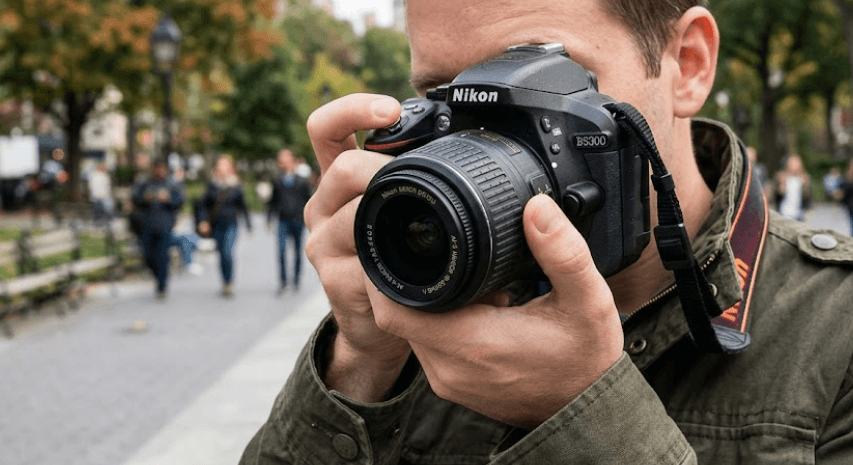
The body weighs approximately 480g, including the battery according to Nikon's specifications, and measures about 125 × 98 × 76mm. It is relatively light for a DSLR, although adding a zoom lens naturally makes the complete setup heavier. The body uses a predominantly plastic construction, but DPReview described it as solid and sensibly designed. The grip and control layout are approachable for beginners, although users moving from modern mirrorless cameras may find the controls and menu system less immediate.
The optical viewfinder provides approximately 95% frame coverage, which is another reminder that this is a DSLR from an earlier generation. You compose through an optical viewfinder rather than an electronic one, so there is no live exposure preview in the same way modern mirrorless cameras provide. That is not necessarily a problem for someone specifically interested in learning traditional photography, but buyers expecting the convenience of a current mirrorless body should understand the difference before choosing the D5300.
Nikon D5300 Size And Handling
| Specification | Nikon D5300 |
|---|---|
| Dimensions | 125 × 98 × 76mm |
| Weight | Approx. 480g |
| LCD | 3.2-inch vari-angle |
| LCD Resolution | Approx. 1.04 million dots |
| Viewfinder | Optical |
| Viewfinder Coverage | Approx. 95% |
| Body Type | DSLR |
| Lens Mount | Nikon F |
Video Features And Connectivity
For video, the D5300 can record Full HD 1080p at up to 60 frames per second. That was a strong feature when the camera launched and remains usable for basic video projects, family recordings, learning content creation, and social-media footage. It also includes a stereo microphone and a microphone input, giving users more flexibility than cameras that rely entirely on built-in audio. However, it does not record 4K video, so buyers specifically interested in high-resolution modern video should look at newer cameras instead.
The articulating screen is particularly useful when recording video because it allows the user to monitor framing from different positions. The D5300 also provides full-time autofocus capabilities in movie mode, although its live-view and video autofocus system is much less sophisticated than the subject-detection systems found on modern mirrorless cameras. DPReview noted limitations around live-view handling, including the way aperture adjustments work during live-view shooting.
Connectivity is one area where the D5300 remains surprisingly practical. Nikon built Wi-Fi and GPS directly into the camera, allowing wireless connectivity and geotagging without requiring an external GPS accessory. The Wi-Fi system is obviously not equivalent to the seamless smartphone integration found on many current cameras, but having connectivity built into an older budget DSLR was a meaningful advantage and remains useful for photographers who want to transfer or share images without relying entirely on cables.
Battery And Connectivity
The D5300 uses the EN-EL14a rechargeable lithium-ion battery, with compatibility for the EN-EL14 as well. Nikon rates the camera at approximately 600 shots under its CIPA testing conditions with the EN-EL14a. Real-world battery life varies with temperature, shooting frequency, display use, Wi-Fi, GPS, and other settings, so buyers of used cameras should not assume that an older battery will still deliver the original rating.
Nikon D5300 For Budget Buyers In 2026
The D5300 makes the most sense for buyers who care about image quality and interchangeable lenses more than having the latest technology. A beginner who wants to move beyond smartphone photography can learn exposure, focal length, depth of field, shutter speed, and RAW editing on this camera without needing a current high-end body. The 24.2MP sensor also gives enough resolution for substantial editing, while the Nikon F mount opens access to a large collection of Nikon lenses and compatible third-party options.
The catch is that the value depends heavily on the condition and asking price of the particular unit. Because the D5300 is an older discontinued-generation DSLR, two used examples can be very different depending on how they were treated. A camera that has spent years in a dry cupboard may be in much better condition than one that has been used heavily for events. Buyers should check the sensor, LCD hinge, viewfinder, battery, SD-card slot, ports, autofocus, shutter operation, and lens condition before paying. A clean body paired with a good lens can be more useful than a cheaper body with a damaged or poor-quality lens.
What To Check Before Buying A Used D5300
| Area | What To Check |
|---|---|
| Sensor | Dust, scratches, unusual marks |
| Shutter | Test several shutter speeds and continuous shooting |
| Autofocus | Check focus accuracy with the included lens |
| LCD | Check hinge, brightness, dead pixels and rotation |
| Battery | Check charging and battery condition |
| Lens | Check fungus, haze, scratches and autofocus |
| Ports | Test USB, HDMI and microphone connections |
| Wi-Fi/GPS | Confirm connectivity features work |
| SD Slot | Test reading and writing to a compatible card |
| Body | Check for cracks, heavy impact or water damage |
Limitations To Know Before Buying
The D5300's biggest weakness in 2026 is not image quality. It is age. Modern cameras have improved autofocus, video, connectivity, stabilization, burst shooting, subject recognition, electronic viewfinders, and smartphone integration significantly. The D5300's 39-point AF system and 5fps continuous shooting can still handle ordinary photography, but buyers interested in fast-moving subjects should understand that they are choosing an older autofocus platform.
Video is another obvious limitation. Full HD 1080p at 60p is perfectly usable for basic recording, but there is no 4K recording. There is also no headphone jack for monitoring audio, according to DPReview's specifications. That makes the D5300 less attractive for someone building a modern video-production setup. For still photography, however, these limitations may not matter much if your priority is learning photography or creating everyday images.
Lens compatibility also deserves attention. The D5300 uses Nikon's F mount, but because the body does not have an internal autofocus motor, some older Nikon lenses will require manual focusing. This is not a deal-breaker because there is a broad selection of AF-S and other compatible lenses with built-in motors, but it is something a first-time buyer should understand before purchasing an inexpensive older lens. The cheapest camera and lens combination is not necessarily the easiest combination to use.
Nikon D5300 Vs Modern Budget Cameras
A modern entry-level mirrorless camera will generally offer advantages in autofocus, video, connectivity, and electronic viewing. Nikon's newer Z-series cameras, for example, use the Z mount and can offer features that simply did not exist when the D5300 launched. The D5300's advantage is different. Its older DSLR ecosystem can be inexpensive on the used market, and the optical viewfinder, physical shooting experience, and access to older F-mount lenses can be appealing to learners.
The difference becomes especially important when the buyer's priorities are clear. Someone primarily interested in photography and learning manual controls may have little reason to pay heavily for features they will not use. Someone who wants to record 4K video, track moving people automatically, transfer content quickly to a smartphone, or shoot demanding action should look at a newer platform. The D5300 can still produce excellent photographs, but it does not magically acquire the capabilities of a 2026 camera simply because its price is lower.
For budget buyers, the D5300 is therefore best evaluated as a photography-first DSLR rather than an all-purpose modern content-creation camera. Its 24.2MP sensor, vari-angle screen, optical viewfinder, built-in Wi-Fi and GPS, and 600-shot CIPA battery rating give it a surprisingly useful foundation. The question is not whether it has the latest features, because it clearly does not. The better question is whether those missing features matter to your particular shooting style.
D5300 Compared With A Modern Camera
| Feature | Nikon D5300 | Modern Budget Mirrorless |
|---|---|---|
| Sensor | 24.2MP DX CMOS | Varies by model |
| Viewfinder | Optical | Usually electronic |
| Video | Up to 1080p 60p | Often includes 4K |
| Autofocus | 39-point DSLR AF | Generally more advanced |
| Stabilization | Lens-dependent | Varies by model |
| Wi-Fi | Built in | Common |
| GPS | Built in | Model dependent |
| Lens Mount | Nikon F | Varies |
| Main Advantage | Affordable DSLR photography | Newer features and AF |
Who Should Buy The Nikon D5300?
The D5300 is a sensible camera for a beginner who wants to learn photography without starting with an expensive modern body. It gives you manual controls, interchangeable lenses, an APS-C/DX sensor, RAW shooting, a useful vari-angle screen, and enough resolution for serious hobby photography. Students, casual photographers, families, and people moving up from smartphone photography can all learn a lot from this type of camera. Its physical controls also encourage you to understand what shutter speed, aperture, ISO, and focal length actually do instead of relying entirely on computational photography.
It can also work for buyers who already own Nikon F-mount lenses. If you have compatible AF-S lenses available, the D5300 can become a relatively inexpensive way to build or maintain a DSLR kit. The built-in Wi-Fi and GPS are useful bonuses, while the 600-shot CIPA battery rating gives the camera reasonable endurance when using a healthy battery.
The D5300 is less suitable for someone who wants the newest autofocus, 4K video, advanced subject detection, compact mirrorless dimensions, or a camera specifically designed for professional video work. In those situations, spending more on a newer camera can bring meaningful improvements. For a buyer whose priority is still photography on a tight budget, however, the D5300 remains a camera worth considering, provided the used unit is in good condition.
Frequently Asked Questions
Q. Is the Nikon D5300 still good in 2026?
Yes, the Nikon D5300 can still be a capable stills camera in 2026. Its 24.2MP DX-format sensor, 39-point autofocus, vari-angle display, and RAW shooting remain useful for beginners and hobby photographers. Its age becomes more noticeable in autofocus, video, connectivity, and overall speed compared with newer cameras.
Q. Is the Nikon D5300 good for beginners?
The D5300 is well suited to beginners who want to learn photography using a traditional DSLR. It provides manual exposure controls, interchangeable lenses, an optical viewfinder, and a 24.2MP sensor, giving new photographers room to develop their skills without requiring a professional camera body.
Q. Does the Nikon D5300 shoot 4K video?
No. The Nikon D5300 records Full HD video at up to 1920 × 1080 and 60 frames per second. It does not offer 4K recording, so buyers focused heavily on modern video production should consider a newer camera.
Q. How many megapixels does the Nikon D5300 have?
The Nikon D5300 has an effective resolution of 24.2 megapixels from its DX-format CMOS sensor. Nikon also removed the optical low-pass filter from the sensor, which was designed to improve fine-detail resolution.
Q. Does the Nikon D5300 have Wi-Fi and GPS?
Yes. The D5300 was notable for including built-in Wi-Fi and GPS. Wi-Fi supports wireless connectivity and remote-control functions, while GPS can be used for location information and geotagging photographs.
Q. How good is the Nikon D5300 battery life?
Nikon rates the D5300 at approximately 600 shots under CIPA testing conditions when using the EN-EL14a battery. Actual battery life can vary considerably depending on temperature, shooting habits, display use, Wi-Fi, GPS, and the age of the battery.
Q. Can I use older Nikon lenses with the D5300?
You can use Nikon F-mount lenses, but autofocus compatibility needs to be checked. The D5300 does not have an in-body autofocus motor, so certain older lenses will require manual focusing. AF-S lenses and compatible lenses with built-in focus motors can autofocus with the camera.
Q. Is the Nikon D5300 good for video?
It can handle basic and enthusiast-level video, with Full HD recording up to 60p and a vari-angle screen. However, the absence of 4K, the older live-view autofocus system, and lack of a headphone jack make it less suitable for serious modern video production.
Q. Does the Nikon D5300 have a flip screen?
Yes. It has a fully articulated 3.2-inch LCD that can be rotated outward and positioned for different shooting angles. This is useful for low-angle photography, overhead compositions, and video recording.
Q. Should I buy a used Nikon D5300?
A used D5300 can make sense for a budget photographer if the body, sensor, battery, screen hinge, autofocus, ports, and included lens are in good condition. Because the model was launched in 2013, condition and asking price are particularly important when evaluating one today.
Final Recommendation
The Nikon D5300 remains a worthwhile budget DSLR when the goal is still photography rather than having the newest camera technology. Its 24.2MP DX sensor, 39-point autofocus system, 5fps burst shooting, 3.2-inch vari-angle LCD, built-in Wi-Fi and GPS, and Full HD 60p video give beginners a surprisingly complete photographic toolkit. These specifications are not cutting-edge in 2026, but they are still capable of producing high-quality photographs when paired with a good lens and sensible shooting technique.
The main reason to buy one today is value in the used or refurbished market, not modernity. Buyers should be realistic about its limitations, particularly the lack of 4K video, older autofocus technology, 5fps burst rate, and compatibility considerations with some older F-mount lenses. A carefully inspected D5300 with a good lens can be a much more useful purchase than a heavily worn example sold only because it appears inexpensive.
For a student, beginner, hobby photographer, or budget-conscious buyer who wants to learn photography with a proper DSLR, the Nikon D5300 still deserves consideration. If your priority is advanced autofocus, 4K video, modern subject detection, or professional content creation, a newer mirrorless camera will be a better fit. For everyone else, the D5300's combination of image quality, controls, lens compatibility, and affordability explains why this older DSLR continues to have a place among budget buyers.