Nikon D5100 vs D5200 vs D5300 vs D5500 vs D5600: Mid-Range Nikon Series Explained
Compare the Nikon D5100, D5200, D5300, D5500, and D5600 to see how this mid-range DSLR series evolved in image quality, autofocus, video, connectivity, and battery life.

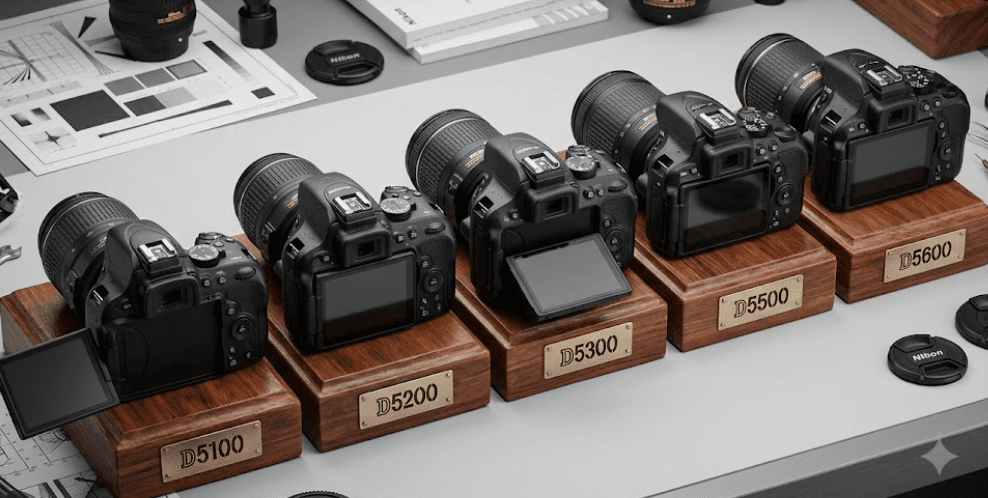
TL;DR The Nikon D5100, D5200, D5300, D5500, and D5600 form a clear progression within Nikon's D5000-series DX-format DSLR line-up. The D5100 starts with a 16.2MP sensor and 11-point autofocus, while the D5200 makes a major jump to 24.1MP and 39-point autofocus. The D5300 adds a 24.2MP sensor without an optical low-pass filter, built-in Wi-Fi and GPS, while the D5500 makes the body lighter and adds a touchscreen. The D5600 keeps much of the D5500's core hardware but adds Nikon's SnapBridge connectivity and a longer 970-shot battery rating. In 2026, these are older cameras, so the D5300, D5500, and D5600 are generally more sensible used or refurbished choices than the D5100 if the condition and price are right.
Nikon D5100 To D5600 Evolution
The Nikon D5100 launched the series comparison with a 16.2MP DX-format CMOS sensor, EXPEED 2 processing, an 11-point autofocus system, and a fully articulating 3-inch LCD. It could record Full HD video at up to 1080p/30p and shoot at up to 4 frames per second. For its time, that combination made the D5100 a capable enthusiast-friendly DSLR, particularly for photographers moving beyond entry-level models. Nikon also gave it a vari-angle screen, which made low-angle photography, portraits, and video framing easier than on many conventional fixed-screen cameras.
The D5200 was the first major step forward in this sequence. Its 24.1MP DX-format sensor nearly increased the available resolution by half compared with the D5100, but the bigger practical improvement was its 39-point autofocus system with nine cross-type sensors. Continuous shooting also increased to 5 fps. The D5200 retained the articulating display but used a 3-inch, 921k-dot panel, while its EXPEED 3 processor moved the series forward from the D5100's EXPEED 2 platform. These changes made the D5200 much more attractive for photographers interested in subjects that move, detailed RAW files, and more flexible autofocus.
The D5300 then refined the formula rather than completely changing it. It retained the 24.2MP class sensor and 39-point autofocus system but moved to EXPEED 4 processing, a larger 3.2-inch 1.04-million-dot vari-angle display, and 1080p video at up to 60 fps. It also introduced built-in Wi-Fi and GPS, which were notable features for a mid-range DSLR at the time. The D5500 followed with a lighter 420g body, touchscreen controls, built-in Wi-Fi, and a much stronger 820-shot CIPA battery rating. Finally, the D5600 kept the 24.2MP sensor, EXPEED 4 processor, 39-point AF and 5 fps shooting, while adding SnapBridge connectivity and extending rated battery life to 970 shots.
Generation-By-Generation Comparison
| Model | Sensor | AF Points | Burst Speed | Display | Video |
|---|---|---|---|---|---|
| Nikon D5100 | 16.2MP | 11 | 4 fps | 3-inch vari-angle | 1080/30p |
| Nikon D5200 | 24.1MP | 39 | 5 fps | 3-inch vari-angle | 1080/60i |
| Nikon D5300 | 24.2MP | 39 | 5 fps | 3.2-inch vari-angle | 1080/60p |
| Nikon D5500 | 24.2MP | 39 | 5 fps | 3.2-inch touchscreen | 1080/60p |
| Nikon D5600 | 24.2MP | 39 | 5 fps | 3.2-inch touchscreen | 1080/60p |
The D5200's 1080/60i specification is worth highlighting because it is sometimes incorrectly described as 1080/60p in comparison articles. Nikon's later D5300, D5500, and D5600 support Full HD 60p recording.
Nikon D5100 Vs D5200
The D5100 and D5200 may look similar at first, but the D5200 is a meaningful upgrade rather than a minor refresh. The D5100's 16.2MP sensor was already capable of producing good images, but the D5200 moves to a 24.1MP sensor and provides substantially more room for cropping. The autofocus system also changes from 11 points with one cross-type sensor on the D5100 to 39 points with nine cross-type sensors on the D5200. That makes the newer camera considerably more versatile when photographing children, pets, sports, or other moving subjects.
The D5200 also raises the continuous shooting speed from 4 fps to 5 fps. Its ISO range starts at ISO 100 and reaches ISO 6400 natively, with expansion available to ISO 25,600, while the D5100 also reaches an expanded ISO 25,600 setting. The important difference is therefore not simply the maximum ISO number. The D5200 combines its newer sensor and processing platform with a much more capable autofocus system, which is more useful in real shooting situations than an identical headline ISO figure.
The D5100 does have one specification that should not be overlooked: its CIPA battery rating is 660 shots, compared with 500 shots for the D5200. However, battery life alone does not make the older camera the better buy. If both cameras are in similar condition and the price difference is reasonable, the D5200 is the stronger choice because its 24.1MP sensor, 39-point AF system, and 5 fps shooting give it considerably more room to grow with a photographer.
Which One Makes More Sense?
| Feature | Nikon D5100 | Nikon D5200 |
|---|---|---|
| Resolution | 16.2MP | 24.1MP |
| Processor | EXPEED 2 | EXPEED 3 |
| AF | 11 points | 39 points |
| Cross-Type AF | 1 | 9 |
| Burst | 4 fps | 5 fps |
| Battery Rating | 660 shots | 500 shots |
| Best For | Basic photography | More demanding photography |
Nikon D5200 Vs D5300
The D5300 is a more evolutionary upgrade over the D5200 than the D5200 was over the D5100. Both cameras use roughly 24MP DX-format sensors and offer 39-point autofocus with nine cross-type sensors, while both can shoot at up to 5 fps. The major sensor change is that the D5300 uses a 24.2MP sensor without an optical low-pass filter, which can provide a small resolution advantage. DPReview also noted that the difference is subtle, particularly when using a typical kit zoom lens, so buyers should not expect dramatically different image quality from the sensor alone.
The D5300 becomes much more interesting when you look beyond still-image resolution. It introduces EXPEED 4 processing, a 3.2-inch 1.04-million-dot vari-angle display, built-in Wi-Fi, and built-in GPS. It also records Full HD at up to 60p, whereas the D5200's highest frame-rate option is 60i. The D5300's CIPA battery rating is 600 shots, which is also higher than the D5200's 500-shot rating.
For a buyer choosing between these two cameras in the used market, the D5300 is usually the more attractive model if the price difference is not large. The built-in Wi-Fi and GPS are particularly useful for photographers who want location data or easier wireless transfer without adding an accessory. However, a clean D5200 with a good lens can still produce excellent photographs, and its 24.1MP sensor and 39-point AF system mean it has not suddenly become incapable just because the D5300 exists.
D5200 Vs D5300 At A Glance
| Feature | Nikon D5200 | Nikon D5300 |
|---|---|---|
| Sensor | 24.1MP | 24.2MP, no OLPF |
| Processor | EXPEED 3 | EXPEED 4 |
| AF | 39 points | 39 points |
| Screen | 3-inch | 3.2-inch |
| Wi-Fi | No built-in Wi-Fi | Built-in Wi-Fi |
| GPS | No built-in GPS | Built-in GPS |
| Battery | 500 shots | 600 shots |
Nikon D5300 Vs D5500
The D5500 is where Nikon shifted the emphasis from simply improving specifications to improving the physical experience. It uses a 24.2MP DX-format sensor without an optical low-pass filter, EXPEED 4 processing, a 39-point AF system, and 5 fps continuous shooting, so the fundamental image-making hardware remains very close to the D5300. The most noticeable physical change is its lighter, more compact body. Nikon lists the D5500 at approximately 420g, compared with approximately 480g for the D5300.
The D5500 also introduces touchscreen operation to this series. Its 3.2-inch vari-angle display has approximately 1.037 million dots, and touch functionality can be used for controls and focusing. Nikon also retained built-in Wi-Fi, while the D5300's built-in GPS was removed. That trade-off is important because the D5300 remains the better choice for someone who specifically wants integrated GPS, while the D5500 is more appealing to photographers who value a lighter body and touchscreen controls.
Battery life is another substantial advantage for the D5500. DPReview's comparison lists an approximately 820-shot CIPA rating for the D5500 versus 600 shots for the D5300. The D5500 therefore makes more sense for travel and long shooting sessions, particularly when carrying spare batteries is inconvenient. It is not a huge image-quality upgrade over the D5300, though, so a well-priced D5300 can still be the better value if GPS matters or the price difference is significant.
D5300 Vs D5500
| Feature | Nikon D5300 | Nikon D5500 |
|---|---|---|
| Resolution | 24.2MP | 24.2MP |
| Processor | EXPEED 4 | EXPEED 4 |
| AF | 39 points | 39 points |
| Weight | 480g | 420g |
| Touchscreen | No | Yes |
| Wi-Fi | Built-in | Built-in |
| GPS | Built-in | No built-in GPS |
| Battery Rating | 600 shots | 820 shots |
Nikon D5500 Vs D5600
The D5600 is one of the easiest comparisons in the series because much of its core hardware remains familiar. It retains the 24.2MP DX-format sensor, EXPEED 4 processor, 39-point autofocus system, 5 fps continuous shooting, 3.2-inch vari-angle touchscreen, and Full HD 60p recording found on the D5500. This means you should not expect a dramatic jump in still-image quality simply by moving from the D5500 to the D5600.
The biggest practical change is connectivity. The D5600 supports Nikon SnapBridge, using Bluetooth and Wi-Fi to connect with compatible smart devices. Nikon positioned SnapBridge as a way to keep the camera connected to a smartphone and make transferring images more convenient. The D5600 also supports autofocus with AF-P lenses, which can be useful for owners building a newer lens setup.
Battery life is another clear advantage. Nikon rates the D5600 at approximately 970 shots per charge under CIPA testing, compared with the D5500's approximately 820-shot rating cited by DPReview. The D5600 is also slightly lighter at approximately 415g. For a used-camera buyer, the D5600 is therefore the most refined version of this particular design, but the D5500 can represent better value if it is substantially cheaper and you do not care about SnapBridge or the additional battery endurance.
D5500 Vs D5600
| Feature | Nikon D5500 | Nikon D5600 |
|---|---|---|
| Sensor | 24.2MP | 24.2MP |
| Processor | EXPEED 4 | EXPEED 4 |
| AF | 39 points | 39 points |
| Touchscreen | Yes | Yes |
| Wi-Fi | Built-in | Built-in |
| SnapBridge | No | Yes |
| Battery Rating | 820 shots | 970 shots |
| Weight | 420g | 415g |
Which Nikon D5000 Camera Should You Buy?
For most buyers in 2026, the D5300, D5500, and D5600 deserve more attention than the D5100 and D5200. The D5100 is now quite old, and while its 16.2MP sensor remains capable, its 11-point AF system and 4 fps burst rate make it harder to recommend when newer models are available at reasonable used prices. The D5200 is a much better starting point because its 24.1MP sensor and 39-point autofocus system represent a substantial generational improvement.
The D5300 is the best option for buyers who want a strong combination of image quality, connectivity, GPS, and Full HD 60p video without needing touchscreen controls. The D5500 is the better choice for someone who values a lighter body, touchscreen operation, and stronger battery life. The D5600 is the most complete version of the series because it adds SnapBridge connectivity and an approximately 970-shot battery rating while retaining the D5500's core imaging platform.
Because all five cameras are older DSLRs by 2026, condition matters as much as the model number. When buying used, check the shutter count, sensor condition, LCD and hinge, battery health, memory-card slot, autofocus performance, lens compatibility, and whether the camera includes a genuine battery and charger. A clean D5500 or D5300 with a good lens can be a better purchase than a heavily used D5600 sold at a premium simply because it is the newest name in this group.
Best Choice By Buyer
| Buyer Type | Recommended Model | Why |
|---|---|---|
| Lowest-cost basic option | D5100 | Capable 16.2MP DSLR if very inexpensive |
| Budget enthusiast | D5200 | 24.1MP sensor and 39-point AF |
| Best feature balance | D5300 | Wi-Fi, GPS, 24.2MP sensor and 60p video |
| Lightweight shooting | D5500 | 420g body and touchscreen |
| Most complete version | D5600 | SnapBridge, touchscreen and 970-shot battery |
Frequently Asked Questions
Q. Which is better, the Nikon D5100 or D5200?
The Nikon D5200 is the better camera overall. It increases resolution from 16.2MP to 24.1MP, moves from 11-point autofocus to a 39-point system with nine cross-type sensors, and increases continuous shooting from 4 fps to 5 fps.
Q. Is the Nikon D5300 better than the D5200?
Yes, the D5300 is generally the better choice. It adds EXPEED 4 processing, a 24.2MP sensor without an optical low-pass filter, built-in Wi-Fi and GPS, a larger 3.2-inch display, and Full HD 60p video.
Q. Does the Nikon D5500 have GPS?
No. The D5500 does not have built-in GPS. This is actually a feature that the D5300 had and the D5500 dropped. The D5500 instead focuses on a lighter body, touchscreen controls, Wi-Fi, and improved battery life.
Q. Does the Nikon D5600 have a touchscreen?
Yes. The D5600 has a 3.2-inch vari-angle touchscreen LCD with approximately 1.037 million dots. Touch functionality can be used for camera controls and focusing.
Q. Which Nikon camera in this series has the best battery life?
The D5600 has the highest rated battery life, at approximately 970 shots per charge under Nikon's CIPA rating. The D5500 follows at approximately 820 shots, while the D5300 is rated at 600 shots.
Q. Which Nikon D5000 camera is best for video?
The D5300, D5500, and D5600 are the stronger choices for video because they support Full HD recording at up to 60p. The D5200's highest 60-frame option is 60i, while the D5100 tops out at 1080p/30p. None of these cameras records 4K video.
Q. Is the Nikon D5600 worth buying in 2026?
It can still be worth buying if you find a clean used or refurbished unit at a sensible price. Its 24.2MP sensor, 39-point AF system, touchscreen, Full HD 60p recording, SnapBridge connectivity, and 970-shot battery rating remain useful. However, buyers should remember that it is an older DSLR rather than a current-generation camera.
Q. Which is better for travel, the D5300 or D5500?
The D5500 is generally better for travel because it weighs approximately 420g compared with approximately 480g for the D5300 and has a higher approximately 820-shot CIPA battery rating. The D5300 is preferable if built-in GPS is important to you.
Q. Does the D5600 have better image quality than the D5500?
Not by a large margin. Both use a 24.2MP DX-format sensor, EXPEED 4 processing, 39-point autofocus, and 5 fps continuous shooting. The D5600's major advantages are connectivity through SnapBridge and its longer rated battery life rather than a major sensor upgrade.
Q. Which Nikon D5000 camera should beginners buy?
For beginners buying used in 2026, the D5300 or D5500 is a sensible starting point if priced well. The D5300 offers built-in GPS and Wi-Fi, while the D5500 adds touchscreen controls, a lighter body, and better battery life. The D5600 is worth considering if SnapBridge connectivity and maximum battery endurance matter to you.
Final Recommendation
The Nikon D5600 is the strongest overall camera in this five-model comparison, but it is not automatically the best purchase at every price. Its 24.2MP sensor, 39-point autofocus system, touchscreen, Full HD 60p recording, SnapBridge connectivity, and approximately 970-shot battery rating make it the most complete version of the D5000-series evolution. If the price difference is small, the D5600 is the model to prioritize.
The Nikon D5500 is arguably the more interesting value option if you find a clean used unit at a noticeably lower price. It delivers essentially the same core imaging platform as the D5600, while the D5300 remains particularly attractive for buyers who want built-in GPS. The D5200 is worth considering when the budget is tight, while the D5100 should generally only be chosen when its lower price clearly reflects its older hardware.
For a 2026 buyer, the smartest approach is therefore not to buy the newest model blindly. Compare the condition, shutter count, lens included, battery health, and asking price alongside the camera's specifications. If all five are priced close together, choose the D5600. If you want maximum value, look closely at the D5500 and D5300. If the D5100 is dramatically cheaper and your needs are basic photography, it can still work, but it should not be treated as equivalent to the later 24MP models.
Ready to upgrade your tech?
Browse our collection of quality refurbished products at unbeatable prices.