
Nikon D3300 vs D3400: Is the Small Upgrade Worth Paying More For?
The Nikon D3300 and D3400 share much of the same core hardware, but the D3400 adds Bluetooth and longer battery life while removing some features. Here is what really changes and what does not.

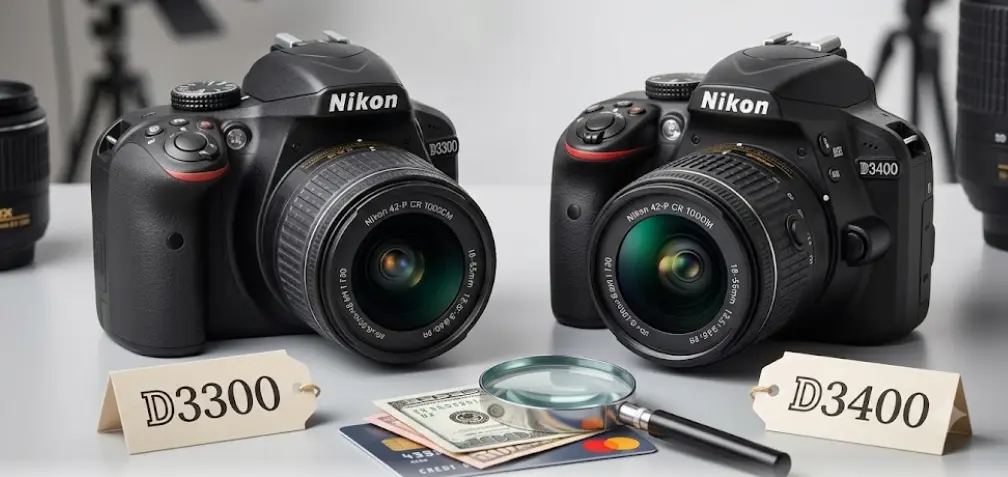
TL;DR The Nikon D3300 and D3400 are remarkably similar entry-level DSLRs, with both using a 24.2MP APS-C sensor, EXPEED 4 processor, 11-point autofocus system, 5fps continuous shooting, fixed 3-inch 921k-dot displays, and Full HD 1080/60p video. The D3400's main improvements are its Bluetooth Low Energy connectivity through Nikon SnapBridge, lighter body, and much higher CIPA-rated battery life of up to 1,200 shots compared with 700 on the D3300. However, Nikon also removed the D3300's external microphone port and sensor-cleaning feature. For someone buying a used camera today, the D3400 makes sense when its price premium is small and wireless transfers or longer battery life matter. If the D3300 is considerably cheaper and comes in better condition, its core image quality remains highly competitive for beginner photography.
Nikon D3300 vs D3400: What Actually Changed?
The Nikon D3300 was launched in 2014 as an entry-level DSLR aimed at people moving into interchangeable-lens photography, while the D3400 followed in 2016 as a relatively modest update. That timing is important because the D3400 was never designed as a completely new camera platform. Both models use a 24.2MP DX-format CMOS sensor and Nikon's EXPEED 4 image processor, and both offer the same 11-point autofocus system, 5fps continuous shooting, and Full HD video recording at up to 60 frames per second. In everyday photography, those shared fundamentals mean the two cameras can produce very similar results when paired with the same lens and used under similar conditions.
The D3400's biggest changes are focused more on convenience than image-making hardware. Nikon added Bluetooth Low Energy connectivity through its SnapBridge system, allowing the camera to maintain a connection with a compatible smartphone for image sharing and related functions. The D3400 also received a major increase in its official CIPA battery rating, rising from 700 shots on the D3300 to 1,200 shots. It was also lighter according to contemporary specifications. These changes make the D3400 more convenient for travel and casual shooting, but they do not represent a major leap in sensor resolution, autofocus hardware, video resolution, or burst performance.
The comparison becomes more interesting because Nikon removed a few features while making those improvements. The D3300 includes an external microphone input and an ultrasonic sensor-cleaning system, while the D3400 does not. The D3400 also has a weaker built-in flash rating than the D3300. That means the newer camera is not simply a case of paying more and getting more. It is a slightly redesigned beginner DSLR with some useful additions and some omissions. For a used-camera buyer, the condition and price difference between individual units can therefore matter more than the model number.
Core Specifications Compared
| Feature | Nikon D3300 | Nikon D3400 |
|---|---|---|
| Sensor | 24.2MP DX CMOS | 24.2MP DX CMOS |
| Processor | EXPEED 4 | EXPEED 4 |
| Autofocus | 11-point AF | 11-point AF |
| Continuous Shooting | 5fps | 5fps |
| LCD | 3-inch, 921k dots | 3-inch, 921k dots |
| Maximum Video | Full HD 1080/60p | Full HD 1080/60p |
| Native ISO Range | 100-12,800 | 100-12,800 |
| Expanded ISO | Up to 25,600 | Up to 25,600 |
| Connectivity | Optional WU-1a adapter | Bluetooth LE with SnapBridge |
| CIPA Battery Rating | 700 shots | 1,200 shots |
| External Microphone | Yes | No |
| Sensor Cleaning | Yes | No |
Image Quality Is Not A Major Upgrade
If image quality is your main reason for considering the D3400, the difference between these two cameras is much smaller than the model numbers might suggest. Both cameras use a 24.2MP DX-format APS-C sensor and EXPEED 4 processing, so neither camera represents a major sensor-generation jump over the other. The D3300 was already capable of producing detailed images with strong Raw performance for its class, and the D3400 retained essentially the same core imaging platform. This is why the D3400 should not be viewed as a camera that suddenly produces dramatically better photographs than the D3300.
For beginners, both cameras provide enough resolution for everyday photography, travel images, portraits, landscapes, product photography, and social media content. A larger difference can come from the lens you use, your exposure settings, lighting, and shooting technique. Moving from an older kit lens to a faster prime lens, for example, can change the look of your photographs far more noticeably than moving from a D3300 body to a D3400 body. The same applies to learning how aperture, shutter speed, and ISO interact. The camera body is only one part of the final image.
The D3400 does have some video-related refinements when paired with its newer AF-P kit lenses, particularly quieter focusing during video capture and improved live-view focusing compared with the older setup. However, the underlying video specification remains Full HD 1080/60p on both bodies. Neither camera offers 4K recording, and neither has a flip-out or touchscreen display. If your priority is photography rather than advanced video production, these limitations are easier to accept. If video is central to your workflow, the age of both DSLRs becomes much more relevant.
Image And Shooting Features
| Feature | Nikon D3300 | Nikon D3400 |
|---|---|---|
| Effective Resolution | 24.2MP | 24.2MP |
| Sensor Size | APS-C/DX | APS-C/DX |
| Low-Pass Filter | None | None |
| Burst Rate | 5fps | 5fps |
| Viewfinder | Optical | Optical |
| Viewfinder Coverage | Approx. 95% | Approx. 95% |
| LCD | Fixed, 3-inch | Fixed, 3-inch |
| Touchscreen | No | No |
| Articulating Screen | No | No |
Battery Life Is The D3400's Biggest Advantage
Battery life is arguably the most meaningful hardware improvement in the D3400. Nikon rated the D3300 for approximately 700 shots per charge, while the D3400 received a much higher CIPA rating of approximately 1,200 shots. That is a substantial difference on paper and can be useful when you are travelling, attending an event, shooting outdoors for a long period, or simply do not want to carry a spare battery everywhere. The higher rating was one of the headline improvements associated with the D3400 when it launched.
However, battery ratings should not be interpreted as a guarantee that every user will get exactly that number of photographs. Actual battery life depends on how you use the camera, including how often you use Live View, review photographs on the LCD, use the flash, and transfer images. The D3400's battery advantage is therefore best understood as additional operating headroom rather than a promise of a fixed number of photographs. Even so, the difference between the official ratings is large enough to matter for photographers who regularly spend long periods away from a charger.
The D3300 also remains perfectly usable for shorter shoots. A 700-shot CIPA rating is not poor by entry-level DSLR standards, and it can be more than enough for casual photography. If you are buying a used D3300, however, remember that battery condition matters. An older battery may no longer perform close to its original capacity. The same principle applies to the D3400. When comparing two used cameras, the physical condition of the battery, charger, body, shutter, and lens can be more important than a small difference in the original specifications.
Battery And Portability
| Feature | Nikon D3300 | Nikon D3400 |
|---|---|---|
| Battery | EN-EL14a | EN-EL14a |
| CIPA Rating | Approx. 700 shots | Approx. 1,200 shots |
| Body Dimensions | Approx. 124 × 98 × 76mm | Approx. 124 × 98 × 76mm |
| Approx. Weight | 460g | 395g |
| Travel Advantage | Good | Better |
Connectivity Makes The D3400 More Convenient
The D3400's other major advantage is Bluetooth Low Energy connectivity through Nikon's SnapBridge system. The D3300 does not have built-in Bluetooth and instead relied on an optional WU-1a wireless mobile adapter for smartphone connectivity. For photographers who frequently want to move images from their camera to a phone, this difference can make the D3400 more convenient. You can pair the camera with a compatible smartphone and use SnapBridge for supported image-transfer functions instead of relying on the D3300's optional wireless accessory.
It is important not to confuse this with built-in Wi-Fi. The D3400 does not have Wi-Fi connectivity. Its wireless system uses Bluetooth Low Energy, and the functionality is more limited than the wireless systems found on many newer cameras. Contemporary testing also found that SnapBridge could be slow or cumbersome for transferring full-resolution images. Therefore, the D3400's connectivity should be treated as a convenience feature rather than a modern wireless workflow comparable to newer mirrorless cameras.
For a beginner who mainly wants to share occasional photographs on a smartphone, the D3400's Bluetooth capability can still be useful. For someone who routinely transfers large Raw files, the difference may be less impressive. In that situation, removing the memory card or using a wired connection can still be more practical. The important point is that the D3400 makes smartphone sharing easier than the D3300's standard configuration, but it does not transform the camera into a modern connected camera.
Connectivity Comparison
| Feature | Nikon D3300 | Nikon D3400 |
|---|---|---|
| Built-In Bluetooth | No | Yes |
| SnapBridge | No | Yes |
| Built-In Wi-Fi | No | No |
| Wireless Adapter Support | WU-1a | Not required for SnapBridge |
| Smartphone Sharing | Optional accessory | Built-in Bluetooth system |
The D3300 Actually Has Some Features The D3400 Lost
One of the most important parts of this comparison is understanding that newer does not automatically mean better equipped. Nikon removed the external microphone input from the D3400, while the D3300 has one. That matters if you are interested in recording video with an external microphone. Both cameras are limited to Full HD video, but the D3300 gives you more flexibility for external audio recording.
The D3300 also has an ultrasonic sensor-cleaning system, which Nikon removed from the D3400. Sensor cleaning does not improve image quality by itself, but it is useful because dust can become visible in photographs, particularly at smaller apertures. The absence of this system does not mean the D3400 cannot be maintained. It simply means the D3400 does not provide the same built-in sensor-cleaning feature as the D3300.
The built-in flash is another area where the D3300 has an advantage on paper. DPReview's specifications list the D3300's flash range at approximately 12m, compared with approximately 7m for the D3400 at ISO 100. This was part of the changes associated with the D3400 and may also help explain why the two cameras' official battery ratings differ so significantly. For ordinary beginner photography, this may not be a deciding factor, but it is another reminder that the D3400 is a refinement rather than a straightforward upgrade in every area.
Features You Give Up With The D3400
| Feature | Nikon D3300 | Nikon D3400 |
|---|---|---|
| External Mic Port | Yes | No |
| Sensor Cleaning | Yes | No |
| Built-In Flash Guide Number | Higher | Lower |
| Bluetooth | No | Yes |
| Battery Rating | 700 shots | 1,200 shots |
Which Camera Makes More Sense For A Beginner?
For someone buying their first DSLR, both cameras remain straightforward options because they share the same basic control philosophy and beginner-focused design. The 24.2MP sensor provides plenty of resolution, the 5fps burst rate is adequate for casual action, and the optical viewfinder provides the traditional DSLR shooting experience. Both cameras also have a fixed LCD rather than a touchscreen or articulating display, so neither is particularly designed around modern smartphone-style shooting.
The D3400 is easier to recommend when you value convenience. Built-in Bluetooth connectivity means you do not need the D3300's optional wireless adapter for supported smartphone-sharing functions, while the 1,200-shot battery rating gives it a substantial advantage for longer shoots. The lighter body can also be useful if you carry the camera during travel or long photography sessions. These are practical improvements rather than dramatic photographic ones, but practical improvements can matter more than headline specifications for a beginner.
The D3300 becomes more attractive when the price difference is significant or when you find a particularly well-maintained example. Because its core imaging hardware is so similar to the D3400's, spending less on the body can leave more money available for a better lens, spare battery, memory card, or camera bag. For a beginner, investing in lenses and learning photography can have a larger impact on the final result than paying a substantial premium for the newer body.
D3300 vs D3400 For Different Buyers
| Buyer Type | Better Fit |
|---|---|
| First DSLR on a tight budget | D3300 |
| Long travel sessions | D3400 |
| Frequent smartphone sharing | D3400 |
| External microphone use | D3300 |
| Similar image quality for less money | D3300 |
| Lighter body | D3400 |
| Beginner photography | Either |
| Used-market value | Depends on condition and price |
What Should You Check When Buying Used?
Because both cameras are older DSLRs, the condition of the individual unit should be part of the buying decision. Do not assume that a D3400 in poor condition is automatically a better purchase than a clean D3300 simply because it is newer. Check the sensor and lens for visible damage, inspect the LCD for cracks or serious scratches, test the buttons and dials, confirm that the memory-card slot works, and make sure the camera can communicate with the lens correctly.
The shutter count is also useful when comparing used examples, although it should not be treated as the only measure of camera condition. A camera with a higher shutter count can still be perfectly usable if it has been maintained properly, while a low-shutter-count camera can have problems from poor storage, physical damage, moisture, or neglected batteries. Test autofocus, exposure, flash operation, Live View, video recording, and image playback before paying for a used body whenever possible.
The lens included with the camera can also change the value of the package considerably. A D3300 with a good AF-P or well-maintained kit lens may be a more useful purchase than a D3400 bundled with a damaged or unsuitable lens. Check for fungus, haze, scratches, focusing problems, and unusual noise. For a beginner, a complete and healthy camera-and-lens kit is generally more useful than simply choosing the newer body.
Frequently Asked Questions
Q. Is the Nikon D3400 better than the D3300?
The D3400 is newer and improves battery life and smartphone connectivity, but it does not provide a major upgrade in core image-making hardware. Both cameras use a 24.2MP sensor, EXPEED 4 processor, 11-point autofocus system, 5fps shooting, and Full HD 1080/60p video.
Q. Does the Nikon D3400 have better image quality than the D3300?
The difference is not substantial because both cameras use essentially the same 24.2MP DX-format sensor and EXPEED 4 processor. Lens choice, lighting, exposure, and shooting technique can have a much greater effect on the final image.
Q. How much better is the D3400 battery life?
Nikon rated the D3300 at approximately 700 shots and the D3400 at approximately 1,200 shots under CIPA testing. Actual results vary depending on how the camera is used.
Q. Does the Nikon D3400 have Wi-Fi?
No. The D3400 has Bluetooth Low Energy connectivity and supports Nikon SnapBridge, but it does not have built-in Wi-Fi.
Q. Can the Nikon D3300 connect to a smartphone?
The D3300 does not have built-in Bluetooth or Wi-Fi. Nikon supported wireless connectivity through the optional WU-1a Mobile Adapter, so smartphone connectivity requires additional equipment.
Q. Does the D3400 have an external microphone jack?
No. The D3400 does not have an external microphone input. The D3300 does, making the older camera more flexible for users who want external audio when recording video.
Q. Does the Nikon D3400 shoot 4K video?
No. Both the D3300 and D3400 record Full HD video, with support for 1080p recording at up to 60 frames per second.
Q. Which camera is lighter, the D3300 or D3400?
The D3400 is lighter according to the specifications reported for the two models. DPReview lists the D3300 at approximately 460g and the D3400 at approximately 395g.
Q. Is the Nikon D3300 still worth buying?
It can be worth considering as a used DSLR if it is in good condition and priced appropriately. Its 24.2MP sensor, 5fps burst shooting, Full HD video, and beginner-friendly controls remain useful, while its external microphone port and sensor-cleaning feature are advantages over the D3400.
Q. Should you pay more for the Nikon D3400?
The D3400's premium is easier to justify when you value its longer battery rating, lighter body, and built-in Bluetooth connectivity. If the price difference is large, the D3300 may offer better value because its core image-making capabilities are very similar.
Final Recommendation
The Nikon D3300 vs D3400 comparison is ultimately less about choosing between two radically different cameras and more about deciding which small differences matter to you. The D3400 brings useful improvements, particularly its 1,200-shot CIPA-rated battery life, lighter body, and built-in Bluetooth Low Energy connectivity through SnapBridge. Those features make it more convenient for travel and casual smartphone sharing. However, the camera also removes the external microphone input and sensor-cleaning system found on the D3300, while retaining the same 24.2MP sensor, EXPEED 4 processor, 11-point autofocus system, 5fps burst rate, fixed LCD, and Full HD 1080/60p video.
For a first-time DSLR buyer, either camera can provide a solid introduction to interchangeable-lens photography. The D3400 is the more convenient choice when its additional battery life and Bluetooth connectivity are useful to your routine. The D3300 becomes particularly compelling when you can find one in excellent condition at a meaningfully lower price. In the used market, the better purchase is therefore not automatically the newer model. Compare the actual price, shutter count, battery condition, included lens, physical condition, and accessories before deciding. If the D3400 costs only slightly more, its convenience features can make the premium reasonable. If the D3300 is substantially cheaper, its very similar core imaging platform makes it a practical alternative.






