

Micro RGB TVs Explained: Samsung and LG's Next-Gen Displays
Micro RGB TVs use tiny red, green, and blue LEDs as an advanced LCD backlight to improve color, brightness, and contrast. Samsung and LG are bringing the technology into premium TVs in 2026.

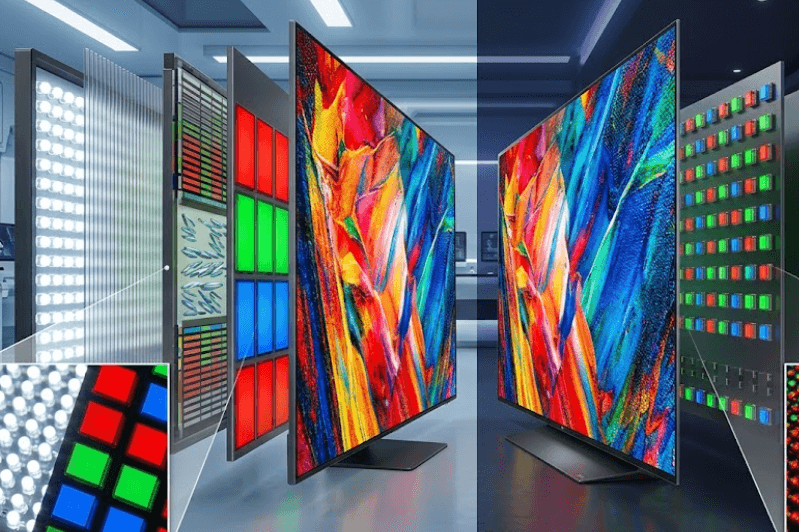
TL;DR Micro RGB TVs are one of the most interesting developments in premium television technology in 2026, but they are not the same thing as MicroLED TVs. Instead, Micro RGB is an advanced LCD backlight approach that uses extremely small red, green, and blue light sources to give the TV more precise control over colour and brightness. Samsung introduced its first Micro RGB TV in 2025 and has expanded the technology into its 2026 lineup, while LG has introduced its Micro RGB evo range as its first flagship RGB TV technology. Samsung's 2026 Micro RGB line-up in India includes the R95H and R85H series, with sizes ranging from 55 inches to 115 inches across the broader line-up, while LG's Micro RGB evo is available in large-screen formats such as 75, 86, and 100 inches. Both brands are targeting buyers who want exceptional colour and brightness without moving to OLED, although the underlying implementation and processing technologies are different.
What Are Micro RGB TVs?
Micro RGB TVs are essentially a new generation of LCD televisions that use very small red, green, and blue LEDs in the backlight rather than relying on a conventional white or blue LED-based backlight system. The important difference is that the red, green, and blue light sources can be controlled with much greater precision. Samsung describes its implementation as using individually controlled red, green, and blue micro LEDs smaller than 100 micro-meters, while LG describes its Micro RGB technology as using extremely small RGB LEDs to improve colour reproduction and light control. The goal is straightforward: give the LCD layer a cleaner and more precisely controlled light source so colours can appear richer and more accurate across different types of content.
The term can be confusing because Micro RGB sounds very similar to MicroLED, but the two technologies should not be treated as interchangeable. A MicroLED TV uses microscopic LEDs as the actual light-emitting pixels, meaning each pixel can produce its own light. Micro RGB TVs from Samsung and LG, on the other hand, remain LCD-based displays that use RGB LEDs as the backlight. That distinction matters because Micro RGB is designed to improve an LCD television's colour and light control, while MicroLED represents a fundamentally different self-emissive display architecture. LG itself describes its Micro RGB evo as an advanced LCD TV, making the distinction particularly important when comparing display technologies.
For buyers, the easiest way to understand Micro RGB is to think of it as an attempt to push LCD technology further rather than replace it completely. Traditional LED TVs can produce good images, while Mini LED improves backlight control by using much smaller LEDs and many more dimming zones. Micro RGB takes a different approach by making the backlight itself colour-aware through red, green, and blue light sources. That can potentially improve colour volume, colour accuracy, brightness control, and the overall richness of HDR content. However, it does not automatically mean that every Micro RGB TV will outperform every OLED or Mini LED TV in every category.
How Micro RGB Technology Improves Picture Quality
The biggest attraction of Micro RGB is its approach to colour. Conventional LCD TVs typically use a backlight that is then filtered and processed by the display layer to create the colours you see. Micro RGB instead introduces red, green, and blue LEDs into the backlight system, allowing the television to exercise more precise control over the light entering the panel. Samsung says its Micro RGB technology can achieve 100% coverage of the BT.2020 colour gamut under its certified Micro RGB Precision Colour criteria, while LG's Micro RGB evo has received Intertek certification for 100% coverage of BT.2020, DCI-P3, and Adobe RGB. These are manufacturer-supported certification claims, so they should be understood as measured certification results rather than a guarantee that every scene will look identical to its source.
Brightness and contrast are also important because a premium TV is not judged by colour alone. Samsung combines its Micro RGB backlight with local dimming to control colour and brightness, while its 2026 models use dedicated Micro RGB AI processing to refine the image. LG takes a similar but technically different route with Micro Dimming Ultra, which the company says uses thousands of dimming zones controlled by its Alpha 11 AI Processor 4K Gen3. This means the technology is not simply about placing RGB LEDs behind an LCD panel. The processor, dimming system, panel characteristics, and image-processing algorithms all contribute to the final picture.
This is particularly relevant for HDR movies, sports, and high-quality streaming content. A scene containing a bright sunset, colourful city lights, or a highly saturated sports uniform can benefit from stronger colour separation and more precise light control. Samsung's Micro RGB TVs combine the backlight system with features such as Micro RGB Precision Colour, HDR processing, and AI upscaling, while LG's Micro RGB evo adds AI HDR Remastering, Dynamic Tone Mapping, and Micro Dimming Ultra. The technology therefore works as part of a larger picture-processing system rather than acting as a single feature that automatically determines image quality.
Micro RGB Compared With Traditional LED And Mini LED
| Technology | Basic Approach | Main Strength | Key Limitation |
|---|---|---|---|
| Traditional LED LCD | LED backlight behind LCD panel | Affordable and widely available | Less precise light and color control |
| Mini LED LCD | Much smaller LEDs with many dimming zones | Strong brightness and contrast | Still depends on LCD and backlight control |
| Micro RGB LCD | Red, green, and blue micro LEDs used as backlight | Precise color and brightness control | Premium pricing and limited availability |
| OLED | Self-emissive pixels | Perfect blacks and excellent contrast | Burn-in risk and brightness trade-offs depending on panel |
| MicroLED | Self-emissive microscopic LED pixels | Exceptional brightness and contrast potential | Extremely expensive and limited availability |
Samsung Micro RGB TVs In 2026
Samsung was the first major TV manufacturer to officially launch a Micro RGB television, introducing its 115-inch model in 2025. The company then expanded the technology for 2026 with R95H and R85H series models. Samsung's announced 2026 range covers 55-, 65-, 75-, 85-, 100-, and 115-inch class sizes, although the exact sizes and models available can vary by market. In India, Samsung launched Micro RGB as part of its 2026 Vision AI TV line-up, with the R95H and R85H families forming the core of the range. Samsung India says the Micro RGB range starts at ₹1,24,990, making it firmly a premium television category rather than a mainstream replacement for regular LED TVs.
The R95H represents the more premium version of Samsung's 2026 Micro RGB approach. Depending on the size, it combines Micro RGB technology with features such as Micro RGB AI Engine Pro, Micro RGB Precision Colour, Micro RGB HDR Pro, 4K AI Upscaling Pro, Glare Free technology, and higher-end gaming motion capabilities. Samsung lists Motion Xcelerator at up to 165Hz for the R95H series, while the R85H reaches up to 144Hz. The difference matters for buyers who are considering a premium TV for gaming as well as movies, because higher refresh-rate support can make compatible gaming content look smoother.
Samsung's India line-up also shows why Micro RGB should not be viewed as a single fixed specification. The R85H and R95H are positioned differently, with the R95H offering a more advanced processing and picture package. Samsung's 2026 product information also highlights Vision AI features, One UI Tizen, Dolby Atmos, Object Tracking Sound, and wireless connectivity options. In other words, Samsung is treating Micro RGB as a premium smart-TV platform rather than simply a new type of backlight. That makes the buying decision more complicated, but it also means buyers should compare the specific model and size rather than assuming that every Micro RGB TV has identical hardware.
LG Micro RGB Evo Explained
LG entered the Micro RGB category in 2026 with the Micro RGB evo, positioning it as its first flagship RGB television. The company's MRGB95-based technology uses Micro RGB backlighting alongside the Alpha 11 AI Processor 4K Gen3 and Micro Dimming Ultra. LG's official specifications list a 4K Ultra HD resolution, 120Hz native refresh rate with VRR support up to 165Hz, Dolby Vision, HDR10 and HLG support, and webOS 26. The 100-inch MRGB96 model is already listed on LG India's website, showing that the technology is not merely a CES concept and has reached the Indian product portfolio.
LG is placing particularly strong emphasis on colour coverage. The company says Micro RGB evo has received Intertek certification for 100% coverage of BT.2020, DCI-P3, and Adobe RGB, which it calls Triple 100% Colour Coverage. This is a different certification claim from Samsung's 100% BT.2020 claim, so it would be misleading to declare one automatically better based only on the number of colour spaces mentioned. What the specifications do show is that both manufacturers are using wide-gamut colour reproduction as one of the main reasons to consider RGB-based LCD technology.
LG also pushes the technology toward gaming and smart-TV use. The Micro RGB evo supports VRR, AMD FreeSync Premium, ALLM, HGiG, and 165Hz native VRR operation, while LG's Motion Booster technology can advertise higher motion refresh behaviour under supported conditions. The TV also uses webOS 26 and includes features such as AI Picture Pro, AI Sound Pro, AI HDR Remastering, Google Cast, Apple AirPlay, and LG's AI-focused software features. This makes LG's approach broader than colour alone, especially for buyers who want one large display for movies, console gaming, streaming, and connected-home use.
Samsung And LG Micro RGB At A Glance
| Feature | Samsung Micro RGB | LG Micro RGB evo |
| Display type | LCD with Micro RGB backlight | LCD with Micro RGB backlight |
| Key RGB approach | Individually controlled RGB micro LEDs | Micro RGB backlight with RGB Primary Color Ultra |
| Color claim | 100% BT.2020 certification | Triple 100% BT.2020, DCI-P3 and Adobe RGB certification |
| Processing | Micro RGB AI Engine / Pro | Alpha 11 AI Processor 4K Gen3 |
| Dimming | RGB color and brightness local dimming | Micro Dimming Ultra |
| Native resolution | 4K | 4K |
| Gaming refresh | Up to 165Hz on R95H | 120Hz native, VRR up to 165Hz |
| Smart platform | One UI Tizen | webOS 26 |
| India availability | Yes | Yes, including 100-inch model listing |
| Positioning | Premium flagship TV | Premium flagship RGB TV |
Micro RGB Vs OLED And Mini LED
The biggest question for buyers is not whether Micro RGB is impressive. It is whether it makes more sense than OLED or Mini LED. OLED remains fundamentally different because its pixels are self-emissive. Each pixel can turn itself off, which gives OLED its characteristic deep blacks and pixel-level contrast. Micro RGB is still an LCD technology, so it relies on a backlight and a dimming system. That means it should not be described as offering the same pixel-level black control as OLED. Its argument is instead built around colour, brightness, large-screen performance, and improved LCD backlight control.
Mini LED is a more direct comparison because both technologies are advanced forms of LCD backlighting. Mini LED uses very small LEDs and a large number of local-dimming zones, while Micro RGB adds separate red, green, and blue micro-light sources to the backlight architecture. This gives Micro RGB a different advantage, particularly in colour control. However, Mini LED remains a mature category with a much wider selection of models and price points, so buyers should not assume that Micro RGB automatically offers better value. A high-end Mini LED TV can still be a more sensible purchase for someone who prioritizes brightness, gaming, or price over the latest display architecture.
The choice also depends heavily on room conditions and viewing habits. OLED can be particularly attractive for movie enthusiasts who watch in a controlled room and want extremely deep blacks. Mini LED can be compelling for bright rooms and buyers who want high brightness without moving to the most expensive display categories. Micro RGB is most interesting for shoppers who want premium LCD performance with a strong emphasis on colour reproduction and large-screen viewing. Since the technology is new and premium-priced, it makes more sense for enthusiasts and early adopters than for buyers simply looking for the best-value 4K TV.
Should You Buy A Micro RGB TV In 2026?
Micro RGB makes the most sense if you are already shopping in the premium TV segment and want something newer than a conventional LED or Mini LED television. Samsung's Indian range starts at ₹1,24,990, while LG's Micro RGB evo sits in a premium category with large-screen models. These prices immediately narrow the audience. If your budget is closer to the mainstream 4K TV market, Micro RGB is not necessary because there are already many capable LED, QLED, Mini LED, and OLED options at lower prices.
The technology becomes more interesting if you have a large living room and want a television that combines strong colour performance with high brightness and modern gaming features. Samsung offers Micro RGB models from 55 inches upward in its 2026 range, while LG's Micro RGB evo is focused on larger formats such as 75, 86, and 100 inches. That large-screen emphasis is important because premium display technology becomes easier to justify when the television is the centerpiece of a dedicated entertainment space rather than a basic bedroom or living-room upgrade.
For most buyers, however, the sensible approach is to compare Micro RGB directly against similarly priced OLED and Mini LED models before purchasing. Look at the actual screen size, brightness performance, local dimming behaviour, gaming refresh rate, HDMI features, smart-TV platform, warranty, and current price rather than choosing based only on the new technology name. Micro RGB is genuinely significant, but it is still an emerging premium category. The fact that Samsung and LG are investing in it suggests that RGB-based LCD technology could become an important part of the high-end TV market, but that does not mean every buyer needs one today.
Frequently Asked Questions
Q. What is a Micro RGB TV?
A Micro RGB TV is an LCD television that uses very small red, green, and blue LEDs in its backlight to improve color and light control. Samsung and LG use their own implementations of the technology, but both position Micro RGB as a premium RGB-based LCD approach.
Q. Is Micro RGB the same as MicroLED?
No. Micro RGB TVs remain LCD televisions that use RGB LEDs as a backlight. MicroLED is a self-emissive display technology in which microscopic LEDs act as the pixels themselves. The names are similar, but the underlying display architectures are different.
Q. What is Samsung Micro RGB TV?
Samsung Micro RGB is the company's premium LCD TV technology that uses micro-sized red, green, and blue LEDs for the backlight. Samsung launched its first 115-inch Micro RGB TV in 2025 and expanded the range significantly for 2026.
Q. What is LG Micro RGB evo?
LG Micro RGB evo is LG's flagship RGB television technology for 2026. It combines Micro RGB backlighting with the Alpha 11 AI Processor 4K Gen3, Micro Dimming Ultra, 4K resolution, and a 120Hz native refresh rate with VRR support up to 165Hz.
Q. Is Micro RGB better than OLED?
Not universally. OLED has self-emissive pixels and can produce true pixel-level blacks, while Micro RGB remains an LCD technology. Micro RGB's strengths are its RGB backlight, colour reproduction, brightness, and large-screen premium positioning.
Q. Is Micro RGB better than Mini LED?
Micro RGB and Mini LED take different approaches to improving LCD picture quality. Micro RGB focuses heavily on RGB colour and light control, while Mini LED uses very small LEDs and many dimming zones. The better choice depends on the specific TV, price, room, and viewing requirements.
Q. Are Micro RGB TVs available in India?
Yes. Samsung introduced Micro RGB to India as part of its 2026 Vision AI TV line-up, with R95H and R85H models. LG also lists its 2026 Micro RGB evo range on its Indian website, including a 100-inch model.
Q. What sizes are available in Samsung Micro RGB TVs?
Samsung announced 55-, 65-, 75-, 85-, 100-, and 115-inch class sizes for its expanded 2026 Micro RGB lineup. Availability varies by market and model, so buyers should check the exact Indian configuration before purchasing.
Q. Are Micro RGB TVs good for gaming?
They can be. Samsung's R95H supports Motion Xcelerator up to 165Hz, while LG's Micro RGB evo offers 120Hz native operation with VRR support up to 165Hz and gaming technologies such as AMD FreeSync Premium and ALLM. The exact gaming experience still depends on the model and connected hardware.
Q. Are Micro RGB TVs worth buying in 2026?
They are worth considering if you want a premium large-screen TV and specifically value advanced color reproduction, brightness, and newer display technology. They are not automatically the best value choice because OLED and Mini LED remain strong alternatives at different price points.
Final Recommendation
Micro RGB is one of the most important new premium LCD developments to watch in 2026, and Samsung and LG are approaching it with slightly different priorities. Samsung has the advantage of being the first to launch the technology commercially and now offers a broad Micro RGB lineup in India, including the R85H and R95H families. LG's Micro RGB evo takes a similarly ambitious approach but combines the technology with its Alpha 11 processor, Micro Dimming Ultra, webOS 26, and certified Triple 100% Color Coverage.
For buyers who want the latest premium LCD technology, Micro RGB is worth a serious look. However, the recommendation is not to buy it simply because it is newer. Compare it with OLED and Mini LED at the same price, check the exact screen size and gaming specifications, and consider whether the improvement in colour and backlight control matters enough for your viewing habits. If you want deep blacks above everything else, OLED remains compelling. If you want mature LCD performance and strong value, Mini LED may still make more sense. If you want a premium large-screen TV with next-generation RGB backlight technology, however, Micro RGB is now a legitimate category rather than just a futuristic concept.
Ready to upgrade your tech?
Browse our collection of quality refurbished products at unbeatable prices.






