
Marshall Stanmore IV Speaker Review: Retro Looks, Modern Bass
The Marshall Stanmore IV combines its signature retro amp-inspired design with stronger bass, a wider soundstage, Auracast, and versatile wired connectivity, making it a compelling premium home speaker.

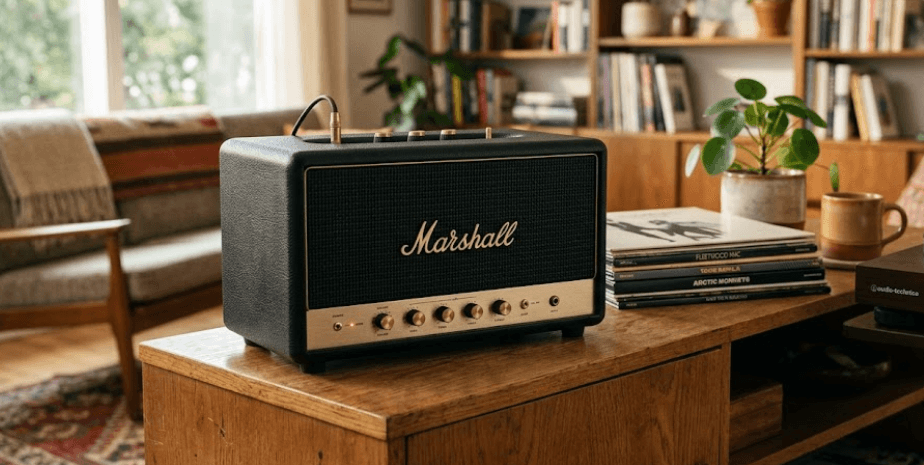
TL;DR: The Marshall Stanmore IV is a premium mains-powered home speaker that combines Marshall's familiar amp-inspired styling with a more refined sound profile than its predecessor. Its redesigned bass port, upgraded tweeters, and Dynamic Loudness help it deliver powerful low-end, clear highs, and a wide soundstage at high volumes. It supports Bluetooth 5.3 with Auracast, LDAC, AUX, and RCA inputs, while the Marshall app adds EQ and placement controls. In India, Marshall lists the Stanmore IV at ₹41,999, making it a premium purchase for listeners who prioritize powerful room-filling sound and distinctive design over smart-speaker features such as Wi-Fi streaming and voice assistants.
Marshall Stanmore IV Design And Build
The Marshall Stanmore IV stays firmly connected to the brand's guitar-amplifier heritage. Its rectangular cabinet, grille, Marshall branding, and physical controls give it the appearance of a classic amplifier rather than a conventional modern wireless speaker. That is a major part of its appeal, because the Stanmore IV is designed to be visible in a room rather than hidden away on a shelf. Marshall offers it in Black and Cream finishes, and the physical design is complemented by tactile controls on the top panel for volume, bass, treble, playback, source selection, and power.
The speaker is not particularly compact, and that is important to understand before buying it. It measures 350 x 203 x 185mm and weighs 3.99kg, so it is designed to stay in one place rather than move around the house like a portable Bluetooth speaker. It also requires mains power, meaning there is no battery-powered listening mode. The larger cabinet, however, gives Marshall room for a 5-inch woofer and two 0.75-inch tweeters, which are central to the speaker's fuller sound.
Build quality is one of the Stanmore IV's strongest selling points, particularly for buyers who care about how a speaker looks alongside their furniture. The design has changed relatively little from the previous generation, but that is not necessarily a weakness because the Marshall aesthetic is already one of the most recognizable in the category. The speaker also has a repairability rating from Marshall and replaceable-part support, which is useful for buyers planning to keep a premium home speaker for several years.
Stanmore IV Design Specifications
| Feature | Marshall Stanmore IV |
|---|---|
| Dimensions | 350 x 203 x 185mm |
| Weight | 3.99kg |
| Finishes | Black, Cream |
| Speaker Type | Stereo home speaker |
| Power | Mains powered |
| Cabinet Principle | Bass-reflex |
| Repairability | Yes |
Marshall Stanmore IV Sound Quality
Sound is where the Stanmore IV makes its strongest case. Marshall has equipped it with one 5-inch woofer powered by a 60W Class D amplifier and two 0.75-inch tweeters, each powered by a 25W Class D amplifier. The speaker has a stated frequency range of 36Hz to 38kHz and a maximum sound pressure level of 97dB SPL at one metre. These specifications do not tell the entire story, but they explain why this is designed as a substantially more powerful home speaker than a small portable Bluetooth model.
The listening experience is particularly convincing if you like music with a strong low-end presence. Independent testing from Tom's Guide found the bass deep and controlled rather than simply loud, while TechRadar also highlighted the speaker's hard-hitting bass and ability to maintain detail across the rest of the frequency range. That distinction matters because a speaker that simply produces more bass can easily make vocals and instruments sound muddy. The Stanmore IV instead aims for a warmer, fuller presentation while retaining clarity in the treble and mid-range.
The upgraded tweeters and waveguides are another important change. Marshall says they are designed to disperse sound across a larger area, creating a wider soundstage and making individual instruments more distinctive. The redesigned bass port is also intended to produce cleaner, more powerful bass and improve performance when the speaker is positioned close to a wall. Dynamic Loudness then adjusts the high and low frequencies as listening levels change, helping the overall sound remain balanced across different volumes.
Audio Hardware At A Glance
| Audio Feature | Stanmore IV |
|---|---|
| Woofer | 5-inch |
| Tweeters | 2 x 0.75-inch |
| Woofer Amplifier | 60W Class D |
| Tweeter Amplifiers | 2 x 25W Class D |
| Frequency Range | 36Hz–38kHz |
| Maximum SPL | 97dB SPL at 1m |
| Sound | Stereo |
Marshall Stanmore IV Bass And Volume
Bass is arguably the most noticeable character of the Stanmore IV. The redesigned bass port is one of the main changes Marshall has made for this generation, and the company says it is intended to deliver deeper and cleaner low frequencies while maintaining tighter bass at higher volumes. That makes the speaker particularly suitable for rock, pop, electronic music, hip-hop, and other genres where the low end plays an important role.
The speaker can also get considerably louder than most people will need for normal indoor listening. Tom's Guide found that the Stanmore IV maintained clarity at high volume levels, while TechRadar noted that some compression can still appear when pushing the speaker to its absolute maximum. That is a realistic way to look at its performance. You should not expect any compact home speaker to sound completely unchanged at 100% volume, but the Stanmore IV has enough headroom for large living rooms and social gatherings without requiring you to operate it near its limit.
The result is a speaker that prioritizes an energetic and immersive presentation rather than an ultra-neutral studio-monitor character. That will appeal to listeners who want music to feel substantial and engaging. If your preference is for a highly analytical sound where every recording is presented with minimal coloration, there are other speaker designs worth considering. For most casual and serious home listening, however, the Stanmore IV's combination of controlled bass, smooth treble, and broad presentation is one of its strongest advantages.
Marshall Stanmore IV Connectivity And Features
The Stanmore IV is more flexible than its retro appearance might suggest. Wireless connectivity is handled through Bluetooth 5.3 with Auracast support, while physical connections include a 3.5mm AUX input and RCA input. That combination makes it suitable for both modern wireless listening and traditional home audio equipment. Marshall specifically supports RCA connectivity for analogue sources such as turntables, although a record player that requires a separate preamp will still need one.
Bluetooth codec support includes SBC, AAC, LDAC, and LC3, and the speaker also supports Bluetooth multipoint. LDAC is particularly useful for compatible devices because it enables higher-quality Bluetooth transmission than basic SBC, although the actual benefit depends on the source device, settings, and listening environment. The 10-metre stated Bluetooth range is typical for a home Bluetooth speaker and should be sufficient for normal room-to-room use without expecting the connection to behave like a long-range wireless network.
The Marshall app adds another layer of control. Users can adjust EQ settings and use placement compensation to tailor the speaker to its surroundings. The physical M-button can also be customized for functions such as an assigned EQ preference or Spotify Tap. Auracast adds multi-speaker functionality, allowing the Stanmore IV to participate in synchronized listening setups with compatible Auracast devices and Marshall's supported ecosystem.
Connectivity Comparison
| Feature | Marshall Stanmore IV |
|---|---|
| Bluetooth | Bluetooth 5.3 |
| Auracast | Yes |
| Bluetooth Multipoint | Yes |
| Bluetooth Codecs | SBC, AAC, LDAC, LC3 |
| AUX | 3.5mm |
| RCA | Yes |
| Wi-Fi | No |
| Microphone | No |
| Marshall App | Yes |
Marshall Stanmore IV Smart Features
One area where the Stanmore IV does not try to compete directly with smart speakers is connected-home functionality. Marshall does not include Wi-Fi connectivity or a microphone, and independent reviews have specifically noted the lack of Wi-Fi streaming and voice assistant support. This means you cannot treat the Stanmore IV like a traditional smart speaker that is always connected to your home network and waiting for a voice command.
That limitation is worth considering because the speaker's price places it against products that offer broader smart-home features. A buyer who mainly wants to say a voice command and start music, control smart-home devices, or stream directly over Wi-Fi may find a competing platform more convenient. The Stanmore IV instead focuses on the fundamentals of a home music system: sound quality, physical controls, Bluetooth connectivity, analogue inputs, and app-based customization.
For listeners who already use a phone, tablet, computer, or another streaming device as their music source, this approach can actually be quite straightforward. You connect over Bluetooth and use the source device to control playback. The tactile controls also make basic adjustments immediate without forcing you to open an app every time you want to change the volume or bass. In other words, the Stanmore IV is better understood as a premium Bluetooth home speaker than as a smart speaker with an amplifier-style design.
Marshall Stanmore IV Price In India
Marshall's Indian website lists the Stanmore IV at an MRP of ₹41,999. The product page currently identifies the Cream model at this price and shows it as coming soon, with a stated delivery time of four to seven business days. Since retail availability and promotional pricing can change, buyers should check the current listing before making a purchase rather than treating the MRP as a permanent street price.
At ₹41,999, the Stanmore IV is clearly positioned as a premium home speaker. Its value therefore depends less on whether it is the cheapest way to get loud audio and more on whether its combination of sound, design, physical controls, and connectivity matches what you want. The retro aesthetic is a significant part of what you are paying for, but the audio hardware and improvements to the bass response and soundstage give it substance beyond its appearance.
The price also makes its missing features more noticeable. There is no Wi-Fi streaming and no voice assistant, so buyers who value those capabilities may find the feature set less complete than some similarly priced competitors. On the other hand, if your priority is a powerful, stylish speaker for music playback, the Stanmore IV's sound quality, analogue inputs, LDAC support, and Auracast functionality make the package considerably more compelling.
Marshall Stanmore IV Value Snapshot
| Category | Assessment |
|---|---|
| Design | Excellent |
| Bass | Excellent |
| Soundstage | Excellent |
| Connectivity | Very good |
| Smart Features | Limited |
| Portability | Low |
| Value | Best for sound-focused buyers |
| India Price | ₹41,999 MRP |
Should You Buy The Marshall Stanmore IV?
The Marshall Stanmore IV makes the most sense for someone who wants a permanent home speaker that looks distinctive and delivers powerful, room-filling sound. Its 5-inch woofer, upgraded tweeters, redesigned bass port, and Dynamic Loudness give it a strong audio foundation, while Bluetooth 5.3, LDAC, AUX, RCA, and Auracast provide enough flexibility for most home listening setups. Independent reviews from Tom's Guide and TechRadar also consistently praise its bass, clarity, wide soundstage, and performance at high volumes.
It is less convincing if your definition of a modern speaker includes Wi-Fi streaming, built-in voice assistants, or battery-powered portability. The Stanmore IV is a mains-powered home speaker, and its 3.99kg cabinet is clearly intended to stay where you place it. That is not necessarily a weakness, but it means you should buy it for the listening experience rather than expecting it to replace a portable Bluetooth speaker or a smart-home hub.
Who Should Buy It?
The Stanmore IV is a strong choice for music listeners who enjoy bass-heavy and energetic tracks, want a speaker that can comfortably fill a living room, and appreciate Marshall's classic amplifier-inspired design. It is also a good fit for vinyl users who want RCA connectivity and for buyers who want the option of adjusting EQ and placement through the Marshall app. For someone who wants premium sound and visual character in equal measure, it is easier to recommend than a speaker that offers more smart features but less personality.
Frequently Asked Questions
Q. What is the price of the Marshall Stanmore IV in India?
The Marshall Stanmore IV is listed at ₹41,999 on Marshall's Indian website. Retail availability and promotional pricing can change, so buyers should check the current official listing before purchasing.
Q. Is the Marshall Stanmore IV portable?
No. The Stanmore IV is a mains-powered home speaker and does not have a built-in battery. It weighs 3.99kg and is designed primarily for stationary indoor use.
Q. Does the Marshall Stanmore IV support Wi-Fi?
No. The Stanmore IV uses Bluetooth 5.3 for wireless connectivity and does not offer Wi-Fi streaming. This is one of the main differences between it and some smart-home-oriented competitors.
Q. Does the Marshall Stanmore IV have voice assistant support?
No. Marshall does not include a microphone in the Stanmore IV, and independent reviews note the absence of voice assistant support.
Q. Does the Marshall Stanmore IV have good bass?
Yes. Bass is one of its strongest features. Marshall has redesigned the bass port for cleaner and more powerful low-end performance, while independent testing found the bass deep, controlled, and impactful.
Q. Can I connect a turntable to the Stanmore IV?
Yes. The Stanmore IV has an RCA input for analogue sources such as a record player. Marshall notes that a turntable requiring a preamp will need one for the connection to work correctly.
Q. Does the Marshall Stanmore IV support LDAC?
Yes. The Stanmore IV supports LDAC along with SBC, AAC, and LC3 Bluetooth codecs. LDAC can provide higher-quality Bluetooth transmission when used with a compatible source device.
Q. Can the Marshall Stanmore IV connect to other speakers?
Yes. It supports Auracast and can participate in compatible multi-speaker listening setups. Marshall says the Stanmore IV can join Auracast broadcasts from supported Marshall devices and other compatible sources.
Q. Is the Marshall Stanmore IV better than the Stanmore III?
The Stanmore IV brings several refinements, including upgraded tweeters and waveguides, a redesigned bass port, Dynamic Loudness improvements, LDAC, and Auracast support. Independent reviews describe it as a worthwhile upgrade over the previous generation, although the overall visual design remains familiar.
Q. Is the Marshall Stanmore IV worth buying?
The Stanmore IV is worth considering if your priorities are powerful bass, clear sound, a wide soundstage, premium build, and Marshall's distinctive retro design. At ₹41,999, however, it is a premium purchase, so buyers who need Wi-Fi streaming, voice assistants, or battery-powered portability should consider alternatives with those features.
Final Recommendation
The Marshall Stanmore IV is a speaker that gets the fundamentals right. It combines Marshall's unmistakable retro amplifier styling with a serious 5-inch woofer, upgraded tweeters, a redesigned bass port, and Dynamic Loudness that helps maintain a balanced presentation as the volume changes. Its Bluetooth 5.3 connectivity, LDAC support, AUX and RCA inputs, Marshall app, and Auracast compatibility also give it enough flexibility for a modern home audio setup.
At ₹41,999 in India, it is not a budget speaker, and its lack of Wi-Fi, voice assistant support, and battery power means it is not the most feature-packed option for every buyer. However, those limitations become easier to accept if your priority is music rather than smart-home functionality. The Stanmore IV is best viewed as a premium, mains-powered home speaker that puts sound and design first.
Ready to upgrade your tech?
Browse our collection of quality refurbished products at unbeatable prices.