iPhone 14 Plus vs iPhone 15 Plus vs iPhone 16 Plus: Which Big-Screen Refurbished iPhone Should You Buy?
Compare the refurbished iPhone 14 Plus, iPhone 15 Plus, and iPhone 16 Plus to find the right big-screen iPhone for your budget, photography needs, battery expectations, and everyday use in 2026.

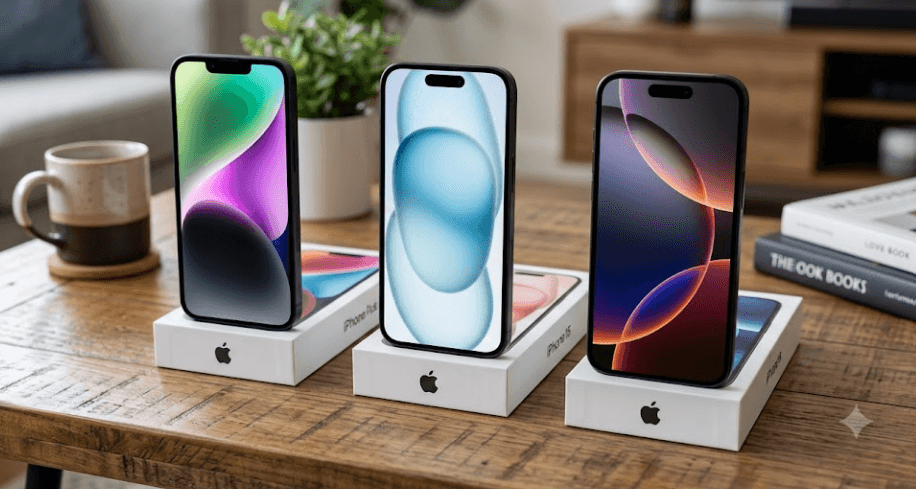
TL;DR: The iPhone 14 Plus, iPhone 15 Plus, and iPhone 16 Plus all offer a large 6.7-inch OLED display, making them practical choices for streaming, browsing, photography, and everyday productivity. The iPhone 14 Plus is worth considering when its refurbished price is significantly lower, the iPhone 15 Plus offers a useful upgrade with its 48MP main camera and USB-C port, and the iPhone 16 Plus is the strongest long-term choice thanks to its A18 chip, improved camera features, and Apple Intelligence compatibility. When buying refurbished in India, compare the actual selling price, battery health, warranty, and return policy rather than choosing solely by model year.
Understanding The Three Big-Screen iPhones
The iPhone Plus range is designed for people who want a larger display and strong battery life without paying for the more expensive Pro Max models. The iPhone 14 Plus arrived in 2022, followed by the iPhone 15 Plus in 2023 and the iPhone 16 Plus in 2024. Although their overall designs are similar, each generation introduces changes that affect everyday use, from processing power and camera capabilities to charging convenience and software features. These differences become particularly important in the refurbished market, where an older model can offer excellent value if its condition and price are right.
All three phones feature a 6.7-inch Super Retina XDR OLED display, Face ID, 5G connectivity, and an IP68 water- and dust-resistance rating under laboratory conditions. Their displays are well suited to watching videos, reading documents, using social media, and viewing photos. However, the iPhone 15 Plus and iPhone 16 Plus offer higher specified brightness than the iPhone 14 Plus, which can make outdoor viewing more comfortable. Apple lists the respective models' display specifications in its official comparison and technical documentation.
The refurbished buying decision is different from choosing between three brand-new phones. A newer model generally offers a longer remaining support horizon, but its higher price does not automatically make it the best purchase. A well-maintained iPhone 14 Plus may suit someone who mainly streams content, takes everyday photos, and uses messaging apps. Buyers who care about camera flexibility, USB-C convenience, and newer AI features have stronger reasons to consider the iPhone 15 Plus or iPhone 16 Plus. The best choice depends on how much those upgrades matter to your daily routine.
Key Differences At A Glance
Feature | iPhone 14 Plus | iPhone 15 Plus | iPhone 16 Plus |
|---|---|---|---|
Launch year | 2022 | 2023 | 2024 |
Display | 6.7-inch OLED | 6.7-inch OLED | 6.7-inch OLED |
Processor | A15 Bionic | A16 Bionic | A18 |
Main camera | 12MP | 48MP | 48MP Fusion |
Charging port | Lightning | USB-C | USB-C |
Dynamic Island | No | Yes | Yes |
Apple Intelligence | No | No | Supported |
Best reason to buy | Lower refurbished price | Camera and USB-C upgrade | Newer hardware and AI support |
Specifications are based on Apple's published model information. Actual refurbished prices, battery condition, and included accessories vary by seller.
Display, Design, And Everyday Performance
Screen Quality And Design
The 6.7-inch OLED display is the biggest reason to choose any of these Plus models. Text looks sharp, colors appear rich, and dark scenes benefit from OLED's ability to display deep blacks. The screen size also makes maps, spreadsheets, video calls, and on-screen keyboards more comfortable to use than on smaller iPhones. Although the three generations share broadly similar display dimensions, the iPhone 15 Plus and iPhone 16 Plus add the Dynamic Island, replacing the older notch design used by the iPhone 14 Plus. This changes how notifications, live activities, and certain background tasks appear on screen.
Brightness is another difference worth considering, especially if you frequently use your phone outdoors. Apple's specifications list typical maximum brightness of 800 nits and HDR peak brightness of 1,200 nits for the iPhone 14 Plus. The iPhone 15 Plus and iPhone 16 Plus support typical maximum brightness of 1,000 nits, HDR peak brightness of 1,600 nits, and outdoor peak brightness of 2,000 nits. These figures describe specified display performance rather than a guarantee that every screen will look identical in every environment. On a refurbished phone, screen condition, replacement-part quality, and any display damage also deserve attention.
Processor And Software Longevity
The iPhone 14 Plus uses Apple's A15 Bionic chip, the iPhone 15 Plus moves to the A16 Bionic, and the iPhone 16 Plus uses the A18. All three remain capable of common tasks such as messaging, video streaming, navigation, and everyday photography. The newer chips, however, give the later models a stronger foundation for demanding apps and future software features. The iPhone 16 Plus also supports Apple Intelligence, subject to compatible software versions, language availability, and regional requirements. The iPhone 14 Plus and iPhone 15 Plus do not support Apple Intelligence.
For refurbished buyers, processor differences should be weighed against the price gap. If your routine involves WhatsApp, Instagram, YouTube, email, and online payments, the iPhone 14 Plus can still be perfectly practical when it is in good condition. If you edit videos, play demanding games, or intend to keep the device for several more years, the A18 in the iPhone 16 Plus makes a stronger case. Software support duration is not guaranteed by a fixed number of years, so it is better to check Apple's current compatibility information rather than assume an exact end-of-support date for any model.
Camera Quality, Battery Life, And Charging
Which Camera System Offers More?
The iPhone 14 Plus has a 12MP main camera and a 12MP Ultra Wide camera, while the iPhone 15 Plus introduces a 48MP main camera. That higher-resolution sensor allows the iPhone 15 Plus to capture 24MP and 48MP photos and provides a 2x telephoto option through sensor cropping. The iPhone 16 Plus also has a 48MP Fusion main camera and a 12MP Ultra Wide camera, with additional capabilities such as macro photography and spatial photos. These upgrades make the newer models more versatile for travel, portraits, food photography, and social media content.
For everyday photography, the iPhone 15 Plus is a meaningful upgrade over the iPhone 14 Plus because it captures more detailed images in suitable conditions. The iPhone 16 Plus builds on that foundation with updated processing, newer Photographic Styles, and Camera Control, which provides a dedicated way to access camera functions. However, a higher megapixel count does not guarantee better results in every situation. Lighting, subject movement, lens condition, and image processing all influence the final photograph, so a refurbished phone's camera should be tested before purchase.
Battery Life And Charging Convenience
Apple rates the iPhone 14 Plus and iPhone 15 Plus for up to 26 hours of video playback, while the iPhone 16 Plus is rated for up to 27 hours. These are laboratory estimates, not guaranteed daily runtimes. Actual battery life depends on battery condition, screen brightness, mobile signal, gaming, video recording, and background activity. For refurbished devices, the battery's present condition can matter more than the small difference between Apple's original estimates. A heavily worn iPhone 16 Plus may need charging sooner than a well-maintained iPhone 14 Plus.
The charging port is a more noticeable practical difference. The iPhone 14 Plus uses Apple's Lightning connector, while the iPhone 15 Plus and iPhone 16 Plus use USB-C. USB-C makes it easier to share charging cables with many newer phones, tablets, and accessories, although the iPhone 15 Plus and 16 Plus support USB 2 data-transfer speeds rather than faster USB 3 speeds. The iPhone 16 Plus also supports faster MagSafe and Qi2 wireless charging than the iPhone 15 Plus under compatible conditions. If you already own USB-C accessories or regularly transfer files, the newer models offer a more convenient setup.
Feature | iPhone 14 Plus | iPhone 15 Plus | iPhone 16 Plus |
|---|---|---|---|
Main camera | 12MP | 48MP | 48MP Fusion |
2x telephoto option | Sensor-based zoom out | Sensor-enabled 2x option | Sensor-enabled 2x option |
Macro photography | No | No | Yes |
Video playback rating | Up to 26 hours | Up to 26 hours | Up to 27 hours |
Charging port | Lightning | USB-C | USB-C |
Camera Control | No | No | Yes |
Refurbished Prices And Value For Money In India
How To Compare The Price Of Each Model
There is no single refurbished price that applies to every iPhone 14 Plus, iPhone 15 Plus, or iPhone 16 Plus in India. The final amount depends on storage capacity, cosmetic grade, battery condition, replacement history, warranty, seller reputation, and current stock. A 128GB iPhone in excellent condition may cost more than a 256GB unit with a weaker battery or a shorter warranty. For this reason, avoid treating an old listing price or an advertised discount as proof that a particular model is a good deal.
The iPhone 14 Plus makes the most sense when the savings are substantial enough to justify its older processor, Lightning port, notch, and 12MP main camera. The iPhone 15 Plus is worth considering when the price difference is reasonable because its 48MP main camera, Dynamic Island, and USB-C connector make it feel more modern. The iPhone 16 Plus is the strongest option for buyers who want the A18 chip and Apple Intelligence compatibility, but these features only justify the extra cost if you expect to use them.
Compare Total Value, Not Just The Sticker Price
When comparing refurbished iPhones, consider the cost of ownership rather than the purchase price alone. A cheaper handset that needs an immediate battery replacement or has an unreliable display can become more expensive than a better-maintained phone with a higher upfront price. A seller's warranty, return window, and clarity about replacement parts are particularly important because the condition of refurbished devices can vary considerably. Ask for written terms before paying, and confirm whether battery replacements and other repairs are covered.
Model | Best Value Argument | Main Trade-Off |
|---|---|---|
iPhone 14 Plus | Lower purchase cost when discounted | Older camera, chip, and Lightning port |
iPhone 15 Plus | Useful upgrades without moving to the newest generation | No Apple Intelligence support |
iPhone 16 Plus | Newer processor, camera features, and AI compatibility | Usually requires a larger budget |
The smartest purchase is the phone that offers the best combination of condition, warranty, and features at the price you can actually get. Check current listings from reputable refurbished sellers and compare equivalent storage options. If the iPhone 16 Plus is only slightly more expensive than a comparable iPhone 15 Plus, it may be the better long-term investment. If the difference is large, a well-maintained iPhone 15 Plus could deliver better value for your money.
What To Check Before Buying A Refurbished iPhone
Battery Health And Replacement Parts
Battery health should be one of your first checks when buying a refurbished iPhone. Open Settings, select Battery, and review Battery Health. A higher maximum-capacity percentage generally indicates less battery wear, but it does not tell the entire story about performance or reliability. Ask the seller whether the battery has been replaced, whether the replacement is covered by warranty, and what battery condition is guaranteed. Do not assume that every refurbished phone meets the same battery-health standard simply because it is sold as refurbished.
You should also inspect Settings, General, and About to check the Parts and Service History when available. Depending on the model and repair, the phone may display information about replaced components or an Unknown Part warning. A warning does not automatically mean the device is unusable, but you should understand the implications before purchasing. Test Face ID, both rear cameras, the front camera, speakers, microphones, buttons, wireless charging, and the charging port. Check the display for dead pixels, uneven brightness, and touch-response problems.
Warranty, Activation Lock, And Return Policy
A refurbished iPhone should be properly erased and ready for activation with your own Apple Account. Make sure Activation Lock is not enabled for a previous owner, and confirm that the IMEI matches the seller's documentation where applicable. If buying online, look for a clear invoice, a written warranty, and a return window that gives you enough time to test the phone. Be cautious about unusually low prices, vague refurbishment descriptions, and sellers who refuse to explain the device's repair history. These precautions are useful for all three models, regardless of their original retail price.
Which Refurbished iPhone Plus Fits Your Needs?
The iPhone 14 Plus is a sensible choice for buyers who want a large OLED screen, dependable everyday performance, and a lower entry price. It handles common activities such as messaging, streaming, video calls, and casual photography without requiring the latest hardware. Its biggest compromises are the older 12MP main camera, Lightning connector, and notch design. Choose it when the price difference is meaningful and the specific device has a healthy battery, a reliable screen, and a satisfactory warranty.
The iPhone 15 Plus is the middle-ground option. Its 48MP main camera, Dynamic Island, brighter specified display, and USB-C connector make it a noticeable step forward without requiring you to buy the newest model. For someone who takes frequent photos, shares charging cables across devices, and wants a modern-looking iPhone for everyday use, it offers a practical balance. It is particularly attractive when a refurbished unit costs substantially less than an equivalent iPhone 16 Plus.
The iPhone 16 Plus is the strongest choice for buyers who prioritize newer hardware and plan to keep their phone for longer. Its A18 chip, Camera Control, macro photography, and Apple Intelligence compatibility provide capabilities missing from the two older models. However, you should not pay a large premium simply for the model number. Compare actual prices, storage, battery health, and warranty coverage before deciding whether the extra features are worth the difference.
Frequently Asked Questions
Q. Which is the best refurbished iPhone Plus model to buy in 2026?
The iPhone 15 Plus is a sensible middle-ground choice for buyers who want a 48MP main camera, Dynamic Island, and USB-C without paying for the newest model. The iPhone 16 Plus is better if Apple Intelligence and newer hardware matter to you. The iPhone 14 Plus makes sense when the price difference is substantial and the device is in good condition.
Q. Is the iPhone 14 Plus still worth buying in 2026?
Yes, if it is priced attractively and has a healthy battery. Its A15 Bionic chip remains suitable for everyday apps, browsing, streaming, and casual gaming. You will miss out on the 48MP main camera, USB-C, Dynamic Island, and Apple Intelligence support available on newer models, so compare the savings carefully.
Q. Is the iPhone 15 Plus better than the iPhone 14 Plus?
For most buyers, yes. The iPhone 15 Plus adds Dynamic Island, a 48MP main camera, USB-C, and a brighter outdoor display specification. Both phones have similarly sized OLED displays and Apple's published estimate of up to 26 hours of video playback. Whether the upgrade is worth it depends on the refurbished price difference and condition.
Q. Is the iPhone 16 Plus worth paying more for?
It can be, particularly if you plan to keep your phone for several years. Its A18 chip, Apple Intelligence support, Camera Control, and newer camera features give it advantages over the older models. However, if you mainly use messaging, social media, and streaming apps, the iPhone 15 Plus may deliver better value.
Q. Do all three iPhone Plus models have 120Hz displays?
No. The iPhone 14 Plus, iPhone 15 Plus, and iPhone 16 Plus have standard 60Hz displays. Their OLED panels provide excellent contrast and color, but they do not offer the 120Hz ProMotion display found on compatible Pro models.
Q. Which has the best camera, the iPhone 14 Plus, 15 Plus, or 16 Plus?
The iPhone 16 Plus offers the most advanced camera features in this comparison, including Camera Control and macro photography through its ultra-wide camera. The iPhone 15 Plus is also a substantial step up from the 14 Plus because it introduces a 48MP main camera. The 14 Plus remains capable for everyday photos.
Q. Is USB-C a major advantage on the iPhone 15 Plus and 16 Plus?
It is convenient if you already use USB-C cables for your laptop, tablet, headphones, or other devices. Both newer models use USB-C, while the iPhone 14 Plus uses Lightning. However, the standard iPhone 15 Plus and 16 Plus support USB 2 data-transfer speeds, so the connector change does not guarantee faster wired data transfers.
Q. How much battery health should I look for in a refurbished iPhone?
A higher battery health percentage generally means more of the battery's original capacity remains. Many buyers prefer a device at 85% or higher, but this is a practical preference rather than a universal guarantee. Ask whether the battery has been replaced, check for service warnings, and consider the warranty and expected replacement cost.
Q. Is a refurbished iPhone waterproof?
No phone should be treated as waterproof. These models originally carry an IP68 rating under specified laboratory conditions, but resistance can diminish through wear, impact, or repairs. A refurbished device's original rating does not guarantee its current condition, so avoid deliberately exposing it to water.
Q. What should I check before paying for a refurbished iPhone?
Check battery health, screen and camera condition, Face ID, speakers, microphones, charging, buttons, and cellular connectivity. Review Parts and Service History where available, verify the IMEI, and make sure Activation Lock has been removed. Read the return policy and warranty terms before paying.
Final Recommendation
For most buyers, the iPhone 15 Plus is the balanced refurbished purchase, provided it costs meaningfully less than the iPhone 16 Plus. Its 48MP main camera, Dynamic Island, USB-C connector, and large OLED display make it a practical everyday phone without paying extra for features you may not use. The iPhone 14 Plus remains worth considering when affordability is the priority and the device is in excellent condition.
Choose the iPhone 16 Plus if you want the newer A18 processor, additional camera capabilities, and Apple Intelligence support. It is the more future-oriented option of the three, although the exact length of future software support cannot be guaranteed. Whichever model you choose, prioritize battery health, genuine or properly documented replacement parts, a written warranty, and a reliable return policy. A well-maintained refurbished iPhone is a better investment than a newer model with a questionable repair history.
Ready to upgrade your tech?
Browse our collection of quality refurbished products at unbeatable prices.