iPhone 12 vs iPhone 13: Which Refurbished iPhone Is the Smarter Buy?
Comparing the refurbished iPhone 12 vs iPhone 13? Discover how their performance, battery life, cameras, software support, and prices compare, plus what to check before buying a refurbished iPhone in India.

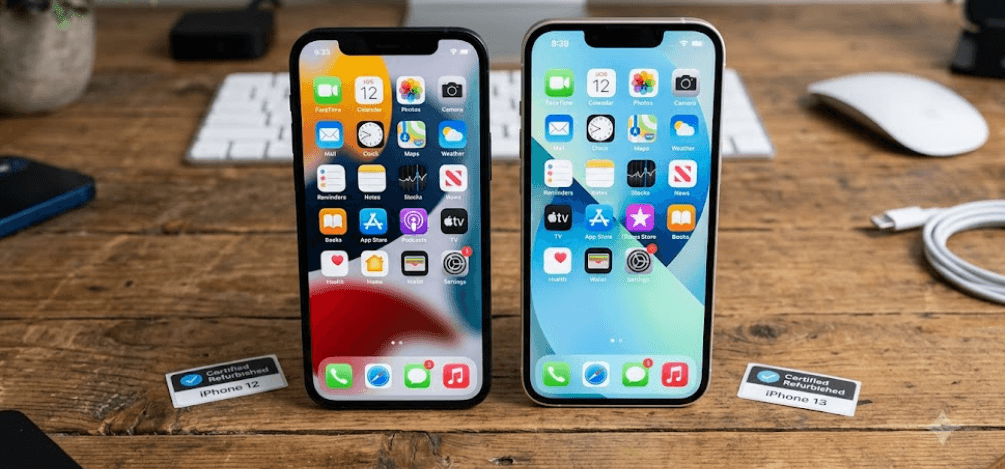
TL;DR: The iPhone 13 is generally the smarter refurbished purchase in 2026 if the price difference is reasonable. It offers the newer A15 Bionic chip, better battery life when new, improved main-camera stabilization, a smaller notch, and a newer release year that may help it remain supported for longer. The iPhone 12 still makes sense for budget-conscious buyers who want an OLED display, 5G, MagSafe, and reliable everyday performance without spending as much. However, refurbished condition matters just as much as model specifications. A well-maintained iPhone 12 with a healthy battery can be a better purchase than an iPhone 13 with significant wear, so compare the actual device, warranty, and final price before deciding.
Understanding the Refurbished iPhone Market in 2026
Buying a refurbished iPhone is a practical way to access Apple's premium hardware without paying the price of a newer model. Instead of choosing between an older budget phone and a new mid-range Android device, buyers can consider an earlier iPhone with an OLED display, capable cameras, and a processor that remains suitable for everyday tasks. The market has also become more relevant as smartphone prices rise and buyers look for better value. However, a refurbished phone is not automatically equivalent to a new one. Its battery, display, repair history, and overall condition can significantly influence the experience you get after purchase.
The iPhone 12 and iPhone 13 are particularly worth comparing because their designs and core features are similar. Both have 6.1-inch Super Retina XDR OLED displays, Face ID, 5G connectivity, dual rear cameras, and support for MagSafe accessories. Their differences become clearer when you examine battery endurance, camera stabilization, processing hardware, and the likely remaining period of software support. These details matter more when you intend to keep a refurbished phone for another two or three years rather than replace it quickly.
What Does Refurbished Mean?
A refurbished phone has generally been inspected, tested, cleaned, and prepared for resale, although the exact process depends on the seller. Some sellers also replace defective components, while others sell pre-owned devices after basic checks. Always read the refurbishment policy rather than assuming every listing includes a new battery, original parts, or the same warranty coverage.
The distinction between refurbished and merely used is important because the condition of an individual device can outweigh the advantages of a newer model. Check the battery health, screen quality, camera operation, charging port, Face ID, and available warranty. A lower price is useful only when the phone works reliably and the seller clearly explains what is covered if something goes wrong.
iPhone 12 vs iPhone 13: Specifications Compared
The iPhone 12 and iPhone 13 share enough features that neither feels unfamiliar to someone moving between them. Both use Apple's flat-edged aluminum design, feature a glass back, and have an IP68 water-resistance rating when in their original condition. Both also use Lightning charging rather than USB-C, which means your existing Lightning cables and compatible accessories can still be useful. For messaging, browsing, video streaming, navigation, and mobile banking, either model can provide a familiar iPhone experience.
The most important hardware differences are the processor, battery, and main camera system. The iPhone 12 uses the A14 Bionic chip, while the iPhone 13 uses the A15 Bionic. The newer chip offers a performance improvement, but that does not mean the iPhone 12 suddenly feels slow during routine tasks. The iPhone 13's more meaningful advantage for many buyers is the combination of improved efficiency, stronger battery endurance when new, and camera improvements that make it more versatile.
The displays are also more similar than some buyers expect. Both use 6.1-inch OLED panels with a 60Hz refresh rate, so neither offers the smoother 120Hz ProMotion experience found on certain Pro models. The iPhone 13 does have a smaller notch and a brighter typical maximum display brightness. If you primarily watch videos, read articles, or use social media, the difference is noticeable but not substantial enough to justify upgrading on its own.
Key Specifications at a Glance
| Feature | iPhone 12 | iPhone 13 |
|---|---|---|
| Release year | 2020 | 2021 |
| Processor | A14 Bionic | A15 Bionic |
| Display | 6.1-inch OLED | 6.1-inch OLED |
| Refresh rate | 60Hz | 60Hz |
| Main camera | 12MP | 12MP |
| Ultra-wide camera | 12MP | 12MP |
| Main-camera stabilization | Optical image stabilization | Sensor-shift optical image stabilization |
| Connectivity | 5G | 5G |
| Charging port | Lightning | Lightning |
| MagSafe | Yes | Yes |
| Water-resistance rating when new | IP68 | IP68 |
Specifications are based on Apple's official device information. Actual water resistance may diminish with age, wear, or previous repairs.
Performance and Software Support
The A14 Bionic inside the iPhone 12 remains capable of handling everyday applications, including WhatsApp, Instagram, Google Maps, YouTube, email, and mobile banking. For users who primarily browse the internet, stream content, and take photographs, the chip is unlikely to be the main reason to reject the phone. Performance depends on the overall condition of the device, available storage, battery health, and the demands of the apps you use. A well-maintained iPhone 12 can still be a sensible choice when its price is substantially lower than that of a comparable iPhone 13.
The iPhone 13 uses the A15 Bionic, which provides a newer processor and a more capable GPU configuration in the standard model. It is a better fit for users who regularly edit videos, play demanding games, or want more performance headroom for future applications. However, buyers should avoid assuming that a newer chip automatically guarantees a specific number of additional years of software support. Apple does not promise a fixed number of major iOS upgrades for every iPhone at launch, and future compatibility can change. Check the current iOS compatibility list before buying either model.
For a refurbished purchase, software support is a long-term value consideration rather than a simple processor comparison. The iPhone 13 launched a year after the iPhone 12, which may give it a longer remaining support window, but the exact end date cannot be confirmed from the release year alone. Both models should also be assessed for their ability to run the apps you depend on today. If your plan is to keep the phone for several years, the iPhone 13 is the more cautious choice, provided its condition and price are comparable.
Which Phone Feels Faster in Everyday Use?
For common tasks, the difference may be modest. Opening messaging apps, checking email, browsing websites, and watching videos should feel familiar on both phones when they are in good condition. The iPhone 13 is more attractive for heavier workloads, but most buyers should weigh its performance advantage alongside battery health and price rather than treating benchmarks as the deciding factor.
Battery Life and Refurbished Condition
Battery life is one of the strongest reasons to choose the iPhone 13 over the iPhone 12. Apple rated the iPhone 13 for up to 19 hours of offline video playback when new, compared with up to 17 hours for the iPhone 12. These are laboratory-based estimates, not guarantees of everyday screen time. Actual endurance varies with network reception, screen brightness, gaming, camera use, background activity, and other factors. Still, the original specifications support the conclusion that the iPhone 13 has an endurance advantage.
Refurbished devices introduce another variable: battery aging. Lithium-ion batteries gradually lose capacity through normal use and charging cycles, so a phone that has been used heavily may last considerably less time than it did when new. That is why a refurbished iPhone 12 with a recently replaced, properly functioning battery could outperform an iPhone 13 with a worn battery. Ask the seller for the battery-health percentage, confirm whether the battery has been replaced, and check for any battery-related service messages.
Charging convenience is similar on both models. Each supports Lightning charging, MagSafe wireless charging, and Qi wireless charging. Neither has the USB-C connector found on newer iPhone generations, so buyers should consider their existing accessories before purchasing. If battery endurance is a priority, compare the actual battery condition of the two listings rather than relying only on the model name. Paying extra for an iPhone 13 with a poor battery may not deliver the improvement you expect.
What Battery Health Should You Look For?
A battery-health reading of 85% or higher is a useful target when comparing refurbished options, although it is not a universal guarantee of quality. A lower reading does not automatically make a phone unusable, but it should influence the price and your likely replacement costs. Ask for clear information about battery condition and replacement coverage before paying.
Camera Quality: Which iPhone Takes Better Photos?
Both phones have a dual 12MP rear-camera system with wide and ultra-wide cameras, so the iPhone 13 does not win simply by offering a higher megapixel count. Its main camera has a wider f/1.6 aperture and sensor-shift optical image stabilization, which helps reduce the effect of hand movement. The iPhone 12 also offers optical image stabilization, but the iPhone 13's sensor-shift implementation is an important hardware improvement. In practical use, this can help when photographing people indoors, capturing evening scenes, or shooting handheld video.
The iPhone 13 also introduces Cinematic mode for video recording, allowing the camera to create a shallow-depth-of-field effect and shift focus between subjects. It supports recording in 1080p at up to 30 frames per second in this mode. Both phones support Dolby Vision HDR video recording, although their supported modes differ. For everyday family photos, food pictures, travel images, and social media uploads, both remain capable. The iPhone 13 simply offers more flexibility for users who take pictures frequently or enjoy experimenting with video.
Refurbished camera condition deserves just as much attention as the original hardware. Scratched lens covers, damaged stabilization mechanisms, non-genuine replacement components, or a poor-quality replacement display can affect the overall experience. Test the wide and ultra-wide cameras in good light and low light, record a short video, and check focus and stabilization. If photography is your main reason for choosing a refurbished iPhone, the iPhone 13 is the stronger option when the two devices are in similar condition.
Refurbished Pricing and Value in India
The iPhone 12's biggest advantage is its lower purchase price. In the listings reviewed for this article, it appeared at around ₹19,499 to ₹21,499, while the iPhone 13 appeared at approximately ₹27,499 to ₹29,299. These figures are seller-specific examples rather than fixed prices for every storage configuration or condition grade. Promotions, stock levels, warranty terms, and battery condition can change the final cost, so compare like-for-like listings before deciding.
At these indicative prices, the difference between the two models is roughly ₹6,000 to ₹10,000, depending on the listing. That extra spending may be worthwhile if you want stronger battery endurance, improved camera stabilization, and a newer processor. The iPhone 12 makes more sense if you have a firm budget limit and mainly need a reliable phone for communication, payments, browsing, and video streaming. In either case, storage capacity matters: compare devices with the same storage before deciding which one offers better value.
A cheaper listing is not always the better deal. A phone with a weak battery, an uncertain repair history, no meaningful warranty, or limited return options can become more expensive after purchase. Before paying, check the total price, battery health, included accessories, return policy, warranty duration, and whether the seller has disclosed any replaced components. Refurbished pricing should be judged by the condition of the actual device, not only by the discount displayed against its original launch price.
Price Comparison
| Model | Indicative refurbished listing price | Best suited for |
|---|---|---|
| iPhone 12 | ₹19,499–₹21,499 | Budget-conscious buyers |
| iPhone 13 | ₹27,499–₹29,299 | Buyers prioritizing battery and camera improvements |
Prices are examples from listings checked for this article and may change. Verify the exact model, storage, condition, and warranty before purchasing.
What to Check Before Buying a Refurbished iPhone
The first step is to verify the phone's identity and condition. Check the model and storage capacity in Settings, inspect the display for dead pixels or uneven brightness, and test Face ID, speakers, microphones, cameras, buttons, Wi-Fi, Bluetooth, and mobile connectivity. Confirm that the device is not linked to another person's Apple Account and that Activation Lock has been removed. Do not pay for a phone that the seller cannot demonstrate can be erased and activated normally.
Next, inspect the battery information and parts-and-service history where available. On supported iOS versions, the Parts and Service History section can help identify certain repairs or replacement components. Its availability and the details shown vary by model, iOS version, and repair history, so do not treat it as a complete record of everything that has happened to the phone. Ask the seller directly about replaced parts and obtain the return and warranty terms in writing.
Finally, evaluate the seller as carefully as the device. Prefer a seller that provides a clear grading system, a documented warranty, a reasonable return window, and transparent information about battery health. Remember that Apple's original IP68 rating does not guarantee that a refurbished device remains water-resistant after years of use or previous repairs. Avoid testing this by exposing the phone to water. A careful inspection before purchase is far safer than relying on a specification that describes the phone when it was new.
Frequently Asked Questions
Q. Is the iPhone 12 still worth buying refurbished in 2026?
Yes, the iPhone 12 can be a good refurbished purchase if you find it at a competitive price with a healthy battery and a reliable warranty. Its OLED display, A14 Bionic chip, 5G connectivity, and dual-camera system remain suitable for everyday tasks. However, check current iOS compatibility and compare the price against the iPhone 13 before purchasing.
Q. Is the refurbished iPhone 13 worth the extra money?
For most buyers, yes, if the price difference is reasonable. The iPhone 13 offers the A15 Bionic chip, better battery endurance when new, sensor-shift stabilization on its main camera, and a smaller notch. These improvements make it a stronger choice for people who intend to keep their refurbished phone for several years.
Q. Which phone has better battery life, the iPhone 12 or iPhone 13?
The iPhone 13 has better rated battery life when new, with up to 19 hours of offline video playback compared with up to 17 hours on the iPhone 12. Actual performance depends on usage and battery condition. For refurbished devices, always compare battery health before choosing.
Q. Do the iPhone 12 and iPhone 13 have the same display?
Both feature a 6.1-inch Super Retina XDR OLED display with a 60Hz refresh rate. The iPhone 13 offers higher typical maximum brightness and a smaller notch, but neither model supports 120Hz ProMotion. Both provide sharp text, rich colors, and deep blacks.
Q. Which refurbished iPhone has the better camera?
The iPhone 13 has the advantage because its main camera features sensor-shift optical image stabilization and it supports Cinematic mode. Both phones have 12MP wide and ultra-wide rear cameras. The condition of the camera lenses and components is also important when buying refurbished.
Q. How much does a refurbished iPhone 12 cost in India?
Listings checked for this article showed prices of approximately ₹19,499 to ₹21,499. The final price depends on the seller, storage capacity, condition, battery health, and warranty. Check current listings before purchasing because refurbished prices can change with stock and promotions.
Q. How much does a refurbished iPhone 13 cost in India?
The listings reviewed showed prices of approximately ₹27,499 to ₹29,299. These are indicative prices, not guaranteed market-wide rates. Compare the storage configuration, battery condition, warranty, and return policy before deciding whether the iPhone 13 offers better value.
Q. Can the iPhone 12 and iPhone 13 run the latest iOS?
Compatibility depends on Apple's current supported-device list and the iOS version available at the time of purchase. Do not assume either model will receive a fixed number of future upgrades. Check Apple's official iOS compatibility information before buying, especially if long-term software support is important to you.
Q. What battery health should I look for in a refurbished iPhone?
A battery-health reading of 85% or higher is a useful target, although the percentage alone does not guarantee good performance. Ask whether the battery has been replaced, check for service warnings, and confirm whether the seller covers battery-related issues under warranty.
Q. Should I buy a refurbished iPhone 12 or iPhone 13 for college?
The iPhone 12 is suitable if you have a strict budget and primarily use messaging, educational apps, social media, and streaming services. The iPhone 13 is the better long-term choice if you can afford the difference and want better battery endurance and camera features.
Ready to upgrade your tech?
Browse our collection of quality refurbished products at unbeatable prices.