Inkjet vs Laser Printers: Which Should You Buy?
Inkjet printers are better for photos and versatile color printing, while laser printers suit fast, text-heavy workloads. Compare cost, speed, quality, maintenance, and use cases before buying.

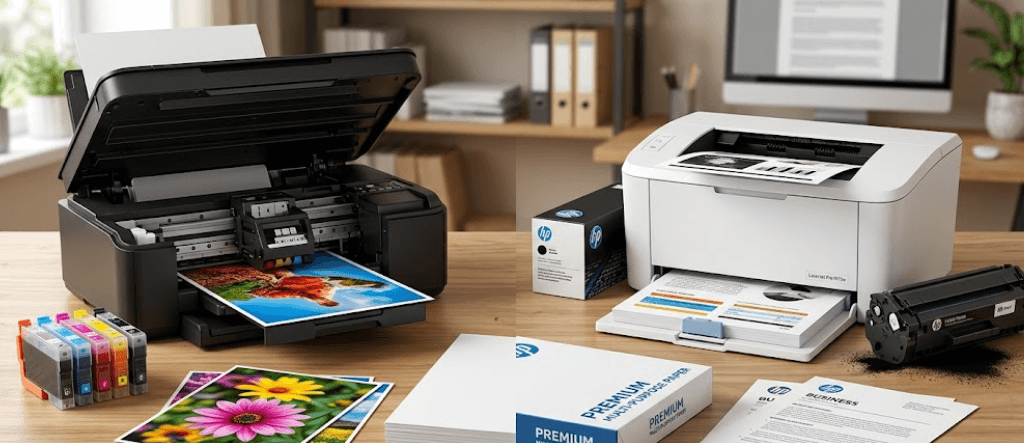
TL;DR Inkjet and laser printers are designed for different printing habits, so there is no single winner for every buyer. Inkjet printers are generally the better choice for photos, detailed color graphics, and households that need versatile colour printing, while laser printers are usually better for people who print large volumes of text documents and want fast, sharp, consistent output. Laser printers also use toner, which does not dry out in the same way liquid ink can, and toner cartridges can offer high page yields depending on the model. However, modern ink tank printers have changed the cost equation for frequent colour printing, with some models offering very high page yields.
How Inkjet And Laser Printers Work?
Inkjet and laser printers create printed pages using completely different technologies, and that difference explains many of their strengths and weaknesses. An inkjet printer places tiny droplets of liquid ink onto paper through a printhead. Depending on the printer, the ink may use dye or pigment formulations, and modern inkjet systems can produce smooth colour transitions that work particularly well for photographs, illustrations, and documents containing detailed graphics. Laser printers, in contrast, use toner, a fine powder, together with an imaging system and heat to transfer and fuse the toner onto the paper. This process is particularly well suited to producing clean text and consistent lines across large batches of documents.
The difference becomes more noticeable when you think about what you normally print. Someone printing school projects, family photographs, colourful presentations, and occasional documents may appreciate the flexibility of an inkjet printer. Someone printing invoices, reports, forms, contracts, and other text-heavy documents every day may get more practical value from a laser printer. This does not mean that an inkjet cannot print documents or that a laser printer cannot print graphics. Both technologies can handle a mixture of content, but they have different areas where they are naturally stronger. Canon and HP both describe laser printers as particularly suitable for speed, text-heavy work, and higher-volume printing, while inkjet models have an advantage for photo and color reproduction.
Another important point is that the simple inkjet-versus-laser comparison has become less straightforward because ink tank printers are now common. A traditional cartridge inkjet and a high-capacity ink tank printer may have very different running costs, even though both use liquid ink. Brother India, for example, lists ink tank models with claimed yields of up to 7,500 black pages and 5,000 colour pages under its stated testing methodology, although actual results vary with what you print. That means buyers should not judge every inkjet printer by the reputation of small, frequently replaced cartridges. The specific printer and consumable system matter just as much as the printing technology itself.
Inkjet Printers: Strengths And Limitations
Where Inkjet Printers Make Sense
Inkjet printers are particularly attractive when colour quality and versatility matter more than maximum document speed. Liquid ink can create smooth colour transitions, making inkjet technology well suited to photographs, illustrations, marketing material, and documents containing complex graphics. HP specifically notes that inkjet printers excel at high-quality colour images and photos, while Canon also positions inkjet models as a strong choice for users who need high-quality colour output. For a home user who occasionally prints photographs, a student who needs colourful project work, or a small business that creates visual documents, an inkjet can therefore be more useful than a monochrome-focused laser printer.
Inkjet printers can also make sense when your printing volume is relatively low but your documents vary considerably. A single machine can handle ordinary black text, colour presentations, images, charts, and photographs without requiring a separate device for different types of work. However, the running cost depends heavily on the type of inkjet you buy. Standard cartridge-based printers can become expensive when you print frequently, while ink tank models are designed around larger reservoirs and refill bottles. HP notes that ink tank printers typically have a higher upfront price but can offer substantially lower ongoing costs than standard cartridge systems, which is why they are increasingly relevant for buyers who print colour documents regularly.
There are also practical considerations around maintenance. Liquid ink can dry out when a printer is left unused for long periods, which is one reason occasional users should think about how often they will actually print. The problem is less straightforward than saying every inkjet will clog, because printer design, ink formulation, usage patterns, and maintenance all influence the experience. Still, buyers who print only a handful of pages every few months should consider the maintenance behaviour of the specific model before purchasing. For frequent color printing, especially when photographs or graphics are important, an inkjet or ink tank printer can remain a very sensible choice.
| Factor | Inkjet Printer |
|---|---|
| Best for | Photos, color graphics, mixed home use |
| Print technology | Liquid ink droplets |
| Color output | Generally strong for photos and detailed graphics |
| Running cost | Depends heavily on cartridge or tank design |
| Maintenance | Liquid ink can require more attention during long periods of non-use |
| Best buyer | Home users, students, creators, and color-focused users |
Laser Printers: Strengths And Limitations
Laser printers are usually the stronger option when your workload is dominated by text and you regularly print multiple pages at a time. They use toner rather than liquid ink, and the printing process is designed around producing sharp text and clean lines quickly. Canon specifically highlights speed, cost per page at higher volumes, text quality, and lower maintenance requirements among the advantages of laser printing. HP similarly notes that laser printers are well suited to text-heavy business documents. For an office that regularly produces reports, invoices, forms, or contracts, these characteristics can make a laser printer feel considerably more efficient.
Toner is another reason laser printers can be attractive to frequent users. Unlike liquid ink, toner does not dry out in the same way, and toner cartridges can have high page yields. However, you should not assume that a quoted cartridge yield is the number you will always achieve. Brother explains that toner yield depends on factors such as the amount of toner coverage, the type of document, and the size of print jobs. A cartridge tested around a standard coverage level can therefore produce a very different real-world result when used for graphics-heavy pages. Page-yield figures are useful for comparing printers, but they should be treated as estimates rather than guarantees.
Laser printers are not automatically the best choice simply because you print regularly. A monochrome laser printer is particularly compelling if almost everything you print is black text, while a colour laser model becomes more relevant when you need faster colour documents and do not require photo-focused output. Colour laser printers can produce high-quality colour graphics, but HP notes that inkjet printers generally have an advantage for detailed photographs because liquid ink can create smoother gradients and transitions. A buyer should therefore decide whether "colour" means business graphics and presentations or actual photo printing, because those are different requirements.
| Factor | Laser Printer |
| Best for | Text-heavy documents and higher-volume printing |
| Print technology | Toner-based printing |
| Text quality | Sharp and consistent |
| Running cost | Often attractive at higher print volumes |
| Maintenance | Generally lower routine maintenance |
| Best buyer | Offices, businesses, and frequent document printers |
Inkjet Vs Laser: Cost, Speed And Quality
The purchase price should not be the only number you compare when deciding between an inkjet and laser printer. The more useful calculation is the total cost of ownership, which includes the printer, replacement ink or toner, paper, and the volume you expect to print. A low-priced printer can become expensive if its consumables need frequent replacement, while a more expensive printer may make sense if its cartridges or toner deliver high yields. HP recommends considering page yield alongside quality, reliability, productivity, and efficiency rather than using cartridge capacity alone as a measure of value.
Speed is another area where laser printers traditionally have an advantage, particularly for high-volume text printing. That does not mean every laser printer is faster than every inkjet printer. Modern inkjet models have improved considerably, and some are designed for high-volume office printing. HP notes that advancements in inkjet technology have made some modern models more competitive on speed, particularly for smaller print jobs. The more accurate buying rule is therefore to compare the advertised pages-per-minute rating of the exact models you are considering, while remembering that real-world speed can change depending on colour, resolution, paper type, and the complexity of the document.
Print quality is where the decision becomes highly dependent on the material you produce. Laser printers are excellent for sharp text and clean lines, which makes them particularly useful for reports and professional documents. Inkjet printers generally have the edge for photographs and detailed colour images because liquid ink can blend colours and gradients more smoothly. A colour laser printer can absolutely handle graphics and colour documents, but if your main reason for buying a printer is to produce photographs, an inkjet remains the safer technology choice. The right question is therefore not simply which printer has better quality, but what kind of quality you need most often.
| Buying Factor | Inkjet | Laser |
| Photos | Better suited | Adequate on color models |
| Text documents | Very good | Excellent |
| High-volume text | Depends on model | Usually stronger |
| Color graphics | Strong | Strong on color models |
| Toner or ink storage | Liquid ink can dry | Toner does not dry out like liquid ink |
| Long-term cost | Highly model-dependent | Often favorable at high volumes |
| Occasional printing | Model-dependent | Often convenient because toner does not dry out |
Which Printer Should You Buy?
For a typical home user, the decision should start with the type of documents you expect to print rather than the brand or advertised printer speed. If your workload includes school assignments, colour charts, photographs, invitations, and occasional documents, an inkjet printer is generally the more flexible option. If you print mostly black-and-white documents, invoices, office reports, forms, or study material in significant quantities, a monochrome laser printer is usually a more logical fit. This distinction also helps prevent a common buying mistake: spending extra on a colour laser printer when you rarely need colour, or choosing a cheap cartridge inkjet when you actually print hundreds of pages every month.
Match The Printer To Your Printing Habits
Your monthly printing volume should be one of the first things you estimate. Someone printing 20 pages a month has a very different requirement from someone printing 500 pages a month. At low volumes, convenience and the type of documents you print may matter more than small differences in cost per page. At higher volumes, cartridge or toner yield becomes increasingly important. Official yield figures from HP and Brother are tested under standardized conditions, but both companies explain that actual results vary according to page coverage and what you print. That is why comparing consumable prices and declared yields for the exact printer is more useful than assuming one technology is always cheaper.
If photographs are an important part of your printing routine, lean toward an inkjet, particularly a model designed for photo printing. If your priority is fast, clean text and you regularly print long documents, a laser printer is usually the better fit. For users who want low running costs while still printing substantial amounts of colour, an ink tank printer deserves consideration rather than being grouped together with traditional cartridge inkjets. Brother India, for example, promotes high page yields on its ink tank range, demonstrating how much the consumable design can change the economics of liquid-ink printing.
The final consideration is how much you value convenience. A laser printer can be appealing to someone who wants to leave the printer unused for periods and return to it without worrying about liquid ink drying. An inkjet can be more attractive when colour versatility and photo output matter more. There is no universal answer because both technologies have evolved considerably. The best printer is the one whose consumables, speed, print quality, connectivity, paper handling, and maintenance requirements match your actual workload rather than the one with the most impressive specification on the box.
Common Buying Mistakes To Avoid
One common mistake is judging a printer only by its upfront price. A printer that looks inexpensive can become costly if its replacement cartridges are expensive or have low yields. The opposite can also happen: a printer with a higher initial price may be more economical over several years if its consumables last longer. HP specifically advises buyers to consider quality, reliability, productivity, and efficiency alongside page yield when assessing printing costs. This is particularly important when comparing cartridge inkjets with ink tank models, because their upfront and ongoing cost structures can be very different.
Another mistake is assuming that every laser printer is monochrome or that every inkjet is designed primarily for photographs. Colour laser printers are widely available and can produce consistent colour graphics, while modern inkjet printers can be designed for office workloads as well as home photo printing. The technology tells you something about the printer, but the exact model determines its capabilities. Before buying, check the printer's supported paper types, print speed, automatic duplexing, connectivity, cartridge or toner yield, and whether it includes features such as scanning and copying if you need an all-in-one machine.
You should also avoid comparing page yields without checking how those figures were measured. HP uses ISO/IEC 24711 methodology for many inkjet cartridge yield measurements, while Brother uses applicable ISO standards for toner yields. Actual results can change substantially based on page coverage, document type, and print behaviour. A page filled with graphics will consume considerably more consumable material than a basic text document. Looking at the official yield for the specific cartridge or toner supported by the printer gives you a much more realistic basis for comparison than relying on generic claims about ink or toner being "cheap."
| Mistake | Better Approach |
| Choosing only by printer price | Compare printer plus consumable costs |
| Assuming all inkjets are expensive | Compare cartridge and ink tank models separately |
| Assuming all lasers are monochrome | Check for color laser models |
| Comparing only advertised speed | Check the exact model and workload |
| Treating page yield as guaranteed | Use official yield figures as comparison estimates |
| Buying without considering print type | Match the printer to documents, photos, or both |
Frequently Asked Questions
Q. Which is better, an inkjet or laser printer?
The better choice depends on what you print. Inkjet printers are generally better suited to photographs, detailed colour images, and mixed home printing, while laser printers are usually stronger for fast, text-heavy and higher-volume document printing.
Q. Is laser printing cheaper than inkjet printing?
It can be, particularly for high-volume text printing, because toner cartridges can offer high page yields and laser printers can have a lower cost per page at higher volumes. However, the exact printer and consumable prices matter, so you should compare the specific models rather than assume laser is always cheaper.
Q. Are inkjet printers better for photos?
Generally, yes. Inkjet printers are particularly well suited to photographs because liquid ink can produce smooth color transitions and detailed images. Color laser printers can print photos, but they generally do not match inkjet output for photo reproduction.
Q. Are laser printers faster than inkjet printers?
Laser printers are traditionally strong for high-volume document printing, but you should compare the rated speed of the exact models. Modern inkjet printers have also become faster, so technology alone does not guarantee that one specific printer will be faster.
Q. Does laser toner dry out like ink?
No. Toner is a powder rather than liquid ink, so it does not dry out in the same way liquid ink can. This is one reason laser printers can be convenient for users who leave their printer unused for periods of time.
Q. Are ink tank printers better than laser printers?
Not necessarily. Ink tank printers can be excellent for users who need large amounts of affordable colour printing, while laser printers remain attractive for fast, text-heavy workloads. The better option depends on what you print and how much you print.
Q. Which printer is better for office documents?
A laser printer is generally a strong choice for offices that produce large volumes of text-heavy documents because laser technology is known for sharp text, fast printing, and efficient high-volume operation.
Q. Which printer is better for occasional home use?
There is no universal answer. If occasional printing includes photographs and colour documents, an inkjet can make more sense. If you mostly print occasional black-and-white documents and want to avoid concerns about liquid ink drying, a laser printer can be attractive.
Q. Does a higher page yield always mean a cheaper printer?
No. Page yield is only one part of the cost equation. You should also consider the price of replacement consumables, the printer's purchase price, print quality, reliability, and your actual page coverage. Official page yields are standardized estimates and may differ from real-world results.
Q. Should I buy a colour laser printer instead of an inkjet?
Choose a colour laser if you mainly need fast, consistent colour documents and graphics. If photographs and smooth colour reproduction are a major priority, an inkjet is generally the better fit.
Final Recommendation
For most buyers, the choice between inkjet and laser printers becomes straightforward once you stop comparing them as competing technologies and instead compare them against your printing habits. Choose an inkjet printer if photographs, colourful documents, illustrations, and flexible home printing are important to you. If you print frequently and want lower running costs for colour, an ink tank model is worth considering instead of a conventional cartridge inkjet. For offices, students with heavy document workloads, and anyone regularly printing large batches of text, a laser printer is generally the more practical choice because of its sharp text output, speed, and toner-based operation.
The most important point is not that one technology is better than the other. It is that the right printer should match your workload. Check the exact consumable prices, official page yields, print speed, colour requirements, paper handling, and features before buying. Once those factors line up with how you actually print, choosing between an inkjet and laser printer becomes much easier and far less likely to result in an expensive mismatch.