IBIS vs Lens Stabilisation: What's the Difference and Do You Need Both?
Discover how IBIS and lens stabilization differ, how they reduce camera shake, and whether you need both. Compare their benefits, limitations, and best uses to choose the right camera setup.

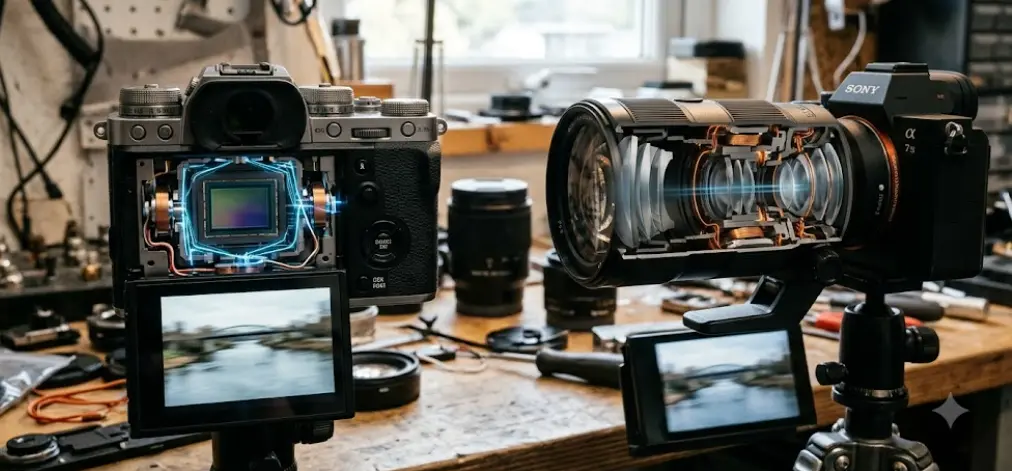
TL;DR: In-body image stabilization (IBIS) and lens stabilization both help reduce blur caused by camera shake, but they work differently. IBIS moves the camera's image sensor to compensate for movement, while optical image stabilization (OIS) moves elements inside the lens. IBIS is especially useful when shooting handheld with unstabilized prime lenses, while lens stabilization can be particularly beneficial with telephoto lenses. If your camera and lens support coordinated stabilization, using both can improve results. However, you do not necessarily need both. Your camera system, shooting style, subject, and budget should guide your decision.
What Is Image Stabilization?
Image stabilization is a camera technology designed to reduce blur caused by small, unintended movements while taking photographs or recording videos. Camera shake becomes more noticeable when shooting handheld at slower shutter speeds, using longer focal lengths, or working in low-light conditions. Stabilization compensates for some of this movement, helping you capture sharper images without always needing a tripod.
However, image stabilization is not a guarantee of perfectly sharp photographs. It cannot freeze a moving person, a running animal, or a moving vehicle. For those situations, you may still need a faster shutter speed. Stabilization also has physical limits, and its effectiveness depends on the camera, lens, focal length, and shooting conditions.
Modern interchangeable-lens cameras commonly use two forms of stabilization: in-body image stabilization and lens-based optical image stabilization. Some systems coordinate both technologies, while others rely on just one. Understanding these differences can help you choose camera equipment that suits your photography or video needs without spending unnecessarily.
What Is IBIS (In-Body Image Stabilization)?
How IBIS Works
In-body image stabilization, commonly called IBIS, works by moving the camera's image sensor to compensate for detected camera movement. Sensors and control systems measure movement, allowing the stabilization mechanism to make rapid adjustments during exposure. Instead of moving optical elements inside the lens, the camera shifts the sensor to help keep the projected image steady.
Many IBIS systems compensate for several types of movement, including pitch, yaw, roll, and horizontal or vertical shift. Systems that correct these five types of movement are commonly described as five-axis stabilization. However, the number of axes supported and the effectiveness of correction vary by camera model and lens combination.
Benefits of IBIS
One of the biggest advantages of IBIS is that it can stabilize compatible lenses that do not have their own optical stabilization. This is particularly useful when shooting with fast prime lenses, older compatible lenses, or manual-focus lenses. Depending on the camera, you may need to enter the focal length manually when using a lens without electronic communication.
IBIS can also be useful for handheld video, travel photography, street photography, and low-light scenes where you want to photograph stationary subjects without a tripod. Since stabilization is built into the camera body, you do not need a separate stabilization unit in every lens you own. However, IBIS performance varies, and it should not be assumed that every lens receives identical stabilization across every camera.
What Is Lens Stabilization (OIS)?
How Optical Image Stabilization Works
Optical image stabilization, or OIS, works through a mechanism inside the lens. Sensors detect camera movement, and selected optical elements shift to compensate for that movement before the image reaches the camera sensor. Different manufacturers use different names for their lens-based systems, including Canon IS, Nikon VR, Sony OSS, Sigma OS, and Tamron VC.
Because the stabilization mechanism is designed into the lens, its correction can be tailored to that lens's optical design and focal length. The stabilized image can also provide a steadier view through compatible optical viewfinders, depending on the camera and lens system. This can make composing and focusing more comfortable, especially when using a long telephoto lens.
Benefits of Lens Stabilization
Lens stabilization is particularly valuable when shooting handheld with telephoto and super-telephoto lenses, where even small movements can cause noticeable blur. It can also help when recording handheld video or photographing stationary subjects indoors, during travel, or in fading daylight.
Another advantage is that stabilization can work with a camera body that does not have IBIS, provided the lens contains a compatible stabilization system. This can make a stabilized lens a practical investment if your camera body lacks sensor-shift stabilization. However, not every lens includes OIS, and the feature's effectiveness depends on the specific lens and shooting conditions.
IBIS vs Lens Stabilization: Key Differences
Although both technologies aim to reduce camera-shake blur, they differ in where the correction happens, their compatibility, and how they perform in particular situations.
| Feature | IBIS | Lens Stabilization (OIS) |
|---|---|---|
| Location | Inside the camera body | Inside the lens |
| What moves | Image sensor | Selected optical elements |
| Lens compatibility | Can stabilize compatible unstabilized lenses | Requires a lens with stabilization |
| Telephoto photography | Effectiveness depends on the body and focal length | Often particularly useful at long focal lengths |
| Prime lenses | Useful with unstabilized primes | Available only on primes that include OIS |
| Video recording | Helps reduce camera-shake movement | Helps reduce camera-shake movement |
| Buying consideration | Stabilization is built into the body | Stabilization must be available in the lens |
| Combined operation | Can coordinate with compatible OIS lenses | Can coordinate with compatible IBIS bodies |
Which System Performs Better?
Neither technology is universally better. IBIS offers the convenience of body-based stabilization across compatible lenses, while OIS can provide effective correction tailored to an individual lens. A camera with IBIS can be an excellent choice for photographers who use several unstabilized prime lenses, whereas a stabilized telephoto lens can be especially helpful for wildlife and sports photographers.
Performance claims also need context. Manufacturers may advertise stabilization in stops, which describe how much slower a shutter speed may be used while achieving comparable sharpness under specified testing conditions. These figures are not guarantees for every photograph. Your technique, focal length, subject movement, and the camera-lens combination all influence the results.
Can IBIS and Lens Stabilization Work Together?
Understanding Dual Stabilization
Yes, many modern camera systems can coordinate IBIS and lens stabilization. Depending on the manufacturer and compatible equipment, this arrangement may be called coordinated IS, Dual I.S., Sync IS, or Sync VR. The camera body and lens communicate to combine or divide stabilization duties, potentially improving correction compared with using either system alone.
The systems may compensate for different types of movement or work together on certain axes. Their exact roles depend on the camera body, lens, mount, firmware, and stabilization design. Therefore, having IBIS and OIS does not automatically mean that both systems deliver the same combined performance on every compatible-looking setup.
When Using Both Makes Sense
Combined stabilization can be valuable for handheld photography in low light, travel photography, macro work, and video recording. For example, a photographer using a compatible stabilized zoom lens on an IBIS-equipped camera may benefit from the coordinated operation of both systems when photographing a stationary subject at a slower shutter speed.
Before buying equipment specifically for dual stabilization, check the manufacturer's compatibility information and the claimed combined performance for your exact camera and lens. A well-designed single stabilization system may already meet your needs, so paying more for both technologies is worthwhile only when the additional capability benefits your shooting style.
Do You Need IBIS, Lens Stabilization, or Both?
Choose IBIS If You Use Multiple Unstabilized Lenses
IBIS is a strong option if you frequently use prime lenses, switch between different lenses, or prefer a camera that provides stabilization across compatible unstabilized optics. It can also be helpful for handheld video and photographers who want to avoid purchasing stabilization in every lens.
However, IBIS alone may not deliver the same results in every situation. If you frequently shoot distant subjects with long telephoto lenses, compare real-world performance at the focal lengths you use most often. The presence of IBIS is useful, but the quality of implementation matters more than the acronym alone.
Choose Lens Stabilization If You Shoot Telephoto
Lens stabilization deserves particular attention if you photograph wildlife, distant subjects, sporting events, or other scenes using long focal lengths. It can be especially helpful when camera shake becomes more noticeable as magnification increases. A stabilized lens can also be a practical solution when your camera body does not offer IBIS.
You do not need to replace every lens you own with a stabilized version. Consider your most frequently used focal lengths, the shutter speeds you typically shoot at, and whether your subjects move. For fast-moving action, a faster shutter speed is often more important than stabilization alone.
Choose Both If Your Photography Benefits From It
If you regularly shoot handheld in challenging conditions, record video, or use a combination of wide, standard, and telephoto lenses, a compatible IBIS-and-OIS setup may offer greater flexibility. It can provide a useful safety net when working without a tripod, particularly when photographing stationary subjects.
Nevertheless, buying both systems should not be your only priority. Autofocus performance, lens aperture, sensor quality, ergonomics, battery life, and overall budget may influence your results more significantly. Choose a camera and lens combination that supports your actual needs rather than paying extra for specifications you may rarely use.
Common Image Stabilization Mistakes to Avoid
Expecting Stabilization to Freeze Motion
A common misconception is that image stabilization can make every slow-shutter photograph sharp. In reality, stabilization compensates for camera movement, not movement within the scene. If a person is walking or a bird is flying, you may still need a faster shutter speed to prevent subject-motion blur.
Assuming Every Lens and Camera Combination Works Identically
Stabilization behaviour varies by manufacturer and model. Some systems coordinate the lens and body automatically, while others have specific settings or compatibility requirements. With adapted or manual lenses, you may need to enter focal length information or configure stabilization manually. Always consult the relevant camera and lens manuals.
Leaving Stabilization On Without Checking the Situation
Stabilization settings should match how you shoot. Some systems detect tripod use or support tripod operation, while others may benefit from being switched off in particular circumstances. Follow the manufacturer's guidance for tripod use, panning, long exposures, and video recording. Do not assume every stabilization system behaves the same way.
Final Recommendation
For most photographers choosing between IBIS and lens stabilization, the best option depends on the equipment they already own and the subjects they photograph. IBIS is a versatile choice for people who use multiple compatible unstabilized lenses, while OIS is particularly valuable for handheld telephoto photography and for camera bodies without sensor-shift stabilization.
If you can afford a compatible camera and lens combination that coordinates both technologies, it can offer additional flexibility. However, having both is not essential for everyone. Prioritize the stabilization performance you need, the lenses you will actually use, and your overall budget. Most importantly, remember that stabilization helps counter camera shake, but good technique, appropriate shutter speeds, and an understanding of your subject remain essential for consistently sharp images.
Frequently Asked Questions
Q. What is the main difference between IBIS and lens stabilization?
IBIS moves the camera's image sensor to compensate for camera shake, while lens stabilization moves optical elements inside the lens. Both help reduce blur caused by camera movement, but their performance depends on the camera, lens, and shooting conditions.
Q. Is IBIS better than optical image stabilization?
Neither is universally better. IBIS works with compatible unstabilized lenses, while optical stabilization can be particularly effective with telephoto lenses. The best option depends on your photography style and equipment.
Q. Do I need IBIS if my lens already has OIS?
Not necessarily. A lens with OIS can provide effective stabilization on a camera without IBIS. A compatible camera with both systems may offer additional benefits, but the improvement varies by model and lens combination.
Q. Can IBIS work with lenses without stabilization?
Yes. IBIS can stabilize compatible lenses without built-in optical stabilization. With some manual or adapted lenses, you may need to enter the focal length manually or configure the camera settings.
Q. Is lens stabilization useful for video recording?
Yes. Optical stabilization can reduce unwanted camera shake during handheld recording. The results depend on the lens and camera, and walking footage may still require additional stabilization or a gimbal.
Q. Does image stabilization help in low light?
Yes. It can help you photograph stationary subjects at slower shutter speeds without a tripod. However, it cannot prevent blur caused by moving subjects, which may require a faster shutter speed.
Q. What does five-axis image stabilization mean?
Five-axis stabilization generally refers to correction for pitch, yaw, roll, and horizontal and vertical shift. The axes supported and the amount of correction available vary between camera systems.
Q. Should I turn off image stabilization when using a tripod?
It depends on your equipment. Some systems automatically detect tripod use, while others may need stabilization disabled in certain situations. Follow the camera and lens manufacturer's instructions, especially for long exposures.
Q. Can image stabilization replace a gimbal?
No. Image stabilization helps reduce camera shake, but a gimbal provides mechanical stabilization that can be better suited to smooth movement while walking or tracking a subject. Some video situations benefit from using both technologies.
Q. How do I know whether my camera or lens has image stabilization?
Check the camera and lens specifications or their instruction manuals. Look for terms such as IBIS, IS, OIS, OSS, VR, OS, or VC. Confirm whether the camera and lens support coordinated stabilization before assuming both systems will work together.
Ready to upgrade your tech?
Browse our collection of quality refurbished products at unbeatable prices.