
How Many Megapixels Do You Actually Need Before You Buy a Camera?
More megapixels do not automatically mean better photos. Learn how much camera resolution you really need for portraits, travel, wildlife, printing, cropping, and everyday photography.

TL;DR You probably do not need as many megapixels as camera marketing makes it seem. For most photographers, a camera in the 20MP to 30MP range offers plenty of resolution for everyday photography, social media, travel, portraits, and reasonably large prints. Higher-resolution cameras become more useful when you regularly crop wildlife or sports photos, make large prints, or need extra flexibility for commercial work. But megapixels are only one part of the picture. Sensor size, lens quality, autofocus, dynamic range, low-light performance, and how you actually use the camera can have a bigger effect on the final photograph. A 24MP camera with a good lens can produce a far more satisfying image than a high-megapixel camera paired with poor optics or used in difficult lighting.
What Do Megapixels Actually Mean?
A megapixel equals one million pixels. If a camera is sold with 24MP its sensor captures 24 million separate pixels. More pixels usually mean an image file and more possible detail provided the lens, focus, sensor and shooting conditions let the camera capture that detail. Sony says that image size is different from image quality. Higher image resolution makes images and larger files while compression and recording settings decide how much information stays in the picture.
This is where shopping for cameras can become confusing. A 45MP camera seems better, than a 24MP camera simply because 45 is a number but the real difference is smaller than the spec sheet says. When you take photos of your family at a holiday upload them to media or create simple photo books you will not use all that extra resolution. In cases people resize the original photo before sharing or viewing.
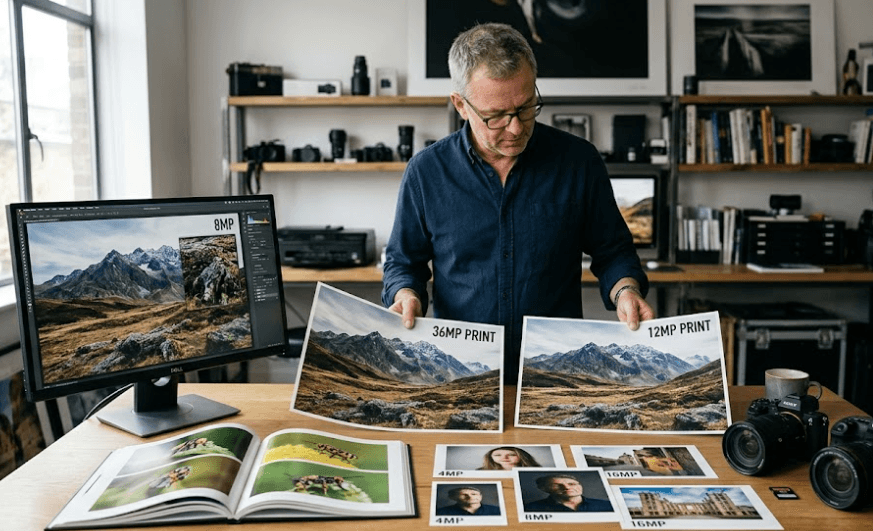
The real benefit of extra megapixels becomes obvious when you have a reason to use them. More resolution gives you additional room to crop into an image while retaining useful detail. It can also help photographers who make large prints or need to deliver high-resolution files to clients. DPReview notes that higher resolution can be particularly useful when cropping, while even relatively modest resolutions are sufficient for many common viewing and printing situations.
Megapixels Are About Resolution, Not Everything
Think of megapixels as the amount of information available in the image, rather than a direct score for picture quality. A high-resolution photograph can still look soft if the lens is not sharp, the subject moves during exposure, or the focus lands in the wrong place. More pixels cannot rescue a fundamentally poor capture.
That is why experienced photographers rarely choose a camera by megapixel count alone. Sensor performance, lens selection, autofocus, exposure, image processing, and shooting technique all influence the final result. The number printed on the camera box tells you something useful, but it does not tell you everything you need to know.
| Camera Resolution | Approximate Image Resolution | Typical Use |
|---|---|---|
| 12MP | Around 4,000 × 3,000 | Everyday photography and online sharing |
| 20MP | Around 5,472 × 3,648 | General photography |
| 24MP | Around 6,000 × 4,000 | Travel, portraits, events, enthusiast use |
| 30MP | Around 6,720 × 4,480 | Detailed photography and larger prints |
| 45MP | Around 8,256 × 5,504 | Heavy cropping, commercial work, large prints |
| 60MP+ | Varies by camera | Specialist, studio, landscape, and high-detail work |
Actual pixel dimensions vary by sensor aspect ratio and camera model.
How Many Megapixels Do You Need?
For most people buying a camera today a resolution of 20MP to 30MP feels very comfortable. I have found that a camera that has 24MP gives you resolution that is enough for everyday photographs and the file sizes stay manageable. That camera works for travel, portraits, family photography, events, landscapes and plenty of enthusiast level work.
There is also a reason not to chase resolution unnecessarily. Higher-resolution files take up storage space and can need more processing power when you import, back up edit and export photographs. If you shoot hundreds or thousands of images during a trip the difference between a moderate-resolution camera and a very high-resolution camera becomes noticeable in your storage workflow.
That does not mean higher resolution is unnecessary. It means you should have a reason for buying a higher-resolution camera. If you frequently crop aggressively photograph subjects produce large-format prints or work with images, for commercial clients moving into the 40MP or higher range can make sense. For everyone the advantages may be hard to notice in ordinary use.
A Simple Megapixel Guide
Your subject should influence the resolution you choose more than the marketing on the camera box. A landscape photographer who prints large wall art has different requirements from someone photographing friends on weekend trips. A wildlife photographer may also benefit from extra pixels because the subject often occupies only a small part of the frame.
Portrait photographers have more flexibility. If you are shooting people with a good lens and producing standard-sized prints or digital images, you do not necessarily need an extremely high-resolution sensor. In many cases, getting the focus, exposure, lens choice, and lighting right will make a bigger difference to the photograph.
| Photography Type | Sensible Resolution Range |
|---|---|
| Family and everyday photography | 16MP to 24MP |
| Travel photography | 20MP to 30MP |
| Portrait photography | 20MP to 30MP |
| Street photography | 20MP to 30MP |
| Landscape photography | 24MP to 45MP+ |
| Wildlife photography | 24MP to 45MP+ |
| Sports photography | 20MP to 30MP+ |
| Studio and commercial work | 30MP to 60MP+ |
| Large-format printing | 30MP to 60MP+ |
These are practical ranges rather than strict requirements. The appropriate resolution depends on the camera, lens, output size, cropping needs, and shooting conditions.
When More Megapixels Actually Help
The biggest reason to buy a high-megapixel camera is cropping flexibility. Imagine photographing a bird sitting far away in a tree. You frame the bird as well as you can, but it still occupies only a small portion of the photograph. If your camera records a high-resolution image, you have more pixels available when you crop the surrounding branches away.
The same principle applies to sports and wildlife photography. You may not always have the opportunity to fill the frame perfectly, especially when the subject is moving quickly or positioned far from you. Extra resolution gives you some breathing room during editing. It does not replace a long lens, but it can make the final crop more useful.
Large prints are another situation where additional resolution can become worthwhile. A photograph intended for a large wall print needs more image information than a photograph that will only be viewed on a phone or laptop. However, there is no single megapixel number that guarantees a good large print. Viewing distance, print quality, image sharpness, and the source photograph all matter.
Cropping Can Change the Equation
Cropping is one of the easiest ways to understand the practical value of megapixels. A 45MP file gives you considerably more room to crop than a 12MP file before the remaining image becomes very small. This can be valuable for wildlife, birds, sports, and landscapes where you may want to adjust the composition after the photograph has been taken.
There is a catch, though. Cropping cannot create detail that the camera and lens never captured. If an image is blurred by camera shake, missed focus, atmospheric distortion, or a poor lens, having more pixels does not magically restore the missing information. DPReview similarly points out that there is little benefit in capturing more pixels when the lens cannot resolve useful additional detail.
So, if you are considering a high-megapixel camera mainly for cropping, make sure the rest of your setup can take advantage of that resolution. A sharp lens, accurate autofocus, appropriate shutter speed, and good technique are just as important.
Why Sensor Size Matters More Than Megapixels
One of the biggest mistakes beginners make is comparing cameras solely by resolution. A camera's sensor size can have a major effect on image quality, particularly in low light and when you want shallow depth of field. Larger sensors can collect more total light for the same exposure conditions, which can help produce cleaner images and greater tonal flexibility.
This is why you should look at the complete camera system rather than treating megapixels as a standalone specification. A 24MP full-frame camera and a 24MP APS-C camera have the same nominal resolution, but they do not necessarily produce identical results in every situation. Sensor design, processing, lenses, and shooting conditions all contribute to the final image.
Larger sensors also come with trade-offs. Full-frame systems can require larger and more expensive lenses, while APS-C and other smaller formats can offer advantages in portability, cost, and reach. DPReview describes sensor format as a series of compromises involving size, price, depth of field, and image quality rather than a simple case of one format being universally correct.
Sensor Size and Resolution Should Be Considered Together
The relationship between sensor size and megapixels is worth understanding before spending more money. Increasing resolution without considering the rest of the imaging system can lead to diminishing returns. More pixels are useful when the sensor, lens, autofocus system, and shooting conditions can actually resolve and preserve that additional information.
Low-light photography is another reason not to obsess over megapixels. A camera used at high ISO in a dim environment has a very different challenge from one shooting a brightly lit landscape at base ISO. Larger sensors can provide an advantage in gathering total light, although the exact result depends on the camera and lens.
For a buyer, the practical lesson is simple: when comparing two cameras, do not stop after reading their megapixel counts. Look at the sensor format, lens ecosystem, autofocus, ISO performance, stabilization, and the type of photography you actually do.
| Factor | Why It Matters |
|---|---|
| Megapixels | Determines image resolution and cropping flexibility |
| Sensor size | Influences light gathering, noise, and depth-of-field potential |
| Lens quality | Affects sharpness, contrast, and detail captured |
| Autofocus | Determines how reliably the camera captures the intended subject |
| Image stabilization | Helps reduce camera shake in suitable shooting situations |
| Dynamic range | Helps retain information across bright and dark areas |
| ISO performance | Affects image quality when shooting in low light |
Do You Need 40MP, 45MP, or 60MP?
For photographers, cameras with extremely high resolution are not something they need every day. They are more of a specialist choice. A camera with a 40MP, 45MP or 60MP sensor can offer real benefits.. Those benefits only stand out when your work really requires them. Commercial photographers, landscape photographers, studio shooters and anyone who prints images may find the extra detail and ability to crop without losing quality very helpful.
For someone who takes photos just for fun a higher resolution might not be worth the trouble. Bigger files take up space. They take longer to move to look at to back up and to edit. If you mostly share your photos online—on media, messaging apps or websites—or print them at a normal size you may not see any difference at all. The extra resolution doesn’t improve your results.
There’s also a calming feeling in not needing the megapixel count. A made 24MP or 26MP camera can serve you well for years. The money you save by not buying the top-end model can go toward lenses, extra batteries, memory cards or other useful gear. These often make a difference, in your photography than just having more megapixels.
Choose Resolution Based on Output
The most useful question is not "How many megapixels does this camera have?" It is "What will I do with these photographs?" If the answer is social media, family albums, online galleries, and occasional prints, a moderate-resolution camera is likely enough.
If your answer involves large prints, heavy cropping, professional delivery, or detailed commercial work, then higher resolution becomes easier to justify. DPReview notes that even 24MP provides substantial resolution for many printing applications, while additional pixels become increasingly useful when you need to crop or preserve fine detail at larger output sizes.
That makes the buying decision much less complicated. Instead of paying for a number you may never use, match the camera's resolution to the way you actually photograph and share your work.
Common Megapixel Mistakes to Avoid
The first error is thinking that more megapixels always result in photos. That is not true. Resolution is one part of how good a picture looks. A photo can have millions of pixels. Still be badly lit, not in focus blurry, full of noise or made worse by a bad lens.
The second error is not paying attention to lenses. Cameras with lenses are systems and the lens plays a big role in how sharp the image is how the scene looks, how much is, in focus and the overall feel of the photo. If you have a budget spending all your money on the camera body and using a bad lens can lead to a camera that has great specs but doesn't feel good to use.
The third error is getting a resolution than you actually need. A high-megapixel camera can be really good. If you don't crop much don't print big and mostly share photos online the extra pixels might just take up more space. Sony says that bigger image sizes usually mean files, so storing and managing those files is part of deciding how much resolution you really need.
What to Check Before Buying
Before picking a camera take a look at the full specification sheet. Don’t just focus on the megapixel number. Consider the sensor format what lenses are available how well the autofocus works, whether there is image stabilization how long the battery lasts how comfortable the camera feels in your hands. How large the files will be. Also think about whether the camera matches the kind of photography you like to do.
Most important of all think about how you shoot. If you like to walk with your camera for hours a lighter system might be better than a heavier one, with higher resolution. If you often photograph birds from away paying attention to lens reach and the ability to crop images without losing quality could be more important.
Frequently Asked Questions
Q. How many megapixels are enough for everyday photography?
Around 20MP to 30MP is enough for most everyday photography, including travel, portraits, family photographs, events, and online sharing. A 24MP camera offers substantial resolution for general use without producing unnecessarily large files.
Q. Is a 24MP camera good enough in 2026?
Yes. A 24MP camera can still be an excellent choice in 2026. Resolution alone does not determine image quality, and 24MP provides plenty of detail for most photographers, particularly when paired with a good lens and capable sensor.
Q. Do more megapixels mean better image quality?
No. More megapixels provide higher resolution and greater cropping flexibility, but image quality also depends on sensor performance, lens quality, focus, exposure, lighting, and image processing.
Q. Is 45MP too much for a beginner camera?
Not necessarily, but most beginners do not need 45MP. It can be useful if you expect to crop heavily, make large prints, or develop an interest in high-detail photography. Otherwise, a lower-resolution camera may be easier and cheaper to manage.
Q. How many megapixels do I need for large prints?
There is no single megapixel requirement for every large print. Print size, viewing distance, image quality, sharpening, and the quality of the original photograph all matter. Higher resolution gives you more flexibility, but even moderate-resolution cameras can produce good prints at appropriate sizes.
Q. Are megapixels important for wildlife photography?
They can be particularly useful for wildlife photography because distant animals often occupy only a small part of the frame. Additional resolution gives you more room to crop while retaining detail. However, lens reach, autofocus, shutter speed, and technique remain extremely important.
Q. Does sensor size matter more than megapixels?
In many situations, sensor size can have a greater influence on image quality than simply increasing the megapixel count. Larger sensors can collect more total light and can provide advantages in low-light performance and depth of field, although the result depends on the complete camera system.
Q. Do higher-megapixel cameras use more storage?
Generally, yes. Higher-resolution photographs contain more image data and can result in larger files, particularly when shooting RAW. That means you may need more memory-card and backup storage as your resolution increases.
Q. Should I buy a high-megapixel camera for better cropping?
If you regularly crop photographs, higher resolution can be useful. Wildlife, sports, and landscape photographers can benefit from having more pixels available after cropping. However, cropping cannot compensate for missed focus, motion blur, atmospheric distortion, or a lens that cannot resolve sufficient detail.
Q. What is more important than megapixels when buying a camera?
The answer depends on your photography, but sensor size, lens quality, autofocus, low-light performance, stabilization, ergonomics, and the available lens system can all be more important than simply choosing the camera with the highest megapixel count.
Final Recommendation
If you are buying a camera. Wondering how many megapixels you actually need, do not make the megapixel number your first filter. For photographers, a camera with about 20 to 30 megapixels gives a very comfortable balance of detail, file size, cropping flexibility and everyday usability. That is resolution for travel, portraits, family photography, events, landscapes and most digital sharing.
Move toward forty forty‑five or higher megapixels when you have a reason for doing so. Frequent cropping, prints, commercial photography, studio work and high‑detail landscapes can all justify the extra resolution. In those cases make sure the rest of the system can take advantage of those megapixels. A high‑resolution sensor paired with a lens and accurate focus can be extremely useful while simply buying more megapixels without considering the lens or sensor does not guarantee better photographs.
For everyone put the budget where you will actually notice it. A good lens, sensor, reliable autofocus, comfortable camera body and the right focal length can do more for your photography than chasing the biggest megapixel number, on the shelf. Buy enough resolution for the photographs you want to make, not the number that looks most impressive on the box.
Ready to upgrade your tech?
Browse our collection of quality refurbished products at unbeatable prices.