

GaN Pixel Chargers Explained: BMX's New Compact Charging Lineup
BMX's GaNsta Pixel 100W and 140W chargers combine compact GaN technology, four charging ports, live power monitoring, and travel adapters in a single charger for laptops and multiple devices.

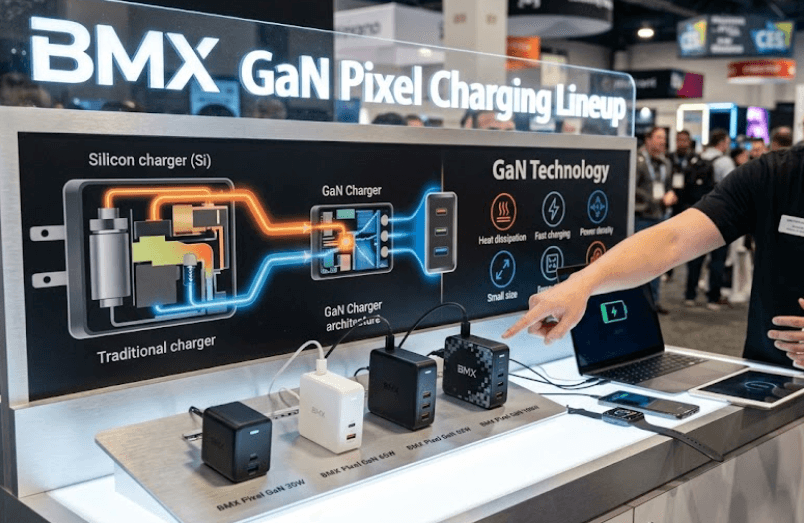
TL;DR BMX's new GaNsta Pixel lineup brings together high-output GaN charging, four-device support, and a built-in pixel display that shows charging information in real time. The lineup currently consists of the GaNsta Pixel 100W at $79.99 and the GaNsta Pixel 140W at $89.99 on BMX's official website. Both models use three USB-C ports and one USB-A port, while the 140W version adds USB Power Delivery 3.1 EPR support for higher-power laptops. The chargers also include international travel adapters, a braided USB-C cable, and a compact body designed to replace several individual charging bricks.
What Are BMX GaNsta Pixel Chargers?
BMX, short for Better Mobile Xperience, is a mobile technology brand that launched in December 2025 and focuses on charging and mobile power products. Its GaNsta Pixel range is an extension of the company's existing GaNsta charger family, but it adds a distinctive feature that most conventional wall chargers do not have: a pixel-style display that provides live information about charging activity. This makes the charger more than a simple power brick because users can see how much power is being delivered without opening an app or relying on a phone notification.
The new lineup consists of two models, the GaNsta Pixel 100W and GaNsta Pixel 140W. The 100W model is positioned for devices such as MacBook Air and MacBook Pro 14-inch-class laptops, while the 140W model is aimed at higher-power laptops, including MacBook Pro 16-inch-class systems. Both versions have three USB-C ports and one USB-A port, allowing a single charger to replace several individual adapters when you are carrying a laptop, phone, tablet, headphones, or other accessories.
The important point is that Pixel is not referring to Google's Pixel smartphone range here. It describes the visual display built into BMX's charger. The display shows charging status and power information directly on the charger, giving users a quick way to understand what is happening across connected devices. That can be particularly useful when multiple products are charging simultaneously, because the charger can automatically divide available power between its ports rather than leaving you guessing whether your laptop is receiving enough power.
BMX GaNsta Pixel 100W vs 140W
The main difference between the two models is their maximum output and USB Power Delivery standard. The GaNsta Pixel 100W supports USB PD 3.0 and can provide up to 100W through its first two USB-C ports when used individually. The third USB-C port supports up to 65W, while the USB-A port can provide up to 22.5W. The 140W model moves to USB PD 3.1 EPR and can deliver up to 140W through its first two USB-C ports individually.
That difference matters mainly if you have a laptop that can actually use higher USB-C charging power. For someone carrying a MacBook Air, a typical Windows laptop, smartphone, tablet, and accessories, the 100W model may already provide enough headroom. The 140W model makes more sense for people using higher-powered laptops or anyone who wants additional charging capacity while keeping multiple devices connected. Buying the 140W model simply because the number is higher does not automatically make charging faster if the connected device cannot accept that level of power.
| Feature | GaNsta Pixel 100W | GaNsta Pixel 140W |
|---|---|---|
| Maximum output | 100W | 140W |
| USB standard | USB PD 3.0 | USB PD 3.1 EPR |
| Ports | 3 USB-C + 1 USB-A | 3 USB-C + 1 USB-A |
| USB-C 1 and 2 | Up to 100W each | Up to 140W each |
| USB-C 3 | Up to 65W | Up to 65W |
| USB-A | Up to 22.5W | Up to 22.5W |
| Listed price | $79.99 | $89.99 |
| Travel adapters | US, EU, UK, AU | US, EU, UK, AU |
The price difference between the models is relatively small on BMX's current product pages. The Pixel 100W is listed at $79.99, while the Pixel 140W is listed at $89.99. That makes the 140W model worth considering if you own a high-power laptop or expect your charging needs to increase, but the 100W model remains the more sensible choice if your devices do not require 140W.
Compact Design And Pixel Display
The biggest physical advantage of the GaNsta Pixel lineup is the combination of high output and a relatively compact chassis. BMX lists both Pixel models at approximately 62 x 65 x 34 mm, although third-party launch coverage has reported 35.9 mm for the depth depending on how the dimensions are measured. BMX says the 100W version is 37% smaller than the charger it compares against, while the 140W version is claimed to be 43% smaller than the supplied MacBook Pro charger used for its comparison. These are manufacturer comparisons, so they should be treated as product-specific claims rather than a universal measurement against every laptop charger.
GaN, or gallium nitride, is what makes this type of compact high-output charger practical. Compared with traditional silicon-based charger designs, GaN allows manufacturers to build smaller power electronics while maintaining high power output and managing heat efficiently. It is important not to confuse GaN with a charging protocol, though. GaN describes the semiconductor technology inside the charger, while standards such as USB Power Delivery determine how compatible devices negotiate charging power. A GaN charger therefore does not automatically make every phone or laptop charge faster.
The pixel display is the feature that separates these chargers from many competing GaN products. BMX says the display can show total power and per-port charging information, allowing users to see what the charger is doing directly on the device. The display does not require an app, Bluetooth connection, or account. For people who regularly charge several devices from one outlet, that visibility can be genuinely useful because it provides immediate feedback instead of leaving the charging process hidden inside the brick.
Four Ports And Power Sharing
Both Pixel chargers have three USB-C ports and one USB-A port, giving them a useful mix for modern devices and older accessories. USB-C handles the high-power connections, while USB-A provides compatibility with accessories that have not moved to USB-C yet. This makes the lineup particularly suitable for people who travel with several devices because one wall socket can handle a laptop, phone, tablet, and smaller accessory without requiring four separate chargers.
However, the maximum output figures should not be interpreted as meaning every port can deliver its maximum simultaneously. Multi-port chargers distribute their available power depending on how many devices are connected and what those devices request. BMX lists an example all-port split of 45W + 30W + 7.5W + 7.5W for the 100W model and 65W + 45W + 7.5W + 7.5W for the 140W model. That distinction is important because a 140W charger does not mean four connected devices will each receive 140W.
| Power Scenario | Pixel 100W | Pixel 140W |
| Maximum total output | 100W | 140W |
| USB-C 1 maximum | 100W | 140W |
| USB-C 2 maximum | 100W | 140W |
| USB-C 3 maximum | 65W | 65W |
| USB-A maximum | 22.5W | 22.5W |
| Example four-port split | 45W + 30W + 7.5W + 7.5W | 65W + 45W + 7.5W + 7.5W |
This power-sharing approach is actually more important for everyday use than the headline wattage. Imagine charging a laptop while your phone and earbuds are connected. The charger needs to divide its available output intelligently rather than simply sending maximum power everywhere. BMX says users can also interact with the charger to turn ports on or off and see how the available power is divided. That makes the Pixel display a functional feature rather than purely a design element.
Travel Features And Safety
BMX has designed the Pixel chargers with travel in mind. Both models include a foldable US plug and interchangeable EU, UK, and AU adapters, along with a 1-meter braided USB-C cable and travel pouch. That means users do not necessarily need to pack a separate wall adapter for every destination. The 100W and 140W versions also support a 100-240V input range, making them suitable for international electrical systems when used with the appropriate included plug adapter.
The travel advantage becomes more obvious when you consider the number of devices people carry today. A laptop charger, phone charger, tablet adapter, and accessory charger can quickly fill a small bag. A four-port GaN charger can consolidate those into one power brick, provided the connected devices support compatible charging standards. For frequent travellers, students, remote workers, and professionals moving between home and office, that consolidation can be more useful than simply having the smallest possible charger.
BMX also lists several protection features for the Pixel models, including temperature monitoring, overvoltage protection, overcurrent protection, overpower protection, and electrostatic protection. The company describes the housing as fire-resistant and highlights AI-based temperature monitoring as part of its safety system. These are manufacturer specifications rather than independent laboratory test results, so they should be understood as claimed product features rather than proof that the charger is safer than every competing model.
Price And Availability
BMX currently lists the GaNsta Pixel 100W at $79.99 and the Pixel 140W at $89.99 on its official website. Both models are listed with a 24-month limited warranty, 30-day returns, and free shipping according to their product pages. The relatively small $10 difference between the two models makes the 140W version interesting for high-power laptop users, while the 100W version remains the better fit when the connected hardware does not need additional capacity.
For Indian buyers, the availability question deserves attention. The official BMX product pages currently show US-dollar pricing and US, EU, UK, and AU plug adapters, but the sources checked for this article do not establish an official India-specific launch price or an Amazon India listing for the GaNsta Pixel models. That means Indian shoppers should check shipping costs, import duties, taxes, warranty coverage, and return arrangements before treating the US list price as the final Indian cost. This is particularly important for imported accessories, where the landed price can be significantly different from the headline dollar price.
The broader GaNsta family also includes non-Pixel LCD chargers in 70W, 100W, 140W, and other configurations, so the Pixel models should not be confused with the entire BMX GaNsta lineup. The Pixel range specifically combines the compact charger design with the pixel-style power display and is currently offered in 100W and 140W configurations. BMX's wider GaNsta range therefore gives buyers more choices, but the Pixel models are the ones aimed at people who want live charging information built into the charger itself.
Who Should Buy The BMX Pixel Chargers?
The GaNsta Pixel 100W is the more practical choice for someone who wants one compact charger for a laptop, phone, tablet, and accessories without moving into the highest power category. It is particularly appealing if your laptop supports USB-C charging up to around 100W and you value having four ports in one unit. The built-in display also gives it an advantage for users who like seeing charging information at a glance. For everyday travel and desk use, the 100W model covers a wide range of common devices without paying extra for power you may never use.
The Pixel 140W is aimed more clearly at power users. Its USB PD 3.1 EPR support and 140W maximum output give it more headroom for compatible high-power laptops, while the three USB-C and one USB-A configuration keeps it useful for multiple devices. It is also only $10 more than the 100W model on BMX's current website, so the upgrade can make sense if you own a laptop that benefits from higher-power USB-C charging.
The main reason not to buy either model is if you only need a basic phone charger. In that situation, paying for 100W or 140W output, four ports, and a live display may be unnecessary. There are already much smaller and cheaper GaN chargers available in lower power classes, including 20W, 25W, and 35W models from several brands in the Indian market. The Pixel line-up makes the most sense when you genuinely need multi-device charging and want to replace several adapters with one compact charger.
Frequently Asked Questions
Q. What is the BMX GaNsta Pixel charger?
The BMX GaNsta Pixel is a compact GaN wall charger with three USB-C ports, one USB-A port, and a built-in pixel display that shows charging information. The lineup currently includes 100W and 140W versions.
Q. What is the difference between the BMX Pixel 100W and 140W chargers?
The main difference is maximum output and USB Power Delivery support. The 100W version uses USB PD 3.0, while the 140W model uses USB PD 3.1 EPR and can deliver up to 140W through its first two USB-C ports individually.
Q. How many devices can BMX GaNsta Pixel chargers charge?
Both Pixel models have four physical charging ports, consisting of three USB-C ports and one USB-A port. They can therefore charge up to four connected devices, although available power is divided between ports when multiple devices are connected.
Q. Does the BMX Pixel charger work with laptops?
Yes. BMX positions the 100W model for MacBook Air and MacBook Pro 14-inch-class laptops and the 140W model for MacBook Pro 16-inch-class laptops. Actual charging speed depends on the laptop's USB-C charging requirements and supported power level.
Q. What does the pixel display show?
The built-in display shows charging status and power information, including per-port details and total power usage. It provides this information directly on the charger without requiring an app or Bluetooth connection.
Q. Is GaNsta Pixel a Google Pixel charger?
No. GaNsta Pixel is a charger product name from BMX, or Better Mobile Xperience. The word Pixel refers to the charger's pixel-style display and is not a Google Pixel accessory designation.
Q. What travel adapters come with the BMX Pixel chargers?
The Pixel 100W and 140W models include a foldable US plug along with EU, UK, and AU travel adapters. BMX also includes a 1-meter braided USB-C cable and a travel pouch.
Q. Is the BMX GaNsta Pixel 140W charger worth buying over the 100W model?
The 140W model makes more sense if you have a high-power laptop that supports USB PD 3.1 EPR or want additional charging headroom. For laptops that do not need more than 100W, the Pixel 100W can be the more sensible choice.
Q. Are BMX GaNsta Pixel chargers available in India?
The official product pages checked currently show US-dollar pricing and international plug adapters, but the available sources do not establish an official India-specific price or local Amazon India listing for the Pixel models. Indian buyers should therefore verify shipping, taxes, duties, and warranty terms before ordering.
Q. How much do the BMX GaNsta Pixel chargers cost?
The GaNsta Pixel 100W is currently listed at $79.99, while the GaNsta Pixel 140W is listed at $89.99 on BMX's official website. Prices and availability can change, so buyers should check the current product page before purchasing.
Final Recommendation
The BMX GaNsta Pixel lineup is interesting because it solves more than one charging problem at the same time. The 100W and 140W models combine GaN efficiency, four-device charging, travel adapters, and live power information in a compact form. The Pixel display is not essential for charging, but it is a useful differentiator for people who regularly connect multiple devices and want to know where the available power is going. The 140W model is the stronger choice for high-power laptop users, while the 100W version is enough for most laptop, phone, and tablet combinations.
For Indian buyers, however, the decision should be based on the final landed price and warranty support rather than the $79.99 or $89.99 headline prices alone. If importing the charger makes it substantially more expensive than established locally available 100W or 140W GaN alternatives, the Pixel display may not justify the premium. If the final price is reasonable and you value compact multi-device charging, the BMX GaNsta Pixel 100W is the better everyday pick, while the 140W model is the one to choose for higher-powered laptops and extra charging headroom.
Overall, the BMX GaNsta Pixel line-up is best viewed as a premium travel and multi-device charging solution rather than simply another fast charger. Its strongest combination is the compact GaN design, four ports, international adapters, and real-time charging display. For someone carrying a laptop and several mobile devices every day, that combination can genuinely reduce the number of chargers in a bag while keeping charging information visible at a glance.
Ready to upgrade your tech?
Browse our collection of quality refurbished products at unbeatable prices.






