Focal Length Explained: What 18mm, 35mm, 50mm, 85mm and 200mm Look Like
Learn how 18mm, 35mm, 50mm, 85mm, and 200mm change your field of view, framing, perspective, and subject isolation, plus how sensor size affects focal length.

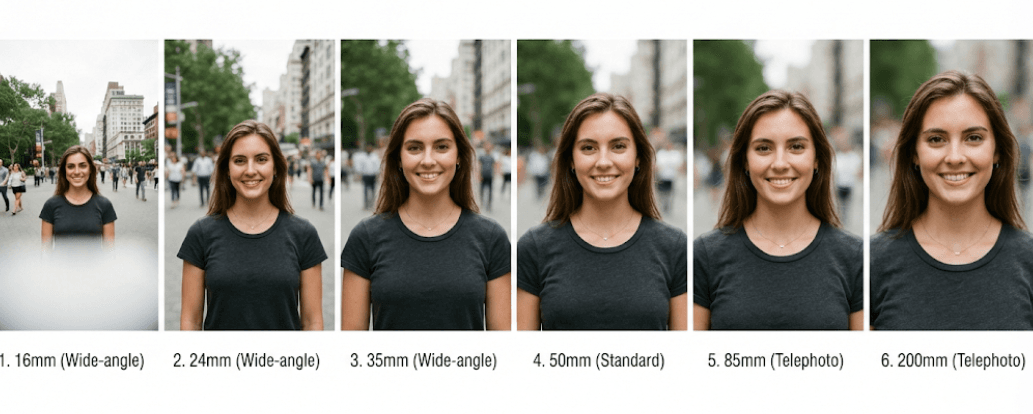
TL;DR: Focal length determines how much of a scene a lens can capture and how large subjects appear in the frame. On a full-frame camera, 18mm gives you a very wide view, 35mm provides a wider everyday perspective, 50mm offers a natural-looking standard view, 85mm is a popular choice for portraits, and 200mm brings distant subjects much closer. However, the same focal length looks different on different sensor sizes. Understanding these differences makes it easier to choose the right lens for landscapes, portraits, street photography, wildlife, sports, and everyday shooting.
What Is Focal Length?
Focal length is the number, measured in millimeters, that you see printed on a camera lens, such as 18mm, 35mm, or 85mm. Technically, it describes an optical distance associated with how the lens forms an image, rather than simply telling you how physically long the lens is. A 200mm lens, for example, does not necessarily have to be physically 200mm long because lens construction can use different optical designs.
For photographers, the more useful way to understand focal length is through field of view and magnification. Shorter focal lengths capture more of the scene, while longer focal lengths capture a narrower portion of it and make distant subjects appear larger in the frame. That is why an 18mm lens can show an entire room while a 200mm lens can isolate a distant bird or athlete.
Focal length also affects how you compose a photograph because it changes how much you need to move to frame your subject. With a wide lens, you may need to get relatively close to fill the frame. With a telephoto lens, you can stand much farther away and still create a tight composition. This difference is what makes each focal length feel so different in practical photography.
18mm: Ultra-Wide And Immersive
An 18mm lens on a full-frame camera gives you a very wide view of the scene. It can capture a large amount of the surroundings, making it useful for landscapes, interiors, architecture, travel photography, and situations where you physically cannot move far enough away from your subject. The diagonal angle of view is roughly 100 degrees on full frame, although the exact field of view depends on the sensor and lens design.
At 18mm, objects close to the camera can look noticeably larger compared with objects farther away. Stand close to a person and their face can appear exaggerated, while the background seems to stretch away behind them. This can be useful for creative environmental portraits, but it is usually not the most flattering focal length for a traditional headshot.
The biggest advantage of 18mm is how much context it gives you. Imagine photographing a mountain from a viewpoint: an 18mm lens can include the foreground, the mountain, and a large portion of the sky in one frame. The trade-off is that you need to pay attention to the edges of the frame, because unwanted objects can easily enter a very wide composition.
35mm: Wide Without Feeling Too Extreme
A 35mm lens sits between an ultra-wide and a standard lens on full frame. Its diagonal angle of view is around 63 degrees, giving you noticeably more of the scene than a 50mm while avoiding some of the exaggerated wide-angle appearance associated with very short focal lengths. This makes 35mm a popular choice for street, travel, documentary, lifestyle, and environmental photography.
One reason 35mm feels versatile is that you can photograph a person while still showing the surroundings. For example, instead of filling the frame entirely with a subject, you can include the café, street, office, or landscape around them. This helps tell a story rather than simply recording the person themselves.
A 35mm lens is also practical indoors because you can often fit more into the frame without having to move very far backward. It is not as wide as 18mm, so it generally requires less care around the edges of the frame. If you want one focal length that works well for everyday photography while still giving your images a sense of environment, 35mm is a strong option.
50mm: The Classic Standard View
On a full-frame camera, 50mm is generally considered a standard focal length. Its diagonal angle of view is roughly 47 degrees, and its perspective can feel relatively natural for many everyday scenes. This is one reason 50mm lenses have remained popular for decades, particularly as compact prime lenses with wide apertures.
A 50mm lens works well for portraits, food, products, street photography, travel, and general everyday images. If you photograph a person from a comfortable distance, you can get a natural-looking composition without including as much surrounding environment as you would with 35mm. At the same time, you are not as tightly restricted as you would be with an 85mm or 200mm lens.
The main limitation is working space. In a small room, 50mm can sometimes feel too tight when you want to include several people or a large portion of the surroundings. Outdoors, however, it becomes much easier to use. A 50mm prime with a wide maximum aperture can also be useful in low light and for creating a shallow depth-of-field effect, although aperture and focusing distance also influence background blur.
85mm: The Portrait Favorite
An 85mm lens is widely associated with portrait photography because it provides a relatively narrow field of view without requiring the photographer to stand extremely far from the subject. On full frame, its diagonal angle of view is approximately 29 degrees. This makes it easier to fill the frame with a face or upper body while leaving distracting surroundings outside the composition.
The longer focal length can also make it easier to create flattering portraits because photographers can maintain a comfortable shooting distance rather than moving extremely close to the person's face. This matters because perspective changes with camera position. If you photograph a face from very close range, nearby features such as the nose can appear more prominent relative to the ears and sides of the face.
An 85mm lens is not limited to portraits, either. It can work well for events, details, fashion, product photography, and candid shots where you want to isolate a subject. Pairing an 85mm lens with a wide aperture, such as f/1.8, can produce a shallow depth of field and strong background separation. The amount of blur, however, depends on the aperture, subject distance, background distance, and sensor format.
200mm: Reach For Distant Subjects
At 200mm, the field of view becomes much narrower than the other focal lengths in this comparison. On a full-frame camera, the diagonal angle of view is approximately 12 degrees. Instead of showing a large portion of the environment, the lens isolates a relatively small section of the scene and makes distant subjects appear much larger in the frame.
This makes 200mm useful for wildlife, sports, outdoor events, distant details, and some forms of landscape photography. Imagine photographing a football player from the sidelines: an 18mm lens would include a huge amount of the field, while a 200mm lens can isolate the player from a much greater distance. The same principle helps when photographing birds or animals that you cannot safely approach.
The trade-off is that small movements become much more noticeable at long focal lengths. Holding a 200mm lens steady can be more demanding, particularly in low light. A faster shutter speed, image stabilization where available, or a tripod or monopod can help. Long lenses can also make backgrounds appear visually closer to the subject, but this is closely tied to shooting distance and framing rather than being a special “compression effect” created by focal length alone.
18mm Vs. 35mm Vs. 50mm Vs. 85mm Vs. 200mm
The easiest way to understand these focal lengths is to imagine photographing the same subject from a suitable distance. At 18mm, you see a lot of the environment. At 35mm, the subject remains connected to the surroundings but becomes more prominent. At 50mm, the frame feels more focused on the subject while retaining some context.
At 85mm, the background takes up less of the frame and the subject can be isolated more easily. At 200mm, the field of view becomes narrow enough to pick out distant details that would occupy only a small part of an image taken at a wider focal length. These differences are primarily about how much of the scene fits into the frame and how large distant subjects appear.
The following table uses full-frame/35mm format as the reference. The angle-of-view figures are approximate diagonal values, because manufacturers and references can specify horizontal, vertical, or diagonal field of view.
| Focal Length | Approx. Diagonal View | Common Uses | What It Feels Like |
|---|---|---|---|
| 18mm | 100° | Interiors, landscapes, architecture | Very wide and immersive |
| 35mm | 63° | Street, travel, documentary | Wide but versatile |
| 50mm | 47° | Everyday, portraits, food | Natural and balanced |
| 85mm | 29° | Portraits, events, details | Tight and subject-focused |
| 200mm | 12° | Wildlife, sports, distant subjects | Narrow and highly magnified |
How Sensor Size Changes Focal Length
The focal length printed on the lens does not physically change when you move that lens from one camera format to another. What changes is the field of view. A smaller sensor captures a smaller central portion of the image projected by the lens, which makes the framing appear tighter compared with the same focal length on a full-frame camera.
For example, Sony uses a 1.5x crop factor for its APS-C cameras. That means a 35mm lens on an APS-C body gives approximately the same field of view as a 52.5mm lens on a full-frame camera. Similarly, a 50mm lens gives a field of view comparable to roughly 75mm on full frame. This is why photographers often discuss “35mm equivalent” focal length when comparing different camera formats.
For the focal lengths in this guide, the approximate APS-C equivalents using a 1.5x crop factor are 27mm for 18mm, 52.5mm for 35mm, 75mm for 50mm, 127.5mm for 85mm, and 300mm for 200mm. These numbers describe equivalent field of view, not a physical change in the lens's focal length. Other sensor formats use different crop factors.
| Actual Focal Length | Approx. APS-C Equivalent* |
|---|---|
| 18mm | 27mm |
| 35mm | 52.5mm |
| 50mm | 75mm |
| 85mm | 127.5mm |
| 200mm | 300mm |
*Based on an approximate 1.5x APS-C crop factor.
Does Focal Length Change Perspective?
This is one of the most important points to understand. Focal length itself does not independently create perspective distortion or compression. Perspective is primarily determined by the camera's position relative to the subject. If you photograph the same subject from the same position, changing the focal length changes how much of the scene is included, but the spatial relationships from that camera position remain the same.
The confusion happens because photographers usually change their position when changing lenses to keep the subject the same size in the frame. For example, you may move much closer when using an 18mm lens and much farther away when using a 200mm lens. Those changes in camera distance alter the apparent relationship between the foreground and background, which creates the familiar wide-angle and telephoto “looks.”
This is why an 85mm portrait can appear more compressed than an 18mm portrait in everyday shooting. The photographer generally stands farther away with the 85mm lens to maintain similar framing. The resulting change in camera position affects perspective, while the narrower field of view and magnification of the longer lens help isolate the subject. Understanding this distinction makes lens choice much easier.
Which Focal Length Should You Choose?
Choose 18mm when your priority is capturing as much of the environment as possible. It is particularly useful for interiors, landscapes, architecture, travel scenes, and creative compositions where you want strong foreground-to-background scale. Just watch the edges of the frame and avoid getting too close to faces unless the distortion is intentional.
Choose 35mm or 50mm when you want an everyday lens. A 35mm gives you more environmental context and works especially well for street and documentary-style photography. A 50mm offers a tighter, more focused composition and is a flexible choice for portraits, food, products, travel, and general photography.
Choose 85mm when portraits and subject isolation are priorities, and move toward 200mm when you need significant reach. For wildlife and sports, 200mm can be useful, although even longer focal lengths may be preferable when subjects are very far away. Ultimately, there is no universally “best” focal length. The right choice depends on how close you can get, how much of the environment you want, and the visual story you want the photograph to tell.
Final Recommendation
If you are learning photography, do not try to memorize focal lengths as rigid categories. Instead, learn to recognize what each focal length does to your frame. 18mm gives context, 35mm balances environment and subject, 50mm keeps things natural and versatile, 85mm emphasizes the subject, and 200mm brings distant subjects into reach.
For someone buying their first interchangeable lens, 35mm or 50mm can be excellent starting points on a full-frame camera because they encourage you to learn composition without being extremely wide or extremely telephoto. Portrait photographers may prefer 85mm, while travellers and landscape photographers may get more use from a wider lens.
Most importantly, remember that focal length is only one part of the final image. Aperture, shutter speed, sensor size, camera distance, subject distance, lighting, and composition all matter. Once you understand how these elements work together, choosing between 18mm, 35mm, 50mm, 85mm, and 200mm becomes much less about memorizing numbers and much more about choosing the perspective and framing you actually need.
Frequently Asked Questions
Q. What does focal length mean in photography?
Focal length is an optical measurement expressed in millimeters that helps determine a lens's field of view and magnification. Shorter focal lengths show more of a scene, while longer focal lengths show a narrower view.
Q. Is 50mm really the same as human vision?
Not exactly. A 50mm lens on full frame is commonly described as a standard lens because its field of view is relatively natural-looking, but human vision and a camera lens do not work in exactly the same way.
Q. Is 35mm or 50mm better for everyday photography?
Both can work well. A 35mm lens captures more surroundings and is useful for travel and street photography, while 50mm provides a tighter, more subject-focused view.
Q. Why is 85mm popular for portraits?
An 85mm lens allows photographers to frame a face or upper body from a comfortable distance while providing a relatively narrow field of view. Wide-aperture 85mm lenses can also produce strong background separation.
Q. Is 200mm good for wildlife photography?
Yes. A 200mm lens can provide useful reach for wildlife, particularly when subjects are relatively close or the photographer can approach safely. Smaller or more distant animals may require longer focal lengths.
Q. Does a higher focal length mean more zoom?
In practical terms, a longer focal length provides greater magnification compared with a shorter focal length when used on the same camera format. However, “zoom” technically describes a lens with a variable focal length.
Q. Does focal length change perspective?
Not by itself. Perspective is primarily determined by camera position. In real-world photography, longer lenses often result in greater shooting distances, which is why they can produce a more compressed-looking perspective.
Q. Does focal length affect background blur?
It can influence the appearance and amount of background blur, but it is not the only factor. Aperture, subject distance, background distance, sensor format, and framing also affect depth of field and blur.
Q. What happens when I use a 50mm lens on an APS-C camera?
The lens remains physically 50mm, but the smaller sensor gives a narrower field of view. With a 1.5x crop factor, its field of view is approximately equivalent to 75mm on full frame.
Q. Which focal length is best for beginners?
There is no single answer. A 35mm or 50mm prime is a good learning tool for many full-frame photographers, while a versatile zoom can be more practical if you photograph a variety of subjects.
Ready to upgrade your tech?
Browse our collection of quality refurbished products at unbeatable prices.