DJI Mic Mini 2S Review: 32-bit Float Recording for Creators
The DJI Mic Mini 2S adds internal 32-bit float recording, AI noise cancellation, adaptive gain, and 14.5GB storage to a compact wireless mic system built for modern creators.

TL;DR The DJI Mic Mini 2S is a compact wireless microphone system designed for creators who want better audio protection without moving to a bulky professional setup. Its biggest upgrade is internal 32-bit float recording, which gives creators much more flexibility when recovering unexpectedly loud audio during editing. Each transmitter has approximately 14.5GB of storage and can record for up to 28 hours in 24-bit mode or about 22 hours in 32-bit float mode. The system also adds two-level AI noise cancellation, adaptive gain control, three voice-tone presets, support for up to four transmitters with one receiver, and direct connection to compatible DJI Osmo devices through OsmoAudio. The transmitter weighs about 12g, while battery life is rated at around 11 hours for each transmitter and 10 hours for the receiver.
What Is The DJI Mic Mini 2S?
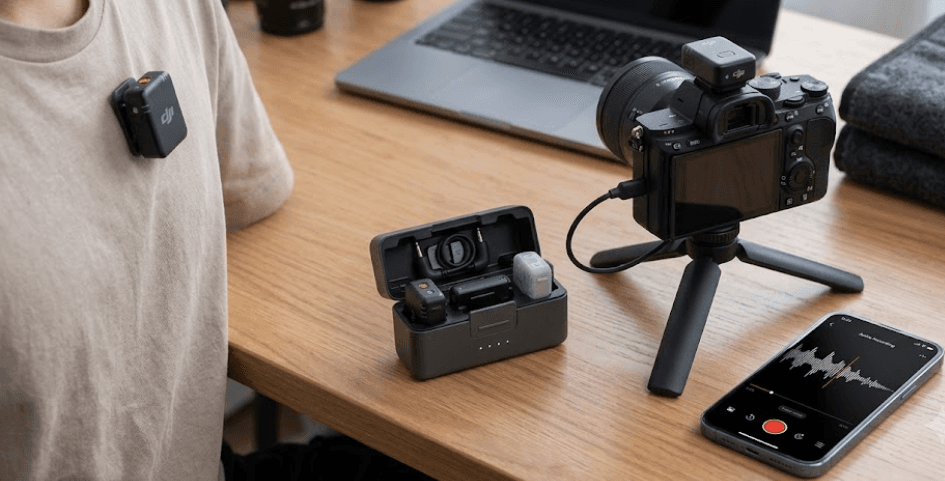
The DJI Mic Mini 2S is the latest compact wireless microphone system in DJI's creator-focused lineup, positioned between the more affordable Mic Mini 2 and the more feature-rich DJI Mic 3. It is built around small transmitters that can be clipped to clothing or attached magnetically, making the system suitable for vlogging, interviews, educational videos, podcasts, travel content, and social media production. The transmitter weighs approximately 12g without the magnetic clip and magnet, so it is light enough to wear without becoming a noticeable part of the setup. DJI also supports multiple configurations, including single-transmitter and two-transmitter kits, allowing buyers to choose a setup based on whether they normally record alone or with another speaker.
The biggest reason the Mic Mini 2S is different from the standard Mic Mini 2 is internal recording. The transmitter can save audio directly instead of relying entirely on the wireless connection between transmitter and receiver. That creates an important backup when shooting in environments where wireless interference or an unexpected connection issue could otherwise ruin a take. DJI gives each transmitter approximately 14.5GB of internal storage. The company rates that storage for up to 28 hours of recording in the default 24-bit mode, while 32-bit float recording reduces the maximum recording time to around 22 hours.
The Mic Mini 2S is also designed to work across different creator setups. A receiver can connect with up to four transmitters, and DJI says the system supports cross-generation connectivity with Mic Mini and Mic Mini 2 transmitters. The transmitter can also connect directly to compatible DJI Osmo products through OsmoAudio, reducing the need for a separate receiver in supported workflows. For creators who move between a smartphone, camera, and DJI action or pocket camera, that flexibility makes the Mic Mini 2S more useful than a microphone designed around only one recording device.
DJI Mic Mini 2S Specifications At A Glance
| Feature | DJI Mic Mini 2S |
|---|---|
| Transmitter weight | Approx. 12g |
| Internal storage | Approx. 14.5GB per transmitter |
| Internal recording | 24-bit and 32-bit float |
| Maximum recording | Up to 28 hours at 24-bit, about 22 hours at 32-bit float |
| Transmitters per receiver | Up to 4 |
| Transmitter battery | Up to 11 hours |
| Receiver battery | Up to 10 hours |
| Noise cancellation | Two-level AI noise cancellation |
| Adaptive gain | Clipping Control and Loudness Balance |
| Voice presets | Regular, Bright, Rich |
How 32-bit Float Recording Helps Creators?
32-bit float recording is the feature that gives the DJI Mic Mini 2S its strongest professional advantage. In simple terms, it provides significantly more room for recovering recordings when the input level changes unexpectedly. That is particularly useful when you cannot predict how loud a speaker will become. An interview subject may suddenly laugh, a presenter may move closer to the microphone, or an outdoor recording may become louder than expected. With internal 32-bit float recording, the creator has more flexibility to adjust levels during post-production instead of depending entirely on a perfectly controlled recording level at the moment of capture. DJI specifically describes the feature as expanding dynamic range and helping recover clipped audio.
It is important, however, not to treat 32-bit float as a magic setting that automatically makes every recording sound better. The benefit is mainly about recording flexibility and dynamic range rather than turning an average microphone into a studio microphone. The physical microphone still determines how the original sound is captured, and the environment still matters. DJI itself notes that the effective range depends on the microphone's physical characteristics. For a creator, the practical advantage is that 32-bit float can provide more room when recording unpredictable sound levels, which can be particularly valuable for interviews, events, outdoor videos, and documentary-style shooting.
The feature also becomes more useful because the recording happens internally on the transmitter. That means the creator has a locally stored audio file that can act as a safety net if something goes wrong with the wireless feed. This is one of the most meaningful differences between the Mic Mini 2S and simpler wireless microphone systems. DJI says internal recording is disabled by default and can be enabled through the DJI Mimo app. The transmitter supports both 24-bit and 32-bit float internal recording, giving users the choice between longer recording capacity and the greater flexibility of 32-bit float.
24-bit vs 32-bit Float Recording
| Recording Mode | Approx. Recording Time | Main Advantage |
|---|---|---|
| 24-bit | Up to 28 hours | Longer internal recording |
| 32-bit float | About 22 hours | Greater flexibility for unpredictable levels |
Audio Quality And Noise Cancellation
The DJI Mic Mini 2S goes beyond internal recording by adding two-level AI noise cancellation. DJI provides different noise-cancellation levels for dealing with background sound, giving creators more control depending on where they are recording. This can be useful when shooting in locations where background noise is difficult to eliminate completely, such as busy streets, cafes, offices, or outdoor public spaces. The purpose is not to replace good microphone placement, but to make the recorded voice easier to work with when the environment is less controlled. Independent testing from TechRadar found that the AI-assisted noise cancellation produced a noticeable improvement over the previous Mic Mini 2 in situations involving background noise.
The system also includes adaptive gain control with two modes. Clipping Control is intended to reduce the risk of distortion from sudden loud sounds, while Loudness Balance adjusts levels to maintain more consistent loudness when the input changes. These features can be useful for creators who record in situations where manually monitoring gain is difficult. DJI specifically recommends using 32-bit float internal recording or adaptive gain control when the creator wants additional protection against clipping. That combination makes the Mic Mini 2S particularly suitable for run-and-gun recording, where there may not be enough time to stop and adjust levels before every take.
Voice customization is another small but useful addition. The Mic Mini 2S offers three voice-tone presets: Regular, Bright, and Rich. These give creators a quick way to alter the character of recorded speech without immediately relying on a full audio-processing workflow. The microphone can also deliver higher-quality audio when connected to a camera through the receiver, with independent testing confirming support up to 96kHz/24-bit in that configuration. Over direct OsmoAudio connections, the supported capture format is up to 48kHz/24-bit. These distinctions matter because creators should not assume every connection method provides identical recording specifications.
Audio Features Compared
| Feature | DJI Mic Mini 2S |
|---|---|
| Internal recording | Yes |
| 32-bit float | Yes |
| AI noise cancellation | Two levels |
| Adaptive gain | Clipping Control and Loudness Balance |
| Voice tone presets | Three |
| Receiver-free internal backup | Yes |
| OsmoAudio direct connection | Supported on compatible devices |
Design, Connectivity, And Battery Life
The Mic Mini 2S follows the compact design philosophy of DJI's Mini microphone range rather than trying to replicate the larger receiver-and-transmitter systems used in professional productions. The approximately 12g transmitter is small enough for discreet use, while the magnetic mounting system makes positioning relatively straightforward. DJI also includes magnetic front covers in different colours, giving creators a little more flexibility when matching the microphone to their clothing or visual setup. The charging case keeps the transmitters and receiver together, which is useful for creators who regularly move between locations and do not want separate microphone components scattered through a camera bag.
Connectivity is one of the system's strongest practical features. A single receiver can work with up to four transmitters, which expands the system beyond simple two-person interviews. DJI also supports cross-generation connectivity, allowing compatible Mic Mini and Mic Mini 2 transmitters to work with the Mic Mini 2S receiver. For compatible DJI Osmo products, the transmitter can connect directly using OsmoAudio. This means the system can scale from a solo creator recording a vlog to a more involved setup for a small panel, interview, or multi-person discussion without immediately requiring a completely different microphone system.
Battery life is also practical for a full shooting day. DJI rates each transmitter for up to 11 hours and the receiver for up to 10 hours. With the charging case included in the two-transmitter kit, DJI lists approximately 40 hours of operating time for the complete system. That is lower than the 48-hour figure quoted for the Mic Mini 2, but the difference comes alongside the Mic Mini 2S's additional internal recording and advanced audio features. Independent testing also found around 11 hours of transmitter use and 10 hours for the receiver, making the manufacturer's figures broadly consistent with real-world testing.
DJI Mic Mini 2S Price And Value
The DJI Mic Mini 2S occupies an interesting position in DJI's current microphone line-up. It was launched globally on August 4, 2026, and is positioned between the Mic Mini 2 and Mic 3. International pricing varies by configuration, with the two-transmitter, one-receiver, charging-case kit listed at £169 in recent reviews. In India, current specialist retailer listings show the two-transmitter, one-receiver kit around ₹19,699 to ₹20,999, while a larger package that also includes the DJI Mic Series Mobile Receiver is listed around ₹22,999. These are current retailer prices rather than a fixed universal price, so buyers should check the exact bundle and seller before comparing deals.
The value proposition becomes clearer when the features are compared with the standard Mic Mini 2. The older model is cheaper and already provides compact wireless recording, noise cancellation, and strong battery life. The Mic Mini 2S costs more because it adds internal recording, 32-bit float support, improved AI noise cancellation, adaptive gain modes, and support for up to four transmitters. For a casual creator who records controlled talking-head videos, those additions may not justify the extra cost. For someone recording interviews, events, travel videos, or unpredictable outdoor content, the backup recording and level protection can be much more valuable.
The Mic 3 remains the more advanced option for creators who need professional workflow features. DJI gives the Mic 3 a touchscreen receiver, timecode functionality, and dual-file internal recording, while the Mic Mini 2S uses a simpler receiver and single-file internal recording. That makes the Mini 2S easier to justify for creators who want the important audio-safety features without paying for every professional control. Independent testing has similarly positioned the Mic Mini 2S as a strong middle ground, offering several features previously associated with the more expensive Mic 3 while keeping the compact design of the Mini range.
DJI Wireless Mic Positioning
| Model | Key Strength | Best Suited For |
|---|---|---|
| DJI Mic Mini 2 | Lower cost and longer battery life | Everyday creators |
| DJI Mic Mini 2S | 32-bit float and internal recording | Serious creators and interviews |
| DJI Mic 3 | Advanced controls and professional workflow | Professional production |
Who Should Buy The DJI Mic Mini 2S?
The DJI Mic Mini 2S makes the most sense for creators who have moved beyond basic smartphone audio but do not necessarily need the full feature set of a professional wireless microphone system. YouTube creators, Instagram and short-form video creators, interviewers, educators, travel vloggers, and small production teams can all benefit from internal recording and 32-bit float support. The biggest advantage is confidence. Instead of worrying that one unexpectedly loud moment or wireless issue will completely destroy a take, you have another layer of protection built into the transmitter. That becomes particularly useful when you are recording once-in-a-lifetime moments or working in situations where repeating the shot is difficult.
It is also a good fit for creators already using DJI equipment. OsmoAudio direct connectivity can simplify a compatible DJI setup because the transmitter can connect directly to supported Osmo devices. The ability to use up to four transmitters with one receiver also gives the system room to grow. Someone starting with one-person videos can add more transmitters later if their content develops into interviews or group discussions. Cross-generation compatibility with supported Mic Mini and Mic Mini 2 transmitters adds another layer of flexibility for existing DJI microphone owners.
However, not every creator needs to spend more for the Mini 2S. If you mainly record controlled indoor videos, have a predictable speaking environment, and rarely deal with sudden changes in sound levels, the standard Mic Mini 2 can already cover the basics at a lower price. Likewise, professional filmmakers who require timecode, a more advanced receiver interface, or dual-file internal recording may be better served by the Mic 3. The Mini 2S sits in the middle for a reason. Its appeal comes from giving serious creators the features that protect their recordings without requiring them to buy the most expensive option.
Frequently Asked Questions
Q. What is the DJI Mic Mini 2S?
The DJI Mic Mini 2S is a compact wireless microphone system for content creators. It adds internal recording, 32-bit float support, AI noise cancellation, adaptive gain, and support for up to four transmitters with one receiver.
Q. Does the DJI Mic Mini 2S support 32-bit float recording?
Yes. The transmitter supports internal 32-bit float recording, which provides greater flexibility for recovering unexpectedly loud or quiet audio during post-production. DJI says the feature must be enabled through the DJI Mimo app and is intended for internal recording.
Q. How much storage does the DJI Mic Mini 2S have?
Each transmitter has approximately 14.5GB of internal storage. DJI rates it for up to 28 hours of 24-bit recording or about 22 hours of 32-bit float recording.
Q. How long does the DJI Mic Mini 2S battery last?
Each transmitter is rated for up to 11 hours of operation, while the receiver is rated for up to 10 hours. The complete two-transmitter system with charging case is rated for around 40 hours of operating time.
Q. How many transmitters can connect to one DJI Mic Mini 2S receiver?
A single DJI Mic Mini 2S receiver can connect with up to four transmitters. DJI also supports cross-generation connectivity with compatible Mic Mini and Mic Mini 2 transmitters.
Q. Does the DJI Mic Mini 2S have noise cancellation?
Yes. It includes two-level AI noise cancellation designed to reduce background noise and keep voices clearer in environments where recording conditions are not fully controlled.
Q. Can the DJI Mic Mini 2S work without a receiver?
Yes. Its internal recording allows the transmitter to capture audio independently, so a receiver is not required for that local recording. It can also connect directly to compatible DJI Osmo devices through OsmoAudio.
Q. Is the DJI Mic Mini 2S better than the DJI Mic Mini 2?
It is more capable, but not automatically better for every user. The Mini 2S adds internal recording, 32-bit float, improved AI noise cancellation, adaptive gain, and four-transmitter support, while the Mic Mini 2 remains a cheaper option with longer rated battery life.
Q. Is the DJI Mic Mini 2S suitable for professional creators?
It can be suitable for many professional creator workflows, especially interviews, vlogs, events, and mobile production. However, creators who require features such as timecode, a touchscreen receiver, or dual-file internal recording should consider the DJI Mic 3 instead.
Q. Should you buy the DJI Mic Mini 2S in 2026?
The DJI Mic Mini 2S is worth considering if you want internal recording and 32-bit float without moving to DJI's highest-priced microphone system. It offers a strong combination of portability, recording protection, noise cancellation, connectivity, and battery life for serious creators.
Final Recommendation
The DJI Mic Mini 2S is one of the more interesting wireless microphone options for creators in 2026 because it focuses on the problems that actually matter when recording in the real world. Internal recording and 32-bit float are more than specification-sheet features when you are filming an interview, travel video, event, or spontaneous piece of content where you cannot simply repeat the moment. The approximately 14.5GB of storage per transmitter, up to four-transmitter connectivity, AI noise cancellation, adaptive gain, and OsmoAudio compatibility make the system considerably more versatile than a basic wireless microphone.
The biggest reason to choose it is the balance between capability and complexity. The standard Mic Mini 2 remains the better choice for buyers who mainly want affordable wireless audio, while the Mic 3 is the more appropriate option for professional workflows that require timecode, dual-file recording, and a more advanced receiver. The Mic Mini 2S sits between those two products and makes the most sense for creators who want better protection against recording mistakes without paying for features they may never use.
Ready to upgrade your tech?
Browse our collection of quality refurbished products at unbeatable prices.