Canon 80D Review: The Enthusiast's DSLR Still Holds Up
The Canon 80D remains a capable enthusiast DSLR with a 24.2MP APS-C sensor, 45-point autofocus, 7fps shooting, strong battery life, and Full HD video.

TL;DR The Canon EOS 80D is an enthusiast-focused DSLR introduced in 2016, but its 24.2MP APS-C sensor, 45-point all-cross-type autofocus system, 7fps continuous shooting, articulating touchscreen, Dual Pixel CMOS AF, and excellent viewfinder battery life still make it a capable camera for photography in 2026. It can produce detailed RAW images, offers a familiar optical viewfinder experience, and works with Canon EF and EF-S lenses. However, its age is obvious in areas such as video resolution, connectivity, and autofocus sophistication compared with newer mirrorless cameras. The 80D records video up to Full HD 60p rather than 4K, and its body is considerably larger and heavier than many modern mirrorless alternatives. For photographers who already own compatible Canon lenses or can find a well-maintained used body at a sensible price, the 80D remains an interesting enthusiast camera. For buyers who want modern video features, advanced subject tracking, or a smaller body, newer mirrorless cameras are easier to justify.
Canon 80D Overview And Design
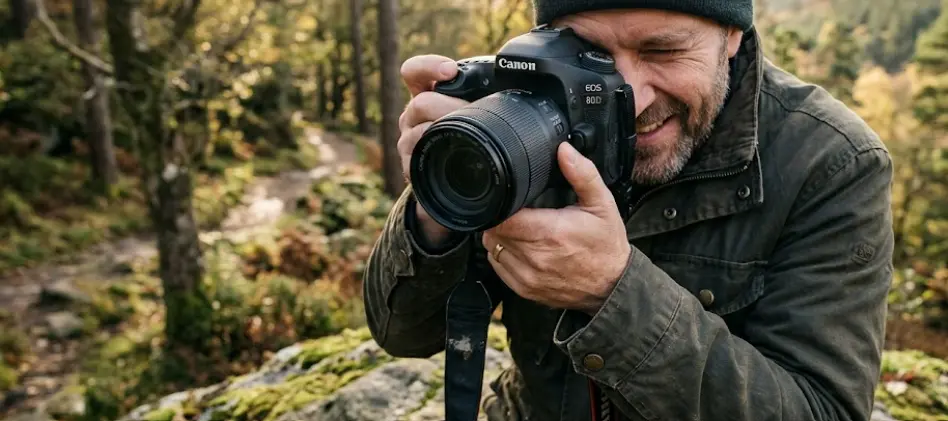
The Canon EOS 80D was designed as an enthusiast-level DSLR and arrived as the successor to the EOS 70D. Its body follows the traditional Canon DSLR approach, with a substantial handgrip, physical controls, an optical pentaprism viewfinder, and a 3-inch fully articulating touchscreen. Canon lists the body at approximately 730 grams with the battery and card, while the body-only weight is approximately 650 grams. That makes the 80D noticeably more substantial than many modern mirrorless cameras, but the larger body also gives you plenty of room for physical controls and a comfortable grip.
The optical viewfinder is one of the reasons the 80D still feels different from a modern smartphone or entry-level mirrorless camera. Canon specifies approximately 100% viewfinder coverage for the standard 3:2 aspect ratio, along with approximately 0.95x magnification. The camera also has a built-in flash, a top-mounted mode dial, and a conventional control layout that makes manual photography easier to learn. For someone moving from automatic shooting to aperture priority, shutter priority, or manual exposure, the physical design remains useful because important controls can be accessed without relying entirely on menus.
The rear screen is another practical strength. It is a 3-inch, approximately 1.04-million-dot capacitive touchscreen with full articulation, so you can flip and rotate it for low-angle, high-angle, or front-facing shooting. The touchscreen works with Live View focusing and touch shutter functions, while Canon's Dual Pixel CMOS AF helps make Live View focusing considerably more usable than the older contrast-detection systems found in many DSLRs of the period. DPReview also highlighted the articulating touchscreen and Live View implementation as particularly useful parts of the 80D experience.
Canon 80D Key Specifications
| Feature | Canon EOS 80D |
|---|---|
| Sensor | 24.2MP APS-C CMOS |
| Lens Mount | Canon EF and EF-S |
| Viewfinder | Optical pentaprism |
| Viewfinder Coverage | Approx. 100% |
| Autofocus | 45-point, all cross-type |
| Continuous Shooting | Up to 7fps |
| Display | 3-inch articulating touchscreen |
| Video | Full HD up to 60p |
| ISO Range | 100-16,000, expandable to 25,600 |
| Battery | LP-E6N/LP-E6 |
| Weight | Approx. 730g with battery and card |
| Wireless | Wi-Fi and NFC |
Canon's official specifications confirm the core hardware, including the 24.2MP sensor, 45-point autofocus system, 7fps shooting, Full HD recording, articulating touchscreen, and LP-E6N battery compatibility.
Image Quality And Sensor Performance
The Canon 80D uses a 24.2MP APS-C CMOS sensor, producing still images at up to 6000 x 4000 pixels. That resolution remains more than adequate for everyday photography, portraits, landscapes, travel images, product photography, and social media content. The camera also supports 14-bit Canon RAW files, giving photographers considerably more flexibility during post-processing than JPEG-only shooting. You can adjust exposure, white balance, shadows, highlights, and color more extensively when working with RAW files.
The sensor was one of the most important improvements over the EOS 70D when the 80D launched. DPReview found that the 80D delivered substantially improved dynamic range compared with its predecessor and described it as having the strongest dynamic range of any Canon APS-C DSLR at that point. That does not mean it matches every modern camera in 2026, but it explains why the 80D continues to produce useful files when paired with good lenses and sensible exposure settings.
The native ISO range runs from ISO 100 to 16,000, with expansion to an equivalent of ISO 25,600. In practical terms, the camera can handle indoor and low-light photography, although newer sensors and image-processing systems can provide cleaner results at high ISO settings. The 80D therefore makes more sense for photographers who are comfortable controlling exposure and using lenses with suitable apertures rather than expecting the camera to solve every low-light situation automatically.
Image Quality At A Glance
| Area | Canon 80D Capability |
|---|---|
| Resolution | 24.2MP |
| Sensor Type | APS-C CMOS |
| RAW | 14-bit Canon RAW |
| Maximum Still Resolution | 6000 x 4000 |
| Native ISO | 100-16,000 |
| Expanded ISO | Equivalent to 25,600 |
| Image Formats | JPEG, RAW, RAW+JPEG |
For photography, the 80D's sensor remains one of its strongest reasons to consider the camera. Its age becomes more noticeable when you move beyond still photography into modern video and computational imaging.
Autofocus And Shooting Performance
Autofocus was another major area where Canon improved the 80D over the previous generation. The viewfinder autofocus system uses 45 AF points, and Canon specifies all 45 as cross-type under supported conditions. This gives the camera a more flexible focusing system than many entry-level DSLRs from the same period. The system supports One-Shot AF, AI Servo AF, AI Focus AF, manual focusing, single-point selection, zone selection, large-zone selection, and automatic 45-point selection.
For everyday photography, that autofocus system is still perfectly usable. Portraits, family events, street photography, travel, and general outdoor shooting can all benefit from the 80D's combination of phase-detection autofocus and a responsive shutter system. Continuous shooting reaches approximately 7 frames per second, which is enough for many moving subjects and casual action photography. However, photographers specifically focused on demanding sports or wildlife tracking will find that newer mirrorless systems have much more sophisticated subject detection and tracking. DPReview also noted that the 80D's AF system was not as advanced for fast action as the more professional EOS 7D Mark II.
Live View is where the 80D becomes particularly interesting for its generation. Canon's Dual Pixel CMOS AF system provides phase-detection autofocus across the sensor during Live View shooting and video. This makes focusing by tapping the touchscreen much more practical than it was on many older DSLRs. DPReview specifically identified Dual Pixel AF as a major part of the camera's appeal, particularly for Live View and video work.
Shooting Performance
| Feature | Canon EOS 80D |
|---|---|
| Viewfinder AF Points | 45 |
| Cross-Type Points | Up to 45 |
| Continuous Shooting | Approx. 7fps |
| Live View AF | Dual Pixel CMOS AF |
| Maximum Shutter Speed | 1/8000 sec |
| Minimum Shutter Speed | 30 sec |
| Bulb Mode | Yes |
| Touch Shutter | Yes |
The 80D therefore remains a capable stills camera, particularly for photographers who enjoy the traditional DSLR shooting experience.
Video Recording And Connectivity
Video is one area where the Canon 80D clearly shows its age. The camera records Full HD video rather than 4K, with recording available at up to 1920 x 1080 resolution and 59.94p or 50p depending on the selected format and region. It also supports Movie Servo AF through Dual Pixel CMOS AF, which was an important advantage for its generation. Canon provides both an external microphone input and a headphone terminal, giving the camera more useful audio monitoring capabilities than many basic consumer cameras of the period.
The lack of 4K does not make the 80D useless for video, but it does limit its relevance for creators working with modern high-resolution workflows. Full HD remains suitable for online videos, basic YouTube production, interviews, instructional content, and social media projects where 1080p delivery is sufficient. However, anyone expecting to crop heavily, produce 4K footage, or use newer video-centric features will find the 80D considerably less flexible than current mirrorless cameras. DPReview also identified the absence of 4K and several modern video features as important limitations.
Connectivity is more dated as well, although the 80D was reasonably well equipped when it launched. Canon included Wi-Fi and NFC, allowing compatible smartphones to receive images and remotely control the camera. The camera also includes a mini HDMI output, USB connectivity, an external microphone input, and a remote-control terminal. These features are still useful, but the overall wireless experience should not be compared directly with the faster smartphone integration found on newer cameras.
Battery Life And Everyday Use
Battery life is one of the more impressive specifications on the 80D even by modern standards. Canon rates the camera for approximately 960 shots when using the optical viewfinder under CIPA testing conditions with 50% flash use. Live View reduces the rated figure to approximately 300 shots. That difference is expected because Live View keeps the rear display and sensor active, while optical viewfinder shooting uses the DSLR's traditional optical path.
For photography-heavy trips, the optical viewfinder battery rating is particularly useful. A photographer spending a full day shooting landscapes, street scenes, family events, or travel images can benefit from the camera's relatively high rated endurance. The removable LP-E6N/LP-E6 battery also makes carrying a spare battery straightforward. This is one area where an older DSLR can still feel reassuring compared with some compact cameras that depend heavily on electronic displays.
The trade-off is portability. At approximately 730 grams with battery and card, the 80D is not a lightweight travel camera, and a large EF or EF-S zoom lens adds substantially more weight. The size can actually be an advantage when using larger lenses because the grip provides better support, but someone moving from a smartphone or compact mirrorless body will notice the difference immediately. The 80D is therefore better suited to photographers who value handling and battery endurance over minimal weight.
Canon 80D Pros And Cons
The strongest argument for the Canon 80D is that its core photography hardware remains useful. The 24.2MP APS-C sensor gives you plenty of resolution, the 45-point autofocus system remains capable for general photography, and 7fps continuous shooting is sufficient for many enthusiast applications. The optical viewfinder, physical controls, articulating touchscreen, and Dual Pixel CMOS AF also give the camera a versatile shooting experience. These are not features that suddenly stop being useful simply because newer cameras exist.
The limitations are mostly connected to the camera's age. There is no 4K video, no modern AI-assisted subject recognition system, and no electronic viewfinder. The body is also relatively large and heavy compared with many current mirrorless cameras. The 80D's Wi-Fi and NFC connectivity were useful when it launched, but newer cameras generally offer more seamless wireless workflows. These limitations do not prevent good photography, but they become important if you are comparing the 80D against current-generation equipment.
The buying decision therefore depends heavily on the condition and price of the individual camera. Because the 80D is an older DSLR, buyers considering a used unit should pay attention to shutter count, sensor condition, LCD condition, battery health, ports, buttons, dials, autofocus performance, and the condition of the lens mount. A clean, well-maintained camera can still be useful, while a heavily used body may not be worth the savings simply because the model itself is inexpensive.
Canon 80D Pros And Cons
| Pros | Cons |
|---|---|
| 24.2MP APS-C sensor | No 4K video |
| 45-point all-cross-type AF system | Large and heavy by modern standards |
| 7fps continuous shooting | Older connectivity experience |
| Excellent optical viewfinder | Less sophisticated tracking than modern cameras |
| Fully articulating touchscreen | No modern mirrorless subject-detection features |
| Dual Pixel CMOS AF | Older DSLR platform |
| Strong viewfinder battery rating | Used-condition risk |
Who Should Buy The Canon 80D?
The Canon 80D makes the most sense for an enthusiast photographer who wants a traditional DSLR experience and is comfortable buying an older camera. It can be a particularly practical option for someone already invested in Canon EF or EF-S lenses because those lenses can be used directly with the camera. The combination of a 24.2MP sensor, optical viewfinder, physical controls, and 7fps shooting gives beginners plenty of room to learn manual photography without immediately needing a high-end body.
It can also work well for photography students, hobbyists, portrait photographers, travel photographers, and people who want to move beyond smartphone photography without spending heavily on a current flagship body. The articulating touchscreen and Dual Pixel AF make Live View easier to use, while the optical viewfinder keeps the classic DSLR shooting experience intact. For someone learning aperture, shutter speed, ISO, focal length, and exposure compensation, the camera provides a substantial set of controls without being positioned as a professional flagship.
However, the 80D is harder to recommend for buyers whose priority is modern video or advanced subject tracking. If your work depends heavily on 4K footage, sophisticated animal or vehicle detection, compact travel equipment, or the latest wireless workflow, the limitations become much more important. In that situation, a newer mirrorless camera can provide a more current feature set even if the older DSLR initially appears cheaper.
Best Fit For The Canon 80D
| User Type | Fit |
|---|---|
| Photography beginner | Good |
| Enthusiast photographer | Good |
| Portrait photographer | Good |
| Travel photographer | Reasonable, if weight is acceptable |
| Sports photographer | Usable, but older AF tracking is a limitation |
| Video creator | Limited by Full HD maximum |
| 4K content creator | Not suitable |
| Existing Canon EF/EF-S owner | Particularly practical |
Frequently Asked Questions
Q. Is the Canon 80D still good in 2026?
The Canon 80D is still capable for still photography in 2026. Its 24.2MP APS-C sensor, 45-point autofocus system, 7fps shooting, articulating touchscreen, and optical viewfinder remain useful, although newer cameras offer more advanced autofocus and video features.
Q. Is the Canon 80D a full-frame camera?
No. The Canon 80D uses an APS-C CMOS sensor measuring approximately 22.3 x 14.9mm. It uses the Canon EF mount and supports EF-S lenses as well.
Q. How many megapixels does the Canon 80D have?
The Canon 80D has approximately 24.2 effective megapixels and can record still images at up to 6000 x 4000 pixels. It also supports 14-bit RAW recording.
Q. Does the Canon 80D shoot 4K video?
No. The Canon 80D records Full HD video, with frame rates up to 59.94p or 50p depending on the selected recording format and region. It does not offer 4K recording.
Q. How fast can the Canon 80D shoot continuously?
The Canon 80D can shoot at approximately 7 frames per second using its high-speed continuous shooting mode. Canon specifies lower rates for certain Live View and Servo AF conditions.
Q. Does the Canon 80D have Dual Pixel autofocus?
Yes. The Canon 80D uses Dual Pixel CMOS AF for Live View and movie shooting, allowing phase-detection autofocus directly on the imaging sensor.
Q. How many autofocus points does the Canon 80D have?
The Canon 80D has 45 autofocus points for viewfinder shooting, with up to 45 cross-type points depending on the lens and shooting conditions.
Q. Does the Canon 80D have Wi-Fi?
Yes. The Canon 80D includes Wi-Fi and NFC connectivity. Canon specifies smartphone image transfer and remote-control functionality among its wireless features.
Q. How good is the Canon 80D battery life?
Canon rates the 80D for approximately 960 shots using the optical viewfinder under its CIPA testing conditions, while Live View shooting is rated at approximately 300 shots. Actual battery life varies with shooting conditions and usage.
Q. Is the Canon 80D good for beginners?
Yes, particularly for beginners who want to learn photography using a traditional DSLR. Its physical controls, optical viewfinder, touchscreen, manual exposure modes, and broad EF/EF-S lens compatibility provide plenty of room to develop photography skills.
Final Recommendation
The Canon 80D still holds up best as a photography-focused enthusiast DSLR rather than as a modern all-purpose camera. Its 24.2MP APS-C sensor remains capable of producing detailed images, while the 45-point autofocus system, 7fps continuous shooting, optical pentaprism viewfinder, articulating touchscreen, and Dual Pixel CMOS AF give it a well-rounded shooting experience. Its approximately 960-shot optical-viewfinder battery rating is also useful for long photography sessions.
The biggest reason to think carefully before buying one in 2026 is not image quality, but age. Full HD is its maximum video resolution, its autofocus does not have the subject-recognition capabilities found in newer mirrorless cameras, and its 730-gram body is considerably larger than many modern alternatives. If those limitations do not affect your work, the 80D can still be a practical enthusiast camera, particularly when paired with good Canon EF or EF-S glass.
For a photographer considering a well-maintained used Canon 80D at a sensible price, the camera remains relevant because the fundamentals are solid. Check the body's physical condition, shutter count, battery health, autofocus, sensor, screen, ports, and included lens before buying. If your priority is still photography and learning the craft of photography, the 80D has enough capability to remain useful. If your priority is modern video, compactness, or advanced autofocus, a newer mirrorless camera is the more appropriate direction.