
Canon 700D vs Nikon D5300: Which Budget DSLR Should You Buy First?
Canon 700D vs Nikon D5300 comes down to handling, resolution, autofocus, connectivity, and lens choice. Compare their specifications and practical strengths before buying a used DSLR in 2026.

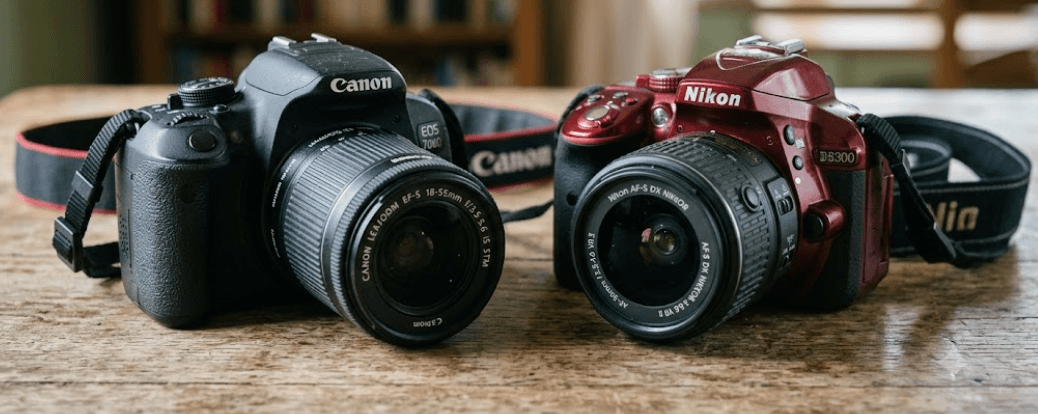
TL;DR The Canon EOS 700D and Nikon D5300 are both older entry-level APS-C DSLRs, but they approach beginner photography differently. The 700D has an 18MP sensor, 9-point cross-type autofocus, a 3-inch vari-angle touchscreen, and 5 fps continuous shooting. At the same time, the D5300 uses a higher-resolution 24.2MP sensor, a 39-point autofocus system, a larger 3.2-inch vari-angle display, built-in Wi-Fi and GPS, and 5fps shooting. The D5300 also removes the optical low-pass filter, while the 700D offers Canon's familiar touchscreen controls and a mature EF/EF-S lens ecosystem. Both cameras are discontinued, so in 2026 the condition of the body, shutter count, battery, and included lens can matter as much as the original specifications.
Canon 700D vs Nikon D5300: What Has Changed
The Canon EOS 700D was introduced in 2013 as an entry-level DSLR and is now a discontinued model. It uses an 18MP APS-C CMOS sensor with Canon's DIGIC 5 processor and provides a 3-inch, 1.04-million-dot vari-angle touchscreen. Its optical viewfinder covers approximately 95% of the frame, and the camera can shoot at up to 5fps. These specifications made it a practical beginner camera when it launched, particularly for photographers who wanted physical controls combined with a touchscreen interface. Canon also included Full HD video recording and a Hybrid CMOS AF system for Live View shooting.
The Nikon D5300 arrived later in 2013 and was positioned in a similar enthusiast and beginner DSLR segment. It uses a 24.2MP DX-format CMOS sensor with EXPEED 4 processing and does not use an optical low-pass filter. Nikon gave it a 39-point autofocus system, 5fps continuous shooting, a 3.2-inch vari-angle display, built-in Wi-Fi, and built-in GPS. It can also record Full HD video at up to 60p. That gives the D5300 a more feature-heavy specification sheet, particularly for photographers interested in resolution, location tagging, wireless transfer, and video.
For a first DSLR in 2026, however, the comparison needs a different perspective from a typical new-camera buying guide. Neither camera should be treated as a current-generation product, because both belong to an older DSLR generation and are generally relevant through the used or refurbished market. That means you should inspect the actual camera before buying rather than choosing entirely from the model name. Battery condition, shutter count, sensor condition, LCD operation, card-slot reliability, lens condition, and the availability of accessories can change the practical value significantly.
Canon 700D vs Nikon D5300: Key Specifications
The specifications show the biggest differences between the two cameras. The D5300 has a clear advantage in sensor resolution, with 24.2MP compared with the 700D's 18MP. More megapixels do not automatically mean better photographs, but the additional resolution can provide more flexibility for cropping and producing larger images. Nikon also removed the optical low-pass filter from the D5300, which was designed to preserve fine detail.
The autofocus systems are also different. The 700D has nine autofocus points, with all nine being cross-type according to Canon's specifications. The D5300 provides 39 selectable autofocus points and 3D tracking through its Multi-CAM 4800DX autofocus system. Both cameras can shoot at up to 5fps, so neither has an advantage in maximum continuous shooting speed. The difference is more about the autofocus system and how it distributes focus points across the frame.
The displays also reflect different approaches. The 700D has a 3-inch vari-angle touchscreen with approximately 1.04 million dots, while the D5300 uses a larger 3.2-inch vari-angle display with approximately 1.037 million dots. The Canon's touchscreen can make menu navigation and Live View shooting more intuitive, while Nikon's larger screen gives you more physical viewing area. Neither camera has a modern electronic viewfinder because both use optical DSLR viewfinders.
| Feature | Canon EOS 700D | Nikon D5300 |
|---|---|---|
| Sensor | 18MP APS-C CMOS | 24.2MP DX CMOS |
| Processor | DIGIC 5 | EXPEED 4 |
| Autofocus | 9-point, all cross-type | 39-point |
| Continuous Shooting | Up to 5fps | Up to 5fps |
| LCD | 3-inch vari-angle touchscreen | 3.2-inch vari-angle |
| Viewfinder Coverage | Approx. 95% | Approx. 95% |
| Native ISO | 100–12,800 | 100–12,800 |
| Expanded ISO | Up to 25,600 equivalent | Up to 25,600 equivalent |
| Video | Full HD up to 30p | Full HD up to 60p |
| Wi-Fi | No built-in Wi-Fi | Built-in Wi-Fi |
| GPS | No built-in GPS | Built-in GPS |
| Weight | Approx. 580g | Approx. 480g |
Specifications are based on manufacturer documentation. Weight figures include the battery and memory card under the respective manufacturers' stated measurement standards.
Image Quality And Sensor Performance
The Nikon D5300 has the specification advantage when it comes to resolution. Its 24.2MP sensor produces images at up to 6,000 × 4,000 pixels, while the Canon 700D's 18MP sensor produces smaller files. For a beginner, that difference may not be obvious in every photograph, particularly when images are viewed on a phone or shared on social media. It becomes more useful when you crop heavily, print photographs, or want additional flexibility while editing RAW files.
The D5300's sensor also removes the optical low-pass filter, which Nikon specifically highlighted as a way to preserve fine detail. This does not mean every D5300 photograph will automatically look better than every photograph from a 700D. Lens quality, exposure, focus accuracy, lighting, shooting technique, and post-processing still play major roles. A well-exposed 700D photograph with a good lens can remain highly usable for learning photography and creating social media content.
Both cameras provide a standard ISO range from 100 to 12,800, with expansion to an equivalent of ISO 25,600. However, you should not buy either camera simply because of its maximum ISO number. At high ISO settings, image noise increases, and the usable result depends on the subject, lighting, exposure, and processing. For a beginner, learning to control aperture, shutter speed, and ISO will generally have a larger impact on results than choosing between two maximum ISO figures.
Autofocus, Handling, And Everyday Shooting
Autofocus is one of the clearest specification differences between these cameras. The Canon 700D uses nine cross-type autofocus points, while the Nikon D5300 provides up to 39 autofocus points with dynamic-area and 3D-tracking options. More autofocus points do not automatically guarantee better photographs, but the D5300's system gives you more selectable focus areas when composing subjects away from the center of the frame.
The Canon takes a different approach to usability. Its 3-inch vari-angle touchscreen allows photographers to change settings and interact with Live View using touch controls. The vari-angle screen can also be useful for shooting from low or high angles. Canon's 700D also supports Movie Servo AF in Live View, particularly when used with compatible STM lenses. These features can make the camera approachable for someone moving from smartphone photography to manual camera controls.
The Nikon D5300 is lighter, at approximately 480g compared with approximately 580g for the 700D. That difference becomes noticeable when the camera is carried for several hours, particularly with an additional lens attached. The D5300 also has built-in Wi-Fi and GPS, which were significant convenience features for its generation. Wi-Fi can support image transfer and remote control through compatible Nikon software, while GPS can record location information with photographs.
Video, Connectivity, And Battery Life
For video, the Nikon D5300 has a technical advantage because it can record Full HD video at up to 60p. The Canon 700D records Full HD video at 30p, 25p, or 24p, with 720p available at higher frame rates. If you want to experiment with smoother Full HD footage or slow-motion-style editing using 60p footage, the Nikon provides more flexibility on paper. Both remain limited compared with modern mirrorless cameras, particularly in autofocus, stabilization, resolution, and video features.
Connectivity is another area where the D5300 has a clear built-in advantage. Nikon included Wi-Fi and GPS in the camera, allowing wireless image transfer and location tagging without requiring separate accessories for those functions. The 700D does not have built-in Wi-Fi or GPS. For a photographer who frequently wants to move photographs from the camera to a smartphone, the D5300's connectivity can make the workflow more convenient.
Battery performance also differs according to manufacturer testing. Nikon rates the D5300 at approximately 600 shots per charge under CIPA conditions, while Canon's published comparison information lists approximately 440 images for the 700D. Actual battery life varies depending on Live View use, flash, temperature, playback, and shooting habits. Since these are older cameras in 2026, battery age should also be checked carefully when buying used because an original battery may no longer deliver its original rated capacity.
| Everyday Feature | Canon EOS 700D | Nikon D5300 |
|---|---|---|
| Touchscreen | Yes | No touchscreen |
| Vari-Angle Screen | Yes | Yes |
| Built-In Wi-Fi | No | Yes |
| Built-In GPS | No | Yes |
| Full HD Maximum Frame Rate | 30p | 60p |
| CIPA Battery Rating | Approx. 440 shots | Approx. 600 shots |
| Approx. Weight | 580g | 480g |
Lens Choice And Used-Market Considerations
Lens availability is particularly important when buying an older DSLR because the body is only one part of the system. The Canon 700D uses the Canon EF/EF-S lens mount, giving buyers access to a large range of Canon-compatible lenses. The Nikon D5300 uses the Nikon F mount, although autofocus compatibility requires attention because Nikon specifies autofocus availability with AF-S and AF-I CPU lenses on the D5300. That means you should check the exact lens model before assuming every older Nikon F-mount lens will autofocus on the camera.
For beginners, the included kit lens can be more important than a small difference in body specifications. A clean 18-55mm kit lens can cover everyday subjects such as portraits, family events, travel, food, and basic street photography. If you later want more background blur or low-light performance, an inexpensive prime lens can teach you more about aperture and composition than simply upgrading the camera body. This is why a used camera bundle with a healthy lens can be more useful than a cheaper body with a damaged or poor-quality lens.
The biggest 2026 buying consideration is condition. Both cameras are old enough that shutter wear, rubber deterioration, dust, battery health, worn ports, sticky buttons, damaged LCD hinges, and lens fungus deserve attention. Ask for sample photographs, inspect the sensor and mirror, test every button and dial, check autofocus at different distances, confirm that the SD card slot works, and record the shutter count where possible. A slightly older body in excellent condition can be a safer used purchase than a cosmetically attractive camera that has been heavily used.
Canon 700D vs Nikon D5300: Which Beginner Should Choose?
The Canon 700D makes sense for a beginner who values straightforward controls, a touchscreen, and Canon's established EF/EF-S lens ecosystem. Its 18MP sensor is still capable of producing detailed photographs for learning, social media, personal projects, and many everyday uses. The vari-angle touchscreen is particularly useful for someone who is transitioning from smartphone photography because touch interaction makes certain shooting and menu operations feel familiar.
The Nikon D5300 has a stronger specification set in several areas. Its 24.2MP sensor provides more resolution, its 39-point autofocus system provides more focus-point coverage, its body is lighter, and it includes Wi-Fi and GPS. It also offers Full HD recording at up to 60p and a larger 3.2-inch vari-angle display. For a beginner interested in landscapes, travel, portraits, cropping, or experimenting with video, those features can provide more room to grow.
Neither camera should be selected solely by counting specifications, however. The lens included in the deal, the condition of the camera, the battery, shutter count, and the asking price can change the equation considerably. In 2026, these are legacy DSLR options, so the sensible approach is to compare complete used kits rather than treating the camera body as if it were a current retail product. Canon itself identifies the 700D as discontinued, while Nikon's current support information continues to document the D5300's specifications.
| Buyer Priority | Camera To Consider | Why |
|---|---|---|
| Higher resolution | Nikon D5300 | 24.2MP sensor |
| Touchscreen controls | Canon 700D | 3-inch vari-angle touchscreen |
| More AF points | Nikon D5300 | 39-point AF system |
| Built-in connectivity | Nikon D5300 | Wi-Fi and GPS |
| Lighter body | Nikon D5300 | Approx. 480g |
| Beginner-friendly touch controls | Canon 700D | Touch-enabled vari-angle LCD |
| Full HD 60p | Nikon D5300 | Supports 1080/60p |
| Canon lens ecosystem | Canon 700D | EF/EF-S compatibility |
Common Mistakes When Buying An Older DSLR
One common mistake is buying based only on megapixels. The D5300's 24.2MP sensor is higher resolution than the 700D's 18MP sensor, but resolution is only one part of image quality. The lens, lighting, focus, exposure, and photographer's technique all influence the final photograph. For someone learning photography, understanding shutter speed, aperture, ISO, focal length, and composition will usually make a bigger difference than simply moving from one older DSLR to another.
Another mistake is ignoring the lens and accessories. A camera body may look inexpensive until you discover that the battery is weak, the charger is missing, the kit lens has fungus, or the camera requires another accessory for the way you intend to use it. With older DSLRs, these details can quickly change the actual cost of ownership. Always compare the complete package and test the camera rather than relying only on a seller's description.
You should also avoid assuming that either model is equivalent to a modern mirrorless camera. These DSLRs can still be excellent learning tools, particularly when purchased at a sensible used price, but they lack many features found on newer cameras. If you need advanced subject detection, modern video autofocus, 4K recording, electronic viewfinder functions, or current wireless workflows, a newer mirrorless model may be more appropriate. The 700D and D5300 make the most sense when their lower used-market cost and traditional DSLR experience are part of the appeal.
Frequently Asked Questions
Q. Is the Canon 700D still worth buying in 2026?
The Canon 700D can still be useful as an inexpensive first DSLR if you find a clean used unit at a sensible price. Its 18MP APS-C sensor, 5fps shooting, vari-angle touchscreen, and 9-point all-cross-type autofocus system remain capable for learning photography. However, Canon lists the model as discontinued, so used condition and price are particularly important.
Q. Is the Nikon D5300 better than the Canon 700D?
The D5300 has several specification advantages, including a 24.2MP sensor, 39-point autofocus system, built-in Wi-Fi and GPS, a lighter body, and Full HD 60p recording. The 700D counters with a touchscreen and Canon's familiar control layout. The better fit depends on the features and lens system you value.
Q. Which camera has better image resolution, Canon 700D or Nikon D5300?
The Nikon D5300 has the higher-resolution sensor. It uses a 24.2MP DX-format CMOS sensor, while the Canon 700D uses an 18MP APS-C CMOS sensor. The D5300 can therefore provide more native resolution and additional cropping flexibility.
Q. Which camera has better autofocus?
The Nikon D5300 has more autofocus points, with a 39-point system compared with the Canon 700D's nine-point system. Canon specifies all nine 700D viewfinder AF points as cross-type, while Nikon provides multiple AF-area modes including 39-point dynamic-area and 3D tracking.
Q. Does the Canon 700D have Wi-Fi?
The Canon 700D does not have built-in Wi-Fi. The Nikon D5300 does have built-in Wi-Fi, along with built-in GPS. This can make the D5300 more convenient for photographers who regularly want wireless image transfer or location-tagged photographs.
Q. Which camera is lighter, Canon 700D or Nikon D5300?
The Nikon D5300 is lighter. Nikon lists the D5300 at approximately 480g, while Canon lists the EOS 700D at approximately 580g under its stated measurement. The 100g difference can become noticeable during travel or longer shooting sessions.
Q. Which camera is better for video?
The Nikon D5300 has the stronger video specification because it can record Full HD at up to 60p. The Canon 700D records Full HD at up to 30p and also supports 720p at higher frame rates. Neither should be confused with a modern 4K mirrorless camera, but the D5300 offers greater Full HD frame-rate flexibility.
Q. Does the Nikon D5300 have a touchscreen?
No. The D5300 has a 3.2-inch vari-angle TFT-LCD display but does not use a touchscreen. The Canon 700D has a 3-inch vari-angle capacitive touchscreen with approximately 1.04 million dots.
Q. Which camera has better battery life?
The Nikon D5300 has the higher manufacturer-rated battery life at approximately 600 shots per charge under CIPA testing. Canon's published specifications list approximately 440 images for the EOS 700D. With used cameras, however, the actual battery condition can be more important than the original rating because both models are several years old.
Q. Should a beginner buy a Canon 700D or Nikon D5300 first?
For a beginner choosing strictly between these two models, compare the actual used condition, included lens, price, and preferred controls before buying. The D5300 offers higher resolution, more AF points, built-in Wi-Fi and GPS, a lighter body, and 60p Full HD video. The 700D offers a touchscreen, vari-angle display, and a straightforward Canon shooting experience. Both can teach the fundamentals of DSLR photography effectively.
Final Recommendation
The Canon 700D vs Nikon D5300 comparison looks different in 2026 because these cameras are no longer current-generation purchases. Both are older DSLRs, and Canon explicitly lists the EOS 700D as discontinued. For someone entering photography through the used market, the goal should therefore be to find a reliable, well-maintained camera rather than simply choosing the model with the longest specification list.
On specifications alone, the Nikon D5300 provides more resolution, more autofocus points, built-in Wi-Fi and GPS, a lighter body, longer rated battery life, and Full HD 60p recording. The Canon 700D remains attractive for beginners who prefer a touchscreen, Canon's interface, and the particular lens options available with an EF/EF-S setup. These differences are meaningful, but they do not eliminate the importance of the lens and condition of a used camera.






