
Canon 700D vs 750D vs 800D: Which Rebel Series Gives the Best Resale Value?
Canon 700D, 750D and 800D remain popular used DSLRs in India. Compare their specifications, current resale signals and key factors that affect second-hand value before buying or selling.

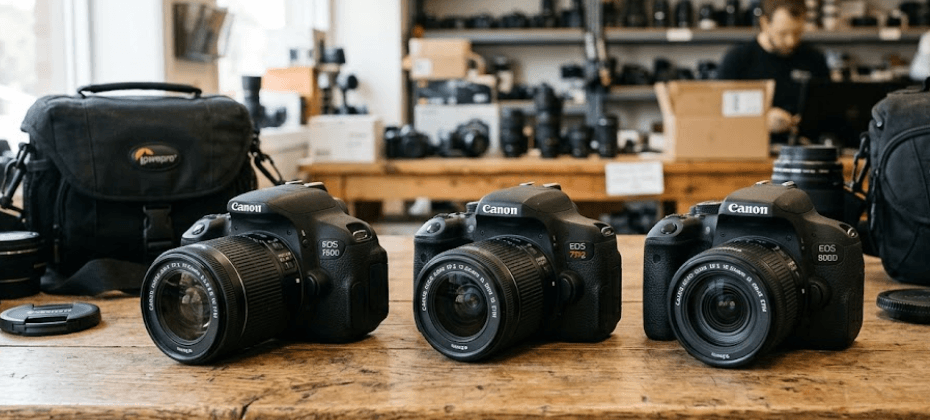
TL;DR The Canon 700D, 750D and 800D remain relevant in India's used DSLR market because they offer interchangeable lenses, familiar controls and access to Canon's extensive EF and EF-S ecosystem at much lower prices than newer cameras. Among the three, the EOS 800D has the strongest current resale position, helped by its newer 24.2MP sensor, 45-point autofocus system and Dual Pixel CMOS AF. The 750D sits between the other two, while the older 700D generally commands less. Current Cashify maximum buyback quotes are ₹19,200 for the 700D, ₹19,800 for the 750D and ₹21,600 for the 800D, although private-market asking prices can be considerably higher and vary with lenses, shutter count and condition. Resale value is therefore about more than the model number alone.
Canon 700D, 750D And 800D Explained
The Canon EOS 700D, EOS 750D and EOS 800D belong to successive generations of Canon's entry-level to enthusiast-focused Rebel DSLR family. The 700D was marketed in 2013 with an 18MP APS-C CMOS sensor, 9-point autofocus and continuous shooting at up to 5 frames per second. The 750D followed with a 24.2MP sensor, 19-point autofocus, and the same approximate 5fps burst rate. The 800D moved the series forward again with a 24.2MP sensor, Dual Pixel CMOS AF and a 45-point autofocus system, making it the most modern body of the three.
These differences matter in the used market because buyers do not look only at the camera's age. They also look at how useful the body remains for photography today. A 700D can still produce good photographs, particularly when paired with a capable lens, but the 750D gives buyers more resolution and a more advanced autofocus system. The 800D goes further with improved autofocus performance and Dual Pixel CMOS AF, making it more attractive to people who want a used DSLR that feels less dated.
The three cameras also share an important advantage for second-hand buyers: compatibility with Canon EF and EF-S lenses. That means a buyer can spend less on an older body and put more of the budget toward lenses. For resale, this is important because a complete kit with a useful lens can be much more attractive than a camera body alone. A seller should therefore think of the body and lens as separate components of the overall resale package rather than assuming the camera's model number determines the entire selling price.
Key Specifications At A Glance
| Feature | Canon 700D | Canon 750D | Canon 800D |
|---|---|---|---|
| Sensor | 18MP APS-C CMOS | 24.2MP APS-C CMOS | 24.2MP APS-C CMOS |
| Autofocus | 9-point | 19-point | 45-point |
| Live View AF | Hybrid CMOS AF | Hybrid CMOS AF III | Dual Pixel CMOS AF |
| Continuous Shooting | Approx. 5fps | Approx. 5fps | Approx. 6fps |
| Video | Full HD | Full HD | Full HD |
| Touchscreen | Yes | Yes | Yes |
| Wi-Fi | No | Yes, with NFC | Yes, with NFC/Bluetooth |
| Lens Mount | Canon EF/EF-S | Canon EF/EF-S | Canon EF/EF-S |
How Resale Value Differs Between The Three
The current Indian used market gives the 800D the clearest advantage when resale value is the focus. Cashify currently shows maximum quoted buyback values of ₹19,200 for the 700D, ₹19,800 for the 750D and ₹21,600 for the 800D. The difference between the 700D and 750D is relatively small, while the 800D has a more noticeable lead in the quoted buyback figures. These are not guaranteed selling prices, however. Actual offers depend on the condition of the individual camera and the seller's chosen platform.
Private-market asking prices tell a similar but less consistent story. Current OLX listings show 700D examples ranging from roughly ₹14,500 to above ₹30,000, while 750D listings commonly appear around ₹20,000 to ₹40,000. Current 800D listings also vary widely, with examples around ₹20,000 to ₹40,000 and some complete kits advertised at higher prices. These figures should not be treated as transaction prices because sellers set their own asking prices, and a camera listed at ₹40,000 does not necessarily sell for ₹40,000.
The biggest reason for this variation is that DSLR resale is strongly affected by what comes with the camera. A 700D body with a basic kit lens, high shutter count and visible wear is a very different proposition from a clean 700D with an 18-135mm lens, original charger, battery and box. The same applies to the 750D and 800D. This is why comparing only body-to-body prices can give a misleading picture of resale value. For a buyer or seller, the condition, shutter count, lens package and proof of ownership can matter almost as much as the model generation.
Current Resale Signals In India
| Model | Current Buyback Quote | Typical Current Private Asking Range* | Resale Position |
|---|---|---|---|
| Canon 700D | Up to ₹19,200 | Roughly ₹14,500 to ₹35,000+ | Older entry point |
| Canon 750D | Up to ₹19,800 | Roughly ₹17,000 to ₹45,000 | Middle position |
| Canon 800D | Up to ₹21,600 | Roughly ₹16,000 to ₹48,000+ | Newest and strongest signal |
*Private-market asking prices vary by condition, shutter count, location and included lenses. They are not confirmed transaction prices.
Why The Canon 800D Holds More Value
The EOS 800D has a practical advantage because it is the newest of these three generations. Its 24.2MP APS-C sensor gives it the same basic resolution class as the 750D, but its autofocus system is considerably more advanced. Canon equipped the 800D with 45 autofocus points and Dual Pixel CMOS AF for Live View shooting. It also offers continuous shooting at approximately 6fps, compared with approximately 5fps on the 700D and 750D. Those improvements make the 800D easier to justify when a buyer is choosing between similarly priced used bodies.
The 800D is also more appealing to buyers who want to use the camera for both photography and video. Its Dual Pixel CMOS AF is particularly relevant in Live View because it provides phase-detection autofocus across the image sensor. That does not turn the 800D into a modern mirrorless camera, but it does make its focusing experience more contemporary than the older 700D. For a second-hand buyer who wants to learn photography, shoot family events or create basic video content, those differences can influence what they are willing to pay.
Resale value also benefits from perceived remaining usefulness. A newer used camera generally has a longer period during which buyers can reasonably expect it to meet their needs before they feel compelled to upgrade. The 800D is still an older DSLR, but its autofocus, resolution and connectivity give it more breathing room than the 700D. Current buyback quotes support this pattern, with Cashify's maximum figure for the 800D sitting above those of the 750D and 700D.
Where The Canon 750D Still Makes Sense
The Canon 750D occupies an interesting position because it delivers a major sensor upgrade over the 700D without moving as far up the used-price ladder as the 800D. Its 24.2MP APS-C sensor provides considerably more resolution than the 18MP sensor in the 700D, while its 19-point all-cross-type autofocus system improves subject acquisition through the optical viewfinder. It also introduced built-in Wi-Fi and NFC, which can make transferring images to compatible devices easier than with the older 700D.
For buyers who find a clean 750D at a sensible price, the model can be a practical compromise. It has enough resolution for portraits, travel photography, product photography and social-media content, while its EF and EF-S lens compatibility gives users plenty of affordable second-hand lens options. The camera also retains the familiar DSLR controls that make it useful for beginners who want to learn exposure, shutter speed and aperture without paying for a newer body.
Its resale position is less straightforward than the 800D's because the 750D is older and does not have the 800D's 45-point autofocus system or Dual Pixel CMOS AF. Still, current buyback figures show only a small difference between the 750D and 700D. That means condition and package quality can easily change which individual camera offers the better deal. A clean 750D with a low shutter count and a good lens can be more attractive than a heavily used 800D body.
700D vs 750D vs 800D
| Area | 700D | 750D | 800D |
|---|---|---|---|
| Resolution | 18MP | 24.2MP | 24.2MP |
| Viewfinder AF | 9 points | 19 points | 45 points |
| Live View AF | Older Hybrid CMOS AF | Hybrid CMOS AF III | Dual Pixel CMOS AF |
| Burst Speed | Approx. 5fps | Approx. 5fps | Approx. 6fps |
| Connectivity | Limited | Wi-Fi/NFC | Wi-Fi/NFC/Bluetooth |
| Used-Market Appeal | Budget focused | Balanced older option | Newest of the three |
What Actually Determines DSLR Resale Value
Model generation is only one part of the resale equation. Shutter count is particularly important because buyers use it as an indication of how heavily a DSLR has been used. A camera with a relatively low shutter count, clean sensor, functioning touchscreen, healthy battery and no visible damage can attract more interest than the same model with extensive wear. The exact shutter count should be checked rather than relying on a seller's description, especially when the price difference between two listings is significant.
The lens can also change the value substantially. Canon EF and EF-S lenses remain useful on many Canon DSLR bodies, so a seller with a desirable lens can often make the complete kit more attractive than the camera body alone. An 18-55mm kit lens is common and may not add as much value as a well-regarded prime or higher-quality zoom. Buyers should therefore check the exact lens model, optical condition, autofocus operation and presence of fungus or haze before comparing two apparently similar camera kits.
Original accessories and documentation can also help. A genuine Canon battery and charger, original box, strap, manuals and purchase documentation make a used camera easier to evaluate. None of these automatically guarantees a higher selling price, but they reduce uncertainty for the buyer. In a market filled with older DSLRs, trust can make a practical difference. A well-documented camera with clear photographs, an honest shutter count and a detailed condition description can be easier to sell than a cheaper but poorly documented listing.
Factors That Affect Resale Value
| Factor | Effect On Resale |
|---|---|
| Camera condition | Strong impact |
| Shutter count | Strong impact |
| Included lens | Strong impact |
| Sensor and LCD condition | Strong impact |
| Original battery and charger | Moderate impact |
| Box and documentation | Moderate impact |
| Model generation | Strong impact |
| Local demand | Can vary significantly |
Should You Buy A Used Canon Rebel DSLR?
A used Canon Rebel can still make sense in 2026 when the price reflects its age and condition. These cameras are not competitive with current mirrorless bodies in every area, particularly autofocus sophistication, video features and compactness, but they can provide an inexpensive way to learn photography. The optical viewfinder, physical controls and interchangeable lenses also give beginners a traditional photography experience that some users prefer over smartphone-style shooting.
The 700D makes the most sense when the purchase price is low and the buyer is more interested in learning photography than owning the newest Rebel body. The 750D is a stronger middle ground because its 24.2MP sensor and 19-point autofocus system give it a meaningful step up from the 700D. The 800D is the most future-friendly of the three because it combines the 24.2MP sensor with 45-point autofocus, Dual Pixel CMOS AF and slightly faster continuous shooting.
For buyers who care specifically about resale, the purchase price matters just as much as the model. Paying too much for an old 800D can erase the benefit of choosing the newer model, while finding a well-priced 750D can leave enough room in the budget for a better lens. Before buying, compare the body condition, shutter count, lens, accessories and asking price rather than choosing solely from the model number.
Common Resale Mistakes To Avoid
One common mistake is assuming that the 800D will automatically sell for more simply because it is the newest model. Current market evidence supports a stronger resale position for the 800D, but individual listings vary widely. A damaged 800D with a high shutter count may be worth less than a clean 750D with a desirable lens. Resale is therefore a combination of model, condition and package rather than a simple ranking based on the camera name.
Another mistake is confusing asking prices with actual resale prices. Online marketplaces can contain optimistic listings that remain unsold for long periods. Current OLX results show substantial price variation for all three models, which demonstrates why one high listing should not be treated as the market value. A more realistic approach is to compare several similar listings and then check what established buyback services are offering.
The third mistake is ignoring the lens ecosystem when calculating resale value. A buyer may be interested in a 700D because it is inexpensive, but a seller with a useful EF-S lens can potentially create a more attractive package. Similarly, someone selling an 800D with multiple lenses should not assume that the body's buyback quote represents the value of the entire kit. The lens should be evaluated separately before deciding whether to sell everything together or individually.
Frequently Asked Questions
Q. Which Canon Rebel has the best resale value among the 700D, 750D and 800D?
The Canon EOS 800D currently has the strongest resale signal among the three. Cashify's current maximum quoted buyback values are ₹21,600 for the 800D, ₹19,800 for the 750D and ₹19,200 for the 700D. Private-market prices vary significantly depending on condition and lenses.
Q. Is the Canon 700D still worth buying in 2026?
The Canon 700D can still be useful for beginners if it is priced appropriately and is in good working condition. Its 18MP sensor, 9-point autofocus and approximately 5fps shooting are older specifications, but the camera remains compatible with Canon EF and EF-S lenses.
Q. Is the Canon 750D better than the 700D?
The 750D has several important advantages. It uses a 24.2MP sensor instead of the 700D's 18MP sensor, has a 19-point autofocus system instead of nine points and includes Wi-Fi and NFC connectivity. It also maintains approximately 5fps continuous shooting.
Q. Is the Canon 800D better for resale than the 750D?
Current buyback and marketplace signals suggest that the 800D generally has the stronger resale position. Its newer generation, 45-point autofocus system, Dual Pixel CMOS AF and approximately 6fps continuous shooting give it additional appeal over the 750D.
Q. What is the shutter count of a Canon 700D, 750D or 800D worth considering?
There is no single shutter-count figure that determines whether a used camera is a good purchase. A lower count can be reassuring, but overall condition, service history, sensor condition and price should also be checked. Buyers should verify the reported count where possible.
Q. Does the lens affect the resale value of a Canon DSLR?
Yes. A camera sold with a useful, clean and functioning lens can be more valuable than a body-only listing. The exact lens model matters because common kit lenses and more desirable primes or zooms can have very different second-hand values.
Q. Which has the better autofocus, Canon 750D or 800D?
The 800D has the more advanced autofocus system. It has 45 autofocus points and Dual Pixel CMOS AF for Live View, while the 750D has a 19-point system and Hybrid CMOS AF III. This difference can matter for moving subjects and Live View shooting.
Q. Does the Canon 800D have a 24.2MP sensor?
Yes. Canon specifies approximately 24.2 effective megapixels for the EOS 800D. The 750D also uses an approximately 24.2MP sensor, while the 700D uses approximately 18MP.
Q. Can Canon 700D, 750D and 800D use the same lenses?
Yes. All three cameras use Canon's EF lens mount and are compatible with EF and EF-S lenses. This shared lens compatibility is one reason these older Canon DSLRs remain relevant in the used market.
Q. What should I check before buying a used Canon 800D?
Check the shutter count, sensor condition, LCD and touchscreen, autofocus, buttons and dials, battery health, memory-card slot, ports, flash and lens condition. Also check whether the seller includes the original charger and battery and whether the camera has visible impact or water damage.
Final Recommendation
If resale value is the main consideration, the Canon EOS 800D has the strongest position among the 700D, 750D and 800D based on current Indian buyback quotes and marketplace signals. Its newer generation, 24.2MP sensor, 45-point autofocus system, Dual Pixel CMOS AF and approximately 6fps continuous shooting give it a clear specification advantage over the older bodies. Current Cashify quotes also place its maximum buyback value at ₹21,600, compared with ₹19,800 for the 750D and ₹19,200 for the 700D.
The Canon EOS 750D is a practical middle option when its used price is meaningfully lower than an 800D. Its 24.2MP sensor, 19-point autofocus system and Wi-Fi/NFC make it substantially more modern than the 700D while keeping it relatively affordable. The Canon EOS 700D is best considered when the purchase price is low enough to reflect its older 18MP sensor and 9-point autofocus system. It can still be a capable learning camera, but its age limits how much buyers are likely to pay for it.
For resale, the safest approach is not simply to buy the newest body. Look for a clean camera with a reasonable shutter count, a good lens, original accessories and clear ownership history. In the current 2026 market, the 800D provides the strongest combination of newer specifications and resale demand, while the 750D can make sense when priced well and the 700D remains primarily a budget-oriented used DSLR choice.






