
Canon 6D vs 6D Mark II: Is Full-Frame Canon Worth the Jump?
The Canon 6D Mark II improves autofocus, resolution, burst speed, Live View, and handling over the original 6D. But in 2026, the older 6D can still make sense if you find it cheaply and already own EF lenses.

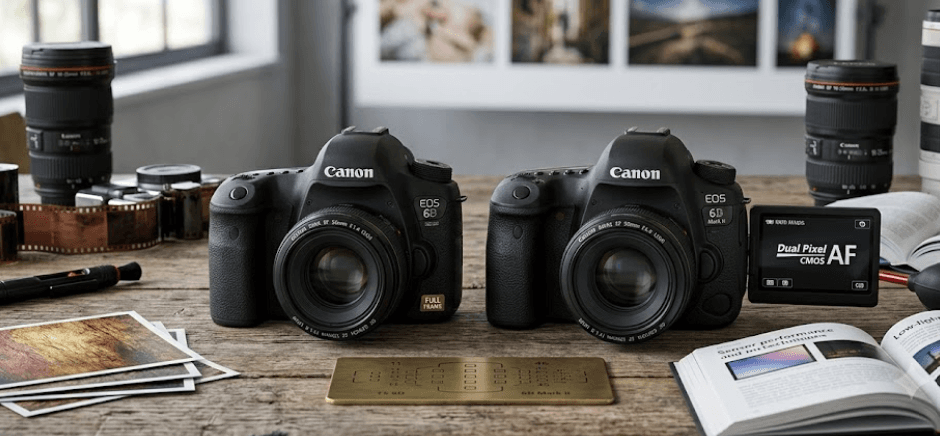
TL;DR The Canon EOS 6D and EOS 6D Mark II are both full-frame DSLRs built around Canon's EF lens mount, but the Mark II is the more capable camera for most photographers. It increases resolution from 20.2MP to 26.2MP, raises continuous shooting from 4.5fps to 6.5fps, replaces the original 6D's basic 11-point autofocus system with 45 cross-type AF points, and adds Dual Pixel CMOS AF, a vari-angle touchscreen, and 1080p video at up to 60fps. The original 6D still has strong image quality, excellent low-light center-point focusing, built-in Wi-Fi and GPS, and can be a sensible budget full-frame option on the used market. However, if the price difference is reasonable and you regularly shoot moving subjects, Live View, portraits, or video, the 6D Mark II is the more practical choice.
Canon 6D vs 6D Mark II Specifications
The biggest difference between the Canon 6D and 6D Mark II is not that one is full-frame and the other is not. Both cameras use full-frame CMOS sensors and the Canon EF mount, so they belong to the same basic system. The original EOS 6D has a 20.2MP sensor and DIGIC 5+ processor, while the EOS 6D Mark II moves to a 26.2MP sensor and DIGIC 7 processor. That extra resolution gives the Mark II more room for cropping and produces larger files, although the jump from 20.2MP to 26.2MP should not be treated as a dramatic transformation in image quality by itself. In normal photography, lens choice, exposure, light, and technique still have a major effect on the final image.
The more meaningful upgrade appears when you look beyond megapixels. The original 6D shoots at up to 4.5 frames per second and uses an 11-point autofocus system, with only its center point being cross-type. The 6D Mark II increases continuous shooting to 6.5fps and uses a 45-point all-cross-type autofocus system through the optical viewfinder. That makes the newer camera considerably more flexible for portraits, events, children, travel, and other situations where subjects do not stay perfectly still. The Mark II also adds Dual Pixel CMOS AF for Live View, which is one of its most important practical improvements over the original camera.
There are also several handling differences that become obvious once you use the cameras rather than simply compare their specification sheets. The original 6D has a fixed 3-inch LCD, while the Mark II introduces a vari-angle touchscreen that can be positioned for low-angle, high-angle, and video shooting. The 6D Mark II also weighs approximately 765g including its battery and memory card, while the original 6D weighs around 770g in the same type of comparison. So despite being newer and more capable, the Mark II does not become dramatically heavier. Both cameras use a single SD card slot and provide built-in Wi-Fi and GPS, although the Mark II adds Bluetooth as well.
Canon 6D vs 6D Mark II At A Glance
| Feature | Canon EOS 6D | Canon EOS 6D Mark II |
|---|---|---|
| Sensor | 20.2MP full-frame CMOS | 26.2MP full-frame CMOS |
| Processor | DIGIC 5+ | DIGIC 7 |
| Viewfinder AF | 11 points | 45 all-cross-type points |
| Live View AF | Contrast-based system | Dual Pixel CMOS AF |
| Continuous Shooting | 4.5fps | 6.5fps |
| LCD | 3-inch fixed | 3-inch vari-angle touchscreen |
| Video | Full HD up to 30fps | Full HD up to 60fps |
| Native ISO | 100-25,600 | 100-40,000 |
| Lens Mount | Canon EF | Canon EF |
| Storage | Single SD card | Single SD card |
| Built-in Wi-Fi | Yes | Yes |
| Built-in GPS | Yes | Yes |
| Weight | Approx. 770g | Approx. 765g |
The specifications above are based primarily on Canon's official specifications, with the original 6D's AF and shooting details cross-checked against independent testing.
Image Quality And Full-Frame Performance
Both cameras continue to benefit from the basic advantage of a full-frame sensor. Their sensor dimensions are approximately 36 x 24mm, which gives photographers access to the familiar full-frame look with wider fields of view for a given focal length and greater control over depth of field when compared with smaller sensor formats using equivalent framing. For portraits, landscapes, low-light photography, and general enthusiast shooting, that full-frame foundation is still useful even though both cameras are several generations old. The original 6D's 20.2MP sensor was already capable of producing detailed photographs, and its relatively modest resolution can actually be perfectly adequate for social media, prints, websites, and many professional applications.
The 6D Mark II increases resolution to 26.2MP, which is a useful but moderate improvement rather than a reason by itself to replace a working 6D. The additional pixels give you somewhat more flexibility when cropping and allow a little more detail in larger output. Canon also gives the Mark II a wider native ISO range of 100 to 40,000, compared with 100 to 25,600 on the original 6D. Both can be expanded to higher settings, but expanded ISO figures should not be interpreted as automatically producing better photographs. In practical use, the Mark II's sensor and processing provide a newer overall package, while the original 6D remains capable of producing very good images when paired with a quality EF lens and used correctly.
This is why the Canon 6D vs 6D Mark II image-quality debate is more complicated than simply declaring the Mark II the winner. If you photograph landscapes from a tripod, portraits in controlled light, or everyday scenes, the difference in resolution may not justify a major upgrade by itself. The Mark II becomes more compelling when image quality is combined with its autofocus, Live View, burst shooting, and screen improvements. In other words, you are not really paying for 6MP more. You are paying for a camera that is easier and more capable to use across a wider range of shooting situations. Independent testing similarly found that the 6D Mark II was generally the better camera while noting that its improvement in everyday image quality was not enormous.
Image Quality Differences
| Area | Canon 6D | Canon 6D Mark II |
|---|---|---|
| Resolution | 20.2MP | 26.2MP |
| Sensor | Full-frame CMOS | Full-frame CMOS |
| Native ISO | 100-25,600 | 100-40,000 |
| Processor | DIGIC 5+ | DIGIC 7 |
| Best Advantage | Proven full-frame image quality | Higher resolution and newer processing |
Autofocus And Shooting Performance
Autofocus is where the Mark II makes one of the clearest jumps over the original 6D. The first-generation EOS 6D uses 11 autofocus points, and only the center point is cross-type. That center point is particularly sensitive in low light and is rated down to -3 EV, which helped make the original 6D attractive to photographers who frequently worked in dim conditions. However, the limited number and central placement of its AF points can make composition and subject tracking more restrictive. If you are photographing a static landscape or carefully composing a portrait, that limitation is manageable. If your subject is moving around the frame, it becomes much more noticeable.
The EOS 6D Mark II replaces that system with 45 all-cross-type AF points through the optical viewfinder. That is a substantial improvement in focusing flexibility, and Canon also supports 27 AF points that can focus with lens combinations offering a maximum aperture of f/8. The Mark II can therefore handle a broader range of focusing situations than the original model. Its 6.5fps maximum continuous shooting speed is also meaningfully faster than the 6D's 4.5fps. For portraits, family photography, events, and occasional action, those extra frames can increase your chances of capturing the right expression or moment.
The difference becomes even more interesting in Live View. The 6D Mark II uses Canon's Dual Pixel CMOS AF, allowing phase-detection autofocus across the imaging sensor and enabling touch-based focus through its vari-angle screen. This is one of the Mark II's strongest usability improvements, particularly for video and low-angle photography. However, it is important not to oversell the camera's tracking abilities. Independent testing found limitations in viewfinder AF coverage and noted that the AF array remains relatively concentrated toward the center. The Mark II is clearly better than the 6D, but it should not be confused with the much more advanced autofocus systems found in modern mirrorless cameras.
Autofocus And Speed Compared
| Feature | Canon 6D | Canon 6D Mark II |
|---|---|---|
| AF Points | 11 | 45 |
| Cross-Type Points | 1 | 45 |
| Maximum Burst | 4.5fps | 6.5fps |
| Live View AF | Basic contrast-based system | Dual Pixel CMOS AF |
| Touch Focus | No | Yes |
| Moving Subjects | Limited | Better suited |
Video And Everyday Handling
The 6D Mark II is the easier camera to recommend if video is part of your workflow, but there is an important limitation that buyers in 2026 should understand. Neither camera offers 4K video recording. The original EOS 6D records Full HD video at up to 30fps, while the 6D Mark II increases Full HD recording to up to 60fps. The Mark II also benefits from Dual Pixel CMOS AF during Live View and video, which makes continuous focusing and focus transitions considerably more convenient than the original 6D. For casual video, interviews, travel clips, and Full HD production, that makes the Mark II more usable.
The vari-angle touchscreen is another improvement that is easy to appreciate outside the specification sheet. On the original 6D, the fixed rear display can make low-angle compositions, overhead shots, and tripod-mounted video less comfortable because you need to work around the fixed screen position. The 6D Mark II allows the screen to swing out and change angle, while touch controls make selecting a focus point much easier. This is particularly useful when shooting from a low position or when you cannot comfortably put your eye to the optical viewfinder.
For everyday photography, the difference is more subtle. Both cameras have familiar DSLR handling, optical viewfinders, EF lens compatibility, and single SD card slots. The 6D Mark II is only slightly lighter according to Canon's specifications, so portability is not a compelling reason to choose one over the other. Battery life also remains respectable for a DSLR, with Canon rating the 6D Mark II at approximately 1,200 shots under its stated test conditions. In 2026, however, buyers should remember that battery condition matters greatly when purchasing a used camera. A well-maintained original 6D with a healthy battery can be more useful than a heavily worn Mark II with a degraded battery and shutter.
Video And Handling Differences
| Feature | Canon 6D | Canon 6D Mark II |
|---|---|---|
| Maximum Video Resolution | Full HD | Full HD |
| Maximum Full HD Frame Rate | 30fps | 60fps |
| Touchscreen | No | Yes |
| Screen Type | Fixed | Vari-angle |
| Dual Pixel AF | No | Yes |
| Wi-Fi | Yes | Yes |
| GPS | Yes | Yes |
| Bluetooth | No | Yes |
Value In 2026 And Buying Used
The buying decision looks very different in 2026 because neither the Canon EOS 6D nor the EOS 6D Mark II is a current-generation camera. Canon's current camera ecosystem has moved strongly toward mirrorless EOS R models, and the 6D Mark II itself is listed through Canon's older/discontinued product ecosystem rather than as a current new-generation body. That means you should not evaluate either DSLR as though you are choosing between two new cameras in a store. The real question is whether a used or refurbished 6D or 6D Mark II gives you enough capability for the money compared with other used full-frame cameras available today.
The original 6D can make sense when the purchase price is low and your priorities are straightforward. It remains a full-frame camera with good image quality, a strong center autofocus point in low light, Wi-Fi, GPS, and access to Canon's extensive EF lens ecosystem. For a photographer moving up from an older APS-C DSLR, it can provide the full-frame experience without requiring the latest body. It is particularly reasonable for landscape, portrait, travel, and general photography where 4.5fps and an 11-point AF system are not major obstacles. The key is condition. At this age, shutter count, sensor condition, LCD condition, battery health, ports, card slot, buttons, and lens compatibility should all be checked before buying.
The 6D Mark II is the safer choice when the price gap between the two used bodies is relatively small. Its 26.2MP sensor, 45-point AF system, 6.5fps burst rate, vari-angle touchscreen, Dual Pixel CMOS AF, and Full HD 60p recording make it considerably more versatile. It is still not a modern mirrorless camera, and the lack of 4K and relatively concentrated viewfinder AF coverage are important limitations. But for someone who already owns Canon EF lenses, wants a familiar DSLR body, and needs better autofocus and Live View performance, the Mark II can remain a practical purchase. The decision should therefore be based on condition and price rather than the Mark II's age alone.
Which Camera Makes More Sense?
| Buyer Requirement | Better Choice |
|---|---|
| Lowest-cost full-frame DSLR | Canon 6D |
| Portrait Photography | Canon 6D Mark II |
| Landscape Photography | Either |
| Low-Light Center-Point AF | Canon 6D |
| Moving Subjects | Canon 6D Mark II |
| Live View Photography | Canon 6D Mark II |
| Full HD Video | Canon 6D Mark II |
| Existing EF Lens Collection | Either |
| Best Overall Capability | Canon 6D Mark II |
| Best Only If Significantly Cheaper | Canon 6D |
Frequently Asked Questions
Q. Is the Canon 6D Mark II better than the Canon 6D?
Yes. The Canon 6D Mark II is the more capable camera overall, with 26.2MP resolution, 45 all-cross-type AF points, 6.5fps continuous shooting, Dual Pixel CMOS AF, and a vari-angle touchscreen.
Q. Is the Canon 6D still worth buying in 2026?
It can be, particularly if you find a well-maintained used body at a substantially lower price than the 6D Mark II. Its 20.2MP full-frame sensor remains capable for portraits, landscapes, travel, and general photography.
Q. Does the Canon 6D Mark II have a full-frame sensor?
Yes. The EOS 6D Mark II uses an approximately 35.9 x 24.0mm full-frame CMOS sensor with 26.2 effective megapixels.
Q. How many autofocus points does the Canon 6D have?
The original Canon EOS 6D has 11 autofocus points, with only the center point being cross-type. Its center point is rated for focusing down to -3 EV under Canon's specified conditions.
Q. How many autofocus points does the Canon 6D Mark II have?
The EOS 6D Mark II has 45 all-cross-type autofocus points through the optical viewfinder. It also uses Dual Pixel CMOS AF for Live View.
Q. Does the Canon 6D Mark II shoot 4K video?
No. The EOS 6D Mark II records Full HD video, with frame rates up to 59.94fps depending on the selected video setting. It does not offer 4K recording.
Q. Which Canon 6D model is better for video?
The 6D Mark II is better for video because it supports Full HD up to 60fps, has Dual Pixel CMOS AF, and includes a vari-angle touchscreen. The original 6D is limited to Full HD up to 30fps.
Q. Is the Canon 6D Mark II good for portraits?
Yes. Its full-frame 26.2MP sensor, 45-point autofocus system, 6.5fps burst shooting, and Canon EF lens compatibility make it well suited to portrait photography. The vari-angle screen is also useful for creative compositions.
Q. Can I use the same lenses on the Canon 6D and 6D Mark II?
Yes. Both cameras use Canon's EF lens mount, so EF lenses designed for Canon's full-frame DSLR system can be used on both bodies. EF-S lenses designed for Canon APS-C DSLRs are not compatible with these full-frame bodies.
Q. Should I upgrade from the Canon 6D to the 6D Mark II?
If you regularly use Live View, photograph moving subjects, shoot video, or want a more flexible autofocus system, the 6D Mark II is a meaningful upgrade. If you mainly shoot static subjects through the optical viewfinder and your 6D already meets your needs, investing in a better lens may provide more value.
Final Recommendation
The Canon EOS 6D Mark II is the better choice for most buyers comparing these two cameras in 2026. The upgrade is not mainly about moving from 20.2MP to 26.2MP. The bigger improvements are the 45-point autofocus system, 6.5fps continuous shooting, Dual Pixel CMOS AF, vari-angle touchscreen, and Full HD 60p video. Those changes make the camera easier to use and more versatile, particularly for portraits, family photography, travel, events, Live View, and casual video.
The original Canon EOS 6D still deserves consideration when it is considerably cheaper and your photography is mostly landscape, portrait, travel, or general still photography. Its 20.2MP full-frame sensor remains capable, and its center AF point performs well in very low light. However, its 11-point autofocus system, fixed screen, 4.5fps burst rate, and older Live View system make it less flexible than the Mark II.
For a 2026 purchase, condition and price should ultimately decide the deal. If you already own Canon EF lenses and find a clean 6D Mark II at a sensible used or refurbished price, it is the model to choose. If the original 6D is substantially cheaper and your subjects are mostly static, it can still be a very capable entry into full-frame Canon photography. Neither should be bought simply because it is a full-frame DSLR, though. At this age, inspect the actual body, shutter count, battery, sensor, card slot, ports, and included accessories before paying, and compare the final cost against newer used mirrorless alternatives.
Ready to upgrade your tech?
Browse our collection of quality refurbished products at unbeatable prices.






