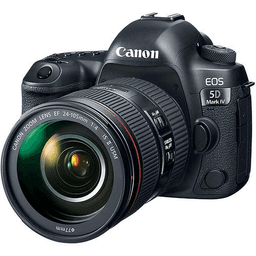
Canon 6D Mark II vs 5D Mark IV: Budget vs Pro Full Frame
The Canon 6D Mark II is the more affordable and lightweight full-frame DSLR, while the 5D Mark IV offers stronger autofocus, higher resolution, tougher construction, dual card slots, and 4K video.

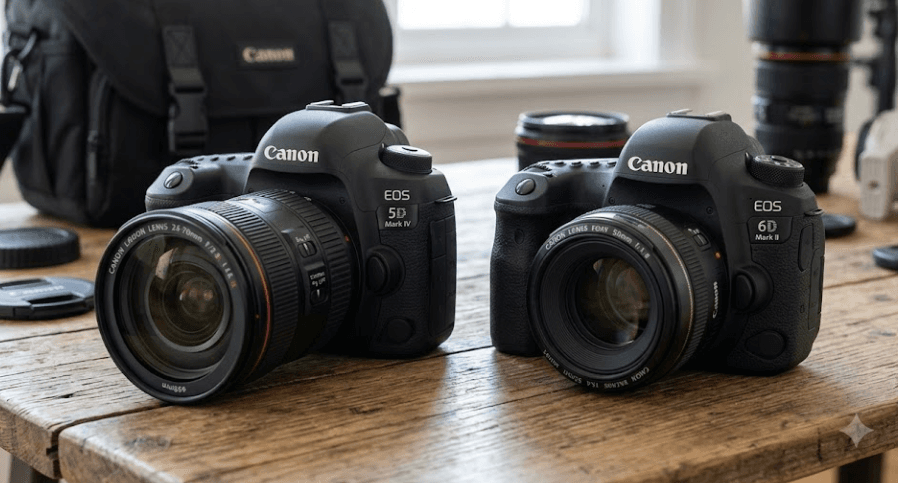
TL;DR The Canon EOS 6D Mark II and EOS 5D Mark IV are both full-frame DSLRs built around Canon's EF lens mount, but they target different photographers. The 6D Mark II is the more approachable option, with a 26.2MP sensor, 45-point all-cross-type autofocus system, 6.5 fps continuous shooting, a vari-angle touchscreen, and a lighter body. The 5D Mark IV steps up to a 30.4MP sensor, 61-point autofocus system, 7 fps shooting, a more professional body, dual card slots, and 4K DCI video. The 6D Mark II makes more sense for enthusiasts, portraits, travel, and general full-frame photography, particularly when a lower-cost body matters. The 5D Mark IV remains the stronger choice for professionals who need better autofocus coverage, greater file flexibility, tougher construction, and a more capable video system.
Canon 6D Mark II And 5D Mark IV At A Glance
The Canon EOS 6D Mark II was introduced in 2017 as a full-frame DSLR positioned below Canon's professional 5D series. It uses a 26.2MP full-frame CMOS sensor and DIGIC 7 processor, with a standard ISO range of 100 to 40,000 and expansion up to ISO 102,400. Its 45-point all cross-type autofocus system is paired with Dual Pixel CMOS AF for Live View, giving the camera a useful combination of traditional DSLR focusing and responsive Live View focusing. Canon also gave it a vari-angle touchscreen, built-in Wi-Fi, Bluetooth, NFC, and GPS, making it a relatively versatile body for its generation.
The EOS 5D Mark IV arrived earlier, in 2016, but occupies the higher professional tier in Canon's DSLR lineup. It uses a 30.4MP full-frame CMOS sensor and DIGIC 6+ processor, with a standard ISO range of 100 to 32,000 that can be expanded to ISO 50 through 102,400. Its 61-point autofocus system gives it considerably more AF coverage than the 6D Mark II, while continuous shooting reaches 7 fps. It also has a 3.2-inch touchscreen with approximately 1.62 million dots, compared with the 6D Mark II's 3-inch, approximately 1.04-million-dot vari-angle screen.
The biggest difference is therefore not simply the number of megapixels. The 5D Mark IV was designed as a more robust professional workhorse, while the 6D Mark II was intended to make full-frame photography more accessible. That distinction becomes important when you compare autofocus, build quality, card storage, video, and handling. The 6D Mark II can produce excellent full-frame images, but the 5D Mark IV gives working photographers more tools for demanding assignments. DPReview's comparison similarly places the 5D Mark IV ahead for build quality, autofocus, and performance, while the 6D Mark II has advantages such as its articulating screen and lower-weight body.
Key Specifications Compared
| Feature | Canon EOS 6D Mark II | Canon EOS 5D Mark IV |
|---|---|---|
| Sensor | 26.2MP full-frame CMOS | 30.4MP full-frame CMOS |
| Processor | DIGIC 7 | DIGIC 6+ |
| ISO Range | 100-40,000 | 100-32,000 |
| Expanded ISO | 50-102,400 | 50-102,400 |
| Autofocus | 45-point, all cross-type | 61-point, 41 cross-type |
| Continuous Shooting | Up to 6.5 fps | Up to 7 fps |
| Rear Screen | 3-inch vari-angle touchscreen | 3.2-inch touchscreen |
| Screen Resolution | Approx. 1.04 million dots | Approx. 1.62 million dots |
| Video | Full HD 60p | 4K DCI up to 30p |
| Card Slots | 1 SD | 1 CF + 1 SD |
| Weight | Approx. 765g body only | Approx. 800g body only |
The specifications show why the two cameras should not be treated as identical alternatives.
Image Quality And Sensor Performance
Both cameras use full-frame sensors, so both can produce the shallow depth of field, tonal separation, and low-light performance that photographers often want when moving up from an APS-C camera. The 5D Mark IV has the resolution advantage at 30.4MP compared with 26.2MP on the 6D Mark II. The difference is not enormous, and it does not mean every photograph from the 5D Mark IV will automatically look better. Lens quality, exposure, lighting, focusing, and post-processing remain major factors. However, the additional resolution gives the 5D Mark IV more room for cropping and large prints when the original image is well captured.
The 6D Mark II is particularly appealing for photographers who want full-frame image quality without moving into the more expensive 5D line. Its 26.2MP sensor provides plenty of resolution for portraits, events, travel photography, family photographs, and online publishing. Its higher standard maximum ISO of 40,000 also looks impressive on the specification sheet, although ISO range alone should not be treated as a direct measure of image quality. In practical photography, both cameras can operate at high ISO, but the 5D Mark IV has an advantage in base-ISO dynamic range and overall RAW flexibility according to independent testing.
That distinction is particularly important for landscape and commercial photographers. If you routinely recover shadows, balance bright skies, or make significant adjustments to RAW files, the 5D Mark IV is the more capable of these two bodies. DPReview specifically noted limitations in the 6D Mark II's lower-ISO dynamic range, which reduces flexibility when heavily processing files. For casual shooting, this may never become a serious problem. For professional workflows where exposure latitude matters, however, it is a genuine reason to choose the 5D Mark IV.
Which Camera Wins For Image Quality?
| Requirement | Better Choice | Why |
|---|---|---|
| Maximum resolution | 5D Mark IV | 30.4MP sensor |
| Everyday full-frame photography | 6D Mark II | Strong image quality with simpler positioning |
| Heavy RAW processing | 5D Mark IV | Better base-ISO dynamic range |
| Large prints and cropping | 5D Mark IV | Higher resolution |
| Portrait photography | Both | Full-frame sensors and Canon EF lens support |
Autofocus And Shooting Performance
Autofocus is one of the clearest areas where the 5D Mark IV separates itself from the 6D Mark II. The 5D Mark IV has 61 AF points, including 41 cross-type points, while the 6D Mark II has 45 AF points, all of them cross-type. More importantly, the 5D Mark IV's AF system provides broader coverage and is better suited to tracking subjects that move unpredictably. This makes it more attractive for sports, wildlife, weddings, and other situations where missing focus can mean losing the photograph entirely.
The 6D Mark II should not be dismissed as a slow or incapable camera. Its 45-point AF system is perfectly usable for portraits, events, travel, and general photography, while its Dual Pixel CMOS AF works particularly well when composing through Live View. The camera can shoot at up to 6.5 fps, which is only slightly behind the 5D Mark IV's 7 fps. For a photographer primarily shooting people who are relatively predictable, landscapes, architecture, or everyday subjects, that small difference may not matter much.
The 5D Mark IV's advantage becomes more obvious when the subject is moving quickly. A professional sports or wildlife photographer benefits from the combination of a denser AF system, stronger tracking capabilities, and slightly faster continuous shooting. The difference between 6.5 fps and 7 fps is not dramatic by modern standards, but the overall autofocus system makes the 5D Mark IV the more dependable tool for demanding action work. Neither camera competes with today's fastest mirrorless bodies, but between these two DSLRs, the 5D Mark IV is the clear performance choice.
Autofocus Comparison
| Feature | EOS 6D Mark II | EOS 5D Mark IV |
|---|---|---|
| AF Points | 45 | 61 |
| Cross-Type Points | 45 | 41 |
| Continuous Shooting | 6.5 fps | 7 fps |
| Live View AF | Dual Pixel CMOS AF | Dual Pixel CMOS AF |
| Best Suited To | Portraits, events, general use | Sports, wildlife, professional events |
Build Quality And Everyday Handling
The 6D Mark II is lighter, weighing approximately 765g with the battery and card, while the 5D Mark IV weighs approximately 800g. The difference is only around 35g, so neither camera qualifies as genuinely lightweight by modern mirrorless standards. Still, the 6D Mark II's body is slightly easier to carry when paired with a full-frame zoom or telephoto lens, and that can make a difference during travel or long shooting sessions.
The bigger distinction is construction and handling. The 5D Mark IV uses a more professional body design and offers the kind of physical controls and durability expected from Canon's higher-end DSLR line. It also has two card slots, with one CF slot and one SD slot. That matters for professional photographers who want an immediate backup of important photographs or need to separate different types of files. The 6D Mark II has a single SD card slot, which is adequate for personal work but less reassuring for paid assignments where redundancy can be important.
The 6D Mark II does have one handling feature that the 5D Mark IV does not: its vari-angle rear touchscreen. The screen can be tilted and rotated for shooting from low or awkward angles, which is useful for architecture, macro photography, travel, and video-style composition. The 5D Mark IV instead uses a fixed touchscreen with higher resolution. Therefore, the professional 5D Mark IV has the stronger overall body and control system, while the 6D Mark II offers a more flexible rear screen.
Build And Handling Comparison
| Feature | EOS 6D Mark II | EOS 5D Mark IV |
|---|---|---|
| Body Weight | Approx. 765g | Approx. 800g |
| Rear Screen | Vari-angle touchscreen | Fixed touchscreen |
| Card Slots | 1 SD | CF + SD |
| Body Positioning | Enthusiast full-frame | Professional full-frame |
| Handling Advantage | Articulating screen | More professional controls and build |
Video Features And Connectivity
Video is another area where the 5D Mark IV has a clear technical advantage. It can record DCI 4K video at up to 30 fps, along with Full HD recording at up to 60 fps and HD recording at up to 120 fps. Canon also included Dual Pixel CMOS AF for Live View and video focusing. One important detail for buyers is that the 5D Mark IV's 4K implementation uses a crop, so its 4K footage does not use the full width of the sensor.
The 6D Mark II is much more limited for video. It can record Full HD at up to 60 fps and offers Dual Pixel CMOS AF for smooth Live View focusing, but it does not record conventional 4K video. Canon lists 4K time-lapse movie functionality, which is different from recording normal 4K footage. This distinction is important because older product listings sometimes describe the camera as having "4K" without explaining that it refers to time-lapse functionality.
For connectivity, the 6D Mark II has built-in Wi-Fi, Bluetooth, NFC, and GPS, giving it a useful feature set for transferring images, remote shooting, and location tagging. The 5D Mark IV also includes built-in Wi-Fi and GPS, along with its professional workflow features. If video is an important part of your purchase decision, the 5D Mark IV is clearly preferable between the two. If you mainly shoot still photographs and want convenient wireless connectivity, the 6D Mark II remains well equipped for its age.
Video Comparison
| Feature | EOS 6D Mark II | EOS 5D Mark IV |
|---|---|---|
| Maximum Standard Video | Full HD 60p | 4K DCI 30p |
| 4K Video Recording | No | Yes |
| 4K Time-Lapse | Yes | Yes |
| Dual Pixel CMOS AF | Yes | Yes |
| Full HD | Up to 60p | Up to 60p |
| HD Slow Motion | Not the same 120p HD mode as 5D IV | Up to 120p HD |
Price And Value In The Used Market
Because both cameras are older DSLRs, buying them in 2026 is primarily a used-market decision rather than a comparison of current flagship cameras. New-stock prices can be misleading because these models have been discontinued from many normal retail channels, while remaining listings may carry unusually high prices. For example, an Amazon India listing for the 5D Mark IV currently shows a very high price, which should not be treated as a realistic indication of its used-market value. Condition, shutter count, accessories, and seller reputation can have a much greater impact on what represents a good deal.
The 6D Mark II generally makes the most sense when the goal is to enter Canon full-frame photography at a lower cost. A photographer who already owns EF lenses can potentially build a capable full-frame kit without spending on the newest mirrorless ecosystem. Its 26.2MP sensor, good high-ISO range, Dual Pixel CMOS AF, GPS, Wi-Fi, and vari-angle screen give it a useful combination for enthusiasts. The camera's limitations become more noticeable when the work requires professional redundancy, advanced autofocus tracking, or 4K video.
The 5D Mark IV makes more sense when the camera itself is expected to be part of a professional workflow. The higher resolution, more sophisticated autofocus system, dual card slots, tougher construction, and 4K recording give it advantages that can justify paying more for a clean used body. However, buyers should also consider the age of the platform. In 2026, a used 5D Mark IV should be evaluated against newer Canon mirrorless options rather than assuming that its original professional status automatically makes it the better purchase today.
Value Comparison
| Buyer Priority | Better Choice |
|---|---|
| Lower-cost full-frame DSLR | EOS 6D Mark II |
| Professional assignments | EOS 5D Mark IV |
| 4K video | EOS 5D Mark IV |
| Lightweight body | EOS 6D Mark II |
| Dual card slots | EOS 5D Mark IV |
| Vari-angle screen | EOS 6D Mark II |
| Advanced action AF | EOS 5D Mark IV |
Which Photographer Should Buy Each Camera?
The Canon EOS 6D Mark II is the better fit for photographers who want full-frame photography without needing every professional feature. It works particularly well for portraits, travel, family photography, events, and general-purpose shooting. The vari-angle screen is genuinely useful when you need unusual shooting angles, while the 26.2MP sensor provides enough resolution for most everyday photographic work. If your existing Canon EF lenses are already part of your kit, the 6D Mark II can also be an affordable way to move into full-frame DSLR photography.
The EOS 5D Mark IV is better suited to photographers whose work depends on consistency and flexibility. Wedding photographers, commercial photographers, landscape shooters, wildlife enthusiasts, and professionals working on paid assignments can benefit from its 61-point AF system, 30.4MP sensor, dual card slots, and stronger body design. The 4K video capability also gives it a substantial advantage if photography and video need to coexist in the same workflow. These advantages do not make every photograph better, but they give the photographer more room when conditions become difficult.
There is also a simple way to approach the decision in 2026. If you find a clean 6D Mark II at a compelling used price and your work is primarily still photography, it can still be a sensible full-frame DSLR. If the price difference to a clean 5D Mark IV is relatively small and you need its autofocus, dual-card workflow, resolution, or 4K video, spending more on the 5D Mark IV is easier to justify. At this age, condition and actual use case should matter more than the original launch positioning of either camera.
Common Buying Mistakes To Avoid
One common mistake is assuming that the 5D Mark IV's higher megapixel count automatically makes it dramatically better for every type of photography. The difference between 30.4MP and 26.2MP is useful, particularly for cropping and large prints, but it is not large enough to define the entire buying decision. A photographer using good lenses and sensible exposure techniques can get excellent results from the 6D Mark II. The more meaningful differences appear when you look at autofocus coverage, RAW flexibility, professional handling, card redundancy, and video features.
Another mistake is buying the 6D Mark II because a listing claims that it offers 4K video. Canon's official specifications make the distinction clear: the camera supports 4K time-lapse movies, but normal movie recording tops out at Full HD 60p. The 5D Mark IV, in contrast, can record DCI 4K at up to 30p. Anyone buying primarily for video should check the exact recording modes rather than relying on a seller's headline specification.
Finally, buyers should not ignore the condition of an older DSLR. Shutter count, sensor condition, mirror operation, autofocus accuracy, battery health, card-slot operation, LCD condition, and included accessories all deserve attention when buying used. A professionally maintained 5D Mark IV can be a better purchase than a heavily used body offered at a seemingly attractive price. The same applies to the 6D Mark II. In 2026, the condition of the individual camera can be just as important as the difference between the two models.
Frequently Asked Questions
Q. Which is better, the Canon 6D Mark II or 5D Mark IV?
The Canon 5D Mark IV is the more capable camera overall because it offers a 30.4MP sensor, 61-point autofocus system, 7 fps continuous shooting, dual card slots, stronger professional construction, and 4K video. The 6D Mark II is the better value-oriented option for photographers who do not need those professional features.
Q. Is the Canon 6D Mark II still good in 2026?
Yes. The 6D Mark II can still be a capable full-frame DSLR for portraits, travel, events, and general photography. Its 26.2MP sensor, 45-point all cross-type AF system, Dual Pixel CMOS AF, and vari-angle touchscreen remain useful. Its limitations are more obvious for demanding RAW processing, professional action photography, and modern video requirements.
Q. Does the Canon 6D Mark II shoot 4K video?
No. The 6D Mark II does not record conventional 4K video. It supports 4K time-lapse movies, while normal movie recording goes up to Full HD 60p.
Q. Does the Canon 5D Mark IV shoot 4K video?
Yes. The 5D Mark IV can record DCI 4K at up to 30 fps and also supports Full HD recording up to 60 fps and HD recording up to 120 fps. Its 4K mode uses a crop of the sensor.
Q. Which camera has better autofocus?
The Canon 5D Mark IV has the stronger autofocus system overall. It provides 61 AF points, including 41 cross-type points, compared with 45 all cross-type points on the 6D Mark II. Its AF system is better suited to demanding moving-subject photography.
Q. Which camera has better image quality?
The 5D Mark IV has the advantage in resolution and base-ISO dynamic range, making it better suited to photographers who frequently crop images or make substantial RAW adjustments. The 6D Mark II can still produce excellent full-frame images, particularly for general photography and portraits.
Q. Is the Canon 6D Mark II lighter than the 5D Mark IV?
Yes. The 6D Mark II weighs approximately 765g, while the 5D Mark IV weighs approximately 800g with the battery and card. The difference is modest, but the 6D Mark II is the lighter body.
Q. Which camera is better for professional photography?
The 5D Mark IV is better suited to professional photography because of its stronger autofocus system, dual card slots, higher resolution, professional-oriented construction, and broader video capabilities. The 6D Mark II can still handle paid work, but the 5D Mark IV offers more safeguards and flexibility for demanding assignments.
Q. Which camera has a better screen?
The answer depends on what you value. The 5D Mark IV has the larger and higher-resolution 3.2-inch touchscreen, while the 6D Mark II has a 3-inch vari-angle touchscreen. The 5D Mark IV wins for screen resolution and size, while the 6D Mark II wins for physical screen flexibility.
Q. Should you buy the Canon 6D Mark II or 5D Mark IV in 2026?
Choose the 6D Mark II if you want an affordable full-frame DSLR mainly for still photography. Choose the 5D Mark IV if you need stronger autofocus, higher resolution, dual card slots, professional handling, or 4K video. For either model, prioritize a clean, well-maintained used body over a bargain price on a heavily used camera.
Final Recommendation
The Canon EOS 6D Mark II is the better budget full-frame DSLR, while the Canon EOS 5D Mark IV is the better professional tool. The 6D Mark II delivers the essential full-frame experience with a 26.2MP sensor, 45-point autofocus, Dual Pixel CMOS AF, a vari-angle touchscreen, and a lighter body. It is a sensible choice for enthusiasts, portrait photographers, travellers, and anyone who wants to enter Canon full-frame photography without paying for features they may never use.
The 5D Mark IV is worth choosing when your photography demands more. Its 30.4MP sensor, 61-point AF system, 7 fps shooting, dual card slots, stronger professional construction, and genuine 4K video make it the more complete camera for demanding workflows. It is especially compelling for wedding, wildlife, commercial, landscape, and professional event photography where autofocus reliability, file flexibility, and backup storage matter.
For a buyer in 2026, however, there is one final consideration: buy based on condition and price, not simply on the model's original market position. A clean 6D Mark II can be excellent value if your needs are straightforward, while a well-maintained 5D Mark IV makes more sense when its professional features will actually be used. If the budget allows and you need the extra capabilities, the 5D Mark IV is the stronger long-term pick between these two. If keeping costs down is the priority, the 6D Mark II remains the smarter value choice.
Ready to upgrade your tech?
Browse our collection of quality refurbished products at unbeatable prices.