
Canon 60D vs 70D vs 80D vs 90D: Canon Series Comparison
Canon's 60D, 70D, 80D and 90D show how the xxD series evolved from an 18MP enthusiast DSLR into a 32.5MP camera with faster shooting, advanced autofocus and 4K video.

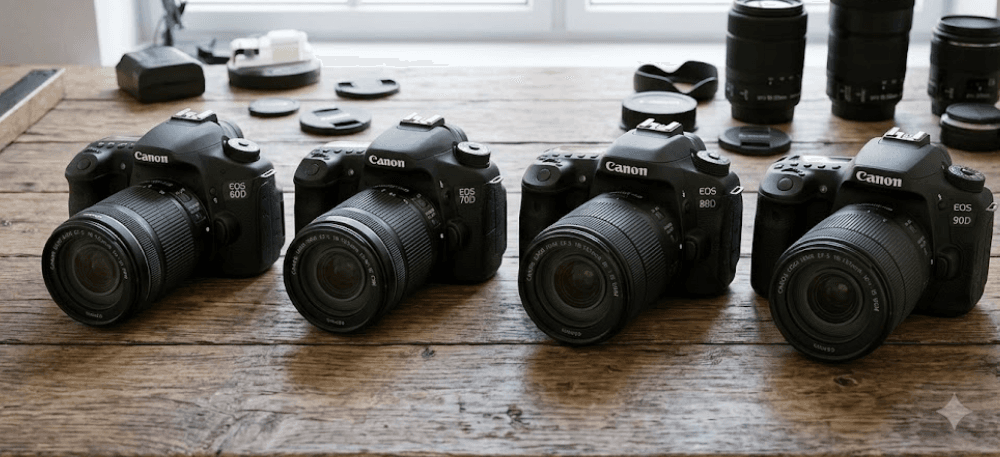
TL;DR The Canon EOS 90D is the strongest camera in this comparison if you want the best overall performance from the Canon xxD DSLR series, with a 32.5MP APS-C sensor, up to 10 fps through the viewfinder, up to 11 fps in Live View, Dual Pixel CMOS AF, and 4K video. The EOS 80D is the better middle ground for buyers who want a capable 24.2MP sensor, 45-point all-cross-type autofocus system, and Full HD video without paying for the 90D. The EOS 70D remains important because it introduced Dual Pixel CMOS AF to Canon's DSLR lineup, while the EOS 60D is now the oldest and most basic option of the four.
Canon xxD Series Evolution
The Canon xxD series has changed significantly between the EOS 60D and EOS 90D, even though all four cameras belong to the same enthusiast-oriented DSLR family. The EOS 60D arrived in 2010 with an 18MP APS-C CMOS sensor and DIGIC 4 processing, while the EOS 70D moved to a 20.2MP sensor and DIGIC 5+ processing in 2013. Canon then increased resolution to 24.2MP with the EOS 80D in 2016, before making a much larger jump to 32.5MP with the EOS 90D in 2019. The progression was not simply about megapixels. Autofocus, continuous shooting, Live View focusing, connectivity and video capabilities also became considerably more advanced as the series developed.
The biggest generational change came with the EOS 70D. While the EOS 60D used a conventional phase-detection autofocus system with nine AF points, the 70D introduced Canon's Dual Pixel CMOS AF system for Live View shooting. It also increased the viewfinder AF system to 19 all-cross-type points and raised the maximum continuous shooting speed from approximately 5.3 fps on the 60D to 7 fps. The EOS 80D kept the 7 fps shooting rate but significantly expanded the viewfinder autofocus system to 45 all-cross-type AF points. This made the 80D much more capable for moving subjects and gave photographers a more sophisticated focusing system without moving away from the familiar DSLR design.
The EOS 90D represents the biggest performance jump in the group. Its 32.5MP APS-C sensor provides substantially more resolution than the 60D, while its DIGIC 8 processor supports faster shooting and newer features. Canon rates the 90D at up to approximately 10 shots per second using the optical viewfinder and up to 11 shots per second in Live View, while its viewfinder autofocus system uses up to 45 cross-type AF points. It also adds 4K movie recording and retains Dual Pixel CMOS AF for Live View and movie shooting. For someone comparing these cameras today, this makes the 90D the most modern and capable DSLR in the four-generation lineup.
Canon xxD Series At A Glance
| Feature | Canon EOS 60D | Canon EOS 70D | Canon EOS 80D | Canon EOS 90D |
|---|---|---|---|---|
| Launch year | 2010 | 2013 | 2016 | 2019 |
| Sensor | 18MP APS-C | 20.2MP APS-C | 24.2MP APS-C | 32.5MP APS-C |
| Processor | DIGIC 4 | DIGIC 5+ | DIGIC 6 | DIGIC 8 |
| Viewfinder AF | 9 points | 19 points | 45 points | Up to 45 points |
| Max burst | 5.3 fps | 7 fps | 7 fps | 10 fps |
| Live View AF | Contrast/phase detection | Dual Pixel CMOS AF | Dual Pixel CMOS AF | Dual Pixel CMOS AF |
| Video | Full HD | Full HD | Full HD | 4K |
| Screen | 3-inch articulating | 3-inch articulating | 3-inch articulating touchscreen | 3-inch articulating touchscreen |
Specifications are based primarily on Canon's published specifications for each model.
Image Quality And Sensor Performance
The EOS 60D can still produce useful images because its 18MP APS-C sensor is capable of capturing enough detail for everyday photography, portraits, travel and many enthusiast applications. However, the newer cameras give you considerably more room to crop and edit. The 70D increases resolution to 20.2MP, the 80D reaches 24.2MP, and the 90D goes all the way to 32.5MP. That difference becomes especially noticeable when you crop wildlife, sports or distant subjects. The 90D therefore has a clear advantage when maximum detail and cropping flexibility matter, although megapixels alone do not guarantee better photographs. Lens quality, exposure, technique and lighting remain important regardless of the camera body.
The EOS 80D is arguably the most sensible point in the series if you want a noticeable image-quality improvement without specifically needing the 90D's very high resolution. Its 24.2MP sensor gives you a useful balance between detail and file size, while the camera's ISO range and DIGIC 6 processing represent a substantial step forward from the older 60D. The 70D also remains capable, particularly for photographers who find a good used body at an attractive price. However, if you are choosing between these models based primarily on sensor generation, the 80D is a much more meaningful upgrade from the 60D than the relatively modest resolution increase of the 70D.
The 90D takes the resolution advantage further with its 32.5MP APS-C sensor. That is useful for wildlife and outdoor photography because a photographer can crop into an image while retaining more pixels than with the older models. The camera also supports 14-bit RAW recording, giving photographers substantial flexibility when editing exposure and colour. At the same time, the 90D's high resolution means storage requirements can increase, especially when shooting large RAW files continuously. In practical terms, the 90D is the clear winner for photographers who value maximum detail, while the 80D remains a very strong choice for general photography where 24.2MP is already more than enough.
Sensor Comparison
| Model | Resolution | Best Advantage |
|---|---|---|
| EOS 60D | 18MP | Basic enthusiast photography |
| EOS 70D | 20.2MP | Improved AF and Live View |
| EOS 80D | 24.2MP | Balanced image quality |
| EOS 90D | 32.5MP | Maximum detail and cropping |
Autofocus And Shooting Speed
Autofocus is one of the clearest reasons to choose a newer xxD camera. The EOS 60D has nine AF points, while the EOS 70D increases that number to 19, with all 19 points being cross-type under Canon's specified conditions. The EOS 70D also introduced Dual Pixel CMOS AF for Live View, which was a major change for Canon DSLRs. Instead of relying only on contrast-based focusing during Live View, the system used phase-detection technology across the sensor to make focusing more practical for subjects viewed on the rear screen. This became an important foundation for later Canon cameras and makes the 70D much more attractive than the 60D for photographers who regularly use Live View.
The EOS 80D improves the viewfinder experience further with 45 all-cross-type AF points and a focusing system designed to handle a wider variety of subjects. Its 7 fps continuous shooting speed is also useful for action, children, pets and sports. The EOS 70D can also shoot at up to 7 fps, so the upgrade from 70D to 80D is not primarily about burst speed. Instead, the 80D gives you a more capable autofocus system, a newer sensor and improved overall handling. This is why the 80D can make more sense than the 70D for photographers who shoot moving subjects regularly but do not need the higher performance of the 90D.
The EOS 90D moves ahead again, offering up to 10 fps when shooting through the optical viewfinder and up to 11 fps in Live View under Canon's specified conditions. Its viewfinder system also provides up to 45 cross-type AF points, while Live View uses Dual Pixel CMOS AF with a much larger selection of focus positions. Canon also includes Eye Detection AF in Live View. This combination makes the 90D substantially more suitable for wildlife, sports and other subjects where timing and tracking matter. The 60D can still handle static and moderately moving subjects, but there is a very clear progression in focusing and shooting speed across the four generations.
Autofocus And Speed Comparison
| Model | Viewfinder AF | Continuous Shooting | Live View AF |
|---|---|---|---|
| EOS 60D | 9 points | 5.3 fps | Older system |
| EOS 70D | 19 cross-type points | 7 fps | Dual Pixel CMOS AF |
| EOS 80D | 45 cross-type points | 7 fps | Dual Pixel CMOS AF |
| EOS 90D | Up to 45 cross-type points | 10 fps | Dual Pixel CMOS AF, Eye Detection |
Video And Everyday Features
Video is another area where the EOS 90D has an obvious advantage. The EOS 60D, 70D and 80D are fundamentally Full HD cameras, although the newer models provide progressively better autofocus and video-oriented controls. The EOS 70D was particularly significant because Dual Pixel CMOS AF made continuous focusing during Live View and movie recording more useful. The EOS 80D continued this approach and added features such as headphone monitoring, giving it a more practical position for enthusiasts who also wanted to record video.
The EOS 90D is the only model in this comparison with 4K movie recording. Canon specifies 4K recording at 3840 × 2160, along with Full HD and HD recording modes. It also provides Movie Servo AF, external microphone support and headphone monitoring. The camera's vari-angle touchscreen makes it easier to frame yourself or shoot from unusual angles, which can be useful for creators, interviews and travel videos. This does not automatically make the 90D a better video camera than every modern mirrorless model, but within this four-camera comparison, its video feature set is clearly the most advanced.
Connectivity and handling also improved over the generations. The 70D introduced built-in Wi-Fi and NFC, while the 80D continued with wireless connectivity. The 90D adds Wi-Fi and Bluetooth alongside its newer processing platform. All four cameras use Canon's EF mount and can use EF and EF-S lenses, which means an existing compatible lens collection can be a major reason to stay with this DSLR family. However, buyers should remember that these cameras are from different generations, and the newest 90D is still a DSLR rather than a modern mirrorless body. If compactness, electronic viewfinders or newer mirrorless autofocus features are priorities, a newer Canon EOS R-series camera may be worth considering instead.
Video Comparison
| Model | Maximum Video Resolution | Touchscreen | Key Video Advantage |
|---|---|---|---|
| EOS 60D | Full HD | No | Basic DSLR video |
| EOS 70D | Full HD | Yes | Dual Pixel CMOS AF |
| EOS 80D | Full HD | Yes | Improved video controls |
| EOS 90D | 4K | Yes | 4K and advanced AF |
Which Canon xxD Camera Should You Buy?
Choosing between the four cameras makes the most sense when you consider the type of photography you actually do. The EOS 60D is the budget-oriented option, but its age means you should buy it only if the price is low and your requirements are basic. The EOS 70D is more interesting because its 20.2MP sensor, 19-point autofocus, and Dual Pixel CMOS AF give it a meaningful advantage over the 60D. For someone learning photography or looking for an inexpensive used DSLR, the 70D can still be a practical starting point when the camera is in good condition.
The EOS 80D is the strongest middle-ground choice. Its 24.2MP sensor, 45-point all-cross-type autofocus system, 7 fps continuous shooting, and Dual Pixel CMOS AF give it a balanced feature set for photography, Live View, and Full HD video. It is particularly appealing to enthusiasts who want a more capable camera than the 70D without specifically needing the 90D's 32.5MP sensor and faster burst rate. If you are buying used, the condition of the individual body, shutter count, battery health, and included accessories can matter as much as the generation itself.
The EOS 90D is the obvious choice if you want the highest performance available from this particular xxD line-up. Its 32.5MP sensor, DIGIC 8 processor, 10 fps optical-viewfinder shooting, 11 fps Live View shooting, 45-point viewfinder AF system, Dual Pixel CMOS AF, and 4K recording give it a substantial advantage over the older cameras. Wildlife photographers, sports shooters, and creators who want a DSLR with strong resolution and modern features will benefit most from the 90D. For casual photography, however, paying significantly more for the 90D may not be necessary if a clean 80D already meets your needs.
Best Canon xxD Camera By User
| User Type | Best Choice | Why |
|---|---|---|
| Beginner on a tight budget | EOS 60D | Basic DSLR experience at potentially low used prices |
| Affordable enthusiast | EOS 70D | Dual Pixel CMOS AF and 7 fps shooting |
| Best overall value | EOS 80D | Strong balance of image quality, AF and features |
| Wildlife and sports | EOS 90D | 32.5MP resolution and up to 10 fps viewfinder shooting |
| Video-focused DSLR user | EOS 90D | 4K recording and advanced Live View AF |
| General photography | EOS 80D | Good balance without the 90D's extra resolution |
Frequently Asked Questions
Q. Which Canon camera is best between the 60D, 70D, 80D and 90D?
The EOS 90D is the strongest overall camera because it has the highest 32.5MP resolution, fastest shooting speed, and most advanced feature set in this comparison. The EOS 80D is the better value-oriented choice if you do not need 4K or the 90D's higher resolution.
Q. Is the Canon 90D much better than the 80D?
Yes, particularly for wildlife, sports and video. The 90D increases resolution from 24.2MP to 32.5MP, raises maximum viewfinder shooting speed from 7 fps to 10 fps, and adds 4K video.
Q. Is the Canon 80D still good for photography?
Yes. Its 24.2MP APS-C sensor, 45-point all-cross-type autofocus system and 7 fps continuous shooting make it a capable enthusiast DSLR for portraits, travel, events, and general photography.
Q. Is the Canon 70D better than the 60D?
Yes. The 70D has a 20.2MP sensor compared with 18MP on the 60D, increases the viewfinder AF system from nine points to 19 all-cross-type points, and adds Dual Pixel CMOS AF for Live View.
Q. Does the Canon 90D have 4K video?
Yes. The EOS 90D can record 4K video at 3840 × 2160, along with Full HD and HD formats.
Q. Which Canon xxD camera has the highest megapixel count?
The EOS 90D has the highest resolution at approximately 32.5MP. The 80D has 24.2MP, the 70D has 20.2MP, and the 60D has 18MP.
Q. Which camera is better for wildlife, the 80D or 90D?
The EOS 90D is better suited to wildlife because it offers higher resolution and faster continuous shooting. Its 32.5MP sensor also gives you more cropping flexibility when the subject is far away.
Q. Which Canon camera has the fastest continuous shooting?
The EOS 90D is the fastest of these four. Canon rates it at up to approximately 10 fps through the optical viewfinder and 11 fps in Live View under specified conditions.
Q. Do the Canon 60D, 70D, 80D and 90D use the same lenses?
They use Canon's EF mount and support Canon EF and EF-S lenses. EF-M lenses are not compatible with these cameras.
Q. Should you buy a Canon 60D in 2026?
The 60D can still make sense as a very inexpensive used DSLR for basic photography, but its age means the 70D or 80D is generally a more sensible choice if the price difference is reasonable. The 90D is the better choice when you want the strongest performance and longer-term capability from this group.
Final Recommendation
The Canon EOS 90D is the clear winner of the Canon 60D vs 70D vs 80D vs 90D comparison. It combines the highest 32.5MP resolution, fastest burst shooting, advanced Dual Pixel CMOS AF and 4K video, making it the most capable option for wildlife, sports, travel and hybrid photo-video work.
The Canon EOS 80D is the smarter value choice if you want a capable enthusiast DSLR without needing every feature of the 90D. Its 24.2MP sensor, 45-point autofocus system and 7 fps shooting remain well suited to everyday photography. The EOS 70D is worth considering when its used price is substantially lower, particularly because Dual Pixel CMOS AF makes it a meaningful step above the 60D. The EOS 60D should mainly be considered when the lowest possible entry price matters more than newer autofocus, resolution and video features.
If you are buying one of these cameras today, prioritize the condition of the used body and the lenses included with it rather than assuming the newest generation is automatically the best value. For maximum capability, choose the 90D. For balanced value, choose the 80D. For a lower-cost enthusiast DSLR, consider the 70D, while the 60D is best reserved for very budget-conscious buyers.
Ready to upgrade your tech?
Browse our collection of quality refurbished products at unbeatable prices.






