Canon 200D vs Nikon D3400: Which Beginner DSLR Kit Gives More for Your Money?
Canon 200D and Nikon D3400 remain capable beginner DSLRs in 2026. Compare their image quality, autofocus, battery, screens, connectivity, and kit value to find the better used or refurbished buy.

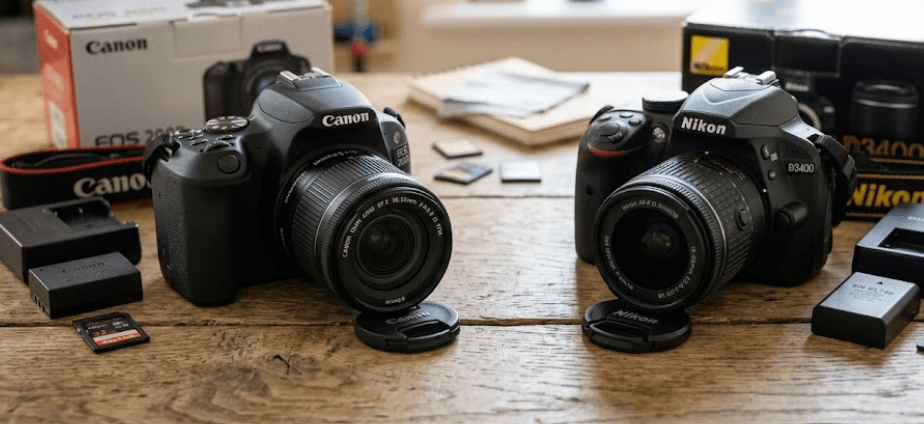
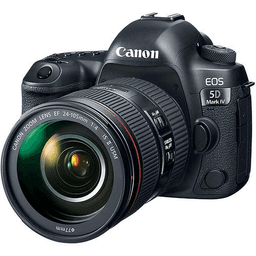
TL;DR The Canon EOS 200D and Nikon D3400 are both 24.2MP APS-C beginner DSLRs, but they take different approaches to usability. The Nikon D3400 has the edge in battery life, with a CIPA rating of around 1,200 shots, while the Canon 200D offers a much more flexible 3-inch vari-angle touchscreen, Dual Pixel CMOS autofocus in Live View, Wi-Fi, Bluetooth, and NFC. Both can record Full HD video at up to 60fps and shoot at roughly 5fps, so neither is a poor choice for learning photography. In 2026, however, both are discontinued models, which means condition, shutter count, included lens, battery health, and warranty can matter more than the original launch price. For most beginners, the Canon 200D is the more versatile camera, while the Nikon D3400 makes more sense if battery life and simple still photography are the priorities.
Canon 200D Vs Nikon D3400: What Has Changed By 2026
The Canon EOS 200D and Nikon D3400 were designed as entry-level DSLRs at a time when beginners were still choosing between affordable DSLRs and early mirrorless cameras. The Canon 200D was introduced in 2017, while the Nikon D3400 arrived in 2016. Both use APS-C-sized sensors with 24.2MP effective resolution, so neither camera is starting from a weak image-quality foundation. For someone learning exposure, aperture, shutter speed, ISO, composition, and interchangeable-lens photography, either camera can still provide a genuine photography experience rather than the simplified controls of a typical point-and-shoot device.
The important difference in 2026 is that these are no longer current-generation cameras. The Canon 200D is discontinued, and the Nikon D3400 is also an older discontinued DSLR. That changes how you should think about value. Instead of comparing them like two current cameras sitting next to each other on a retail shelf, you should compare the condition of the individual unit, the lens included in the kit, battery health, shutter count, accessories, and whether the seller provides any meaningful warranty. A cheaper camera with a damaged kit lens or exhausted battery may not actually be the better deal.
This also means the phrase "kit gives more for your money" needs some context. A kit is only valuable if the included lens suits what you want to photograph. The standard 18-55mm kit lens on either system is useful for portraits, family photographs, travel, street photography, and everyday learning, but it will not replace a telephoto lens for distant subjects. If two listings have similar prices, compare the complete package rather than choosing based only on the camera body. In the 2026 used and refurbished market, a clean camera with a good 18-55mm lens can be a much smarter beginner purchase than a cheaper body sold without a useful lens.
2026 Buying Position
| Factor | Canon EOS 200D | Nikon D3400 |
|---|---|---|
| Launch period | 2017 | 2016 |
| Status in 2026 | Discontinued | Discontinued |
| Sensor | 24.2MP APS-C CMOS | 24.2MP APS-C DX CMOS |
| Best strength | Live View and usability | Battery life |
| Beginner appeal | Very high | High |
| Typical current purchase | Used/refurbished | Used/refurbished |
Image Quality And Sensor Performance
The two cameras are surprisingly close when you look at their core imaging hardware. The Canon 200D uses a 24.2MP APS-C CMOS sensor, while the Nikon D3400 uses a 24.2MP DX-format CMOS sensor. Both give beginners plenty of resolution for everyday photographs, cropping, printing, and learning RAW editing. The sensor size is also important because APS-C is considerably larger than the sensors used in most basic compact cameras and smartphones, giving these DSLRs a useful foundation for controlling depth of field and working in challenging lighting conditions.
For daylight photography, the difference between the two is unlikely to be dramatic enough for a beginner to choose one solely on resolution. Lens quality, exposure, focusing technique, and the photographer's ability to work with light will often have a greater impact on the final image. Both cameras also offer a broad standard ISO range that can be extended in-camera, allowing beginners to experiment with low-light photography. The Nikon D3400 has a standard ISO range of 100 to 25,600, while the Canon 200D also reaches ISO 25,600 natively.
Where the experience starts to diverge is in how you compose and focus. The Canon 200D has a fully articulating touchscreen and Canon's Dual Pixel CMOS AF in Live View. That makes it particularly convenient for beginners who want to compose using the rear screen, shoot from unusual angles, or record video. The Nikon D3400 has a fixed 3-inch LCD and relies on its traditional optical viewfinder for the classic DSLR shooting experience. If you mainly photograph through the viewfinder, this difference becomes less important.
Image Quality At A Glance
| Feature | Canon EOS 200D | Nikon D3400 |
|---|---|---|
| Effective resolution | 24.2MP | 24.2MP |
| Sensor type | APS-C CMOS | DX CMOS |
| Standard ISO | 100-25,600 | 100-25,600 |
| Processor | DIGIC 7 | EXPEED 4 |
| Continuous shooting | Up to 5fps | Up to 5fps |
| RAW shooting | Yes | Yes |
Autofocus And Ease Of Use
Autofocus is one of the biggest reasons to choose the Canon 200D over the Nikon D3400 for a beginner. Through the optical viewfinder, the Canon uses a 9-point autofocus system, while the Nikon D3400 has an 11-point phase-detection autofocus system. On paper, Nikon has more points. That does not automatically make it the better autofocus camera, because the Canon's major advantage appears when you switch to Live View or video.
The Canon 200D uses Dual Pixel CMOS AF for Live View, including face detection and tracking capabilities. That makes focusing through the rear screen considerably more useful than on many older entry-level DSLRs. If you are photographing children, pets, food, products, or yourself from a tripod, being able to use the touchscreen and Live View system can make the camera feel much more approachable. It is one of the features that gives the 200D an advantage beyond its basic sensor specifications.
The Nikon D3400 is still perfectly capable for conventional photography. Its 11-point autofocus system uses phase detection through the optical viewfinder, and Nikon also included a Guide Mode designed to help new photographers understand different shooting situations. This makes the D3400 particularly appealing to someone who wants to learn traditional DSLR photography and mostly plans to use the optical viewfinder. The Canon is more flexible, but the Nikon can still be an excellent learning tool when paired with the right lens.
Which Is Easier For Beginners?
| Feature | Canon EOS 200D | Nikon D3400 |
|---|---|---|
| Viewfinder AF points | 9 | 11 |
| Live View AF | Dual Pixel CMOS AF | Contrast-detect/Live View AF |
| Touchscreen | Yes | No |
| Articulating screen | Yes | No |
| Beginner assistance | Guided interface and touchscreen controls | Guide Mode |
| Ease of Live View shooting | Better | More limited |
Screen, Design, And Portability
The Canon 200D has one of the strongest physical advantages in this comparison because its 3-inch display is both touch-sensitive and fully articulating. A vari-angle screen can be useful when shooting low to the ground, holding the camera above a crowd, framing yourself for video, or simply reviewing photographs from a more comfortable angle. For beginners coming from smartphones, the touchscreen also reduces the learning curve because many controls feel more familiar.
The Nikon D3400 uses a fixed 3-inch LCD with approximately 921,000 dots. It does not have touchscreen functionality or a vari-angle mechanism, but that is not necessarily a problem if your main interest is traditional still photography. Its optical viewfinder remains useful in bright outdoor conditions where a rear screen can be difficult to see. Nikon also kept the body relatively light, with an official weight of approximately 395g for the camera body, making it easy to carry during travel.
The Canon 200D weighs approximately 453g with the relevant measurement convention, so the Nikon has an advantage in body weight. However, the difference is small enough that the lens you attach can have a larger effect on how heavy the complete kit feels. Both are compact compared with many larger DSLRs, which is part of the reason they remain attractive on the used market. If portability is important, compare the complete camera-and-lens combination rather than judging the body alone.
Design Comparison
| Feature | Canon EOS 200D | Nikon D3400 |
|---|---|---|
| LCD | 3-inch touchscreen | 3-inch fixed LCD |
| LCD resolution | Approx. 1.04 million dots | Approx. 921,000 dots |
| Screen movement | Vari-angle | Fixed |
| Approx. body weight | 453g | 395g |
| Optical viewfinder | Yes | Yes |
| Built-in flash | Yes | Yes |
Battery Life, Video, And Connectivity
Battery life is where the Nikon D3400 has a clear advantage. Nikon rates the D3400 at approximately 1,200 shots per charge under CIPA testing conditions. The Canon 200D is rated at approximately 650 shots when using the optical viewfinder. Actual battery life varies with Live View use, flash, image review, wireless connectivity, temperature, and shooting habits, but the difference in the official ratings is significant. For travel photography or long outdoor sessions, the D3400 can reduce the need to carry a spare battery.
Video tells a different story. Both cameras can record Full HD video at up to 60fps, which remains adequate for basic video creation, tutorials, family footage, and learning camera-based filmmaking. Neither should be purchased in 2026 if advanced 4K video is your main priority, because modern mirrorless cameras offer substantially more sophisticated video features. However, for a beginner who primarily wants still photography with occasional Full HD recording, both cameras remain usable.
Connectivity is another area where Canon is more versatile. The EOS 200D includes Wi-Fi, Bluetooth, and NFC, making wireless image transfer and device connectivity more convenient. The D3400 introduced Nikon's SnapBridge system through Bluetooth Low Energy, allowing compatible smartphones to remain connected and images to be transferred. For casual sharing, both approaches can work, but the Canon offers a broader set of built-in wireless connectivity features.
Battery And Connectivity
| Feature | Canon EOS 200D | Nikon D3400 |
|---|---|---|
| CIPA battery rating | Approx. 650 shots | Approx. 1,200 shots |
| Video | Full HD up to 60fps | Full HD up to 60fps |
| Wi-Fi | Yes | No conventional built-in Wi-Fi |
| Bluetooth | Yes | Yes |
| NFC | Yes | No |
| Best for long shoots | Good | Better |
Kit Lens And Overall Value
For a beginner, the lens can matter as much as the camera body. The Canon 200D was commonly sold with Canon's EF-S 18-55mm kit lenses, including versions with optical image stabilization and STM focusing depending on the bundle. Nikon sold the D3400 with the AF-P DX NIKKOR 18-55mm f/3.5-5.6G VR as a common kit option. Both focal-length ranges are useful for learning because they cover everyday wide-angle shooting and short telephoto perspectives.
The Nikon AF-P 18-55mm VR kit lens is particularly useful for beginners because vibration reduction can help reduce the effects of camera shake in still photographs. Canon's stabilized 18-55mm options also provide useful everyday flexibility. However, kit bundles vary considerably on the second-hand market. A listing that says "Canon 200D kit" may contain a different lens from another 200D listing, so you should never assume the lens simply from the camera name.
In 2026, value should therefore be judged by the complete package. Current Indian refurbished listings show that both models can still appear on the refurbished market, but prices and availability fluctuate. One current listing showed a refurbished Canon EOS 200D body at around ₹31,299 and a Nikon D3400 at around ₹23,499, although these figures are seller-specific and should not be treated as fixed market prices. The lower Nikon price can make it attractive for beginners on a tight budget, while the Canon's touchscreen, vari-angle display, and Live View autofocus can justify paying more when the condition and lens are comparable.
What You Get For Your Money
| Buying Priority | Better Choice | Why |
|---|---|---|
| Lowest refurbished cost | Nikon D3400 | Often available at a lower used/refurbished price |
| Touchscreen controls | Canon 200D | 3-inch touchscreen |
| Flexible screen | Canon 200D | Fully articulating display |
| Battery endurance | Nikon D3400 | Approx. 1,200 CIPA shots |
| Live View autofocus | Canon 200D | Dual Pixel CMOS AF |
| Traditional still photography | Nikon D3400 | Simple optical-viewfinder experience |
| Wireless features | Canon 200D | Wi-Fi, Bluetooth, and NFC |
| Beginner versatility | Canon 200D | More flexible shooting interface |
Common Buying Mistakes In 2026
The first mistake is buying either camera simply because the listing describes it as a "professional DSLR." Neither the Canon 200D nor Nikon D3400 is a professional flagship, and both were designed as entry-level models. That is not a criticism. It is exactly why they can still be useful for beginners. The important thing is to buy them for what they actually offer: affordable access to interchangeable lenses, manual controls, APS-C image quality, and a traditional photographic workflow.
The second mistake is ignoring the condition of a used DSLR. Check the shutter count where possible, inspect the sensor for obvious damage, test every physical button and dial, check whether the LCD has damage, examine the lens for fungus or haze, and make sure autofocus works consistently. Battery condition also matters because an older battery may no longer deliver anything close to its original capacity. A cheap camera that immediately needs a replacement battery and lens repair can become an expensive purchase.
The third mistake is treating the camera body as the complete system. Canon and Nikon use different lens mounts, and your future lens purchases will be tied to that system. Before buying, think about whether you want to add a 50mm prime, a telephoto zoom, or another specialized lens later. If you already own compatible Canon or Nikon lenses, staying within that ecosystem may make more financial sense than switching simply because one body is marginally better.
Used DSLR Checklist
| Check Before Buying | Why It Matters |
|---|---|
| Shutter count | Indicates previous use |
| Sensor condition | Repairs can be expensive |
| Kit lens condition | Fungus or haze affects image quality |
| Battery health | Old batteries may have reduced capacity |
| Autofocus | Confirms the camera focuses correctly |
| LCD and touchscreen | Important on the Canon 200D |
| Ports and card slot | Ensures reliable connectivity |
| Included charger | Replacement chargers add cost |
| Warranty | Reduces used-market risk |
Which Beginner DSLR Should You Buy?
The Canon EOS 200D is the stronger all-round beginner camera when both options are similarly priced and in similar condition. Its 24.2MP APS-C sensor gives you image quality comparable in resolution to the Nikon, but the camera adds a touchscreen, vari-angle display, Dual Pixel CMOS AF in Live View, and broader wireless connectivity. These features make it easier for someone coming from smartphone photography to understand and enjoy a DSLR without having to rely entirely on the optical viewfinder.
The Nikon D3400 becomes the more compelling choice when price and battery life matter most. Its 24.2MP sensor remains capable, its optical-viewfinder autofocus system has 11 points, and its approximately 1,200-shot CIPA battery rating is excellent for a camera of this class. Nikon's Guide Mode also makes it approachable for someone who wants the camera itself to provide some learning assistance. If you find a clean D3400 with the AF-P 18-55mm VR lens at a substantially lower price than a comparable Canon 200D kit, the Nikon can offer excellent value.
The final decision should therefore be based on the actual listing rather than the model name alone. In 2026, neither camera should be bought as a new-generation DSLR because both are old platforms and the market has moved strongly toward mirrorless cameras. But if you specifically want an affordable DSLR to learn photography, a good-condition Canon 200D or Nikon D3400 can still make sense. Between the two, the Canon 200D gives beginners more flexibility, while the Nikon D3400 gives budget-conscious buyers stronger battery endurance and potentially better value.
Frequently Asked Questions
Q. Is the Canon 200D better than the Nikon D3400?
The Canon 200D is the better all-round beginner option because it has a touchscreen, vari-angle display, Dual Pixel CMOS AF in Live View, and broader wireless connectivity. The Nikon D3400 has the advantage in battery life and remains very capable for traditional still photography.
Q. Is the Nikon D3400 still worth buying in 2026?
Yes, but mainly as a used or refurbished camera. It is discontinued, so condition and price are more important than simply choosing the model. A clean D3400 with a good 18-55mm VR kit lens can still be a sensible first DSLR.
Q. Is the Canon 200D good for beginners?
Yes. Its simple controls, touchscreen, vari-angle display, 24.2MP APS-C sensor, and Dual Pixel CMOS AF make it particularly approachable for someone learning photography.
Q. Which camera has better battery life, Canon 200D or Nikon D3400?
The Nikon D3400 has the clear advantage. Nikon rates it for approximately 1,200 shots per charge, while the Canon 200D is rated at approximately 650 shots when using the optical viewfinder.
Q. Do Canon 200D and Nikon D3400 shoot 4K video?
No. Both cameras are limited to Full HD video, with recording available at up to 60fps. If 4K video is a priority, a newer mirrorless camera would be a better choice in 2026.
Q. Which camera has better autofocus?
It depends on how you shoot. The Nikon D3400 has 11 phase-detection autofocus points through its optical viewfinder, while the Canon 200D has 9. However, the Canon's Dual Pixel CMOS AF gives it a major advantage for Live View and video focusing.
Q. Which camera is lighter, Canon 200D or Nikon D3400?
The Nikon D3400 is lighter by the manufacturers' published body-weight figures. Nikon lists approximately 395g, while the Canon 200D is around 453g under its published specification convention.
Q. Can I use different lenses on the Canon 200D and Nikon D3400?
No. They use different lens mounts. The Canon 200D uses Canon's EF/EF-S mount system, while the Nikon D3400 uses the Nikon F mount. You should therefore consider future lens purchases before choosing a camera system.
Q. Which kit lens is better for a beginner?
Both manufacturers offered useful 18-55mm kit lenses. Nikon's AF-P DX 18-55mm VR is a strong beginner option, while Canon's stabilized 18-55mm STM versions are also useful for everyday photography. Always check the exact lens included with a used listing.
Q. Should I buy a Canon 200D or Nikon D3400 instead of a mirrorless camera?
Choose one of these DSLRs if you specifically want an inexpensive way to learn traditional photography and can find a good-condition used or refurbished kit. If you want newer autofocus, 4K video, modern connectivity, and a longer upgrade path, a current mirrorless camera is usually the better 2026 purchase.
Final Recommendation
The Canon EOS 200D is the better overall beginner DSLR kit when you compare two cameras in similar condition and at similar prices. Its 24.2MP APS-C sensor provides plenty of image quality for learning photography, while the vari-angle touchscreen, Dual Pixel CMOS AF, and wireless connectivity make the camera more flexible for everyday shooting. It is especially appealing to beginners who want to move between the optical viewfinder, Live View, photography, and occasional video without fighting the camera's interface.
The Nikon D3400 is the better value-first choice when you find it substantially cheaper or when battery life is your biggest priority. Its 1,200-shot CIPA rating is a genuine advantage, and its 24.2MP sensor, 11-point viewfinder autofocus, 5fps continuous shooting, and Full HD video remain perfectly usable for learning. A well-maintained D3400 with the AF-P 18-55mm VR kit lens can be an excellent low-cost entry into interchangeable-lens photography.
For a 2026 buyer, however, the smartest approach is not to pay a premium simply because either camera is an old DSLR. Check the condition, shutter count, lens, battery, charger, and warranty first. If the prices are close, choose the Canon 200D for its broader feature set and easier beginner experience. If the Nikon D3400 is significantly cheaper and your focus is still photography and long battery life, it gives you more than enough camera to learn the fundamentals.