Camera: Canon EOS M50 Review: Is It Still a Good Starter Mirrorless Camera?
The Canon EOS M50 remains a capable starter mirrorless camera with a 24.1MP sensor, reliable photo autofocus, and a flip-out screen. Discover its strengths, 4K limitations, lens compatibility, and whether it's worth buying in 2026.

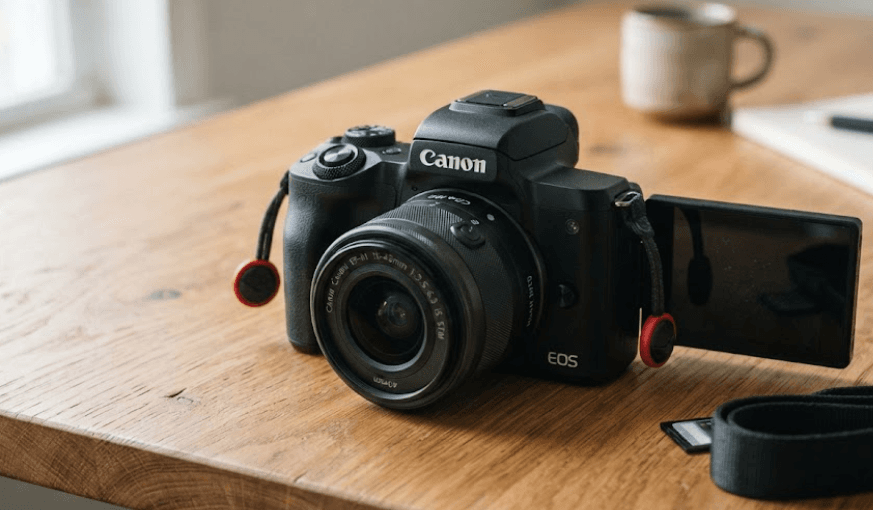
TL;DR: The Canon EOS M50 remains a capable entry-level mirrorless camera for beginners who want sharp photographs, reliable autofocus for everyday shooting, and an easy-to-use design. Its 24.1MP APS-C sensor, fully articulating touchscreen, and electronic viewfinder make it suitable for travel, portraits, product photography, and Full HD content creation. However, its heavily cropped 4K video, less effective autofocus in 4K, limited EF-M lens ecosystem, and modest battery life reveal its age. Since Canon lists the original EOS M50 as discontinued, it makes the most sense as a carefully inspected used purchase at an attractive price rather than a long-term investment for someone planning to build a larger camera system.
Canon EOS M50: Specifications At A Glance
The Canon EOS M50 launched in 2018 as a compact mirrorless camera designed to make photography more accessible. It combines a relatively small body with an APS-C sensor, interchangeable lenses, and automatic shooting modes that help newcomers get started without immediately learning manual exposure.
Its 24.1MP sensor produces photographs at up to 6000 × 4000 pixels, providing enough resolution for social media, travel albums, portraits, and many commercial uses. The camera also supports RAW capture, giving users more flexibility when adjusting exposure, white balance, and other image characteristics during editing.
Although the specifications remain useful for everyday photography, the camera's age matters when evaluating its value today. The following table summarizes its key hardware and capabilities.
| Specification | Canon EOS M50 |
|---|---|
| Release year | 2018 |
| Sensor | 24.1MP APS-C CMOS |
| Lens mount | Canon EF-M |
| Autofocus | Dual Pixel CMOS AF for supported modes |
| Continuous shooting | Up to 10 fps in One-Shot AF; up to 7.4 fps in Servo AF |
| Video recording | 4K at 24/25 fps; Full HD up to 60 fps |
| Display | 3-inch, fully articulating touchscreen |
| Electronic viewfinder | 2.36-million-dot EVF |
| Connectivity | Wi-Fi, Bluetooth, and NFC |
| Battery | LP-E12 |
| Storage | SD, SDHC, and SDXC cards |
Specifications are based on Canon's published documentation. Actual performance depends on settings, lens choice, battery condition, and shooting conditions.
Design And Handling: Compact And Beginner-Friendly
The EOS M50 is a relatively lightweight camera with a comfortable grip, making it practical for everyday use and travel. Its compact body is easier to carry than many larger DSLR setups, especially when paired with a small EF-M lens. The grip also provides a more secure hold than a flat-bodied compact camera, although users with larger hands may find the controls slightly cramped.
One of its strongest features is the fully articulating 3-inch touchscreen. The screen can be flipped out and rotated to help with low-angle photography, overhead compositions, and self-recording. Its touch interface makes selecting focus points, navigating menus, and reviewing photographs straightforward, even for someone moving up from a smartphone.
The built-in electronic viewfinder is another useful addition. It allows photographers to compose images in bright sunlight when the rear display may be difficult to see. However, the camera's battery life is modest by modern standards, so carrying a spare battery is sensible for long outings. Overall, its design prioritizes portability and ease of use rather than extensive professional controls.
Image Quality: Still A Strong Point
The EOS M50's 24.1MP APS-C sensor remains capable of producing detailed, attractive photographs. In good lighting, images can look crisp, with natural colors and sufficient detail for online publishing, personal projects, and many small-business needs. Its interchangeable-lens design also gives users greater creative control than a basic point-and-shoot camera.
The sensor's size helps when creating portraits with a softly blurred background, provided you use a suitable lens, aperture, and subject distance. RAW capture is especially useful for beginners who want to learn photo editing, as it offers more flexibility than relying exclusively on JPEG files. Exposure, highlights, shadows, and color balance can often be adjusted more effectively when working with RAW images.
Low-light performance is respectable for an entry-level camera of its generation, but it is not unlimited. Image noise becomes more noticeable as ISO increases, particularly in dim indoor environments. A faster lens, adequate lighting, and a suitable shutter speed can help improve results. The M50 also lacks in-body image stabilization, so stabilization depends on the lens, shooting technique, or external support.
Autofocus And Shooting Performance
For photography, the EOS M50 offers Dual Pixel CMOS autofocus with face detection and subject tracking in supported modes. It can focus quickly in everyday situations, making it useful for portraits, family photographs, travel scenes, and casual content creation. Its touchscreen also lets users select a focus point directly, which can be more intuitive than navigating focus points through physical controls.
The camera can shoot continuously at up to 10 frames per second with One-Shot AF, or up to 7.4 frames per second with Servo AF. These figures make it capable of capturing short bursts of movement, such as children playing or pets running. However, the maximum rate alone does not guarantee that every frame will be sharply focused, particularly when subjects move unpredictably.
For beginners, the autofocus system is generally one of the M50's most appealing features. It can reduce the learning curve when moving away from smartphone photography, although performance varies with the lens and lighting. If your main priority is photographing fast sports, wildlife, or other demanding action, newer cameras with more advanced subject recognition and tracking are worth considering.
Video Performance: Good In Full HD, Limited In 4K
The EOS M50 records Full HD video at up to 60 frames per second, making it a practical option for YouTube videos, interviews, tutorials, and everyday content. Its articulating screen helps users frame themselves while recording, and the camera includes a 3.5mm external microphone input for improved audio capture. These features remain useful for creators who prioritize straightforward Full HD production.
Its 4K capability, however, comes with important compromises. The camera records 4K UHD at 24 or 25 frames per second, depending on the video system selected, but uses a substantial crop of the sensor. Canon also confirms that Dual Pixel CMOS autofocus is unavailable in 4K, with the camera switching to contrast-detection autofocus instead. This can make focusing less dependable when recording moving subjects or filming yourself.
For most beginners, Full HD is the more practical setting on the original M50. It provides a wider field of view and more capable autofocus than the camera's 4K mode, although digital stabilization can introduce additional cropping. If your work requires reliable 4K autofocus, extensive handheld filming, or modern video features, a newer camera is likely to be a better investment.
Lens Compatibility: The Biggest Long-Term Concern
The EOS M50 uses Canon's EF-M lens mount, which supports native EF-M lenses and compatible EF or EF-S DSLR lenses through Canon's EF-EOS M adapter. This gives buyers access to several useful options, including compact everyday zooms, portrait lenses, and telephoto lenses. However, adapted DSLR lenses can make the overall setup larger and less convenient.
The bigger issue is the system's long-term upgrade path. Canon's official store lists the EOS M50 body as discontinued, and the EF-M mount is a legacy system rather than the focus of Canon's newer RF-mount mirrorless lineup. While existing EF-M lenses can still be useful, buyers should carefully consider availability, condition, and the cost of future upgrades.
If you already own compatible EF-M lenses, the M50 can remain a sensible camera to keep using. If you are buying your first interchangeable-lens camera, however, consider the complete system rather than the body alone. A slightly more expensive camera with a broader current lens ecosystem may offer better long-term value than a cheaper body tied to an older mount.
Connectivity, Battery Life, And Everyday Use
The M50 includes Wi-Fi, Bluetooth, and NFC, providing options for wireless connectivity and image transfer. With compatible devices and Canon's supported software, you can transfer photographs to a smartphone for editing or sharing. Wireless functions can make a difference for travel photographers and social media creators who want to publish images without regularly removing the memory card.
Battery life is one of the camera's practical weaknesses. The LP-E12 battery may be sufficient for a short photo walk, but extended trips, long sessions, and frequent video recording can require a spare. Actual battery performance varies according to screen use, temperature, wireless connectivity, and shooting habits. Buying a used body without checking battery condition can add an unexpected expense.
The camera's everyday experience is otherwise approachable. Automatic modes help newcomers get started, while aperture priority, shutter priority, and manual exposure allow gradual skill development. It is a useful learning tool for understanding composition, depth of field, exposure, and lens selection. Just remember that its age can affect compatibility with newer accessories and software, so verify the features you need before purchasing.
Pros And Cons: What You Should Know
The Canon EOS M50's biggest advantage is that it combines approachable controls with image quality that remains competitive for basic photography. The articulating touchscreen, electronic viewfinder, interchangeable lenses, and capable still-photo autofocus give beginners room to develop their skills. It is particularly appealing to people who mainly shoot photographs and only occasionally record video.
Its weaknesses become more important when the camera is compared with newer mirrorless models. The cropped 4K mode, less capable 4K autofocus, modest battery life, and lack of in-body image stabilization limit its appeal for modern video workflows. The discontinued body and legacy lens mount also make future system upgrades less straightforward.
The final decision depends on your budget and intended use. A clean, fairly priced used M50 can be an excellent way to learn photography, but it should not be treated as an automatic bargain simply because it costs less than a new camera. Condition, included accessories, lens compatibility, and the availability of alternatives all matter.
| Pros | Cons |
|---|---|
| Detailed 24.1MP APS-C images | Significant crop in 4K video |
| Beginner-friendly touchscreen | Dual Pixel AF unavailable in 4K |
| Built-in electronic viewfinder | Modest battery life |
| Useful autofocus for everyday photography | No in-body image stabilization |
| Compact body | Discontinued camera body |
| RAW photography support | Legacy EF-M lens ecosystem |
| External microphone input | Less suitable for demanding modern video work |
Is The Canon EOS M50 Worth Buying In 2026?
The EOS M50 can still make sense if your priority is photography and you find a well-maintained used unit at a reasonable price. It provides enough resolution for everyday shooting, travel, portraits, product images, and learning photography fundamentals. Its screen and viewfinder also make it comfortable to use in a variety of situations, which is valuable when you are still developing your technique.
Before buying, inspect the sensor, lens mount, screen hinge, buttons, ports, and memory-card slot. Test autofocus, take photographs at different settings, record a short video, and check for battery swelling or overheating. Confirm that the charger and battery are included, and compare the total price with newer used or entry-level mirrorless cameras. A low body price can become less attractive if you need to replace accessories or purchase expensive adapted lenses.
Consider your future plans as well. If you expect to focus on photography, the M50 can remain a capable starter camera. If you want advanced video autofocus, a current lens system, or a clear upgrade path, compare it with cameras in Canon's newer RF-mount range and other manufacturers' current mirrorless options. The best purchase is the camera that meets your needs today without unnecessarily limiting your next step.
Final Recommendation And Decision Framework
The Canon EOS M50 is still a good starter mirrorless camera for photography, provided you understand its age and buy it at the right price. Its image quality, accessible controls, articulating touchscreen, and useful still-photo autofocus make it a capable choice for beginners who want to move beyond smartphone photography.
However, it is not the best choice for every new creator. Its 4K video limitations and discontinued EF-M system make it less attractive for people planning to build a long-term camera kit or produce regular 4K content. If video is a major priority, evaluate newer alternatives before committing to the M50.
Our recommendation: Buy the EOS M50 if you find a well-maintained used unit with a suitable lens at a genuinely competitive price and mainly intend to shoot photographs or Full HD video. If you are buying a camera for the next several years and expect to expand your lens collection, compare newer mirrorless systems first. The M50 can still deliver excellent results, but its value today depends more on the deal you find than on its original reputation.
Frequently Asked Questions
Q. Is the Canon EOS M50 still worth buying in 2026?
Yes, the Canon EOS M50 can still be worth buying if you mainly take photographs and find a well-maintained used unit at a competitive price. Its 24.1MP sensor and beginner-friendly controls remain useful, but its discontinued status and limited upgrade path deserve consideration.
Q. Is the Canon EOS M50 good for beginners?
Yes. Its automatic modes, touchscreen, electronic viewfinder, and accessible autofocus system make it a good starting point for learning photography. Beginners can gradually progress to manual exposure and RAW editing.
Q. Does the Canon EOS M50 record 4K video?
Yes. It records 4K UHD video at 24 or 25 fps, depending on the selected video system. However, the mode applies a substantial crop and does not support Dual Pixel CMOS autofocus, making Full HD more practical for many users.
Q. What is the difference between the Canon EOS M50 and M50 Mark II?
The M50 Mark II introduces refinements to features such as eye detection and video-oriented functions. Both cameras use a 24.1MP APS-C sensor and the EF-M mount, and both have limitations in 4K autofocus. Compare the exact features you need before paying extra for the Mark II.
Q. Which lenses are compatible with the Canon EOS M50?
The camera accepts Canon EF-M lenses directly. Compatible EF and EF-S DSLR lenses can also be used with the Canon EF-EOS M mount adapter. RF-mount lenses are not directly compatible.
Q. Is the Canon EOS M50 good for YouTube videos?
It can work well for Full HD YouTube videos, tutorials, and talking-head recordings. Its articulating screen and external microphone input are helpful, but its 4K autofocus limitations make it less suitable for creators who need dependable 4K recording.
Q. Does the Canon EOS M50 have image stabilization?
The camera does not have in-body image stabilization. Stabilization depends on the lens's optical stabilization, digital stabilization where supported, or external equipment such as a tripod.
Q. How long does the Canon EOS M50 battery last?
Canon rates the LP-E12 battery at approximately 235 still images under standard CIPA testing conditions, although actual results vary. Carrying a spare battery is advisable for travel, extended photography sessions, and video recording.
Q. Is the Canon EOS M50 discontinued?
Yes. Canon's official US store lists the original EOS M50 body as discontinued. Used units may still be available, but buyers should check the camera's condition, lens availability, and repair options before purchasing.
Q. What should I check before buying a used Canon EOS M50?
Inspect the sensor, lens mount, screen hinge, buttons, ports, and battery condition. Test autofocus, take sample photographs, record a short video, and verify that the charger and included lens work properly. Compare the complete package price with newer mirrorless alternatives before deciding.
Ready to upgrade your tech?
Browse our collection of quality refurbished products at unbeatable prices.