
Buying an Old DSLR vs a New Entry-Level Mirrorless: Which Makes More Sense?
An old DSLR can offer excellent image quality and affordable lenses, but a new entry-level mirrorless camera brings newer autofocus, video features, and a clearer upgrade path.

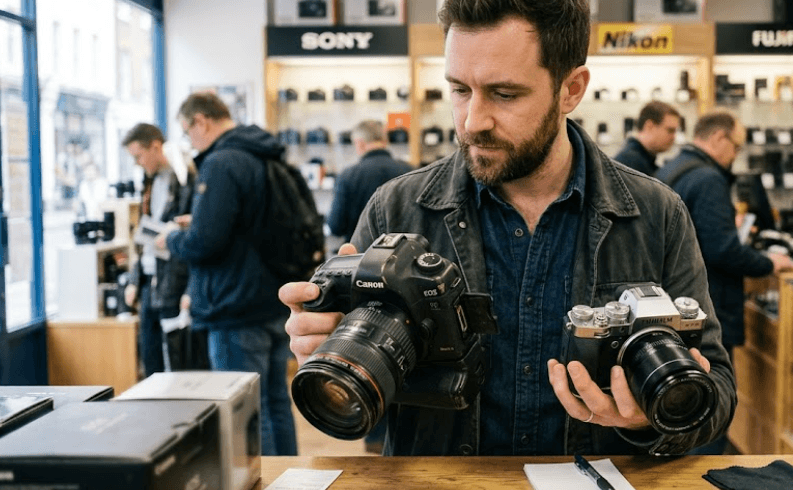
TL;DR Buying an old DSLR can still make sense in 2026 if you find a well-maintained body at a low price and your priority is still photography rather than advanced video or the newest autofocus features. A DSLR such as the Nikon D3500 can deliver excellent still images, while its optical viewfinder and strong battery life remain practical advantages. A new entry-level mirrorless camera, however, gives you newer autofocus systems, an electronic viewfinder, a more compact design, and access to the direction in which major camera manufacturers are developing their systems. For example, Canon's EOS R100 uses a 24.1MP APS-C sensor, Dual Pixel CMOS AF and an electronic viewfinder, while current industry guidance points to mirrorless as the main direction for new camera development.
Understanding The Difference
An old DSLR and a new entry-level mirrorless camera can both produce excellent photographs, but they approach photography differently. A DSLR uses a mirror and optical viewfinder, allowing you to see the scene directly through the lens. When you press the shutter, the mirror moves out of the way so light reaches the image sensor. A mirrorless camera removes that mirror mechanism and sends the sensor's live image to an electronic viewfinder or the rear display. This difference affects size, autofocus, battery consumption, shooting experience, and video performance rather than automatically determining image quality.
The age of the camera is also important. A used DSLR from several years ago may still have a capable APS-C or full-frame sensor, interchangeable lenses, manual controls, RAW capture, and a reliable mechanical design. The Nikon D3500, for example, is an older entry-level DSLR with a 24.2MP DX-format sensor and an optical viewfinder, while Nikon rates its battery for up to 1,550 shots under CIPA testing. That shows why an older DSLR should not automatically be treated as obsolete simply because newer cameras use mirrorless designs.
A new entry-level mirrorless camera gives you a different advantage. You are buying newer technology, which can include more sophisticated subject detection, better live-view autofocus, modern connectivity, and stronger video features. Canon's EOS R100, for example, has a 24.1MP APS-C sensor, Dual Pixel CMOS AF, an electronic viewfinder and 4K video recording at up to 24fps. These features demonstrate the type of technology available even at the entry level of today's mirrorless market.
DSLR Vs Mirrorless At A Glance
| Feature | Old DSLR | New Entry-Level Mirrorless |
|---|---|---|
| Viewfinder | Optical | Electronic |
| Mirror mechanism | Yes | No |
| Size | Generally larger | Generally more compact |
| Autofocus | Depends heavily on model and shooting mode | Modern models generally offer advanced on-sensor AF |
| Battery life | Often stronger | Usually lower, depending on model |
| Video | Varies by generation | Generally a stronger priority |
| Used lens availability | Often excellent | Depends on mount and system |
| Long-term development | Mature system | Active development focus |
Image Quality And Sensor Performance
The biggest misconception when comparing an old DSLR with a new entry-level mirrorless camera is that the newer camera will automatically produce better photographs. Camera age and camera type are not the same thing as image quality. Sensor size, sensor generation, lens quality, exposure, focusing accuracy, lighting, and the photographer's technique all affect the final photograph. A well-maintained DSLR with a good lens can still produce images that look excellent, particularly in good light. The mirror itself does not make a DSLR photograph worse than a mirrorless photograph.
Sensor size deserves particular attention because an entry-level mirrorless camera and an old DSLR may use similarly sized sensors. Canon's EOS R100, for example, uses an APS-C sensor measuring approximately 22.3 × 14.9mm with 24.1 effective megapixels. A camera such as the Nikon D3500 also uses a DX-format sensor and provides 24.2MP resolution. That means the basic sensor format and resolution can be remarkably similar despite the cameras belonging to different generations and systems.
Where the new mirrorless camera can pull ahead is in the complete shooting experience. Newer processors and autofocus systems can make it easier to capture moving subjects accurately, while the electronic viewfinder can show exposure and other shooting information before you press the shutter. This does not guarantee better photographs in every situation, but it can reduce the amount of guesswork involved. For beginners who are still learning exposure, that preview can be particularly useful.
What Actually Affects Image Quality?
| Factor | Why It Matters |
|---|---|
| Sensor size | Influences noise, dynamic range and depth-of-field possibilities |
| Lens quality | Can affect sharpness, contrast and low-light performance |
| Autofocus | Helps keep moving or difficult subjects sharp |
| Image processing | Affects JPEG rendering, noise reduction and colour |
| Lighting | Often has a larger effect than camera age |
| Photographer skill | Composition and exposure remain fundamental |
Autofocus, Viewfinders, And Everyday Shooting
Autofocus is one of the areas where a new entry-level mirrorless camera can offer a meaningful advantage over an older DSLR. Modern mirrorless cameras can perform autofocus directly on the image sensor, allowing manufacturers to build subject detection and tracking into the shooting system. Canon's EOS R100, for instance, supports Dual Pixel CMOS AF, Face Detection and Eye Detection, with selectable autofocus areas covering a large portion of the frame.
An older DSLR can still focus quickly through its dedicated phase-detection autofocus system when using the optical viewfinder, but the exact performance depends heavily on the model. Older entry-level DSLRs were not designed around the same level of subject recognition and continuous tracking now found in many mirrorless cameras. If you mostly photograph landscapes, portraits, architecture or posed subjects, that difference may not matter much. If you photograph children, pets, sports or moving subjects, newer autofocus technology can be more useful.
The viewfinder experience is another major difference. A DSLR's optical viewfinder shows the actual scene through the lens without displaying an electronic preview. A mirrorless EVF instead displays the sensor's live feed, which can show exposure, focus information and other settings before the photograph is taken. Sony's a6100, for example, uses a 0.39-inch electronic viewfinder with approximately 1.44 million dots. This illustrates how even an older mirrorless body can provide a fundamentally different shooting experience from a DSLR's optical finder.
Autofocus And Viewfinder Comparison
| Area | Old DSLR | New Entry-Level Mirrorless |
|---|---|---|
| Optical viewing | Strong advantage | Not available |
| Exposure preview | Limited through optical finder | Available through EVF |
| Eye detection | Model-dependent | Common on newer models |
| Subject tracking | Model-dependent | Generally more advanced |
| Moving subjects | Can be very capable | Newer systems often have an advantage |
| Learning exposure | Requires more interpretation | EVF can show changes before shooting |
Battery Life, Size, And Portability
Battery life is one area where an old DSLR can still be surprisingly competitive. Because the optical viewfinder does not need to continuously power an electronic display, DSLR shooting can consume less battery during normal viewfinder use. Nikon rates the D3500 for approximately 1,550 shots per charge under CIPA testing, although real-world battery life varies with shooting habits, temperature, flash use, image review, and other settings. This is a useful reminder that older technology is not automatically worse in every practical category.
Mirrorless cameras generally make portability easier because removing the mirror and optical viewfinder assembly allows manufacturers to design more compact bodies. The total size of a camera kit still depends heavily on the lens, so a small mirrorless body does not automatically mean a tiny camera system. Nevertheless, the body itself can be easier to carry, and manufacturers can build compact lenses around shorter mirrorless mounts. Nikon's current 2026 guidance also highlights smaller size and weight as practical advantages of mirrorless systems.
For travel, street photography and everyday family photography, that difference can influence how often you actually carry the camera. A camera that stays at home because it feels bulky is less useful than a slightly less powerful camera that you take everywhere. The same principle applies to lenses. A cheap DSLR body may look like a bargain until you add a large collection of lenses and accessories, while an entry-level mirrorless kit can sometimes provide a simpler starting package.
Portability And Battery Trade-Offs
| Consideration | Old DSLR | New Entry-Level Mirrorless |
|---|---|---|
| Body size | Usually larger | Usually smaller |
| Battery endurance | Often stronger | Generally lower |
| Travel convenience | Depends on body and lenses | Often easier |
| Spare batteries | Useful | Often more important |
| Lens size | Can be substantial | Wide range, including compact lenses |
| Long shooting sessions | Battery advantage can help | Carrying a spare is practical |
Lens Choice And Long-Term System Value
The lens ecosystem may be more important than the camera body when deciding between an old DSLR and a new entry-level mirrorless camera. DSLR systems have had decades to accumulate lenses, flashes and accessories. Used Canon EF and Nikon F lenses can therefore be widely available, although availability and pricing depend on the exact mount, condition and local market. This can make a used DSLR system attractive to someone who wants to build a photography kit without paying new-lens prices.
The catch is that the DSLR ecosystem is mature rather than the main direction of new development. Canon and Nikon have shifted their current interchangeable-lens development toward mirrorless systems, and Nikon's current 2026 guidance specifically describes mirrorless as the direction of ongoing system development. That does not make existing DSLR lenses unusable, but it is an important consideration if you expect to keep buying new lenses and upgrading your camera over several years.
Mirrorless systems also offer a potential migration path for some existing DSLR users. Canon, for example, states that its EOS R100 can use compatible EF and EF-S lenses through the EF-EOS R mount adapter, subject to compatibility limitations. Nikon similarly offers the FTZ II adapter for using compatible F-mount NIKKOR lenses on Z-series bodies. This means buying mirrorless does not always require throwing away an existing lens collection.
Lens Ecosystem Comparison
| Factor | Old DSLR System | New Mirrorless System |
|---|---|---|
| Used lenses | Often abundant | Increasingly available |
| New lens development | Limited compared with mirrorless | Active |
| Adapter options | Usually unnecessary | Can enable use of older DSLR lenses |
| Lens prices | Used DSLR lenses can be affordable | New native lenses may cost more |
| Upgrade path | Mature ecosystem | Strong current development |
| Long-term system planning | Best for low-cost used setups | Better suited to new system investment |
Price And Practical Buying Value
Price is where the old DSLR can make a compelling case. A used DSLR body that has already depreciated can cost substantially less than a new mirrorless camera, leaving more money for a better lens, external flash, tripod or other accessories. However, the cheapest body is not necessarily the cheapest complete system. A camera with a worn battery, damaged shutter, fungus-affected lens or unreliable autofocus can turn a low purchase price into an expensive repair project.
A new entry-level mirrorless camera costs more upfront, but the price includes a newer body, current manufacturer support and modern features. It can also reduce the need to upgrade quickly if its autofocus, connectivity and video capabilities already match your requirements. Canon's EOS R100 demonstrates how much capability can now be built into an entry-level mirrorless body, including a 24.1MP APS-C sensor, electronic viewfinder, Dual Pixel CMOS AF and 4K recording.
The smarter calculation is therefore the total system cost rather than just the camera-body price. If an old DSLR body costs less but requires an additional lens, battery and repair, the gap can disappear quickly. On the other hand, if you find a clean DSLR body bundled with a good lens at a genuinely low price, it can remain a sensible photography tool. Used-market sources in 2026 continue to describe DSLRs as attractive bargains, particularly because the lens ecosystem remains mature.
Buying Value At A Glance
| Buyer Priority | Old DSLR | New Entry-Level Mirrorless |
|---|---|---|
| Lowest initial cost | Strong potential | Usually higher |
| New technology | Limited by model age | Strong |
| Used lens bargains | Strong | Moderate to strong |
| Video features | Model-dependent | Generally stronger |
| Autofocus development | Mature | Active |
| Long-term upgrade path | More limited | Stronger |
| Best reason to buy | Low-cost photography | New system and features |
Who Should Buy An Old DSLR?
An old DSLR makes sense when photography is your main priority and you are comfortable buying used equipment. It can be particularly appealing to students, hobby photographers and beginners who want to learn manual exposure, composition and interchangeable-lens photography without spending heavily on the camera body. A well-maintained DSLR with a good prime or standard zoom can teach you the same fundamentals that you would learn on a new mirrorless camera.
It can also make sense when the deal includes good lenses. The lens often contributes more to the usefulness of a camera system than the body alone, so a used DSLR bundle with a quality lens can be more interesting than a cheap body without suitable glass. Before buying, however, inspect the sensor, lens elements, autofocus, shutter operation, battery condition, card slot, buttons and viewfinder. Older cameras can have perfectly usable electronics while still showing physical wear from years of use.
The strongest case for an old DSLR is therefore not that DSLR technology is superior. It is that mature equipment can offer excellent photography at a lower cost. If you mostly shoot still photographs and do not need advanced subject tracking, modern video features or a compact body, an older DSLR can continue to do the job extremely well.
Who Should Buy A New Entry-Level Mirrorless?
A new entry-level mirrorless camera makes more sense when you want modern autofocus, a smaller body and a system that is actively receiving new development. It is also the more natural choice for someone who expects to shoot both photographs and video. Newer mirrorless models can combine electronic viewfinders, on-sensor autofocus, subject detection and modern connectivity in ways that older entry-level DSLRs generally cannot match.
The advantage becomes more noticeable if your subjects move. Children, pets, events and casual action photography can benefit from modern tracking and eye-detection systems. Video creators also have more reason to consider mirrorless because manufacturers have increasingly developed these systems around hybrid photo and video shooting. Current 2026 camera guides continue to emphasize mirrorless cameras for hybrid photography and video, while Nikon describes autofocus intelligence and video capability among the areas where mirrorless has moved ahead.
The new mirrorless option also gives you a cleaner starting point. Instead of building around an older DSLR mount and eventually switching systems, you can begin with a current mount and gradually add lenses. That matters if photography is likely to become a long-term hobby rather than a short-term experiment. The initial cost is higher, but the system can be easier to build around your future needs.
Common Mistakes When Choosing Between Them
The biggest mistake is choosing based only on megapixels. A 24MP DSLR and a 24MP mirrorless camera can both produce high-resolution photographs, and the difference in real-world results can come down to lenses, exposure, autofocus and shooting technique. Canon's EOS R100 and Nikon's D3500 illustrate this clearly, with both using APS-C-class sensors and around 24MP resolution despite being different generations and camera types.
Another mistake is buying the cheapest used DSLR without checking its condition. A camera that has spent years in harsh conditions may have sensor dust, lens fungus, worn batteries, damaged ports or unreliable controls. Ask for sample photographs, inspect the lens under good light, test autofocus at different distances and check whether the camera records correctly to a memory card. A slightly more expensive used kit in better condition can be a more sensible purchase than the absolute cheapest listing.
The final mistake is ignoring the lens system. Buying a camera is the beginning of the cost rather than the end. If you purchase a DSLR because the body is cheap but later discover that the lenses you want are difficult to find, you may eventually spend more switching systems. Conversely, buying a mirrorless body without budgeting for suitable lenses can also lead to disappointment. The camera, lens and accessories should be treated as one system.
Mistakes To Avoid
| Mistake | Better Approach |
|---|---|
| Comparing megapixels alone | Compare sensor, lens and autofocus |
| Buying the cheapest DSLR | Check condition and shutter operation |
| Ignoring lens availability | Research the mount first |
| Assuming mirrorless is always better | Match features to your use |
| Forgetting battery costs | Budget for spare batteries |
| Buying only for video specs | Consider the complete shooting workflow |
Frequently Asked Questions
Q. Is an old DSLR still worth buying in 2026?
Yes, an old DSLR can still be worth buying if the body is in good condition, the price is low and you mainly shoot still photographs. Older DSLRs can deliver excellent image quality and often have access to a large used lens market. The decision becomes less attractive if you need modern subject tracking, advanced video features or a compact body.
Q. Is a new entry-level mirrorless better than an old DSLR?
It depends on what you need. A new mirrorless camera generally offers newer autofocus technology, electronic viewfinder features, modern connectivity and a more current upgrade path. An old DSLR can offer lower purchase costs, strong battery life and affordable used lenses.
Q. Does mirrorless have better image quality than DSLR?
Not automatically. Image quality depends on sensor size and generation, lens quality, exposure, processing and shooting technique. A good DSLR with a quality lens can still produce excellent photographs, while a new mirrorless camera may provide advantages in autofocus and shooting convenience.
Q. Do DSLRs have better battery life?
Many DSLRs can have an advantage in battery life because their optical viewfinders do not require the electronic display used by mirrorless EVFs. For example, Nikon rates the D3500 at approximately 1,550 shots per charge under CIPA testing. Actual battery life varies with usage.
Q. Are DSLR lenses still available in 2026?
Yes. Used DSLR lenses remain available, particularly for established Canon and Nikon systems. Availability varies by mount, focal length and market. The important consideration is that major manufacturers are focusing new system development on mirrorless platforms.
Q. Can old DSLR lenses be used on mirrorless cameras?
In many cases, yes, using an appropriate mount adapter. Canon supports compatible EF and EF-S lenses on EOS R cameras through its EF-EOS R adapter, while Nikon offers the FTZ II adapter for compatible F-mount lenses on Z-series cameras. Compatibility and functionality depend on the specific lens and camera.
Q. Is a DSLR better for beginners?
A DSLR can be an excellent learning tool because it provides traditional controls and an optical viewfinder. However, a new mirrorless camera can also be beginner-friendly because its electronic viewfinder can preview exposure and provide shooting information before the photograph is taken.
Q. Is mirrorless better for video?
Newer mirrorless cameras generally have stronger video-focused features than older entry-level DSLRs. Their on-sensor autofocus and electronic preview can also make video shooting easier. The exact video capability still depends on the individual camera, so specifications should be checked before buying.
Q. What should I check before buying a used DSLR?
Check the camera body for physical damage, test the shutter, autofocus and card slot, inspect the sensor and viewfinder, examine the lens for fungus or haze, and check the battery condition. Taking sample photographs at different apertures and focus distances is also useful.
Q. Should I spend more on a lens or a camera body?
For many photographers, putting a meaningful portion of the budget toward a good lens can make more sense than spending everything on the newest body. The right balance depends on your subject and shooting style, but lenses can remain useful across multiple camera generations.
Final Recommendation
For most buyers starting from scratch in 2026, a new entry-level mirrorless camera is the more straightforward long-term purchase because current camera development is centered on mirrorless systems, and newer models offer modern autofocus, electronic viewfinders, hybrid photo-video features and current lens ecosystems. That does not make an old DSLR a bad camera. It simply means the value proposition is different. Current industry guidance and manufacturer strategies both show that mirrorless is the active direction for new interchangeable-lens development.
An old DSLR makes more sense when the price difference is substantial, you primarily shoot still photographs, and you find a clean body with good lenses. A model such as the Nikon D3500 demonstrates that an older DSLR can still provide a high-resolution APS-C sensor, optical viewfinder and very strong rated battery life. For a photography-focused beginner, those fundamentals can be more valuable than having the newest camera body.
If the budget allows and you want one camera system to keep developing over the coming years, the new entry-level mirrorless route provides the more current foundation. If the budget is tight and you find a genuinely well-maintained DSLR kit at a significant discount, buying used can still be a practical way to enter interchangeable-lens photography. The important point is to compare the complete camera system, including the lens, battery, condition and future upgrade path, rather than choosing solely between DSLR and mirrorless labels.






