Blue Light Therapy Devices: Do They Actually Work?
Blue light therapy devices can help with some conditions, particularly mild to moderate acne, but results depend on the device, condition, and consistent use. Here is what the evidence actually says.

TL;DR Blue light therapy devices can work, but their effectiveness depends heavily on what you are trying to treat. Visible blue light has the strongest practical use in dermatology, particularly for some cases of mild to moderate acne, where FDA-cleared home devices exist, and dermatology guidance recognizes visible-light devices as an option for treating pimples. However, blue light should not be treated as a universal solution for every skin or health concern. It does not reliably clear blackheads, whiteheads, cysts, or nodules, and at-home devices are generally less powerful than professional treatments. Light therapy is also used for seasonal affective disorder, but that typically involves bright-light therapy using a light box, not simply a small blue LED device.
What Is Blue Light Therapy?
Blue light therapy is a form of light-based treatment that exposes the skin or body to a controlled wavelength of visible light. In skincare, blue light is commonly used because certain wavelengths can interact with biological processes in acne-prone skin. This is different from ordinary room lighting because therapeutic devices are designed to deliver light within a particular range and at a controlled intensity. The exact wavelength, dose, distance, treatment time, and intended use can vary considerably between devices, which is why simply seeing the words “blue LED” on a product does not automatically mean that it has been clinically validated for a particular condition. The FDA classifies certain over-the-counter powered light-based devices for acne, including devices designed to emit energy in the blue and red regions of the spectrum for mild to moderate acne vulgaris.
The phrase “blue light therapy” can also create confusion because people use it to describe several different products. A blue LED acne mask, a bright-light box used for seasonal affective disorder, and blue-light-blocking glasses are not interchangeable treatments. They may all involve light, but they have different purposes and mechanisms. For example, evidence for seasonal affective disorder concerns bright-light therapy intended to replace some of the reduced daylight exposure associated with winter, with traditional light boxes commonly delivering around 10,000 lux. That is fundamentally different from using a small blue LED skincare mask for acne.
This distinction matters when you are researching blue light therapy devices because marketing language can make the category sound broader than the evidence actually is. A device may advertise benefits for acne, skin appearance, mood, sleep, inflammation, or general wellness, but each claim needs to be evaluated separately. A device being cleared or authorized for one intended use does not mean it has been proven to treat every condition mentioned in an advertisement. The FDA also distinguishes medical devices from certain low-risk general wellness products, so shoppers should look at the specific intended use rather than assuming that every light-based product has the same level of clinical evidence.
How Blue Light Therapy Is Used
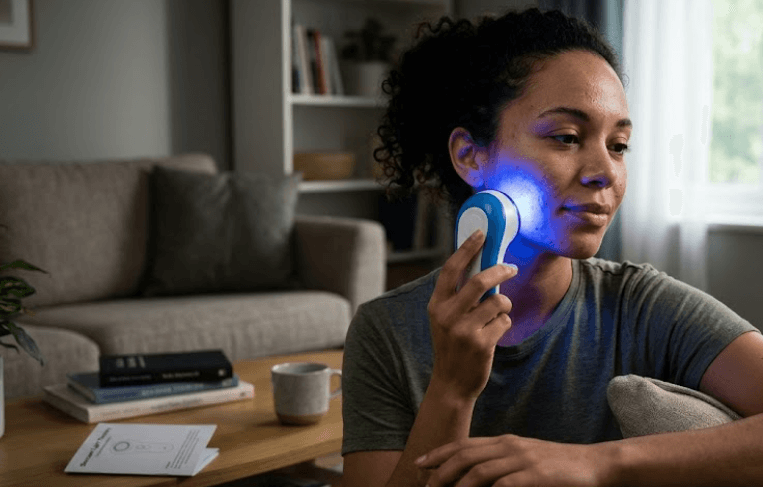
For acne, visible blue light is generally used as a non-invasive treatment applied directly to acne-prone skin. At-home devices are typically less powerful than professional equipment, which means they may require repeated sessions over several weeks rather than producing an immediate change. The American Academy of Dermatology notes that some FDA-approved at-home visible-light LED devices can treat pimples, but they do not treat every type of acne lesion.
Does Blue Light Therapy Actually Work?
The short answer is yes for some specific uses, but “works” needs to be defined carefully. For acne, the American Academy of Dermatology states that visible light can treat pimples, while also noting that it does not effectively treat blackheads, whiteheads, acne cysts, or nodules. That makes blue light more appropriate as a targeted option for certain inflammatory acne concerns rather than a replacement for every established acne treatment. The AAD also points out that there is no reliable way to know in advance which individuals will see results from an at-home device, making expectations an important part of the buying decision.
The evidence is different when the goal is improving mood or treating seasonal affective disorder. Light therapy is a recognized approach for people with seasonal affective disorder, but the evidence and treatment protocols generally involve bright-light therapy rather than consumer blue-light skincare devices. NCCIH describes light therapy as potentially useful for people with a history of seasonal affective disorder and notes that traditional light boxes commonly provide about 10,000 lux while filtering ultraviolet light. Therefore, buying a blue LED mask marketed for skin and expecting it to provide the same therapeutic effect as a properly designed bright-light box would be an inaccurate comparison.
Sleep is another area where shoppers should be particularly cautious. Blue-enriched light exposure in the evening can influence circadian timing and melatonin, which is one reason people are often advised to reduce bright or blue-enriched light before bed. However, this does not mean that a blue-light therapy device should be used at night to improve sleep. Research on blue-light-blocking interventions has produced mixed results, and a recent systematic review of randomized crossover trials found no statistically significant improvements in several objective sleep measures. In other words, “blue light” can have different effects depending on the context, and a therapeutic blue-light device should not automatically be marketed as a sleep aid.
What The Evidence Supports?
| Intended Use | Evidence Position | Practical Takeaway |
|---|---|---|
| Mild to moderate acne | Some support | Can help treat pimples with appropriate devices |
| Blackheads and whiteheads | Limited for visible light | Do not expect blue light to clear these reliably |
| Acne cysts and nodules | Not an appropriate standalone treatment | Professional acne treatment may be needed |
| Seasonal affective disorder | Light therapy has evidence | Use an appropriate bright-light therapy device |
| General sleep improvement | Mixed evidence | Do not assume blue light therapy improves sleep |
| General wellness claims | Varies by product | Check the exact intended use and evidence |
Blue Light Therapy For Acne
Blue light therapy has its clearest consumer use in acne treatment. The American Academy of Dermatology explains that visible-light devices can treat pimples and that some blue, red, and blue-plus-red LED devices have been cleared by the FDA for at-home use. These home devices are less powerful than the equipment used by dermatologists, so the experience is different from receiving professional light treatment. The practical advantage is convenience, while the trade-off is that users generally need consistent treatment over time and should not expect the same results from every device.
One important limitation is that acne is not a single type of skin problem. A person can have inflammatory pimples alongside blackheads, whiteheads, cysts, or nodules, and blue light does not address all of these equally. The AAD specifically notes that visible light is not effective against blackheads, whiteheads, acne cysts, or nodules. This means a blue light therapy device may make sense for someone whose main concern is pimples, but it should not be presented as a complete acne-management system. Established treatments such as benzoyl peroxide, topical retinoids, salicylic acid, and other therapies remain important options depending on the type and severity of acne.
Consistency is another part of the equation. At-home devices generally require repeated use, and the AAD notes that some devices may need to be used twice daily for several weeks, depending on the product. This is one reason shoppers should pay attention to the manufacturer's treatment schedule instead of assuming that longer exposure will produce faster results. More light is not automatically better, and following the device's instructions matters for both effectiveness and safety. If acne is severe, painful, scarring, or dominated by cysts and nodules, relying exclusively on an at-home blue-light device can delay more appropriate medical treatment.
Blue Light Compared With Standard Acne Care
Blue light can be useful as an additional option, but it should not automatically replace proven acne treatments. The AAD's current acne guideline recommends several topical and systemic therapies, including benzoyl peroxide, topical retinoids, salicylic acid, azelaic acid, antibiotics in appropriate circumstances, and isotretinoin for selected patients. That broader treatment framework is important because acne treatment depends on severity, lesion type, skin characteristics, and the individual's response to treatment.
Benefits And Limitations Of Home Devices
The biggest benefit of home blue light therapy devices is convenience. You can use them without scheduling repeated clinic visits, and many products are designed around short, repeated sessions. For someone with mild acne who prefers a non-invasive option, that convenience can make it easier to follow a consistent routine. Some home devices have also received FDA clearance through the 510(k) pathway for acne-related uses, showing that there are legitimate medical-device products in this category rather than only cosmetic gadgets.
The main limitation is that home devices should not be treated as miniature dermatology clinics. The AAD specifically notes that at-home devices are less powerful than those used by dermatologists. Results can therefore vary, and users may need several weeks of regular treatment before deciding whether the device is worthwhile. Another limitation is that the category contains products with very different specifications, intended uses, and regulatory histories. Two devices may look almost identical online while having different wavelengths, treatment schedules, and evidence behind their claims.
Safety also deserves attention. Light-based treatments can affect the eyes, and some people may have medical conditions or medications that increase sensitivity to light. FDA information on photo-biomodulation devices highlights potential risks such as eye injury, skin sensitivity, burns, pigmentation changes, itching, and pain in some contexts. That does not mean every consumer blue-light device is dangerous, but it does mean that users should follow the manufacturer's safety instructions, use eye protection when required, and seek medical advice when they have a condition or medication that may cause photosensitivity.
What To Check Before Buying
| Factor | Why It Matters |
|---|---|
| Intended use | Confirms what the device is actually designed to treat |
| Wavelength | Different wavelengths have different biological effects |
| FDA status where applicable | Helps distinguish regulated medical-device claims from general wellness marketing |
| Treatment schedule | Determines how practical consistent use will be |
| Eye protection | Important because intense light can pose eye risks |
| Acne type | Blue light is not effective for every acne lesion |
| Device instructions | Correct distance and session length affect safe use |
How To Choose A Blue Light Therapy Device?
Start with the condition you actually want to treat. If your goal is acne, look for a device specifically intended for acne rather than buying a generic LED product simply because it emits blue light. The FDA maintains databases for medical devices, and its classification system includes over-the-counter powered light-based devices intended to treat mild to moderate acne vulgaris. Checking the exact product and intended use is more meaningful than relying on phrases such as “medical-grade” or “clinical strength” used in advertising.
Next, look at the treatment instructions rather than focusing only on the number of LEDs or the color of the mask. A useful device should provide clear information about how long each session should last, how frequently it should be used, how close it should sit to the skin, and whether eye protection is required. These details are important because light therapy is dose-dependent, and a product cannot be judged properly from its appearance alone. If the manufacturer provides vague claims but little information about intended use or treatment parameters, that should make you more cautious.
Finally, consider whether the device fits into your routine. A product that requires frequent sessions may be less useful if you know you will not use it consistently. You should also consider the type of acne you have and whether an at-home device is likely to address your main concern. If your acne includes painful nodules, cysts, significant inflammation, or scarring, a dermatologist can provide a more appropriate assessment. The goal is not to find the most expensive blue light therapy device, but to find one with a clearly defined purpose and evidence that matches your actual problem.
Common Myths About Blue Light Therapy
One common misconception is that every blue LED device provides the same treatment. It does not. Light-based devices differ in wavelength, intensity, treatment area, exposure time, and intended use. A device designed for acne should not automatically be considered equivalent to a bright-light box for seasonal affective disorder. This distinction is particularly important because the phrase “light therapy” covers several different technologies and treatment approaches.
Another misconception is that blue light can cure every form of acne. The evidence does not support that claim. The AAD specifically states that visible light can treat pimples but is not effective against blackheads, whiteheads, cysts, or nodules. That means someone with a more complicated acne pattern may see limited improvement even when the device itself is functioning as intended.
A third myth is that stronger or longer exposure automatically produces better results. Light-based treatments are designed around specific exposure parameters, and exceeding the recommended use can increase the risk of unwanted effects without guaranteeing better results. The safest approach is to follow the manufacturer's instructions and avoid improvising with exposure time. If a device causes significant irritation, pain, visual symptoms, or an unexpected skin reaction, stop using it and seek appropriate medical advice.
Myth Vs Fact
| Myth | Fact |
|---|---|
| All blue LED devices work the same way | Devices differ in wavelength, intensity, and intended use |
| Blue light cures all acne | It mainly targets pimples and does not treat every acne lesion |
| More exposure means faster results | Follow the specified treatment schedule |
| A skincare mask treats SAD | SAD light therapy generally uses bright-light boxes |
| Every LED product is medically validated | Regulatory status and evidence vary by device |
| Blue light therapy replaces a dermatologist | Severe or persistent acne may require professional treatment |
Frequently Asked Questions
Q. Do blue light therapy devices actually work?
Yes, some blue light therapy devices can work for specific conditions. The strongest consumer use discussed here is acne, where certain visible-light devices can treat pimples. However, results vary, and the treatment does not work equally well for every type of acne.
Q. Does blue light therapy help acne?
Blue light can help treat pimples associated with mild to moderate acne. The American Academy of Dermatology notes that some FDA-approved at-home visible-light devices can be used for this purpose, although they are less powerful than professional equipment.
Q. Can blue light therapy remove blackheads and whiteheads?
No. The AAD states that visible light is not effective against blackheads or whiteheads. It is therefore better suited to certain pimples than to every type of acne lesion.
Q. Can blue light therapy treat cystic acne?
Blue light should not be relied on as a standalone treatment for cysts or nodules. The AAD specifically states that visible light does not effectively treat acne cysts or nodules, so people with these forms of acne should consider professional medical advice.
Q. Is blue light therapy the same as light therapy for seasonal depression?
No. Light therapy for seasonal affective disorder generally involves bright-light therapy using a light box, commonly around 10,000 lux, rather than a small blue LED skincare device.
Q. Can blue light therapy improve sleep?
You should not assume that blue light therapy improves sleep. Evening exposure to blue-enriched light can affect circadian rhythms, while research on blue-light-blocking interventions has produced mixed findings. These are separate concepts from therapeutic blue LED devices.
Q. Are blue light therapy devices safe?
Many devices can be used safely when operated according to their instructions, but light-based treatments can carry risks, particularly for the eyes and sensitive skin. Some people may also have photosensitivity concerns, so following safety instructions is important.
Q. How long does blue light therapy take to show results?
Results are not usually immediate. The AAD notes that some at-home devices require repeated use, potentially twice daily for several weeks, depending on the specific product. Always follow the treatment schedule provided for your device.
Q. Should I use blue light therapy instead of acne medication?
Not automatically. Current AAD acne guidelines recommend several established treatments, including benzoyl peroxide, topical retinoids, salicylic acid, azelaic acid, and other therapies depending on the situation. Blue light may be an additional option rather than a universal replacement.
Q. What should I check before buying a blue light therapy device?
Check the intended use, regulatory status where applicable, treatment instructions, wavelength information, eye-safety guidance, and evidence supporting the specific claim. Most importantly, make sure the device is designed for the condition you actually want to address.
Final Recommendation
Blue light therapy devices can work, but they are not a universal health or skincare solution. For consumers considering these products primarily for acne, the category has a legitimate place in treatment, particularly for certain pimples associated with mild to moderate acne. The American Academy of Dermatology recognizes visible-light devices as an option, and the FDA has a specific classification for over-the-counter powered light-based devices intended for mild to moderate acne vulgaris. At the same time, the evidence has clear boundaries: visible light does not reliably treat blackheads, whiteheads, cysts, or nodules, and at-home devices are less powerful than professional equipment.
The most important buying decision is therefore not choosing the device with the most LEDs or the boldest marketing claims. Look for a product with a clearly stated intended use, transparent treatment instructions, appropriate safety information, and regulatory documentation where applicable. If your goal is seasonal affective disorder, choose a properly designed bright-light therapy product rather than assuming an acne-focused blue LED mask will provide the same benefit. If your goal is sleep, remember that reducing evening blue-light exposure is a different concept from using blue light therapeutically.
Overall, blue light therapy is worth considering when the specific device and the specific condition match the evidence. It is best viewed as a targeted treatment option, not a cure-all. For persistent, severe, painful, or scarring acne, professional medical guidance remains the more reliable starting point than relying entirely on an at-home light device.
Ready to upgrade your tech?
Browse our collection of quality refurbished products at unbeatable prices.