Biggest Smartphone Innovations of 2026
Smartphone innovation in 2026 is moving beyond bigger specifications. On-device AI, silicon-carbon batteries, advanced foldables, smarter displays, and improved cameras are making phones more capable and practical.

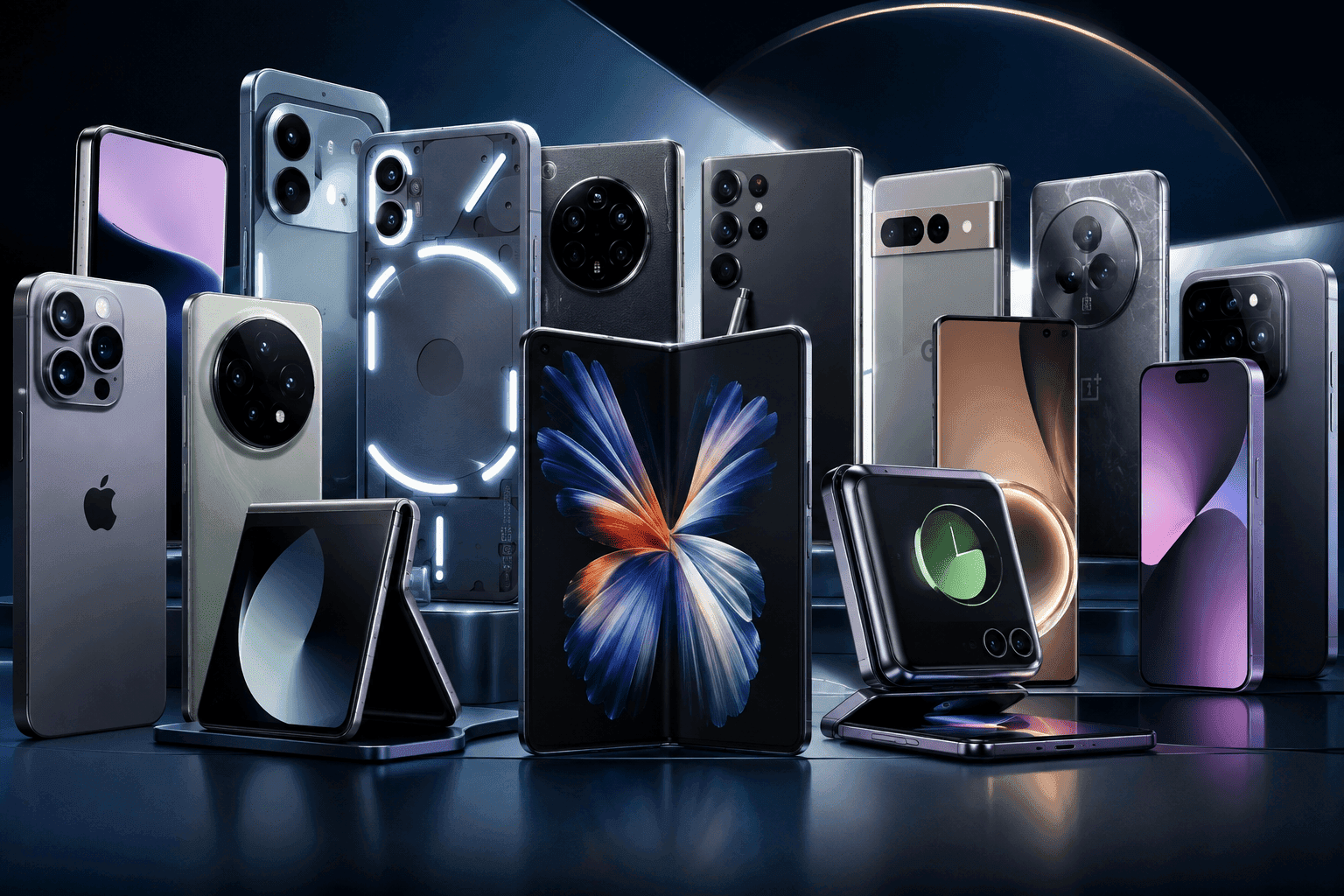
TL;DR The biggest smartphone innovations of 2026 are focused on making phones more useful rather than simply adding bigger numbers to the specification sheet. On-device and AI-powered features are becoming more deeply integrated into everyday tasks, while silicon-carbon battery technology is allowing manufacturers to fit larger batteries into relatively compact designs. Foldable phones are also becoming more practical as manufacturers work on thinner bodies, stronger displays, and improved usability. At the same time, flagship phones are pushing display technology, computational photography, privacy features, and charging performance further. Samsung's Galaxy S26 series, for example, adds new AI-powered functions and privacy safeguards, while the iPhone 17 generation has pushed thin design and battery efficiency. Meanwhile, the wider Android market is increasingly adopting high-capacity silicon-carbon batteries, with several 2026 smartphones crossing the 6,000mAh mark.
AI Is Becoming A Core Smartphone Feature
Artificial intelligence is arguably the biggest change happening inside smartphones in 2026. Instead of treating AI as a separate chatbot or camera mode, manufacturers are increasingly integrating it into the operating system and everyday functions. Samsung's Galaxy S26 series, for example, introduces AI-powered features such as Call Screening, which can identify unknown callers and summarize their intent, along with Privacy Alerts that use machine learning to identify potentially unnecessary access to sensitive information. This shows how smartphone AI is moving from novelty features toward functions that can operate in the background and reduce the amount of manual work users have to do.
The important change is that AI is also becoming more closely connected to the phone's hardware. Modern smartphone processors increasingly include dedicated neural processing capabilities that can handle AI workloads locally. On-device processing can reduce the need to send every task to a remote server, which can improve responsiveness and potentially provide better privacy for supported functions. However, not every AI feature runs completely on the device. Many smartphone AI systems still combine local processing with cloud-based services depending on the complexity of the task, so buyers should not assume that every AI feature works offline.
The practical impact is more important than the AI label itself. A useful AI feature should save time, improve accessibility, assist with communication, or make another smartphone function easier to use. Features such as call screening, summarization, image editing, translation, and contextual assistance are therefore more meaningful than simply having an AI-branded processor. In 2026, the strongest smartphone AI experiences are becoming part of the operating system rather than remaining isolated applications.
AI Is Moving Beyond Chatbots
The smartphone is increasingly being positioned as an assistant that understands context. Instead of opening a separate application for every task, users can increasingly rely on AI features integrated into calling, messaging, photography, search, and productivity tools. This is still an evolving area, and the exact capabilities vary significantly between brands and regions, but the direction is clear: AI is becoming part of the smartphone's basic software experience rather than an optional add-on.
Silicon-Carbon Batteries Are Changing Battery Design
Battery technology is another major smartphone innovation in 2026. Silicon-carbon battery technology is becoming increasingly visible in smartphones because it allows manufacturers to increase energy density without simply making the phone dramatically thicker. Traditional lithium-ion batteries use graphite-based anodes, while silicon-carbon designs incorporate silicon into the anode material to store more lithium ions. The technology has therefore become particularly attractive for manufacturers trying to combine slim designs with much larger battery capacities.
The change is already visible in the market. Counterpoint Research reported in March 2026 that six of the top 10 smartphones with batteries of at least 6,000mAh featured silicon-carbon technology in January 2026. This is important because smartphones crossing the 6,000mAh threshold were once relatively unusual in mainstream flagship designs. The increasing use of silicon-carbon batteries shows that manufacturers are finding ways to increase battery capacity while maintaining competitive phone dimensions.
The benefit for consumers is straightforward: larger capacity can provide more room for heavy use, particularly when combined with efficient processors and displays. It can also reduce the need to carry a charger or power bank during long days. However, battery capacity alone does not determine battery life. Software optimization, processor efficiency, display brightness, refresh rate, modem behaviour, and the user's workload all influence actual endurance. A 7,000mAh phone does not automatically last twice as long as a 3,500mAh phone.
Why Battery Capacity Is Increasing?
The growth of AI processing, high-refresh-rate displays, gaming, cameras, and 5G connectivity has increased the amount of power smartphones can consume. Manufacturers therefore need to improve both efficiency and capacity. Silicon-carbon technology addresses part of the problem by increasing the amount of energy that can be stored within a given physical space. It is one of the most practical hardware developments of 2026 because users can notice its effect directly in everyday battery life.
| Battery Innovation | Consumer Benefit | Important Limitation |
|---|---|---|
| Silicon-carbon cells | Higher capacity in a similar space | Does not guarantee longer battery life |
| Larger batteries | More energy available for daily use | Can increase weight |
| Faster charging | Shorter time connected to a charger | Heat and charging behavior still matter |
| Better processor efficiency | Lower power consumption | Depends on workload and software optimization |
Foldable Smartphones Are Becoming More Practical
Foldable smartphones have moved beyond being experimental products and are becoming a more established premium category in 2026. The biggest innovation is no longer simply making a screen fold. Manufacturers are working on thinner bodies, stronger flexible displays, improved hinges, and better software that can take advantage of multiple screen sizes. The goal is to make a foldable feel like a normal smartphone when closed while giving users substantially more screen space when it is opened.
Samsung's 2026 foldable lineup demonstrates how the category is developing. The Galaxy Z Fold8, Z Fold8 Ultra, and Z Flip8 continue to use flexible displays while focusing on usability and portability. The Fold8 Ultra, for example, expands the internal display to around 8 inches, creating more room for multitasking, content consumption, and productivity. Samsung has also emphasized software experiences designed around the larger screen rather than simply stretching standard phone applications across it.
The biggest challenge remains price and durability. Foldable phones still cost more than conventional smartphones with comparable processors and cameras, while their flexible displays and hinge mechanisms introduce additional engineering complexity. However, the category is becoming more convincing because the benefit is easy to understand. A user can carry a relatively compact device and unfold it when a larger display is needed. That makes foldables particularly interesting for people who want more screen space without carrying both a smartphone and tablet.
Foldables Are Moving Toward Different Use Cases
The foldable category is also becoming more diverse. Book-style foldables focus on productivity and large-screen multitasking, while flip-style models prioritize portability and compactness. This means foldables are no longer competing against traditional smartphones in exactly the same way. Instead, manufacturers are using different folding designs to solve different problems.
| Foldable Type | Main Advantage | Best Suited For |
| Book-style foldable | Large internal display | Multitasking and productivity |
| Flip-style foldable | Compact when closed | Portability and convenience |
| Large-screen foldable | More workspace | Heavy multitasking and media |
Smartphone Displays Are Getting Smarter
Display innovation in 2026 is less about simply increasing resolution and more about improving the overall viewing experience. High-refresh-rate OLED and AMOLED panels are now common across premium smartphones, while manufacturers are focusing on brightness, power efficiency, adaptive refresh rates, color accuracy, and visibility in challenging lighting conditions. Samsung's Galaxy S26 series, for example, uses Dynamic AMOLED 2X displays and introduces improvements to image processing through its ProScaler technology.
Another interesting development is the increasing attention being given to privacy at the display level. Samsung's Galaxy S26 Ultra includes a built-in Privacy Display designed to restrict viewing angles, allowing users to see their content more clearly while making it harder for people beside them to view the screen. This is particularly relevant for people who regularly use smartphones in offices, airports, public transportation, and other crowded environments.
Thinness is also becoming an important part of display and device engineering. Apple's iPhone Air demonstrates the direction manufacturers are taking, combining an extremely thin body with a high-end A19 Pro processor, a 6.3-inch display, and a titanium frame. The challenge is maintaining performance and battery life while reducing physical thickness. That makes thin-phone engineering an innovation story in its own right, because manufacturers have to balance battery capacity, thermal management, structural strength, and camera hardware within a smaller physical volume.
Display Innovation Is About More Than Resolution
A 2K or higher resolution does not automatically make one smartphone better than another. Brightness, refresh-rate behavior, touch response, color reproduction, outdoor visibility, and power efficiency can have a much larger effect on daily use. In 2026, the best displays are becoming smarter about when they need to run at higher refresh rates and how much power they consume.
Smartphone Cameras Are Becoming More Computational
Camera innovation is also shifting from megapixel counts toward computational photography. Modern smartphones increasingly combine camera sensors, image signal processors, neural processing hardware, and AI-powered software to produce the final image. This allows phones to improve HDR processing, skin tones, night photography, stabilization, portrait effects, and zoom quality without relying entirely on larger physical camera hardware.
The trend is particularly important because smartphone photography is now heavily dependent on software. Two phones with similarly sized sensors can produce noticeably different results because their image-processing pipelines handle exposure, noise, color, sharpening, and dynamic range differently. AI can also assist with functions such as object removal, image enhancement, editing, and scene recognition. The result is that the camera experience increasingly depends on the combination of hardware and software rather than a single specification.
Video is also receiving more attention as smartphone users increasingly create content for social media. Apple's iPhone 17 generation, for example, combines its A19 platform with updated camera hardware and features such as Dual Capture, which allows users to record using the front and rear cameras in supported scenarios. The iPhone Air also uses a 48MP Fusion Main camera with a 2x telephoto option and a Center Stage front camera designed for more flexible selfies and video calls.
AI Is Supporting The Camera Experience
The important point is that AI does not replace the camera sensor. Better sensors, lenses, stabilization, and optics still matter. Instead, AI and computational photography help smartphones make better use of the hardware available to them. This is why buyers should look at actual camera samples, stabilization, video quality, and low-light performance instead of selecting a phone solely because it has the highest megapixel number.
Connectivity Is Becoming More Flexible
Smartphone connectivity is also expanding beyond conventional cellular networks. Satellite communication is gradually becoming more relevant in consumer smartphones, particularly for emergency messaging and situations where traditional cellular coverage is unavailable. The technology is still dependent on the phone, satellite service, carrier, country, and specific feature, so buyers should check regional availability rather than assuming that any phone with satellite hardware provides universal satellite communication.
The broader connectivity picture is also changing as newer smartphones adopt faster Wi-Fi standards, improved Bluetooth capabilities, and more sophisticated modem technology. These upgrades matter because smartphones are increasingly expected to work as the central hub for wireless accessories, smart-home devices, cars, computers, and other connected products. Better connectivity therefore affects the entire ecosystem around the phone rather than just download speeds.
For Indian buyers, network compatibility and regional support are especially important. A smartphone can have advanced connectivity hardware but still offer a different feature set depending on the market in which it is sold. This is one reason checking the India-specific model and specifications is essential before buying an imported flagship. Hardware specifications should always be considered alongside carrier support, software availability, warranty coverage, and local service options.
Connectivity Is Becoming Part Of The Safety Experience
Satellite messaging is particularly interesting because it can provide a communication option when cellular networks are unavailable. However, it should not be treated as a replacement for normal mobile networks. Availability, message types, emergency functionality, and coverage depend on the implementation and service provider. The innovation is valuable because it adds another layer of connectivity for specific situations rather than eliminating the need for conventional networks.
What These Innovations Mean For Smartphone Buyers?
The biggest change in 2026 is that smartphone innovation is becoming more practical. AI can reduce repetitive tasks, silicon-carbon batteries can provide more capacity without proportionally larger phones, foldables can provide tablet-like displays in pocketable designs, and better displays can improve both usability and privacy. These developments are more meaningful than simply increasing processor clock speeds or camera megapixels because they address problems users actually experience.
At the same time, buyers should avoid treating every new technology as a reason to upgrade. A phone released two or three years ago can still be fast enough for everyday applications, photography, gaming, and communication. The value of a 2026 smartphone depends on whether the new features solve a problem you actually have. Someone who frequently runs out of battery may benefit greatly from a silicon-carbon battery, while someone who mainly uses WhatsApp and YouTube may gain less from a flagship AI processor.
The smartest approach is therefore to compare innovations according to your routine. Battery-heavy users should look closely at capacity, charging, and efficiency. Photography-focused buyers should compare camera processing and video capabilities. Productivity users may benefit from foldables and larger displays, while privacy-conscious buyers may value features such as Samsung's Privacy Display. The best smartphone innovation is ultimately the one that makes the device more useful without forcing you to pay for features you will rarely use.
| Innovation | Biggest Benefit | Best For |
| On-device and integrated AI | Automation and assistance | Productivity users |
| Silicon-carbon batteries | Higher capacity | Heavy smartphone users |
| Foldable displays | More screen in a portable form | Multitasking |
| Advanced OLED displays | Better viewing experience | Media and gaming |
| Computational photography | Better image processing | Content creators |
| Satellite connectivity | Communication beyond cellular coverage | Travelers and emergencies |
Frequently Asked Questions
Q. What is the biggest smartphone innovation of 2026?
A. AI integration is one of the biggest smartphone innovations of 2026 because manufacturers are moving AI deeper into calling, privacy, photography, productivity, and system-level functions. Battery technology and foldable hardware are also major developments.
Q. What are silicon-carbon batteries in smartphones?
A. Silicon-carbon batteries use silicon-containing anode technology to increase energy density compared with conventional graphite-based designs. This allows manufacturers to fit larger battery capacities into relatively compact smartphones.
Q. Are silicon-carbon batteries better than normal lithium-ion batteries?
A. Silicon-carbon technology can provide higher energy density, which is useful for increasing smartphone battery capacity. However, actual battery life still depends on the processor, display, software, network usage, and other components.
Q. Are foldable phones worth buying in 2026?
A. Foldable phones are becoming more practical as manufacturers improve their hinges, displays, thickness, and software. They can be worth considering if you specifically want a larger screen for multitasking while retaining a relatively portable device.
Q. Is AI on smartphones processed entirely on the device?
A. No. Some AI tasks can be processed locally using dedicated hardware, while more demanding features may rely on cloud computing. The exact approach depends on the manufacturer, feature, processor, and software.
Q. Are smartphone cameras improving because of AI?
A. AI and computational photography are helping smartphones improve image processing, HDR, portraits, low-light photography, and editing. However, sensor quality, lenses, stabilization, and image-processing software all contribute to the final result.
Q. Why are smartphone batteries getting larger in 2026?
A. Smartphones increasingly use power-intensive features such as high-refresh-rate displays, 5G, advanced cameras, gaming hardware, and AI processing. Silicon-carbon battery technology is helping manufacturers increase capacity without necessarily making phones proportionally thicker.
Q. What is the advantage of a privacy display on a smartphone?
A. A privacy display is designed to make information on the screen harder for people viewing from an angle to see. This can be useful when using a phone in public places such as offices, airports, or public transportation.
Q. Is a higher megapixel camera always better?
A. No. Megapixels are only one part of smartphone camera performance. Sensor size, lens quality, stabilization, image processing, dynamic range, and low-light performance can have a major impact on the final image.
Q. Should you upgrade to a 2026 smartphone?
A. Upgrade if a new feature solves a genuine problem, such as poor battery life, limited camera performance, insufficient multitasking capability, or the need for a foldable display. If your current phone already handles your workload comfortably, there may be little reason to upgrade solely for a newer processor or AI branding.
Final Recommendation
The biggest smartphone innovations of 2026 are not defined by one specification. The most meaningful changes are happening across AI, battery technology, displays, foldable designs, cameras, and connectivity. On-device and system-level AI is making smartphones more context-aware, while silicon-carbon batteries are allowing manufacturers to increase capacity without simply making devices thicker. Foldables are becoming more practical, and display technology is increasingly focused on brightness, efficiency, privacy, and usability rather than resolution alone.
For most buyers, battery and AI improvements are likely to have the most noticeable day-to-day impact. If you frequently struggle with battery life, a newer smartphone with a high-capacity silicon-carbon battery can make a meaningful difference. If you rely heavily on productivity, photography, or communication, integrated AI features may offer more practical value. Foldables remain a more specialized purchase, but their improved hardware and software make them increasingly credible alternatives to conventional flagship phones.
The final recommendation is simple: do not buy a 2026 smartphone just because it has the newest technology. Buy it when that technology improves the way you actually use your phone. For most users, that means prioritizing battery life, display quality, camera performance, software support, and useful AI features before chasing headline specifications. In 2026, the smartest smartphone is not necessarily the one with the longest specification sheet, but the one that turns its new technology into a genuinely better everyday experience.