Best Camera for Studying Photography as a Student
Choosing the best camera for studying photography means balancing image quality, manual controls, lenses, autofocus, and price. These student-friendly mirrorless cameras offer room to learn and grow.

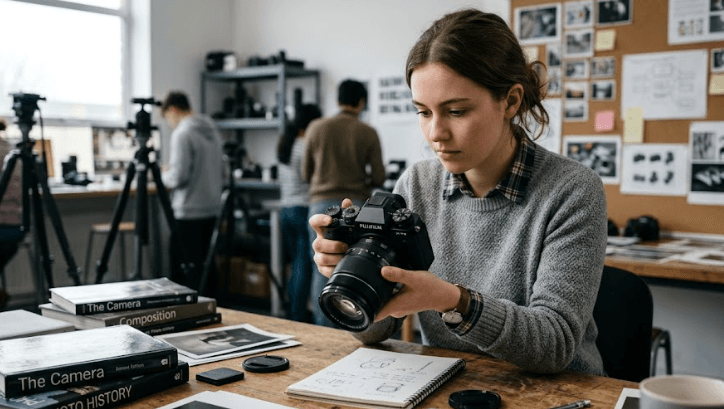
TL;DR: The best camera for studying photography as a student should help you learn photography rather than simply automate it for you. A good interchangeable-lens camera gives you manual control over shutter speed, aperture, ISO, focus, and exposure while leaving enough room to grow through different lenses and accessories. The Canon EOS R10 is the strongest all-round choice for most students because it combines a 24.2MP APS-C sensor, fast autofocus, a compact body, and access to Canon's RF lens system. The Nikon Z50II is another excellent learning-focused option, while the Fujifilm X-S20 is particularly attractive if photography students also want serious video and in-body stabilization. Sony's a6400 remains capable, especially for students who value autofocus and access to the extensive E-mount ecosystem.
What Makes A Good Student Camera?
Choosing a camera for studying photography is different from choosing one simply for travel or social media. A student needs a camera that makes it possible to understand why an image looks the way it does. Manual exposure controls are therefore more important than having the largest sensor or the highest megapixel count. Being able to change aperture, shutter speed, and ISO lets students see how exposure, depth of field, motion blur, and noise interact. An interchangeable-lens camera is particularly useful because changing lenses teaches another fundamental part of photography: how focal length and perspective affect the final image.
The camera should also be comfortable enough to use regularly. Photography is learned through repetition, and a technically excellent camera is not particularly useful if a student finds it difficult to carry or operate. Features such as an electronic viewfinder, a tilting or vari-angle screen, reliable autofocus, RAW capture, and straightforward physical controls can make learning easier. The Canon EOS R10, for example, combines a 24.2MP APS-C sensor with a lightweight body and Canon's Dual Pixel CMOS AF II system, while the Nikon Z50II uses a 20.9MP DX-format sensor and an EXPEED 7 processor with subject detection and 3D Tracking.
Budget also needs to include more than the camera body. Students eventually need additional lenses, memory cards, spare batteries, a camera bag, and potentially a tripod or external flash. Spending an entire budget on the body can therefore leave little money for the equipment that actually expands what you can photograph. A sensible student setup is usually a camera with a versatile kit lens first, followed by a fast prime or another specialist lens once the student understands which type of photography they enjoy.
The Important Specifications For Students
A student's first camera should have enough resolution for coursework, printing, cropping, and editing without making files unnecessarily difficult to manage. Around 20MP to 26MP is already plenty for learning and for most photography assignments. The more important consideration is the sensor format, because APS-C cameras offer a useful balance between image quality, camera size, lens availability, and overall cost. The Canon EOS R10 has 24.2MP, the Sony a6400 has 24.2MP, the Fujifilm X-S20 has 26.1MP, and the Nikon Z50II has 20.9MP.
RAW support is another important feature because photography students should learn how much control they have during editing. Shooting RAW allows greater flexibility when adjusting exposure, white balance, highlights, shadows, and color during post-processing. A good autofocus system also matters because students can then spend more time learning composition and timing rather than constantly fighting inaccurate focus. These features are more useful for education than simply chasing specifications such as extremely high burst rates.
| Feature | Why It Matters For Students |
|---|---|
| APS-C sensor | Balances image quality, size, and cost |
| Manual exposure | Teaches the fundamentals of photography |
| RAW capture | Gives more control during editing |
| Interchangeable lenses | Helps students learn focal length and perspective |
| Electronic viewfinder | Makes exposure and composition easier to evaluate |
| Reliable autofocus | Helps with people, action, and everyday assignments |
| Tilting or vari-angle screen | Useful for creative angles and video |
| Good lens ecosystem | Gives students room to progress |
Best Cameras For Photography Students
The Canon EOS R10 is the strongest all-round recommendation for a student starting serious photography. Its 24.2MP APS-C CMOS sensor provides enough resolution for coursework and general creative work, while Canon's Dual Pixel CMOS AF II system supports human and animal eye detection. The camera can shoot at up to 15 frames per second using its mechanical shutter and up to 23 frames per second with its electronic shutter, although students do not need those speeds for most assignments. Its relatively compact body also makes it easier to carry around campus or on field assignments.
The Nikon Z50II is another particularly strong choice for students because it is designed around an APS-C DX-format sensor and uses Nikon's EXPEED 7 processor. It has 20.9 million effective pixels, a 3.2-inch vari-angle touchscreen, and an electronic viewfinder. Nikon also gives it subject detection and 3D Tracking, which makes it useful for learning portrait, street, event, and action photography. The Z50II can therefore grow with a student instead of becoming limiting after the first semester. Nikon's current India listing shows the Z50II with the 16-50mm lens at ₹98,945, although prices and offers can change.
The Fujifilm X-S20 is the better option for students who want photography and video to develop together. It uses a 26.1MP APS-C X-Trans CMOS 4 sensor and includes five-axis in-body image stabilization rated up to seven stops under CIPA testing conditions. It can record 6.2K video at up to 30p and 4K at up to 60p, giving students considerably more video flexibility than they may need initially but plenty of room to grow. Fujifilm also offers Film Simulation modes, which can make experimenting with color and visual style particularly enjoyable while students learn the fundamentals.
Student Camera Comparison
There is no single camera that wins every category, so the better approach is to compare what each model teaches and enables. The Canon EOS R10 is especially well balanced for still photography and autofocus. The Nikon Z50II offers a modern autofocus system and a strong Nikon lens ecosystem. The Fujifilm X-S20 adds stabilization and unusually strong video capabilities, while the Sony a6400 remains a capable option with a mature E-mount lens ecosystem and strong autofocus.
| Camera | Sensor | Effective Resolution | Stabilization | Video Highlight | Student Strength |
|---|---|---|---|---|---|
| Canon EOS R10 | APS-C CMOS | 24.2MP | Lens-dependent | 4K 60p | Best overall learning balance |
| Nikon Z50II | APS-C/DX CMOS | 20.9MP | Lens-dependent | 4K | Strong autofocus and handling |
| Fujifilm X-S20 | APS-C X-Trans CMOS 4 | 26.1MP | 5-axis IBIS | 6.2K/30p | Best hybrid learning option |
| Sony a6400 | APS-C CMOS | 24.2MP | Lens-dependent | 4K | Strong AF and lens ecosystem |
The specifications above are based on manufacturer documentation. The Sony a6400 uses a 24.2MP APS-C sensor and supports 4K recording, while its autofocus system includes Real-time Tracking and Real-time Eye AF. The Fujifilm X-S20's 26.1MP sensor and seven-stop-rated IBIS give it a clear advantage for handheld work, while the Canon R10 and Nikon Z50II offer strong autofocus without built-in sensor stabilization.
Choosing The Right Lens For Learning
The kit lens is usually the best place for a student to start because it teaches versatility without requiring a large additional investment. A standard zoom lets students experiment with wide-angle compositions, normal perspectives, and moderate telephoto framing without changing lenses constantly. The Canon RF-S 18-45mm, Nikon Z DX 16-50mm, and Sony 16-50mm class of lenses are examples of compact starter options. They are not necessarily the brightest lenses available, but that is not a major problem when the purpose is to understand composition and camera controls first.
Once a student becomes comfortable with the kit lens, a fast prime can teach a completely different set of skills. A lens with a wider maximum aperture allows students to explore shallow depth of field, subject separation, and low-light photography. A 35mm or 50mm equivalent perspective can also encourage students to move physically rather than relying entirely on zoom. That is valuable because photography education is not only about operating a camera. It is also about understanding distance, perspective, framing, and the relationship between the subject and background.
Lens cost should therefore be considered before committing to a camera system. A camera body may look affordable initially, but the total cost can rise significantly once a student begins adding lenses. Canon's RF mount, Nikon's Z mount, Sony's E mount, and Fujifilm's X mount all give photographers paths to expand their systems. Students should look at the lenses they are likely to need over the next three to five years rather than choosing a camera only because its body is currently discounted.
Build A Student-Friendly Camera Kit
A sensible student kit should start with one versatile zoom lens. This gives enough flexibility for campus photography, portraits, landscapes, travel, and assignments without creating unnecessary complexity. After that, a fast prime is often the most educational second purchase because it makes students think about aperture, subject distance, and composition differently.
A spare battery and reliable SD card are also more useful than many beginners realize. Running out of battery during an assignment can be frustrating, while a slow or unsuitable memory card can create problems when shooting bursts or recording high-bitrate video. Students should also budget for a basic bag that protects the camera without making the setup too bulky to carry.
| Purchase | Priority | Why |
|---|---|---|
| Camera body | Essential | Core learning tool |
| Kit zoom | Essential | Covers multiple focal lengths |
| Memory card | Essential | Stores RAW and video files |
| Spare battery | High | Useful during long assignments |
| Fast prime lens | Medium | Teaches depth of field and low-light shooting |
| Tripod | Medium | Useful for landscapes and long exposures |
| External flash | Later | Better after learning natural-light basics |
How Much Should A Student Spend?
A student does not necessarily need a full-frame camera to learn photography properly. APS-C cameras already provide enough image quality for coursework, portraits, landscapes, street photography, events, and most personal projects. In fact, choosing APS-C can leave more money available for lenses, which can have a major effect on the types of photographs a student can produce. The Canon EOS R10 is listed by Canon India with an MRP of ₹92,995 for the RF-S 18-45mm kit, while the Nikon Z50II with the 16-50mm lens is currently listed by Nikon India at ₹98,945.
Students with a larger budget can consider the Fujifilm X-S20 because its built-in stabilization and stronger video capabilities make it a more complete hybrid system. However, paying more does not automatically mean learning faster. A student who is still learning exposure and composition may get more educational value from spending the difference on a second lens, a photography workshop, storage, or printing rather than moving immediately to a higher-priced body.
Used equipment can also make sense, but it requires more care. Students should check the sensor for damage, inspect the lens for fungus or haze, test autofocus, examine the camera mount, check battery condition, and verify that all controls work properly. Buying used from a reputable source with a return policy or warranty is generally safer than choosing an unusually cheap listing from an unknown seller.
Match The Camera To Your Course
For a student whose coursework is primarily still photography, the Canon EOS R10 is the easiest recommendation because it offers a strong combination of resolution, autofocus, controls, compactness, and lens flexibility. The Nikon Z50II is similarly well suited to students who prefer Nikon handling or want to build around the Z system. Both provide enough capability to learn serious photography without requiring a professional-level investment.
For students studying photography alongside filmmaking, content creation, or social media production, the Fujifilm X-S20 deserves closer attention. Its five-axis IBIS and 6.2K recording capability make it a particularly flexible hybrid camera. Fujifilm's Film Simulation system also gives students an easy way to experiment with different visual styles while still learning how exposure and color affect the image.
Sony's a6400 remains relevant when autofocus and access to the E-mount ecosystem are priorities. Its 24.2MP APS-C sensor, 425-point phase-detection and 425-point contrast-detection AF system, Real-time Tracking, and Real-time Eye AF make it capable for subjects that move. Sony India currently lists the body at ₹82,990, although the final kit price depends on the lens selected and current offers.
| Student Type | Best Fit | Main Reason |
|---|---|---|
| First serious photography camera | Canon EOS R10 | Balanced stills, AF, controls, and size |
| Nikon learner | Nikon Z50II | Strong AF and Z-mount growth path |
| Photography + video student | Fujifilm X-S20 | IBIS and advanced video |
| Action and subject tracking | Sony a6400 | Strong tracking and Eye AF |
| Budget-conscious learner | Canon EOS R50 or used APS-C | Lower entry cost |
Common Mistakes Students Should Avoid
The biggest mistake is buying a camera based only on megapixels. A 24MP camera is already capable of producing high-resolution photographs, and moving from 24MP to 26MP does not suddenly make someone a better photographer. Students should instead learn to control exposure, focus, composition, light, and timing. A technically simpler camera can produce better work when the photographer understands those fundamentals.
Another common mistake is buying an expensive body and then using only the kit lens forever. The lens determines focal length, maximum aperture, perspective, and much of the practical shooting experience. A student who eventually wants portraits, macro photography, wildlife, or low-light work will need different lens characteristics. It is therefore smarter to choose a camera system with lenses that fit the student's future interests.
Students should also avoid relying entirely on automatic modes. Automatic modes are useful while getting comfortable with the camera, but photography courses usually become much more meaningful once students understand aperture priority, shutter priority, manual exposure, exposure compensation, and metering. The objective is not to stop using automation completely. It is to understand what the camera is doing and know when to take control.
Frequently Asked Questions
Q. What is the best camera for studying photography as a student?
The Canon EOS R10 is the strongest all-round choice for most students because it combines a 24.2MP APS-C sensor, strong autofocus, manual controls, interchangeable lenses, and a relatively compact body.
Q. Is an APS-C camera good enough for photography students?
Yes. APS-C cameras provide more than enough image quality for learning, coursework, portraits, landscapes, street photography, and most student projects. They can also keep the overall system smaller and more affordable than many full-frame setups.
Q. Should a photography student buy a mirrorless camera?
A mirrorless camera is a strong choice because current models offer interchangeable lenses, electronic viewfinders, RAW capture, strong autofocus, and extensive manual controls. These features give students room to learn and develop.
Q. Is the Nikon Z50II good for photography students?
Yes. The Z50II uses a 20.9MP DX-format sensor, EXPEED 7 processing, subject detection, 3D Tracking, and a vari-angle touchscreen. Nikon also offers multiple Z-mount lens options as students progress.
Q. Is the Fujifilm X-S20 good for learning photography?
Yes. The X-S20 combines a 26.1MP APS-C sensor with five-axis in-body stabilization and extensive manual exposure controls. Its 6.2K video capability also makes it useful for students studying both photography and video.
Q. Is the Sony a6400 still worth considering for students?
Yes. The a6400 remains a capable APS-C camera with a 24.2MP sensor, 4K video, Real-time Tracking, and Real-time Eye AF. Its established E-mount ecosystem is another advantage for students who expect to add lenses over time.
Q. How many megapixels does a photography student need?
There is no specific minimum, but around 20MP to 26MP is already sufficient for most photography coursework and general creative work. Learning exposure, composition, light, and editing will have a much greater effect on results than a small difference in megapixel count.
Q. Should students buy a kit lens or a prime lens first?
A kit zoom is usually the better first lens because it provides multiple focal lengths and lets students explore different types of photography. A fast prime is an excellent second lens once the student understands what focal lengths and apertures they prefer.
Q. Is it better to spend more on lenses than the camera body?
After reaching a capable entry-level camera body, putting money into lenses can be more useful than continually upgrading the body. A good lens can remain useful when the camera body is eventually replaced, provided the lens mount remains part of the student's system.
Q. Can a photography student use the camera for video too?
Yes. Modern mirrorless cameras are increasingly capable hybrid tools. The Fujifilm X-S20 is particularly strong for students who want video alongside photography because it supports 6.2K recording and 4K recording at up to 60p.
Final Recommendation
For most students studying photography, the Canon EOS R10 is the best overall choice. It has the right combination of image quality, autofocus, manual control, compactness, and lens flexibility without pushing students into professional-camera pricing. Its 24.2MP APS-C sensor is more than adequate for coursework, while Canon's autofocus system gives beginners enough assistance to concentrate on composition and subject matter. Canon India currently lists the RF-S 18-45mm kit at an MRP of ₹92,995, although actual selling prices and offers can change.
The Nikon Z50II is the strongest alternative for students who prefer Nikon or want its newer EXPEED 7 autofocus and processing platform. The Fujifilm X-S20 is the better investment for students who know they want to combine photography with serious video, particularly because of its in-body stabilization and 6.2K recording. The Sony a6400 remains a sensible choice for students who prioritize autofocus and the established E-mount lens ecosystem.
The most important point is that the best student camera is not necessarily the most expensive one. Buy a body that gives you full manual control, choose a versatile first lens, and keep enough budget for the equipment and practice that will actually develop your skills. For a student beginning serious photography in 2026, an APS-C mirrorless camera such as the EOS R10, Z50II, X-S20, or a6400 provides more than enough capability to learn the fundamentals and build a photography portfolio without outgrowing the system immediately.