
Autonomous Robotaxis Explained: How Zoox and Waymo Are Expanding in 2026
Waymo and Zoox are rapidly expanding autonomous ride-hailing in 2026. Here is how their robotaxis work, where they operate, how their approaches differ, and what comes next.

TL;DR Autonomous robotaxis are moving from limited experiments to commercial ride-hailing services in more U.S. cities in 2026. Waymo currently has the broader commercial footprint, with fully autonomous rides available across multiple U.S. markets and further expansion planned in cities including Denver, Las Vegas, San Diego, and Tampa. Zoox is taking a different approach with a purpose-built, all-electric vehicle that has no steering wheel or pedals. In August 2026, Zoox began charging for rides in Las Vegas after receiving a temporary federal exemption allowing limited commercial deployment. The two companies are therefore competing on different strengths: Waymo is focused on scaling an autonomous driving system across more vehicle platforms and cities, while Zoox is building the vehicle and autonomous system together around a dedicated robotaxi experience.
What Are Autonomous Robotaxis?
An autonomous robotaxi is a ride-hailing vehicle that can transport passengers without a human driver actively controlling the vehicle. Instead of relying on a person to steer, brake, accelerate, and interpret the road continuously, the vehicle uses an automated driving system built from sensors, computing hardware, mapping, and software. The important distinction is that a robotaxi is not simply a regular car with a few driver-assistance features. Commercial robotaxi services from companies such as Waymo are designed to operate without a human driver in the front seat within defined operating conditions. Waymo describes its service as fully autonomous ride-hailing, with riders able to request a vehicle through its app.
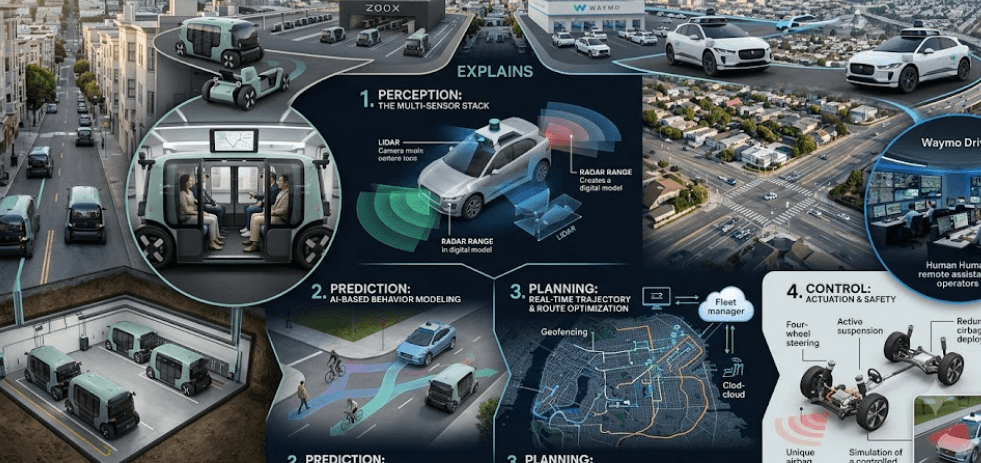
The technology works by combining several types of information about the vehicle's surroundings. Cameras can identify road markings, traffic signals, vehicles, pedestrians, and other objects, while additional sensors and computing systems help the vehicle understand distance, movement, and its position on the road. The autonomous driving system then makes decisions such as when to slow down, stop, change lanes, or proceed through an intersection. These systems are designed for specific operational conditions, which means "autonomous" does not mean a vehicle can necessarily drive anywhere, in every weather condition, or on every road without restrictions. Waymo and Zoox both define operating conditions and expand their service areas gradually as their systems are validated.
What makes 2026 important is the shift from technology demonstrations toward larger commercial operations. Waymo has already expanded its paid autonomous ride-hailing network across several U.S. markets, while Zoox has crossed an important regulatory milestone that allows it to begin commercial deployment of its unusual steering-wheel-free vehicle. That does not mean robotaxis have suddenly become universally available. Service areas remain geographically limited, regulations differ by state, and both companies are still scaling their fleets and operating systems. The change is that consumers can now encounter autonomous ride-hailing as an actual transportation service rather than only as a technology demonstration.
How Waymo Is Expanding In 2026?
Waymo entered 2026 with a significant advantage in commercial robotaxi operations because it already had a functioning paid autonomous ride-hailing service in multiple U.S. markets. In February, the company opened public service in Dallas, Houston, San Antonio, and Orlando, taking its commercial metro footprint to 10 markets at that point. By June, Waymo said it was expanding its footprint in Miami and across Austin, Atlanta, Houston, and the San Francisco Bay Area, with plans to cover more than 1,400 square miles across 11 cities. This expansion illustrates the company's strategy: rather than waiting for one nationwide launch, Waymo is building a network city by city and increasing its service area within markets as the technology matures.
Waymo is also expanding beyond its existing fleet strategy. Its sixth-generation Waymo Driver is being adapted to additional vehicle platforms, including the Hyundai IONIQ 5. In July, Waymo said it had begun autonomous driving of IONIQ 5 vehicles with a specialist present while preparing for future fully autonomous operations. The company also announced preparations for fully autonomous operations in Denver, Las Vegas, San Diego, and Tampa. These operations were initially planned to begin with employees before the company moved toward welcoming public riders. This approach is important because expanding a robotaxi business is not simply about adding cars. Each new city and vehicle platform requires testing, mapping, validation, fleet operations, and regulatory coordination.
Waymo is also beginning its international expansion. On August 25, 2026, the company announced that it would begin testing autonomous vehicles in Munich, Germany, with the goal of launching a commercial ride-hailing service there by the end of 2027. The Munich program will initially involve mapping and testing before commercial deployment, making it a longer-term expansion rather than an immediate European robotaxi launch. Waymo has also been testing in Tokyo and London, although regulatory conditions mean international expansion is moving at different speeds. This shows that Waymo's long-term strategy extends beyond its established U.S. network and toward adapting its autonomous driving technology to new road systems and regulatory environments.
Waymo Expansion At A Glance
| Area | 2026 Development |
|---|---|
| Commercial U.S. service | Multiple U.S. cities |
| New 2026 markets | Dallas, Houston, San Antonio and Orlando |
| Further 2026 expansion | Denver, Las Vegas, San Diego and Tampa |
| International development | Munich testing announced |
| Autonomous system | Sixth-generation Waymo Driver |
| New vehicle platform | Hyundai IONIQ 5 testing |
| Ride access | Waymo app and selected partner platforms |
How Zoox Is Taking A Different Route?
Zoox is approaching robotaxis differently because it designed a dedicated vehicle specifically for autonomous ride-hailing. Instead of taking a conventional car and adding an autonomous driving system, Zoox developed a purpose-built, all-electric robotaxi with no traditional steering wheel or pedals. Its cabin uses two rows of seats facing each other, and the vehicle is designed to operate in either direction. That design gives Zoox more freedom to optimize the interior around passengers rather than around a human driver. It also creates a regulatory challenge because traditional vehicle safety rules were written around conventional vehicles with human controls.
The major regulatory breakthrough came in July 2026, when the U.S. National Highway Traffic Safety Administration granted Zoox a temporary exemption covering specific federal motor vehicle safety standards. The exemption allows commercial deployment of up to 2,500 vehicles annually for two years, subject to additional oversight and reporting requirements. This is an important distinction because the approval does not mean every aspect of Zoox's vehicle or autonomous system received a blanket certification. NHTSA's documentation specifically limits the safety-equivalency analysis to the requirements covered by the exemption, while the manufacturer remains responsible for compliance with other applicable requirements.
Zoox subsequently began charging passengers for robotaxi rides in Las Vegas on August 10, 2026. Before that, the company had been providing free rides as part of its testing and early-rider programs in markets including Las Vegas and San Francisco, while expanding testing in Austin and Miami. Zoox's commercial rollout therefore remains more limited than Waymo's, but the company is moving toward a broader footprint. Its March 2026 expansion plans included growing service in San Francisco and Las Vegas and testing in Austin and Miami, while the company's current service information identifies Austin as an emerging market and Miami as a planned expansion.
Zoox And Waymo Compared
| Feature | Waymo | Zoox |
| Core approach | Autonomous driving system across vehicle platforms | Purpose-built robotaxi |
| Human controls | Uses vehicles with conventional controls | No steering wheel or pedals |
| Commercial scale | Broader U.S. commercial footprint | Commercial launch began in Las Vegas |
| Vehicle strategy | Multiple vehicle platforms | Dedicated all-electric robotaxi |
| 2026 focus | U.S. city expansion and international preparation | Commercialization and expansion of purpose-built vehicles |
| Parent company | Alphabet | Amazon |
Why Robotaxi Expansion Matters?
The biggest potential benefit of robotaxis is that transportation could become less dependent on the availability of human drivers. A fully autonomous ride-hailing network can theoretically operate for longer periods without requiring drivers to work individual shifts, although real-world robotaxi operations still need human staff for fleet management, customer support, maintenance, remote assistance, and other functions. For passengers, the experience can also change because the vehicle becomes a space where they can work, relax, or simply avoid the stress of driving. Waymo's commercial service already operates around the idea that passengers can request a fully autonomous ride through an app.
Robotaxis could also create new mobility options for people who cannot drive or do not have access to a personal vehicle. However, the effect on transportation will depend on how these services interact with existing public transit, taxis, and ride-hailing networks. Autonomous vehicles are not automatically a replacement for buses or trains, particularly in dense cities where mass transit can move large numbers of people more efficiently. The more realistic near-term picture is a mixed transportation system where robotaxis fill particular gaps, such as first-mile and last-mile journeys, late-night travel, airport trips, or areas with limited transit coverage.
At the same time, rapid expansion brings legitimate questions about safety, regulation, employment, and how much autonomy cities should give private technology companies. In 2026, those questions are becoming more visible as robotaxis move into additional neighborhoods and markets. Recent reporting has highlighted public and regulatory concerns around incidents, local oversight, and the potential impact on driving jobs. The industry therefore has to prove not only that autonomous vehicles can drive safely, but also that their deployment can earn public trust and fit into existing urban transportation systems.
What Could Happen Next?
The next stage of robotaxi development will probably focus less on proving that a vehicle can drive autonomously and more on proving that the business can scale efficiently. Waymo's expansion into additional cities and its work with multiple vehicle platforms point toward a model where the same autonomous driving technology can eventually support a larger and more diverse fleet. The company's planned Munich operations also suggest that geographic expansion will increasingly involve adapting the system to different road layouts, traffic patterns, regulations, and weather conditions rather than simply copying an existing U.S. deployment.
Zoox faces a different scaling challenge. Its purpose-built vehicle gives it control over the entire passenger experience, but manufacturing a dedicated robotaxi at scale is a different proposition from deploying autonomous systems on vehicles already designed for conventional roads. Its temporary federal exemption provides a path for limited commercial deployment, while state and local approvals remain important for individual markets. Zoox has already indicated that Las Vegas is the starting point for paid service, with additional markets expected as the necessary requirements are completed.
The competition between the companies could ultimately benefit the broader autonomous vehicle industry because they are testing different approaches to the same problem. Waymo is demonstrating how an autonomous driving system can scale across conventional vehicle platforms and multiple cities, while Zoox is testing what happens when the vehicle itself is designed around autonomy from the beginning. Neither approach has eliminated the difficult questions around safety, cost, regulation, fleet maintenance, and public acceptance. For 2026, the most important development is therefore not that robotaxis have arrived everywhere. It is that commercial autonomous ride-hailing is becoming a larger and more visible part of urban transportation in selected markets.
Frequently Asked Questions
Q. What is an autonomous robotaxi?
An autonomous robotaxi is a ride-hailing vehicle that can transport passengers without a human driver actively controlling the vehicle. It uses an automated driving system involving sensors, computing hardware, software, and mapping to navigate within defined operating conditions. Waymo's commercial service is an example of fully autonomous ride-hailing, where passengers can request a vehicle through an app.
Q. Are Waymo robotaxis fully driverless in 2026?
Yes, Waymo operates fully autonomous ride-hailing services in multiple U.S. markets. The company describes its commercial service as having no human driver in the front seat, although its broader operations include human specialists and support personnel for fleet and operational needs.
Q. Where does Waymo operate in 2026?
Waymo's current service footprint includes multiple U.S. markets, including Dallas, Houston, Los Angeles, Miami, Nashville, Orlando, Phoenix, San Antonio, and the San Francisco Bay Area, with Austin and Atlanta served through an Uber partnership. Waymo is also preparing additional autonomous operations and has announced Munich testing ahead of a planned commercial service in 2027.
Q. How is Zoox different from Waymo?
Zoox designs a purpose-built robotaxi rather than relying solely on conventional vehicle platforms. Its vehicle is all-electric, bidirectional, and intentionally designed without a steering wheel or pedals. Waymo, meanwhile, is expanding its autonomous driving system across multiple vehicle platforms.
Q. Are Zoox robotaxis available for paid rides?
Yes. Zoox began charging passengers for rides in Las Vegas on August 10, 2026. The company had previously offered free rides as part of testing and early-rider programs. Its commercial expansion into additional markets depends on completing the relevant regulatory requirements.
Q. Why does Zoox not have a steering wheel?
The Zoox vehicle was purpose-built for autonomous ride-hailing, so it does not need traditional human driving controls in its intended operating design. The absence of those controls also meant Zoox needed specific federal regulatory exemptions before commercial deployment.
Q. Is Waymo expanding outside the United States?
Yes. Waymo announced in August 2026 that it would begin autonomous vehicle testing in Munich, Germany, to launch a commercial ride-hailing service there by the end of 2027. The Munich program begins with mapping and testing rather than immediate commercial passenger service.
Q. Are robotaxis completely independent of human support?
No. Fully autonomous driving means there is no human driver actively controlling the vehicle, but robotaxi companies still require people for fleet operations, maintenance, customer support, testing, and other functions. Autonomous operation should therefore not be confused with a transportation network that has no human involvement whatsoever.
Q. Are robotaxis safer than human-driven cars?
Safety is one of the central questions surrounding autonomous vehicles, and it should not be reduced to a simple yes-or-no claim. Companies publish safety data and methodologies, while regulators conduct their own assessments and impose operating requirements. Zoox, for example, has published a safety-case framework covering its hardware, software, and operations, but the company's framework is not the same as independent certification of its overall safety.
Q. Will robotaxis replace taxis and ride-hailing drivers?
Robotaxis could reduce demand for some driving work if autonomous fleets become large enough, but the scale of that impact remains uncertain. Human staff will still be required for areas such as vehicle maintenance, fleet operations, customer support, and other roles. The eventual effect will depend on how quickly autonomous services expand, how regulators respond, and how passengers use them.
Final Recommendation
Autonomous robotaxis have moved into a much more important phase in 2026, but the market is still developing. Waymo is currently the stronger example of commercial scale, with a broader U.S. ride-hailing network and an active strategy to expand into additional cities and vehicle platforms. Zoox is the more distinctive challenger, using a purpose-built vehicle without a steering wheel or pedals and beginning paid commercial rides in Las Vegas after receiving a temporary NHTSA exemption.
For the industry, the most important takeaway is that autonomous mobility is no longer only about whether the technology can drive a car. The real test is whether companies can scale safely, economically, and consistently across different cities while earning public and regulatory trust. Waymo's expansion and Zoox's commercialization show two different paths toward that goal. As 2026 continues, their progress will provide a useful indication of whether robotaxis can evolve from limited urban services into a mainstream part of transportation.
Ready to upgrade your tech?
Browse our collection of quality refurbished products at unbeatable prices.